EnglishFreePrintable
Satire and Social Critique
A free english worksheet ready for your classroom. Open in Kuraplan to grab the print-ready PDF, customize it for your students, or generate a fresh version in seconds.
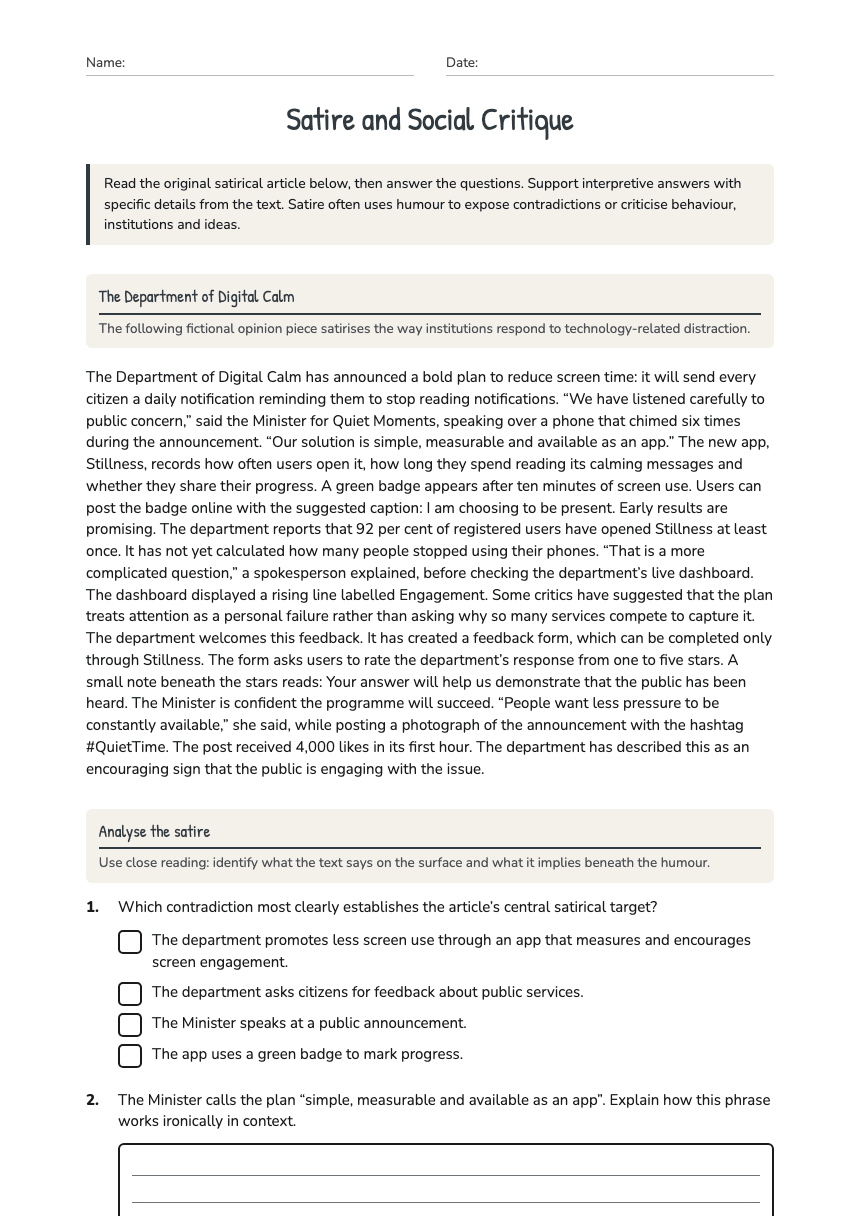
Name:Date:
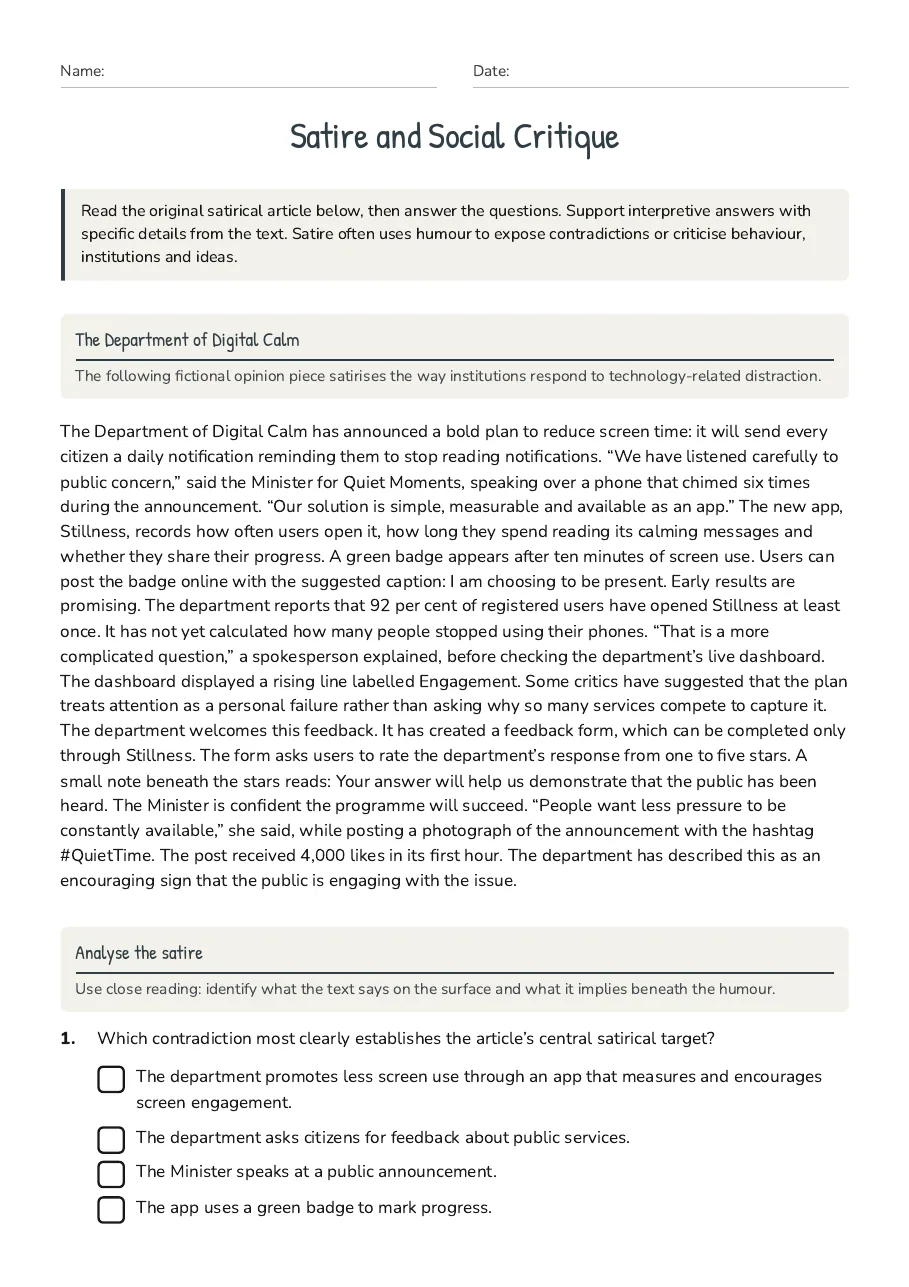
Satire and Social Critique
Read the original satirical article below, then answer the questions. Support interpretive answers with specific details from the text. Satire often uses humour to expose contradictions or criticise behaviour, institutions and ideas.
The Department of Digital Calm
The following fictional opinion piece satirises the way institutions respond to technology-related distraction.
The Department of Digital Calm has announced a bold plan to reduce screen time: it will send every citizen a daily notification reminding them to stop reading notifications. “We have listened carefully to public concern,” said the Minister for Quiet Moments, speaking over a phone that chimed six times during the announcement. “Our solution is simple, measurable and available as an app.”
The new app, Stillness, records how often users open it, how long they spend reading its calming messages and whether they share their progress. A green badge appears after ten minutes of screen use. Users can post the badge online with the suggested caption: I am choosing to be present.
Early results are promising. The department reports that 92 per cent of registered users have opened Stillness at least once. It has not yet calculated how many people stopped using their phones. “That is a more complicated question,” a spokesperson explained, before checking the department’s live dashboard. The dashboard displayed a rising line labelled Engagement.
Some critics have suggested that the plan treats attention as a personal failure rather than asking why so many services compete to capture it. The department welcomes this feedback. It has created a feedback form, which can be completed only through Stillness. The form asks users to rate the department’s response from one to five stars. A small note beneath the stars reads: Your answer will help us demonstrate that the public has been heard.
The Minister is confident the programme will succeed. “People want less pressure to be constantly available,” she said, while posting a photograph of the announcement with the hashtag #QuietTime. The post received 4,000 likes in its first hour. The department has described this as an encouraging sign that the public is engaging with the issue.
Analyse the satire
Use close reading: identify what the text says on the surface and what it implies beneath the humour.
1.Which contradiction most clearly establishes the article’s central satirical target?
- The department promotes less screen use through an app that measures and encourages screen engagement.
- The department asks citizens for feedback about public services.
- The Minister speaks at a public announcement.
- The app uses a green badge to mark progress.
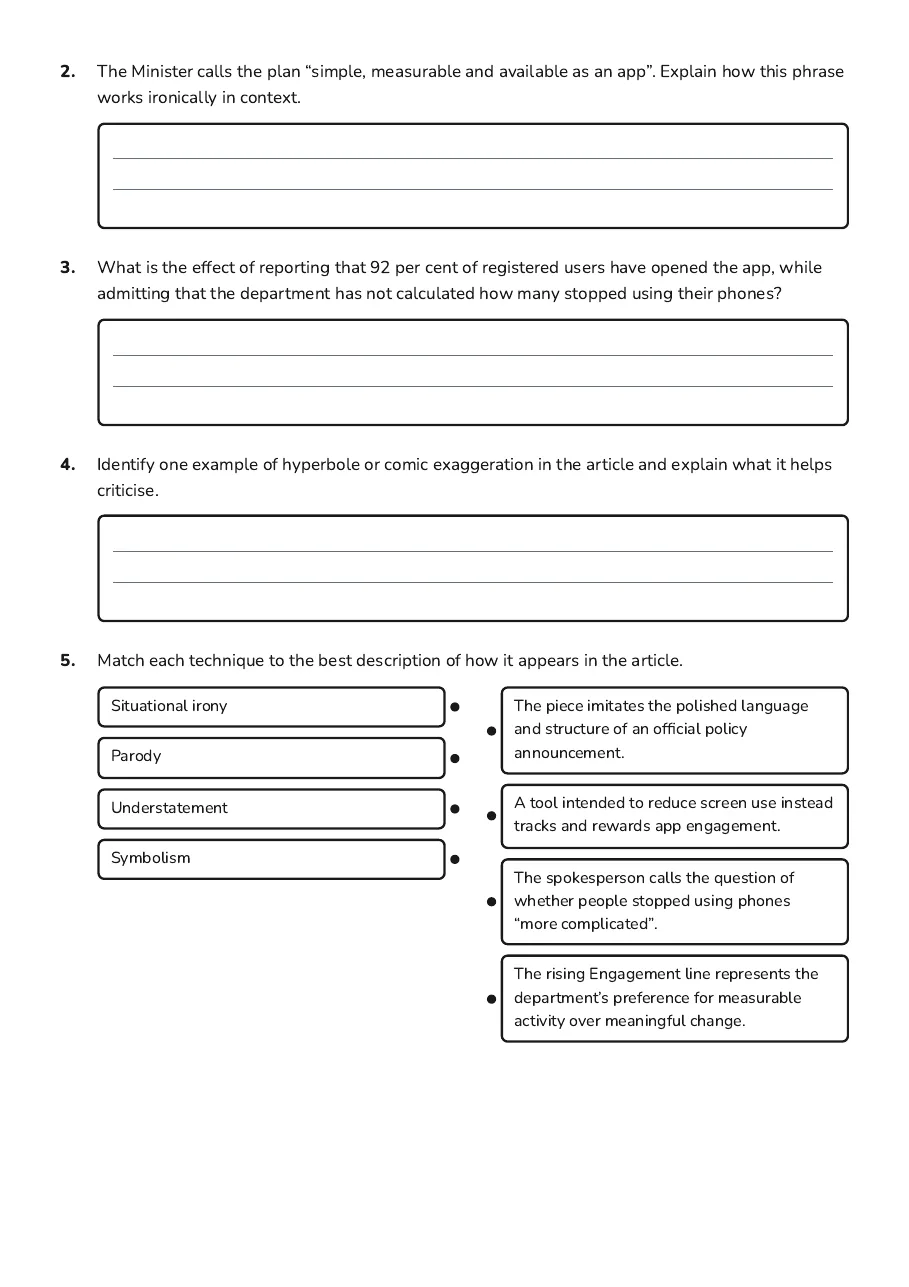
2.The Minister calls the plan “simple, measurable and available as an app”. Explain how this phrase works ironically in context.
3.What is the effect of reporting that 92 per cent of registered users have opened the app, while admitting that the department has not calculated how many stopped using their phones?
4.Identify one example of hyperbole or comic exaggeration in the article and explain what it helps criticise.
5.Match each technique to the best description of how it appears in the article.
- Situational irony
- Parody
- Understatement
- Symbolism
- The piece imitates the polished language and structure of an official policy announcement.
- A tool intended to reduce screen use instead tracks and rewards app engagement.
- The spokesperson calls the question of whether people stopped using phones “more complicated”.
- The rising Engagement line represents the department’s preference for measurable activity over meaningful change.
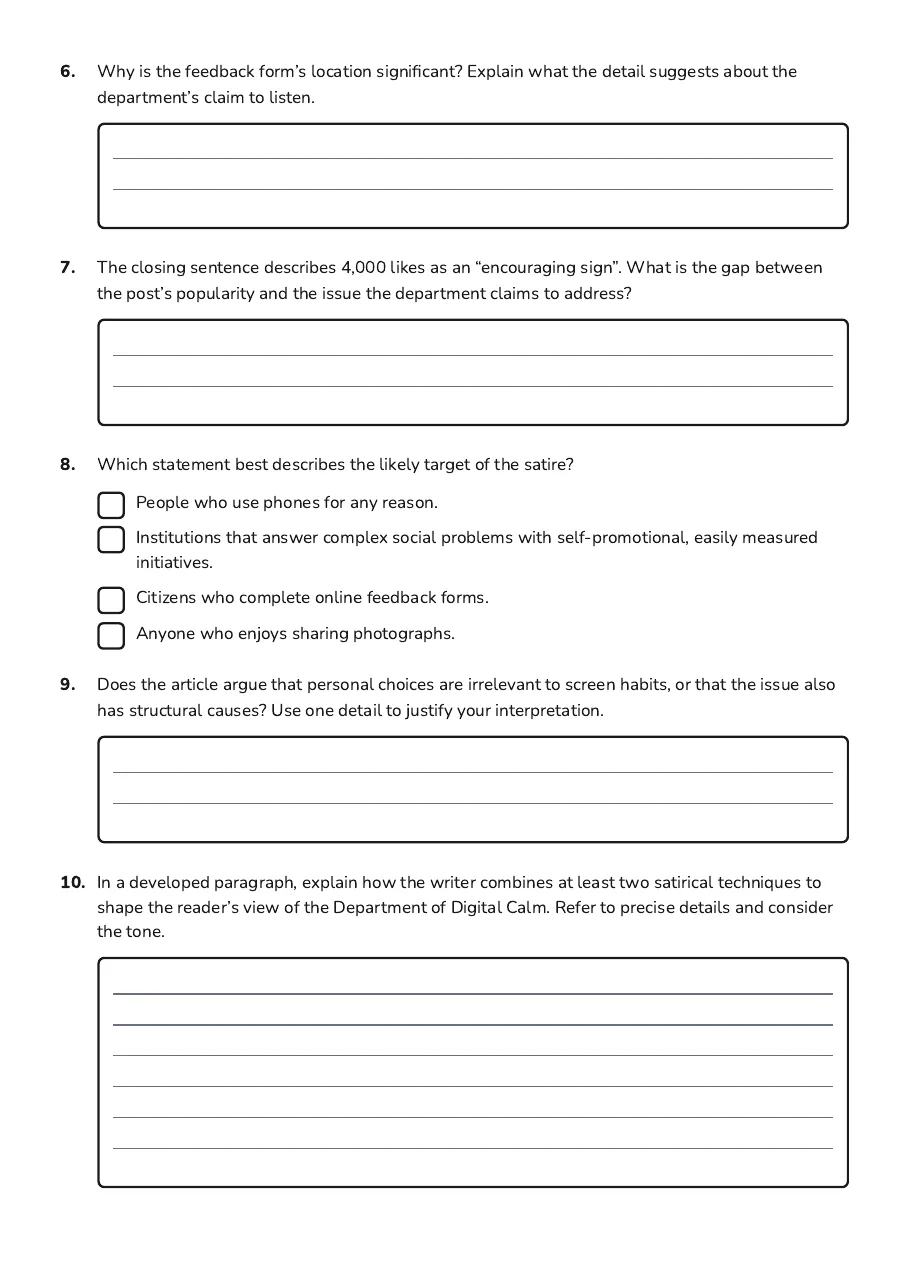
6.Why is the feedback form’s location significant? Explain what the detail suggests about the department’s claim to listen.
7.The closing sentence describes 4,000 likes as an “encouraging sign”. What is the gap between the post’s popularity and the issue the department claims to address?
8.Which statement best describes the likely target of the satire?
- People who use phones for any reason.
- Institutions that answer complex social problems with self-promotional, easily measured initiatives.
- Citizens who complete online feedback forms.
- Anyone who enjoys sharing photographs.
9.Does the article argue that personal choices are irrelevant to screen habits, or that the issue also has structural causes? Use one detail to justify your interpretation.
10.In a developed paragraph, explain how the writer combines at least two satirical techniques to shape the reader’s view of the Department of Digital Calm. Refer to precise details and consider the tone.
3 printable pages
Page 1
Page 2
Page 3
About This Worksheet
Free in Kuraplan
Sign up free, grab the PDF, and customize it for your class.
Print-Ready
Formatted for standard paper. Clean layout, easy to read.
AI-Generated
Created with Kuraplan's AI, designed for real classroom use.
For Teachers & Parents
Use in classrooms, for homework, tutoring, or homeschool.
Need a custom version of this worksheet?
Kuraplan's AI generates custom worksheets in seconds — differentiated for every learner, aligned to your curriculum.
Generate Custom Worksheets — Free No credit card Curriculum-aligned Under 60 seconds