ScienceFreePrintable

Separating Mixtures Techniques

A free science worksheet ready for your classroom. Open in Kuraplan to grab the print-ready PDF, customize it for your students, or generate a fresh version in seconds.
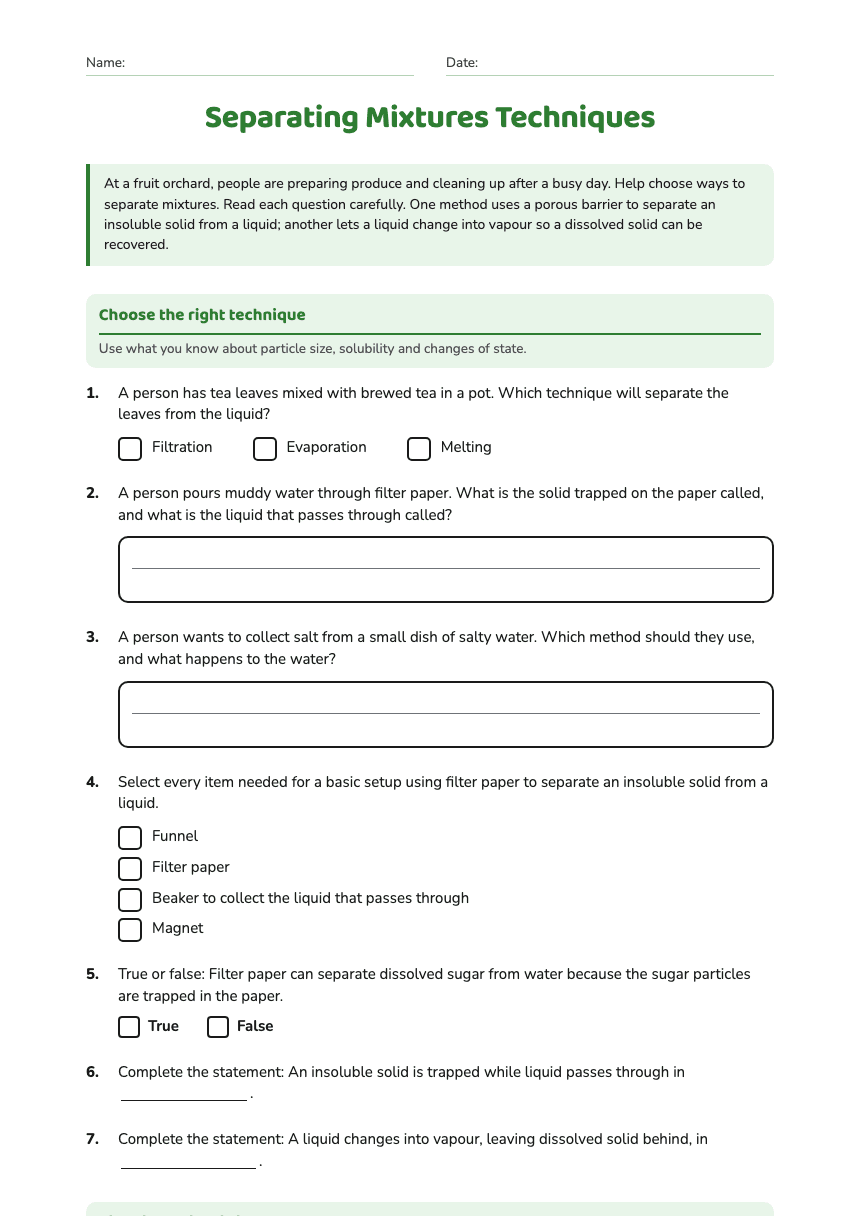
Separating Mixtures Techniques worksheet preview
Name:Date:

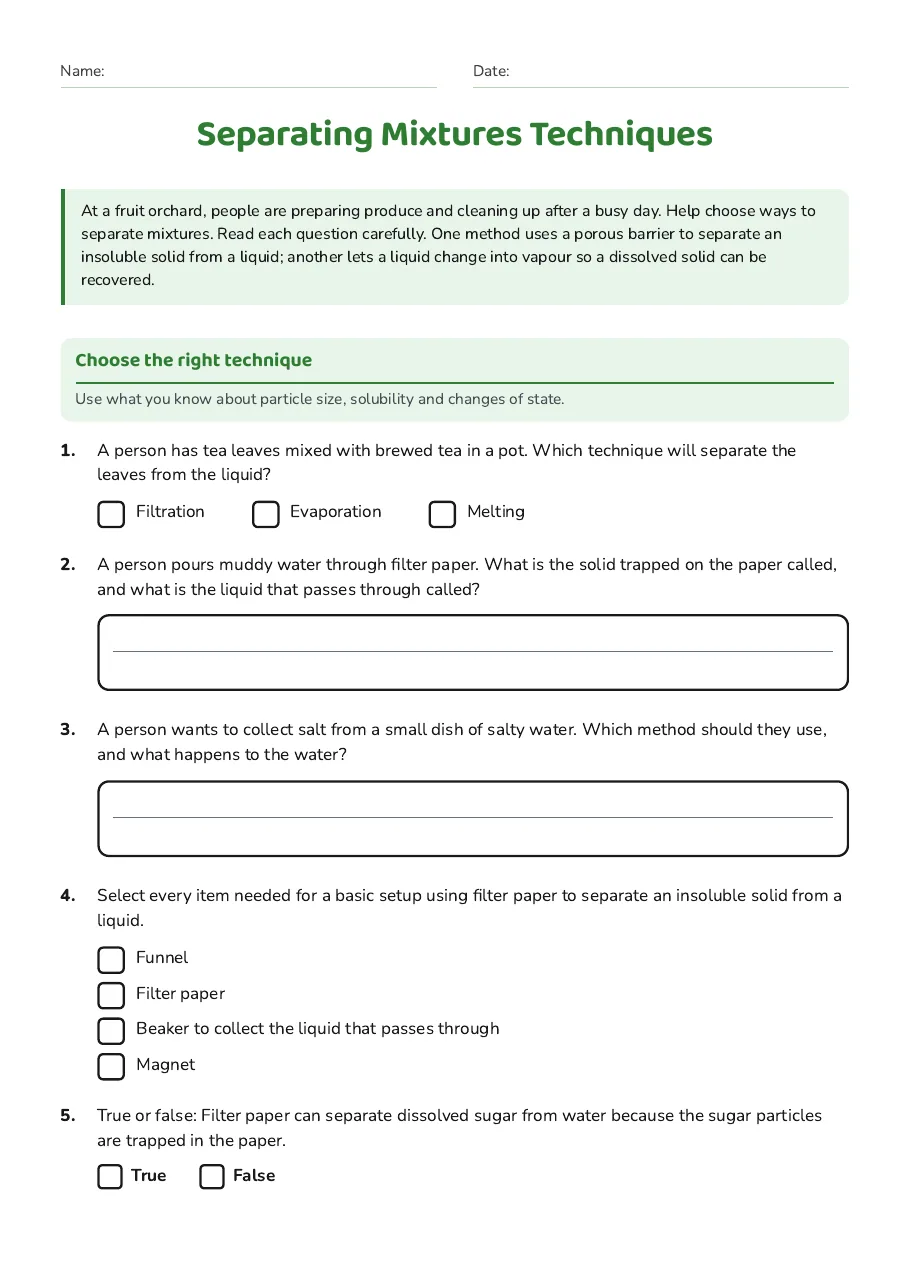
Separating Mixtures Techniques

At a fruit orchard, people are preparing produce and cleaning up after a busy day. Help choose ways to separate mixtures. Read each question carefully. One method uses a porous barrier to separate an insoluble solid from a liquid; another lets a liquid change into vapour so a dissolved solid can be recovered.

Choose the right technique

Use what you know about particle size, solubility and changes of state.

1.A person has tea leaves mixed with brewed tea in a pot. Which technique will separate the leaves from the liquid?
  • Filtration
  • Evaporation
  • Melting
2.A person pours muddy water through filter paper. What is the solid trapped on the paper called, and what is the liquid that passes through called?
3.A person wants to collect salt from a small dish of salty water. Which method should they use, and what happens to the water?
4.Select every item needed for a basic setup using filter paper to separate an insoluble solid from a liquid.
  • Funnel
  • Filter paper
  • Beaker to collect the liquid that passes through
  • Magnet
5.True or false: Filter paper can separate dissolved sugar from water because the sugar particles are trapped in the paper.
TrueFalse
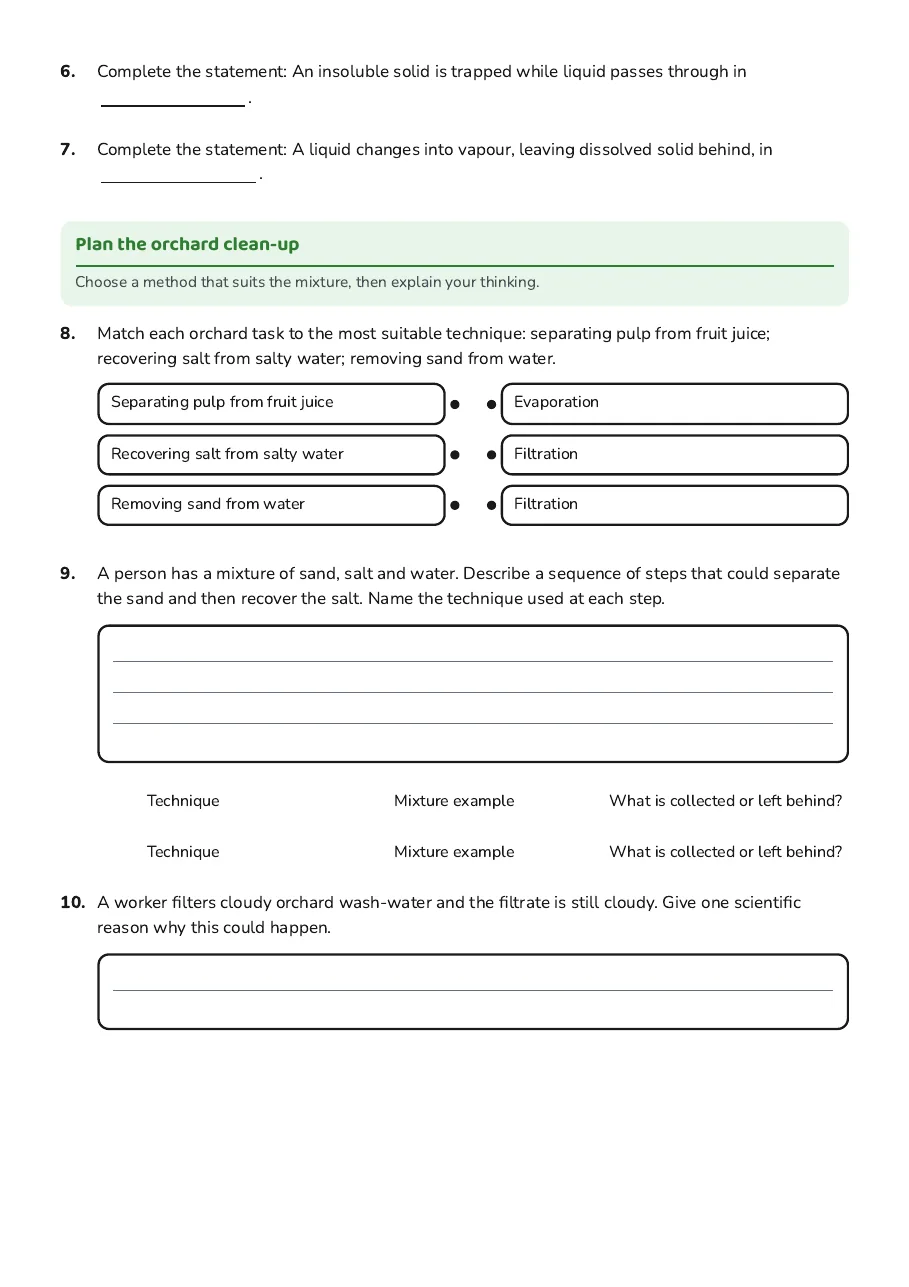
6.Complete the statement: An insoluble solid is trapped while liquid passes through in .
7.Complete the statement: A liquid changes into vapour, leaving dissolved solid behind, in .

Plan the orchard clean-up

Choose a method that suits the mixture, then explain your thinking.

8.Match each orchard task to the most suitable technique: separating pulp from fruit juice; recovering salt from salty water; removing sand from water.
  • Separating pulp from fruit juice
  • Recovering salt from salty water
  • Removing sand from water
  • Evaporation
  • Filtration
  • Filtration
9.A person has a mixture of sand, salt and water. Describe a sequence of steps that could separate the sand and then recover the salt. Name the technique used at each step.

Technique

Mixture example

What is collected or left behind?

Technique

Mixture example

What is collected or left behind?

10.A worker filters cloudy orchard wash-water and the filtrate is still cloudy. Give one scientific reason why this could happen.
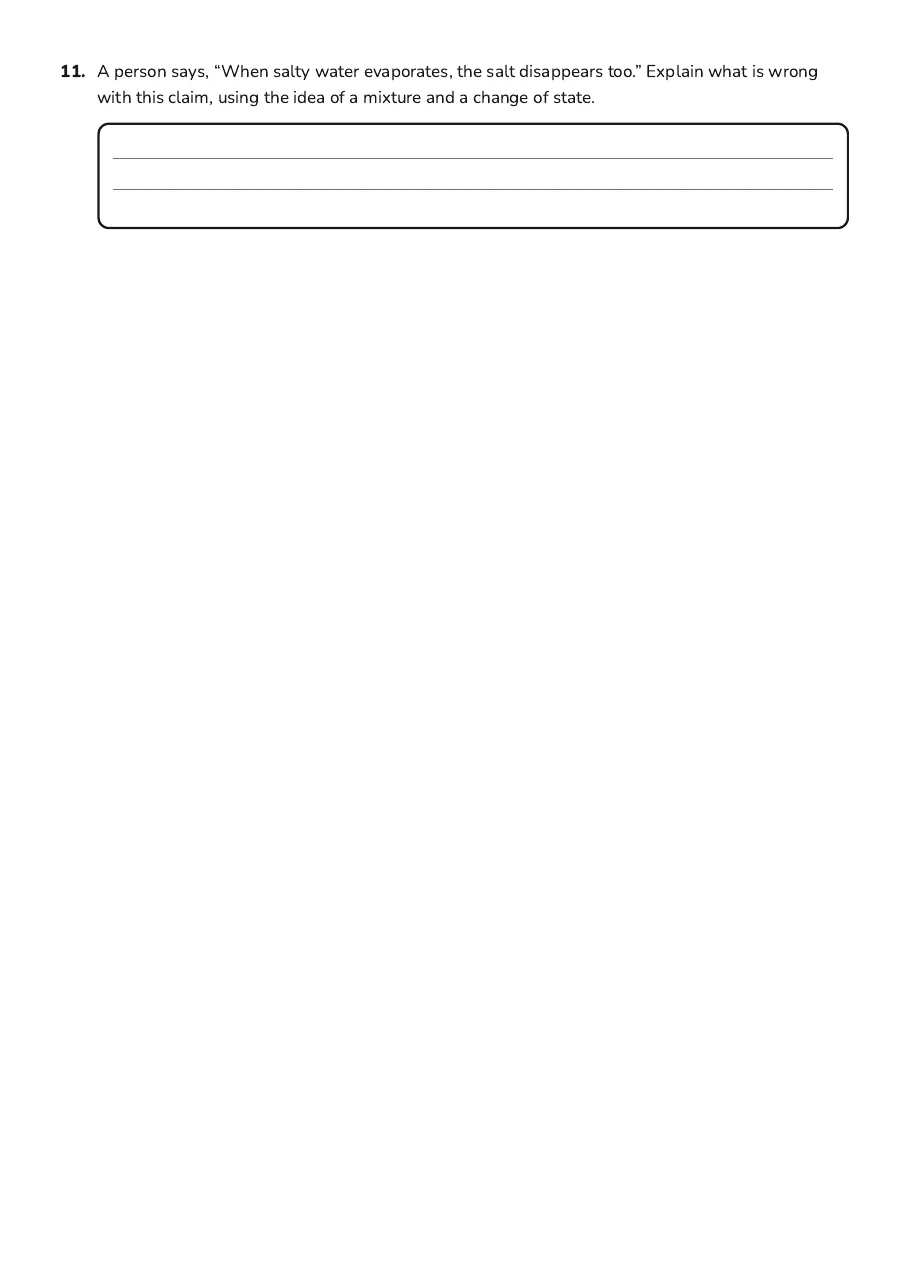
11.A person says, “When salty water evaporates, the salt disappears too.” Explain what is wrong with this claim, using the idea of a mixture and a change of state.

3 printable pages

  • Separating Mixtures Techniques, page 1 of 3: Choose the right technique

    Page 1

  • Separating Mixtures Techniques, page 2 of 3: Plan the orchard clean-up

    Page 2

  • Separating Mixtures Techniques, page 3 of 3: 11. A person says, “When salty water evaporates, the salt disappears too.” Explain what…

    Page 3

About This Worksheet

Free in Kuraplan

Sign up free, grab the PDF, and customize it for your class.

Print-Ready

Formatted for standard paper. Clean layout, easy to read.

AI-Generated

Created with Kuraplan's AI, designed for real classroom use.

For Teachers & Parents

Use in classrooms, for homework, tutoring, or homeschool.

Need a custom version of this worksheet?

Kuraplan's AI generates custom worksheets in seconds — differentiated for every learner, aligned to your curriculum.

Generate Custom Worksheets — Free
No credit card Curriculum-aligned Under 60 seconds