Shakespeare Theatre Reflection
A free english worksheet ready for your classroom. Open in Kuraplan to grab the print-ready PDF, customize it for your students, or generate a fresh version in seconds.
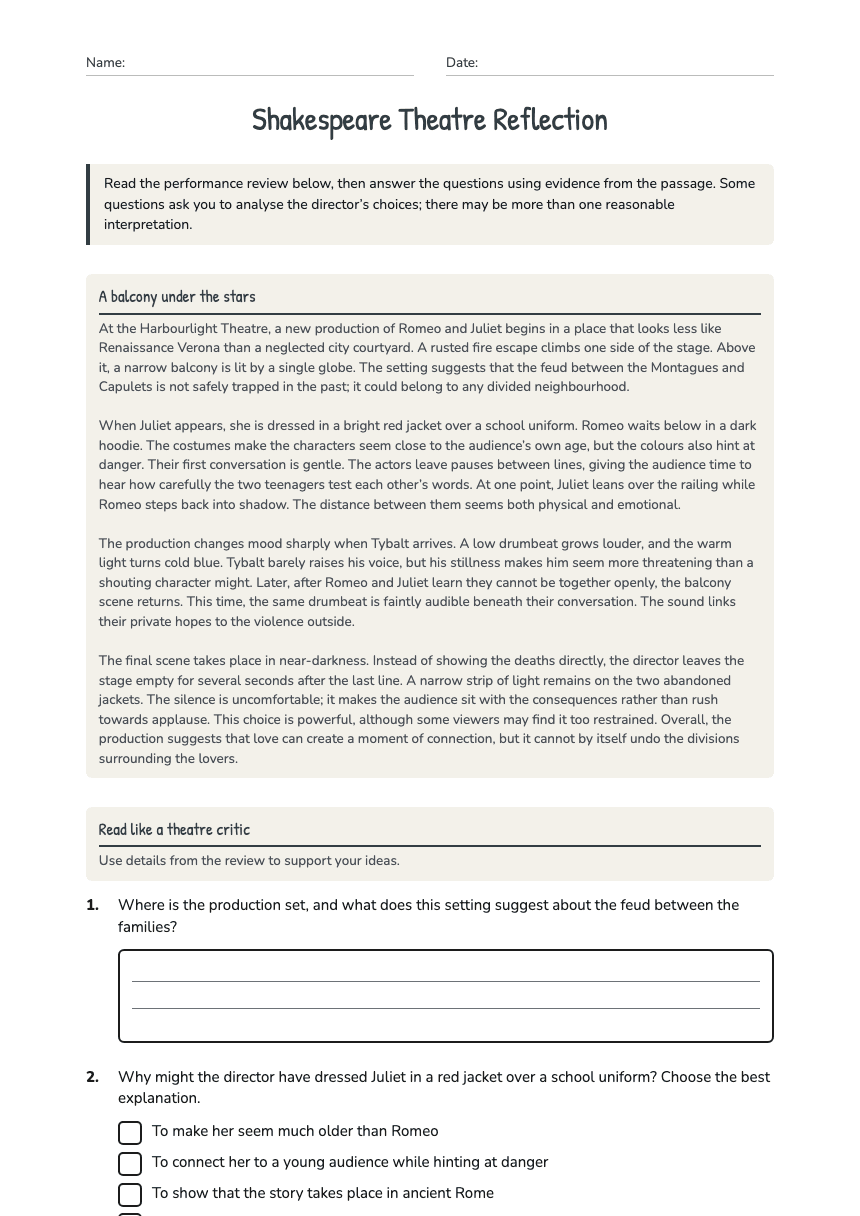
Shakespeare Theatre Reflection
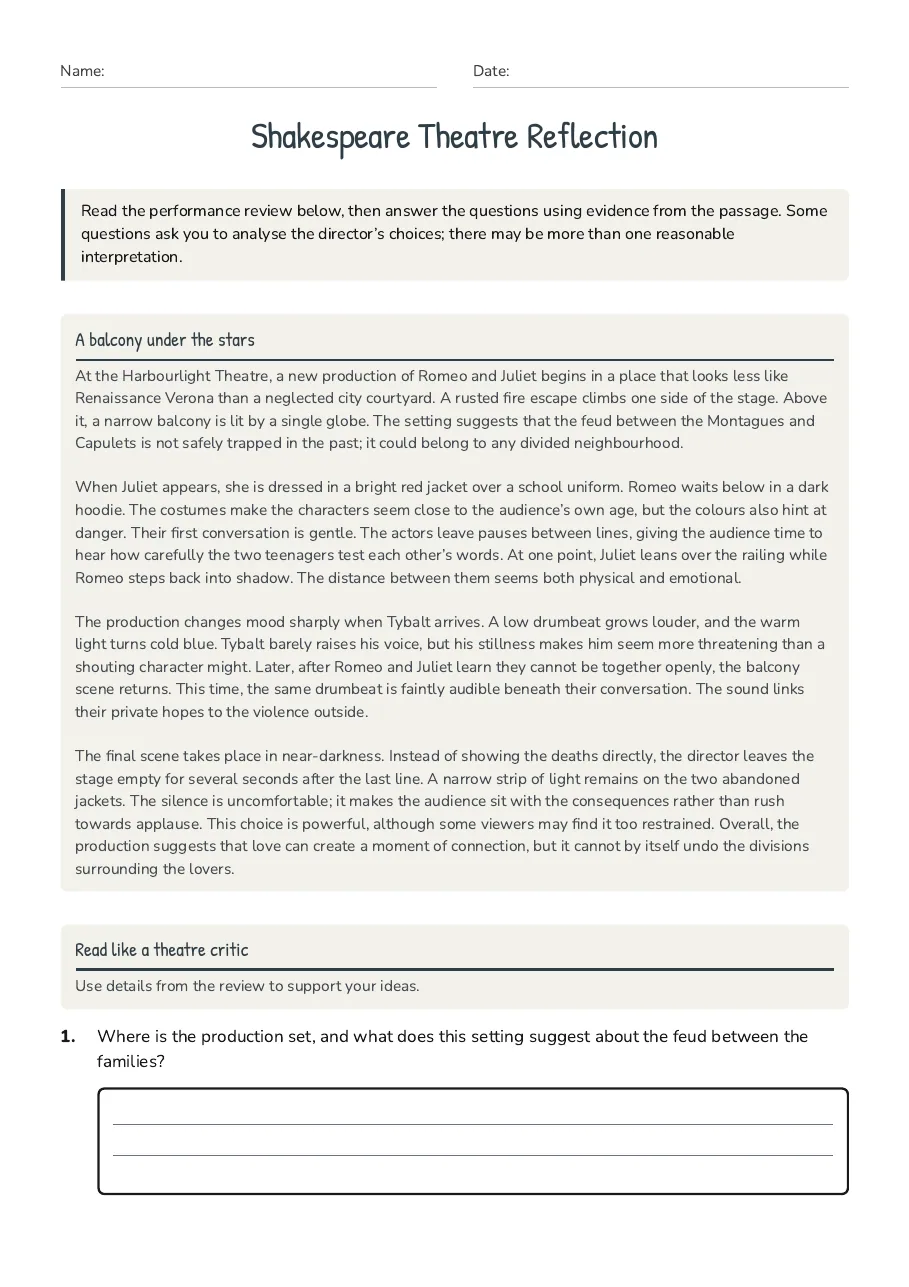
A balcony under the stars
At the Harbourlight Theatre, a new production of Romeo and Juliet begins in a place that looks less like Renaissance Verona than a neglected city courtyard. A rusted fire escape climbs one side of the stage. Above it, a narrow balcony is lit by a single globe. The setting suggests that the feud between the Montagues and Capulets is not safely trapped in the past; it could belong to any divided neighbourhood. When Juliet appears, she is dressed in a bright red jacket over a school uniform. Romeo waits below in a dark hoodie. The costumes make the characters seem close to the audience’s own age, but the colours also hint at danger. Their first conversation is gentle. The actors leave pauses between lines, giving the audience time to hear how carefully the two teenagers test each other’s words. At one point, Juliet leans over the railing while Romeo steps back into shadow. The distance between them seems both physical and emotional. The production changes mood sharply when Tybalt arrives. A low drumbeat grows louder, and the warm light turns cold blue. Tybalt barely raises his voice, but his stillness makes him seem more threatening than a shouting character might. Later, after Romeo and Juliet learn they cannot be together openly, the balcony scene returns. This time, the same drumbeat is faintly audible beneath their conversation. The sound links their private hopes to the violence outside. The final scene takes place in near-darkness. Instead of showing the deaths directly, the director leaves the stage empty for several seconds after the last line. A narrow strip of light remains on the two abandoned jackets. The silence is uncomfortable; it makes the audience sit with the consequences rather than rush towards applause. This choice is powerful, although some viewers may find it too restrained. Overall, the production suggests that love can create a moment of connection, but it cannot by itself undo the divisions surrounding the lovers.
Read like a theatre critic
Use details from the review to support your ideas.
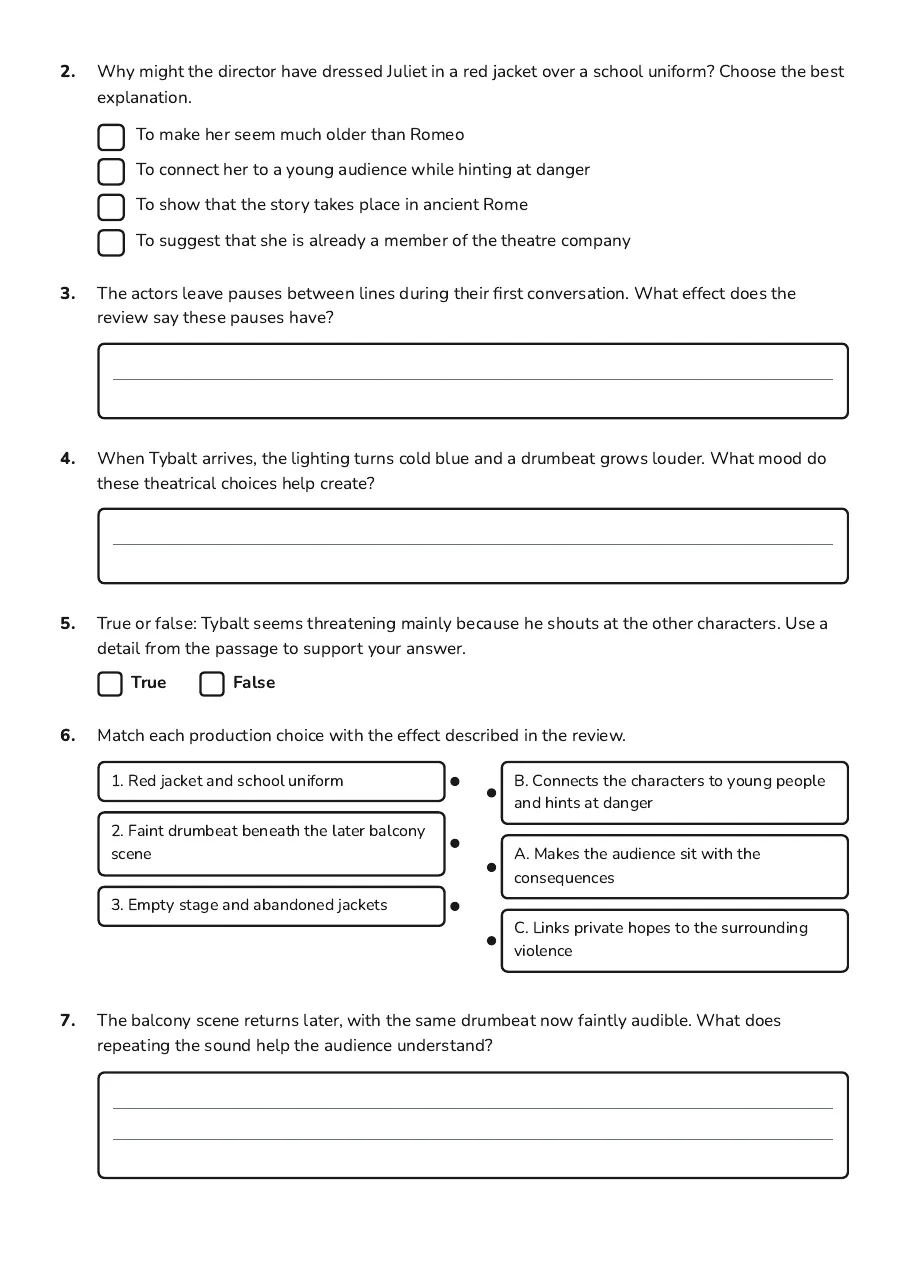
- To make her seem much older than Romeo
- To connect her to a young audience while hinting at danger
- To show that the story takes place in ancient Rome
- To suggest that she is already a member of the theatre company
- 1. Red jacket and school uniform
- 2. Faint drumbeat beneath the later balcony scene
- 3. Empty stage and abandoned jackets
- B. Connects the characters to young people and hints at danger
- A. Makes the audience sit with the consequences
- C. Links private hopes to the surrounding violence
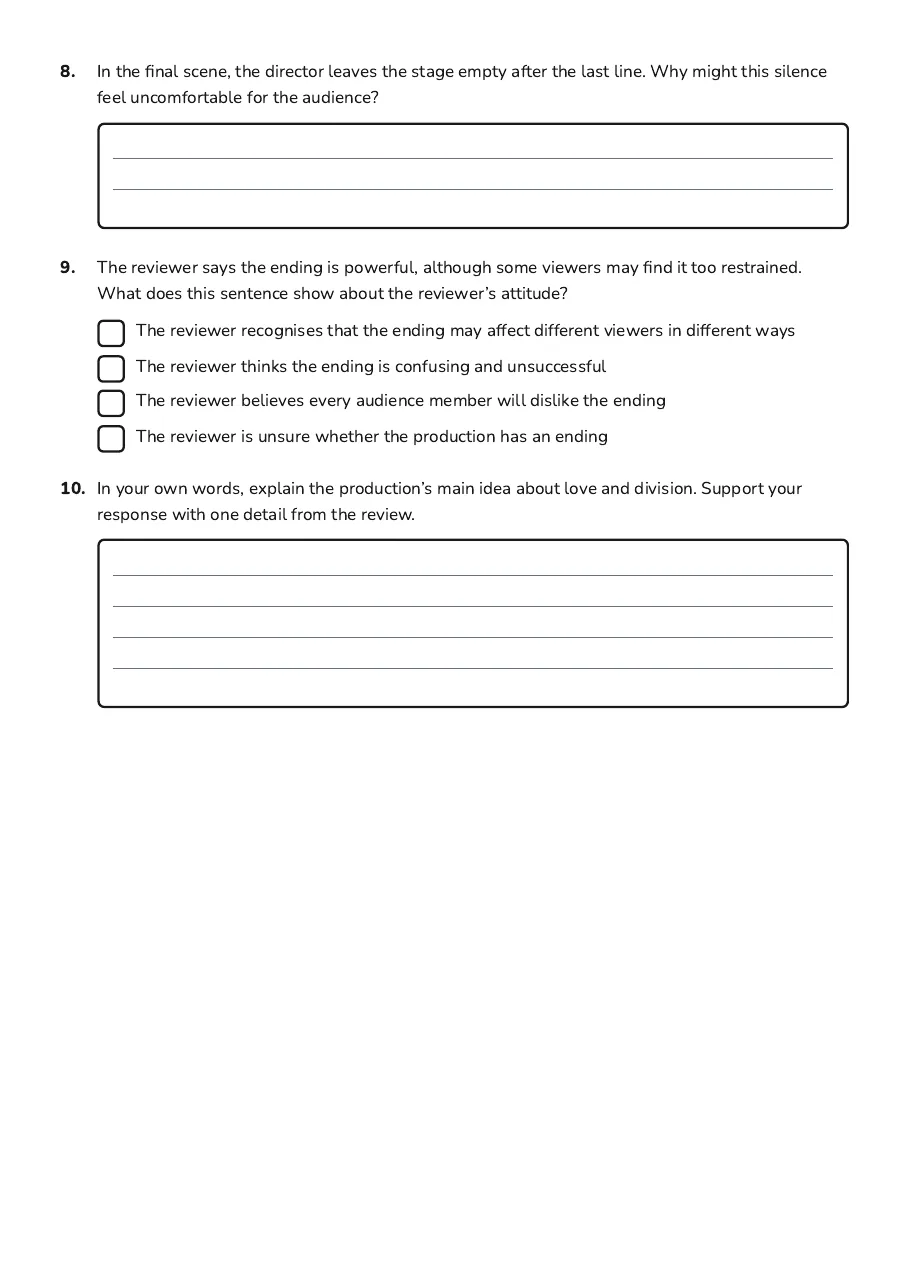
- The reviewer recognises that the ending may affect different viewers in different ways
- The reviewer thinks the ending is confusing and unsuccessful
- The reviewer believes every audience member will dislike the ending
- The reviewer is unsure whether the production has an ending
3 printable pages
Page 1
Page 2
Page 3
About This Worksheet
Free in Kuraplan
Sign up free, grab the PDF, and customize it for your class.
Print-Ready
Formatted for standard paper. Clean layout, easy to read.
AI-Generated
Created with Kuraplan's AI, designed for real classroom use.
For Teachers & Parents
Use in classrooms, for homework, tutoring, or homeschool.
Need a custom version of this worksheet?
Kuraplan's AI generates custom worksheets in seconds — differentiated for every learner, aligned to your curriculum.
Generate Custom Worksheets — Free