Solutions: Mole Fraction Normality
A free science worksheet ready for your classroom. Open in Kuraplan to grab the print-ready PDF, customize it for your students, or generate a fresh version in seconds.
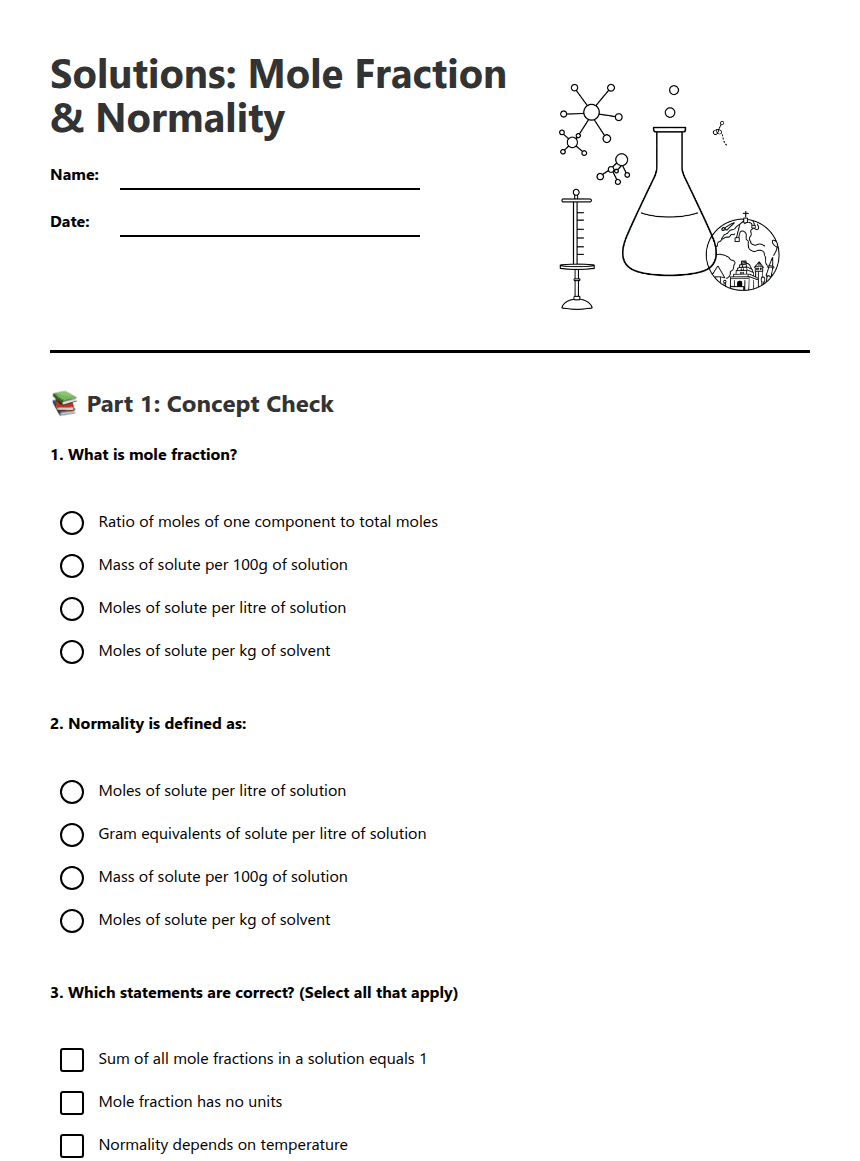
Solutions: Mole Fraction & Normality Worksheet-1

📚 Part 1: Concept Check
🧮 Part 2: Calculations
Formula: χ = nsolute / ntotal
Answer: χethanol = __________
Given: Molarity = 0.5M, n-factor for H₂SO₄ = ____
Answer: Normality = __________ N
Molar masses: C₂H₅OH = 46 g/mol, H₂O = 18 g/mol
χethanol = __________ and χwater = __________
🎯 Part 3: Extension & Application
Hint: At neutralisation, N₁V₁ = N₂V₂
Answer: Volume = __________ mL
🔍 Detailed Solutions
1. What is mole fraction?
The correct answer is: Ratio of moles of one component to total moles. Mole fraction is a way of expressing the concentration of a component in a mixture. It is calculated as:
χA = nA / (nA + nB + ...)
2. Normality is defined as:
The correct answer is: Gram equivalents of solute per litre of solution. Normality (N) is a measure of concentration equivalent to molarity multiplied by the number of equivalents per mole of solute.
3. Which statements are correct?
Correct statements: Sum of all mole fractions in a solution equals 1, Mole fraction has no units, Normality = Molarity × n-factor. Normality does not depend on temperature directly, but the reaction conditions can affect it.
4. Calculate mole fraction of ethanol.
Given: 2 moles of ethanol and 8 moles of water.
χethanol = nethanol / (nethanol + nwater) = 2 / (2 + 8) = 0.2
5. Find the normality of 0.5M H₂SO₄ solution.
Given: Molarity = 0.5M, n-factor for H₂SO₄ = 2 (since it can donate 2 protons).
Normality = Molarity × n-factor = 0.5 × 2 = 1 N
6. Calculate the mole fraction of each component.
Given: 23g of ethanol and 72g of water.
Moles of ethanol = 23 g / 46 g/mol = 0.5 moles
Moles of water = 72 g / 18 g/mol = 4 moles
χethanol = 0.5 / (0.5 + 4) = 0.5 / 4.5 = 0.111
χwater = 4 / 4.5 = 0.889
7. Volume of 0.2N HCl needed.
Using N₁V₁ = N₂V₂:
0.2N × VHCl = 0.15N × 25 mL
VHCl = (0.15 × 25) / 0.2 = 18.75 mL
8. Why is mole fraction useful in Raoult's Law?
Mole fraction is crucial in Raoult's Law as it helps in calculating the vapor pressure of each component in a solution. It provides a way to express the concentration of a component relative to the total amount of substance in the mixture.
9. When to use normality vs molarity?
Normality is used for reactions where equivalents are involved, such as acid-base and redox reactions. Molarity is used for general concentration measurements. Both concepts depend on the equivalent weight of the solute.
10. Design a simple experiment.
Example: Mix sugar and water to create a solution. Measure the amount of sugar and water used, then calculate the mole fraction of sugar in the solution. Discuss how this relates to the concept of mole fraction.
About This Worksheet
Free in Kuraplan
Sign up free, grab the PDF, and customize it for your class.
Print-Ready
Formatted for standard paper. Clean layout, easy to read.
AI-Generated
Created with Kuraplan's AI, designed for real classroom use.
For Teachers & Parents
Use in classrooms, for homework, tutoring, or homeschool.
Need a custom version of this worksheet?
Kuraplan's AI generates custom worksheets in seconds — differentiated for every learner, aligned to your curriculum.
Generate Custom Worksheets — Free