Social SciencesFreePrintable

Timelines and Calendars Worksheet

A free social sciences worksheet ready for your classroom. Open in Kuraplan to grab the print-ready PDF, customize it for your students, or generate a fresh version in seconds.

Timelines and Calendars Worksheet worksheet preview
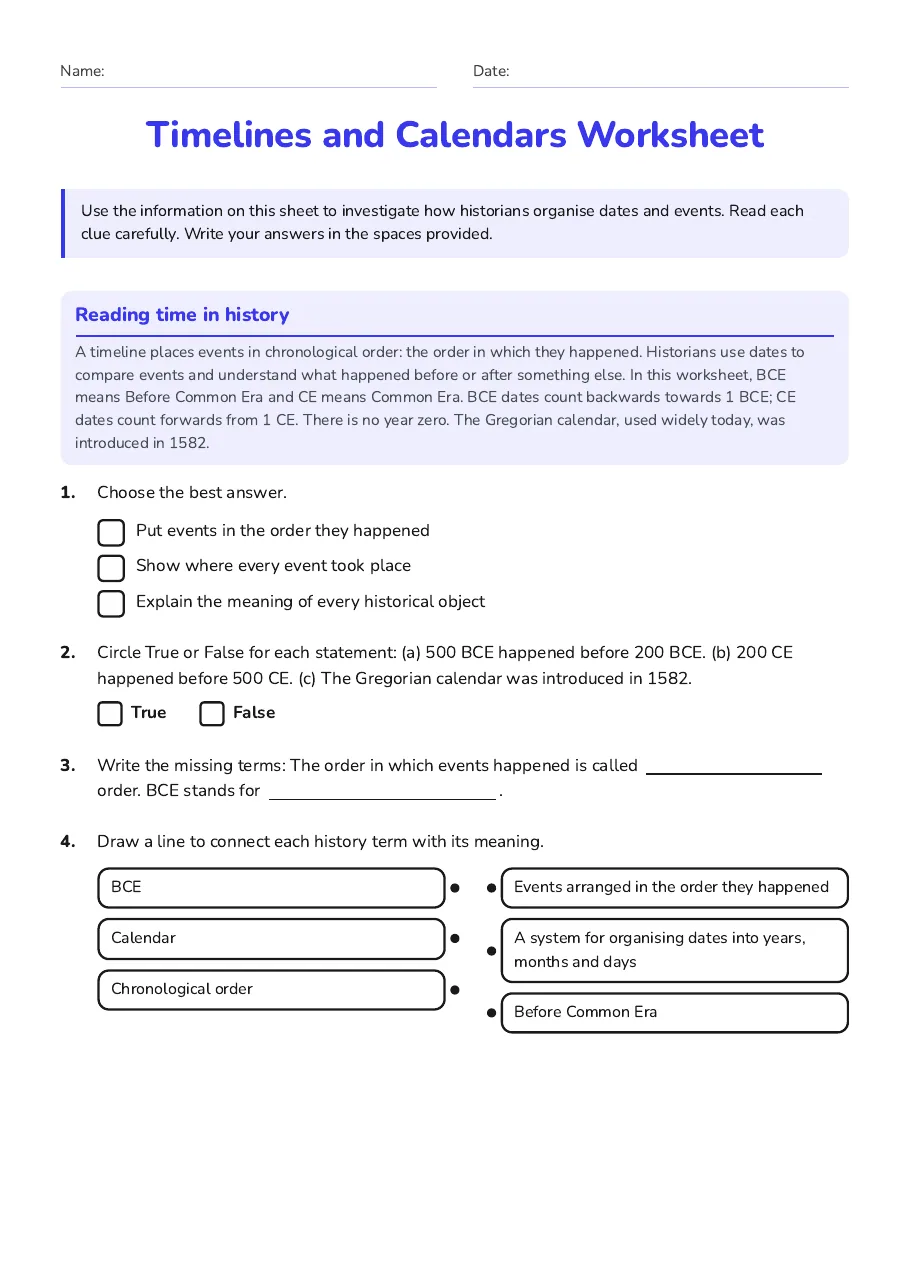
Name:Date:

Timelines and Calendars Worksheet

Use the information on this sheet to investigate how historians organise dates and events. Read each clue carefully. Write your answers in the spaces provided.

Reading time in history

A timeline places events in chronological order: the order in which they happened. Historians use dates to compare events and understand what happened before or after something else. In this worksheet, BCE means Before Common Era and CE means Common Era. BCE dates count backwards towards 1 BCE; CE dates count forwards from 1 CE. There is no year zero. The Gregorian calendar, used widely today, was introduced in 1582.

1.Choose the best answer.
  • Put events in the order they happened
  • Show where every event took place
  • Explain the meaning of every historical object
2.Circle True or False for each statement: (a) 500 BCE happened before 200 BCE. (b) 200 CE happened before 500 CE. (c) The Gregorian calendar was introduced in 1582.
TrueFalse
3.Write the missing terms: The order in which events happened is called order. BCE stands for .
4.Draw a line to connect each history term with its meaning.
  • BCE
  • Calendar
  • Chronological order
  • Events arranged in the order they happened
  • A system for organising dates into years, months and days
  • Before Common Era

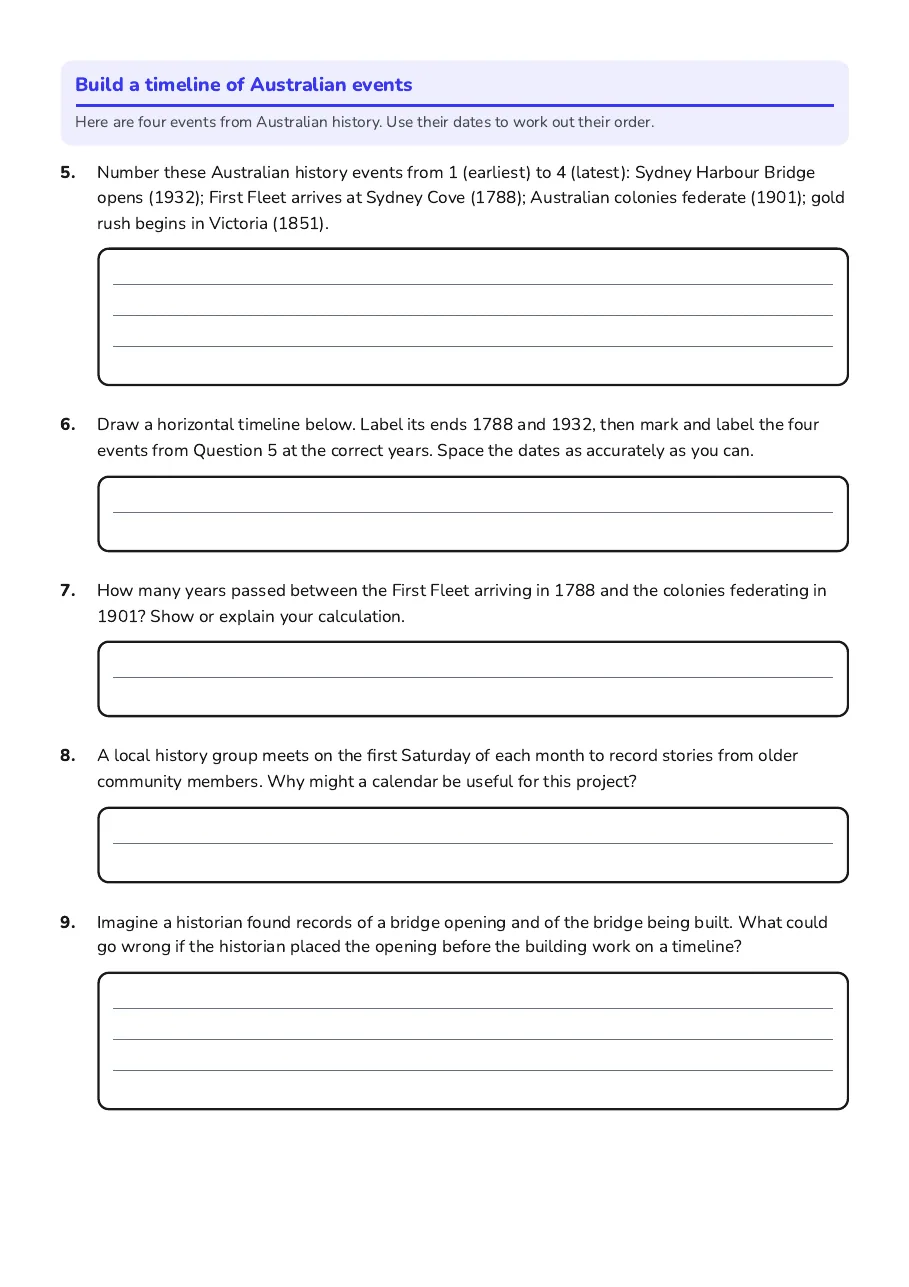
Build a timeline of Australian events

Here are four events from Australian history. Use their dates to work out their order.

5.Number these Australian history events from 1 (earliest) to 4 (latest): Sydney Harbour Bridge opens (1932); First Fleet arrives at Sydney Cove (1788); Australian colonies federate (1901); gold rush begins in Victoria (1851).
6.Draw a horizontal timeline below. Label its ends 1788 and 1932, then mark and label the four events from Question 5 at the correct years. Space the dates as accurately as you can.
7.How many years passed between the First Fleet arriving in 1788 and the colonies federating in 1901? Show or explain your calculation.
8.A local history group meets on the first Saturday of each month to record stories from older community members. Why might a calendar be useful for this project?
9.Imagine a historian found records of a bridge opening and of the bridge being built. What could go wrong if the historian placed the opening before the building work on a timeline?
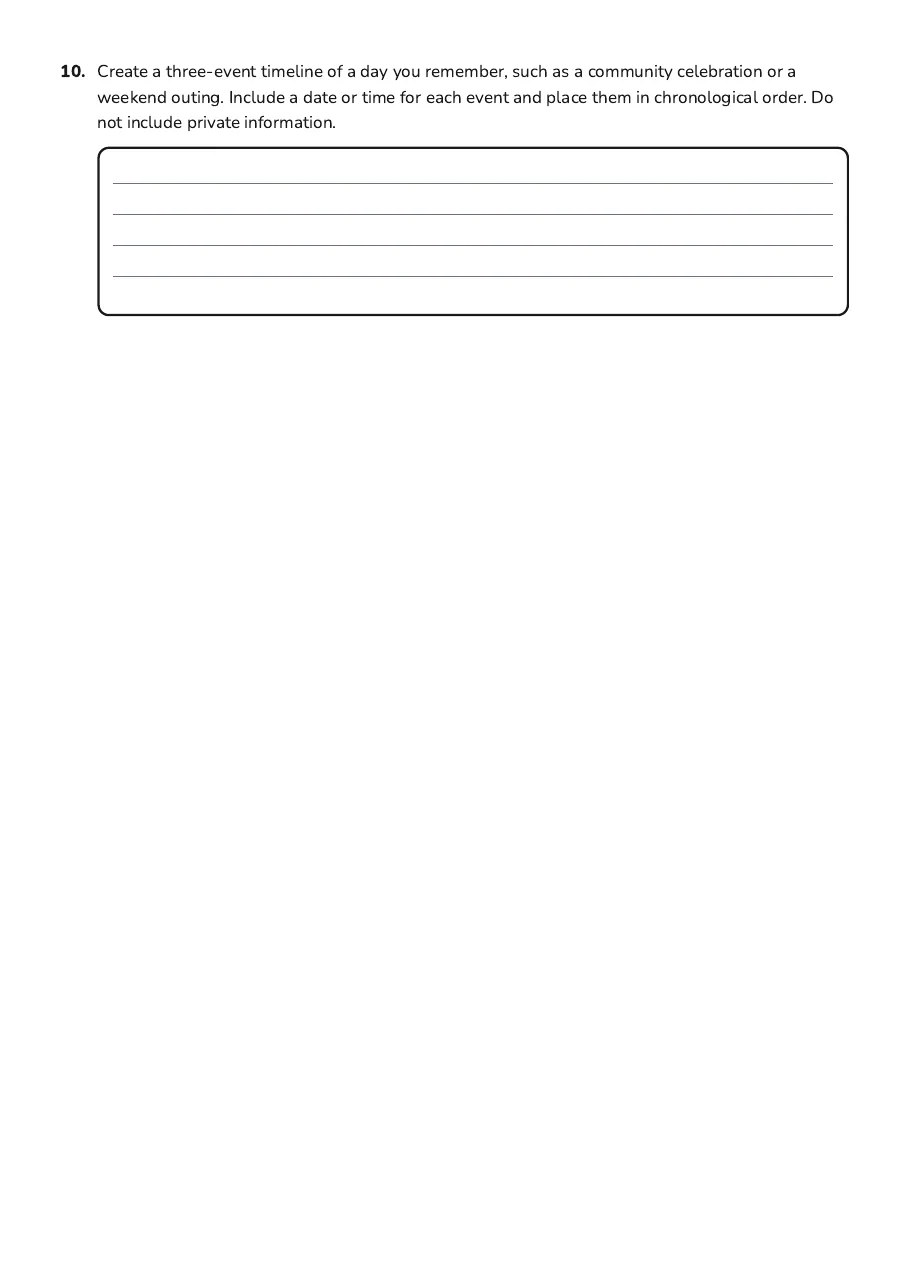
10.Create a three-event timeline of a day you remember, such as a community celebration or a weekend outing. Include a date or time for each event and place them in chronological order. Do not include private information.

3 printable pages

  • Timelines and Calendars Worksheet, page 1 of 3: Reading time in history

    Page 1

  • Timelines and Calendars Worksheet, page 2 of 3: Build a timeline of Australian events

    Page 2

  • Timelines and Calendars Worksheet, page 3 of 3: 10. Create a three-event timeline of a day you remember, such as a community celebration…

    Page 3

About This Worksheet

Free in Kuraplan

Sign up free, grab the PDF, and customize it for your class.

Print-Ready

Formatted for standard paper. Clean layout, easy to read.

AI-Generated

Created with Kuraplan's AI, designed for real classroom use.

For Teachers & Parents

Use in classrooms, for homework, tutoring, or homeschool.

Need a custom version of this worksheet?

Kuraplan's AI generates custom worksheets in seconds — differentiated for every learner, aligned to your curriculum.

Generate Custom Worksheets — Free
No credit card Curriculum-aligned Under 60 seconds