Understanding Narrative Forms
A free english worksheet ready for your classroom. Open in Kuraplan to grab the print-ready PDF, customize it for your students, or generate a fresh version in seconds.

Understanding Narrative Forms
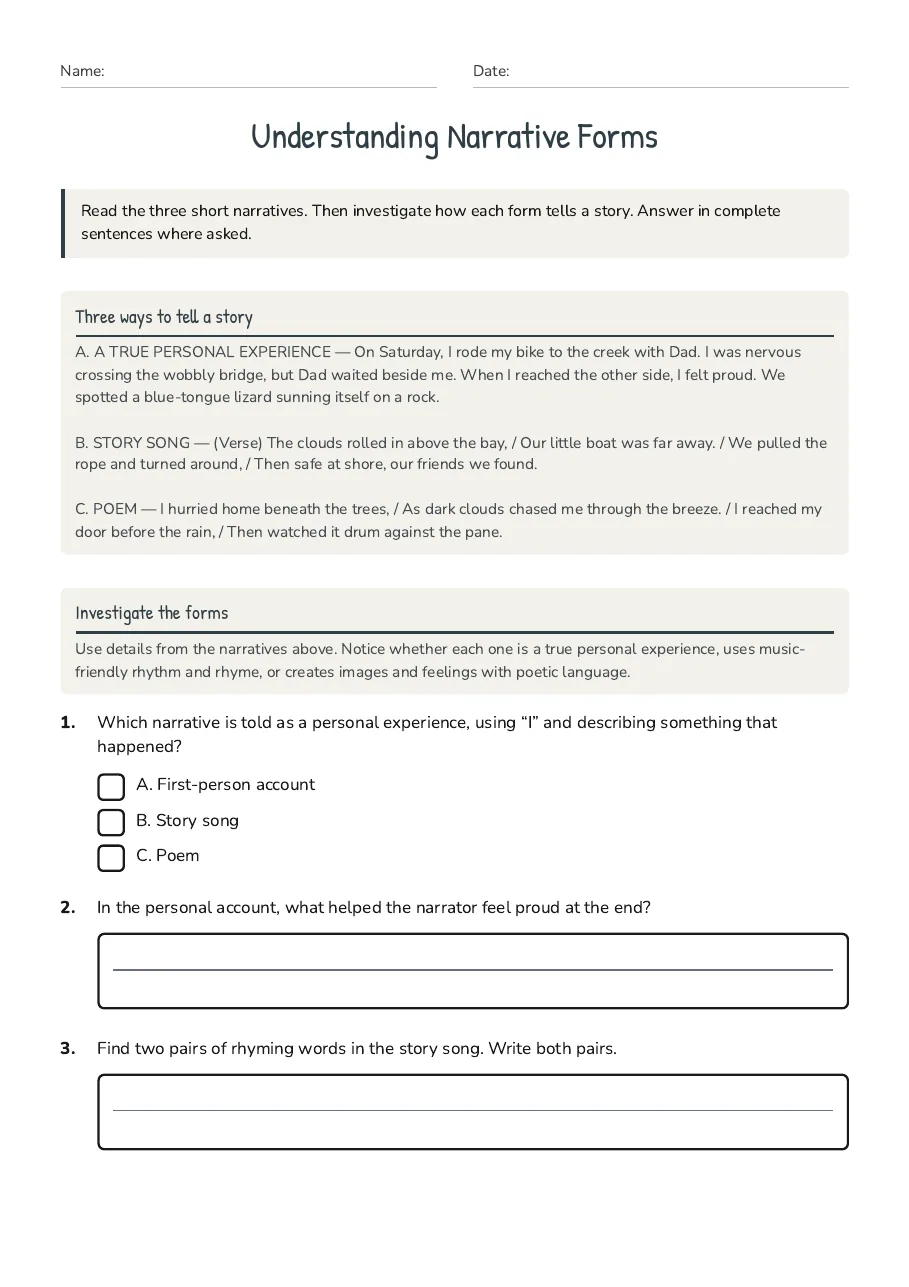
Three ways to tell a story
A. A TRUE PERSONAL EXPERIENCE — On Saturday, I rode my bike to the creek with Dad. I was nervous crossing the wobbly bridge, but Dad waited beside me. When I reached the other side, I felt proud. We spotted a blue-tongue lizard sunning itself on a rock. B. STORY SONG — (Verse) The clouds rolled in above the bay, / Our little boat was far away. / We pulled the rope and turned around, / Then safe at shore, our friends we found. C. POEM — I hurried home beneath the trees, / As dark clouds chased me through the breeze. / I reached my door before the rain, / Then watched it drum against the pane.
Investigate the forms
Use details from the narratives above. Notice whether each one is a true personal experience, uses music-friendly rhythm and rhyme, or creates images and feelings with poetic language.
- A. First-person account
- B. Story song
- C. Poem
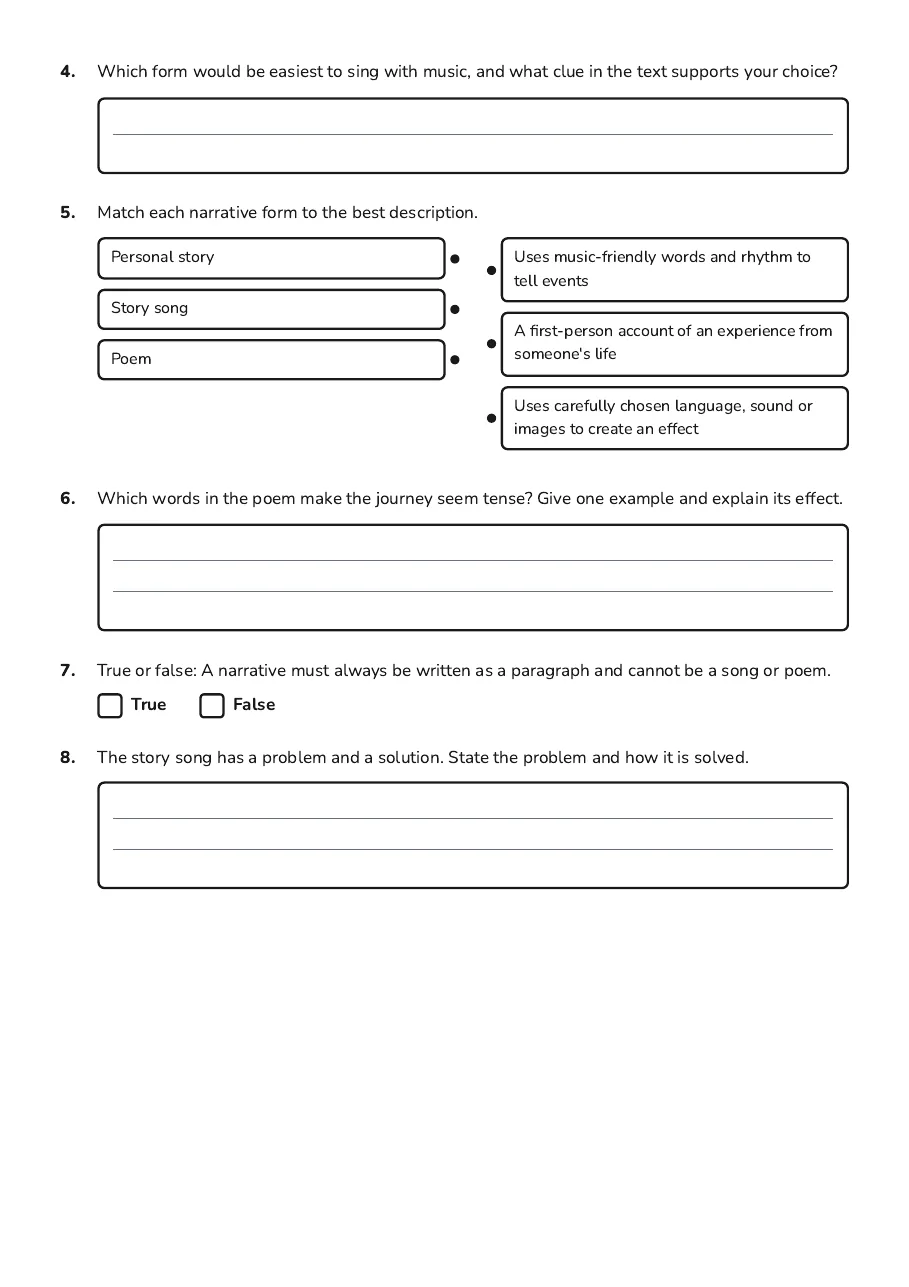
- Personal story
- Story song
- Poem
- Uses music-friendly words and rhythm to tell events
- A first-person account of an experience from someone's life
- Uses carefully chosen language, sound or images to create an effect
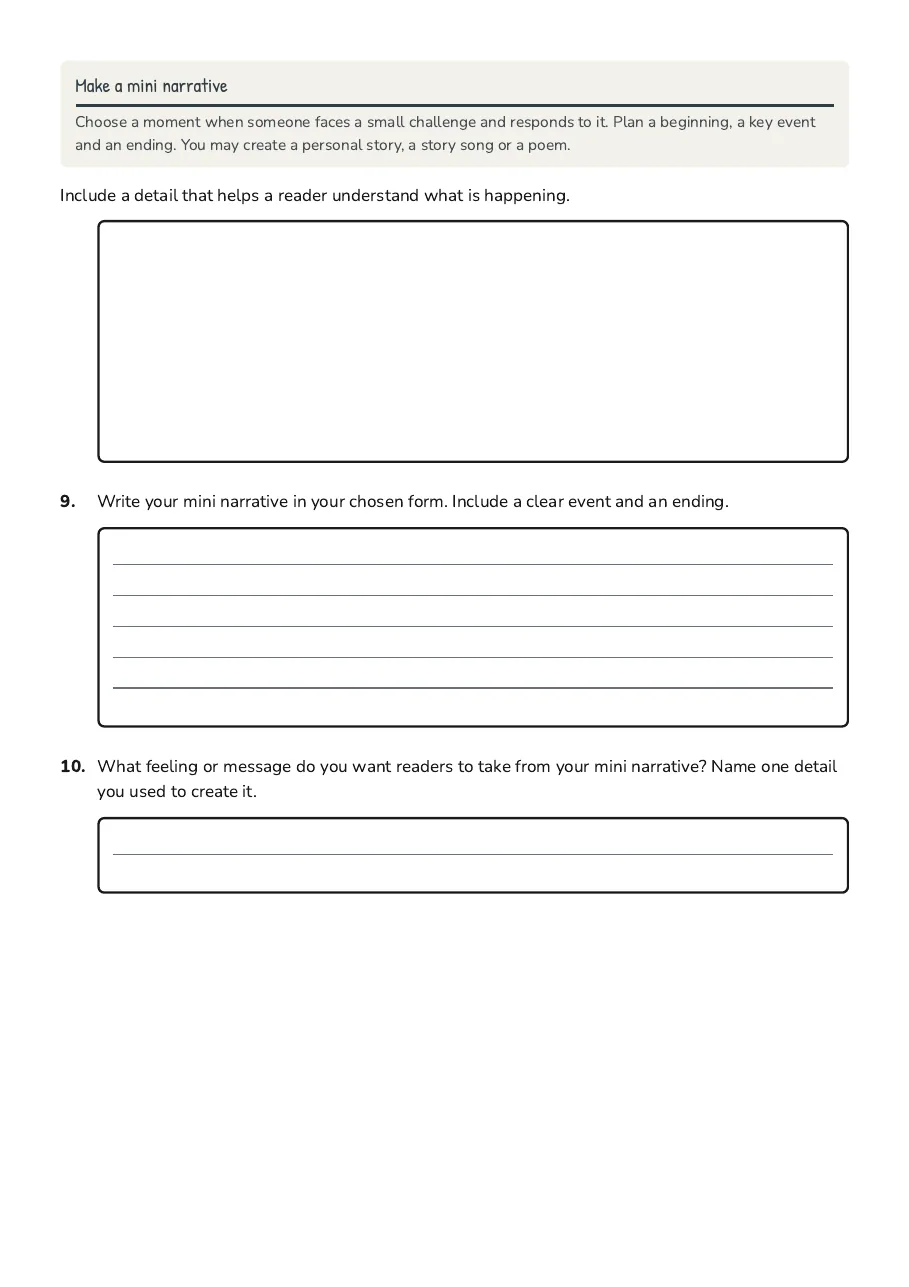
Make a mini narrative
Choose a moment when someone faces a small challenge and responds to it. Plan a beginning, a key event and an ending. You may create a personal story, a story song or a poem.
3 printable pages
Page 1
Page 2
Page 3
About This Worksheet
Free in Kuraplan
Sign up free, grab the PDF, and customize it for your class.
Print-Ready
Formatted for standard paper. Clean layout, easy to read.
AI-Generated
Created with Kuraplan's AI, designed for real classroom use.
For Teachers & Parents
Use in classrooms, for homework, tutoring, or homeschool.
Need a custom version of this worksheet?
Kuraplan's AI generates custom worksheets in seconds — differentiated for every learner, aligned to your curriculum.
Generate Custom Worksheets — Free