ArtFreePrintable

Understanding Our Environments

A free art worksheet ready for your classroom. Open in Kuraplan to grab the print-ready PDF, customize it for your students, or generate a fresh version in seconds.

Understanding Our Environments worksheet preview
Name:Date:

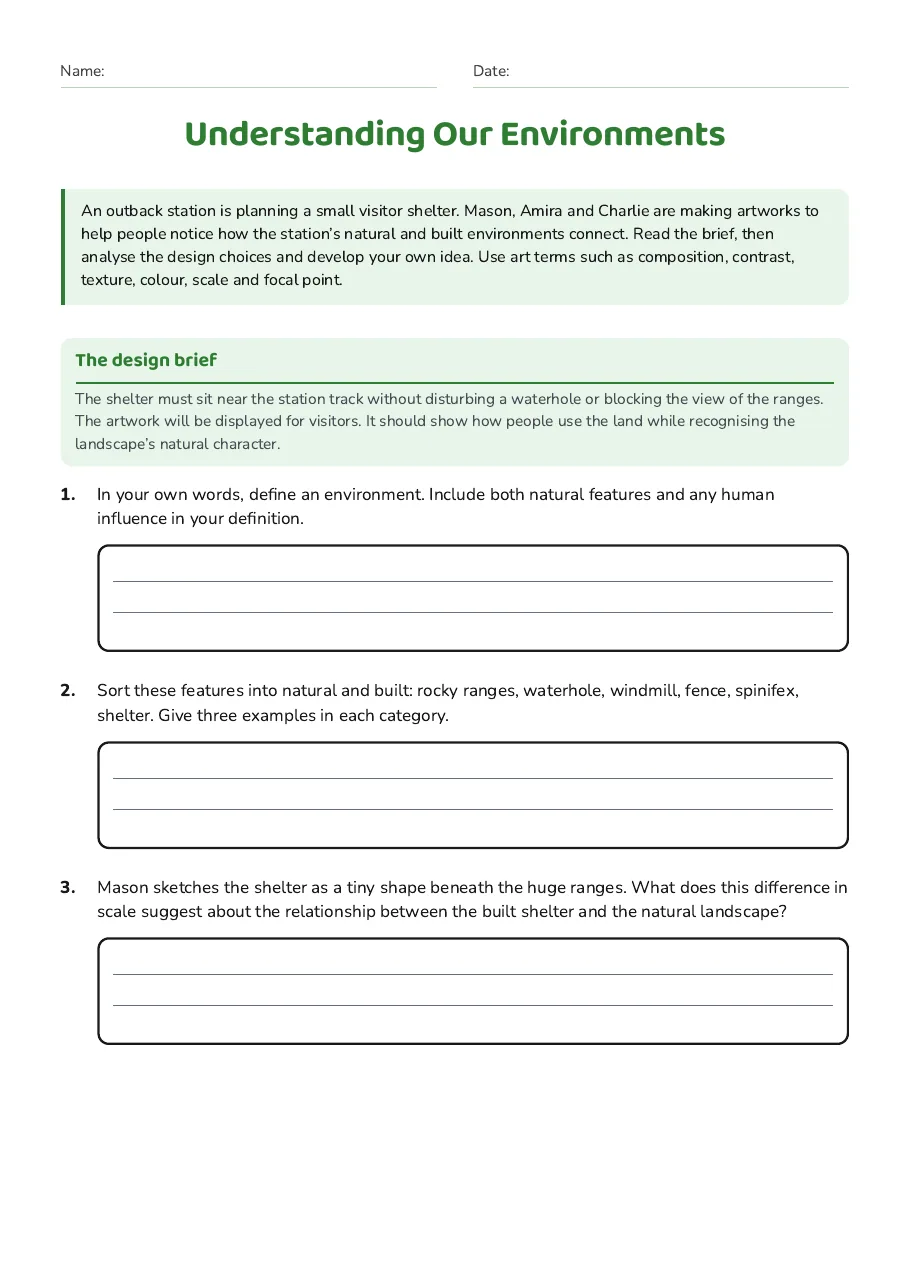
Understanding Our Environments

An outback station is planning a small visitor shelter. Mason, Amira and Charlie are making artworks to help people notice how the station’s natural and built environments connect. Read the brief, then analyse the design choices and develop your own idea. Use art terms such as composition, contrast, texture, colour, scale and focal point.

The design brief

The shelter must sit near the station track without disturbing a waterhole or blocking the view of the ranges. The artwork will be displayed for visitors. It should show how people use the land while recognising the landscape’s natural character.

1.In your own words, define an environment. Include both natural features and any human influence in your definition.
2.Sort these features into natural and built: rocky ranges, waterhole, windmill, fence, spinifex, shelter. Give three examples in each category.
3.Mason sketches the shelter as a tiny shape beneath the huge ranges. What does this difference in scale suggest about the relationship between the built shelter and the natural landscape?
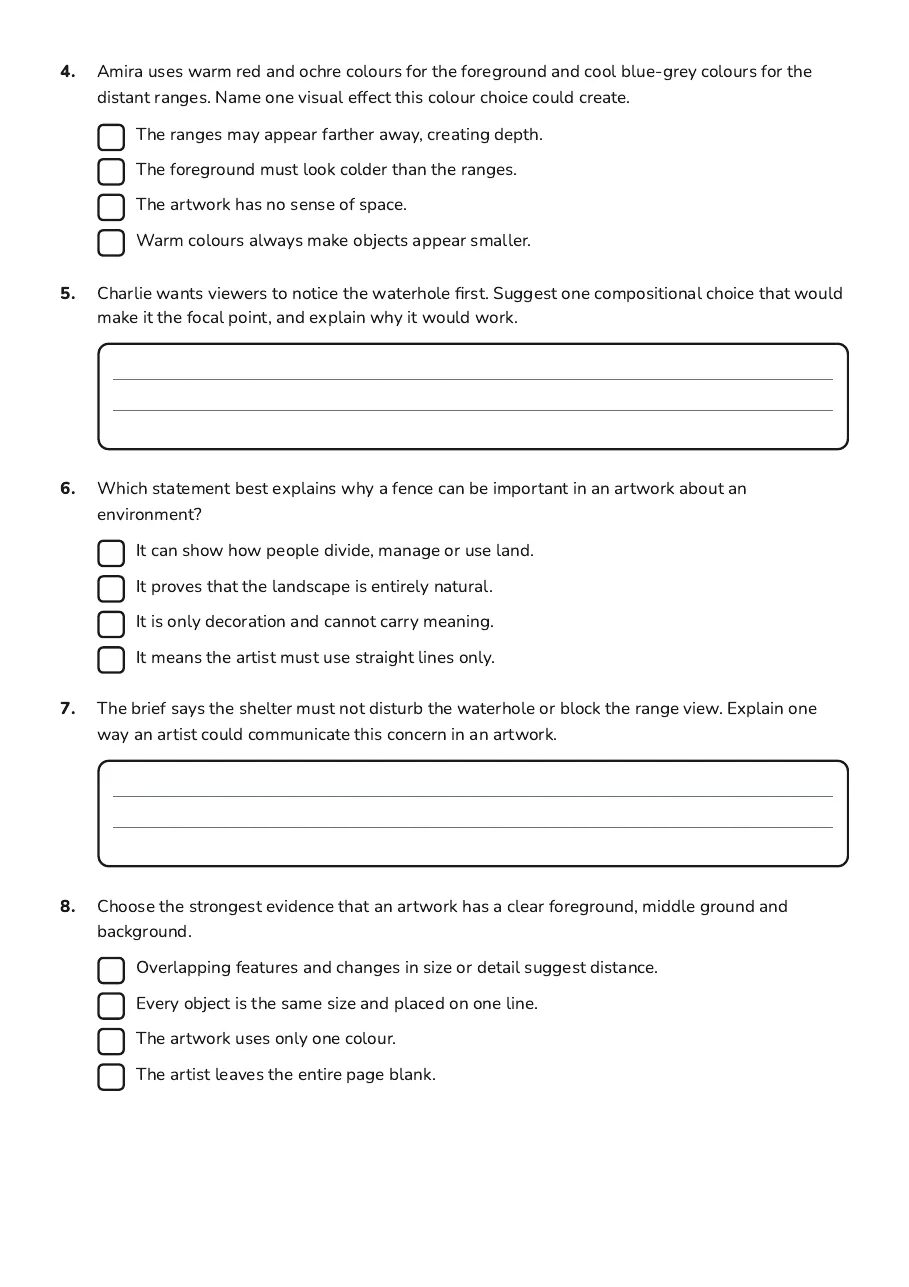
4.Amira uses warm red and ochre colours for the foreground and cool blue-grey colours for the distant ranges. Name one visual effect this colour choice could create.
  • The ranges may appear farther away, creating depth.
  • The foreground must look colder than the ranges.
  • The artwork has no sense of space.
  • Warm colours always make objects appear smaller.
5.Charlie wants viewers to notice the waterhole first. Suggest one compositional choice that would make it the focal point, and explain why it would work.
6.Which statement best explains why a fence can be important in an artwork about an environment?
  • It can show how people divide, manage or use land.
  • It proves that the landscape is entirely natural.
  • It is only decoration and cannot carry meaning.
  • It means the artist must use straight lines only.
7.The brief says the shelter must not disturb the waterhole or block the range view. Explain one way an artist could communicate this concern in an artwork.
8.Choose the strongest evidence that an artwork has a clear foreground, middle ground and background.
  • Overlapping features and changes in size or detail suggest distance.
  • Every object is the same size and placed on one line.
  • The artwork uses only one colour.
  • The artist leaves the entire page blank.
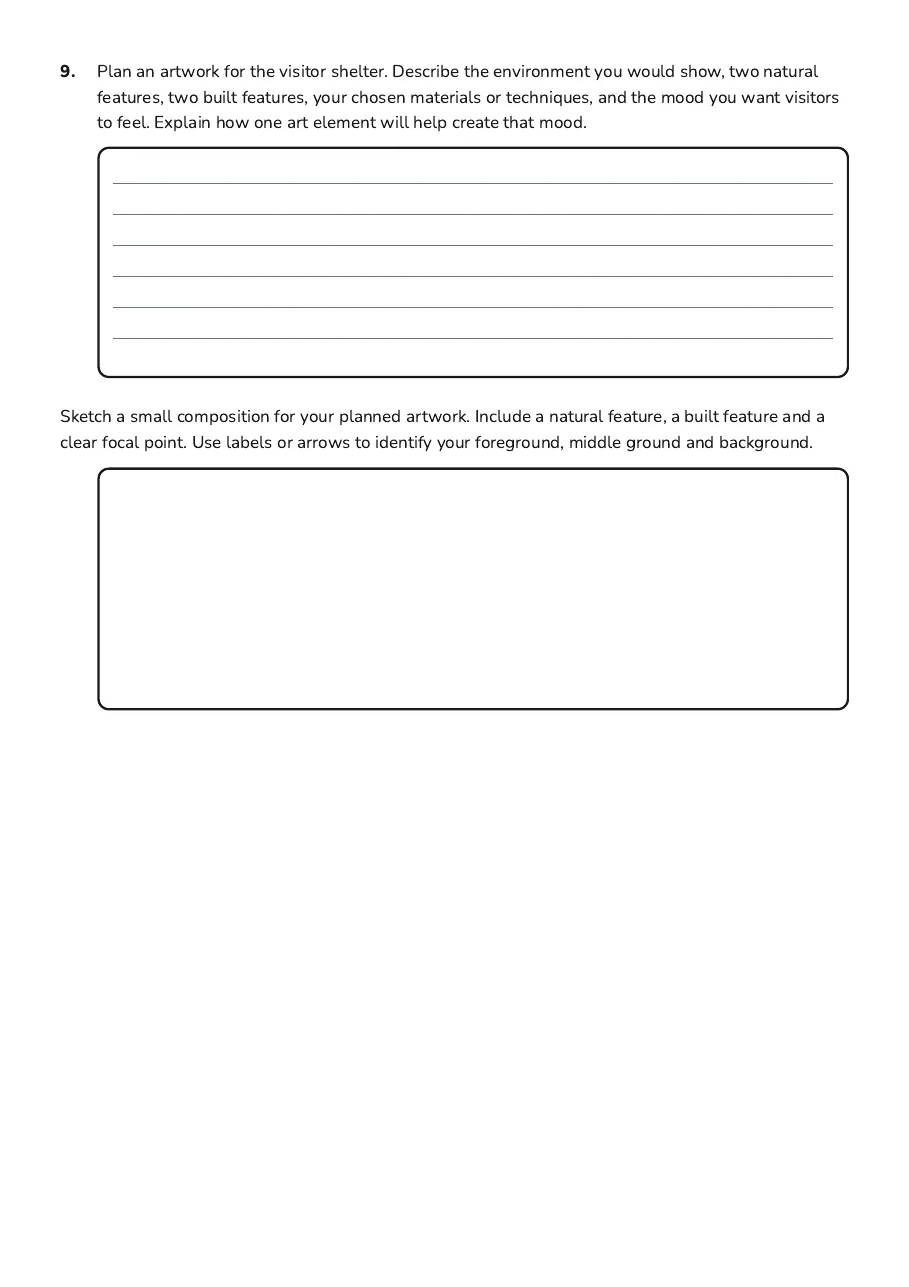
9.Plan an artwork for the visitor shelter. Describe the environment you would show, two natural features, two built features, your chosen materials or techniques, and the mood you want visitors to feel. Explain how one art element will help create that mood.
Sketch a small composition for your planned artwork. Include a natural feature, a built feature and a clear focal point. Use labels or arrows to identify your foreground, middle ground and background.

3 printable pages

  • Understanding Our Environments, page 1 of 3: The design brief

    Page 1

  • Understanding Our Environments, page 2 of 3: 4. Amira uses warm red and ochre colours for the foreground and cool blue-grey colours…

    Page 2

  • Understanding Our Environments, page 3 of 3: 9. Plan an artwork for the visitor shelter. Describe the environment you would show, two…

    Page 3

About This Worksheet

Free in Kuraplan

Sign up free, grab the PDF, and customize it for your class.

Print-Ready

Formatted for standard paper. Clean layout, easy to read.

AI-Generated

Created with Kuraplan's AI, designed for real classroom use.

For Teachers & Parents

Use in classrooms, for homework, tutoring, or homeschool.

Need a custom version of this worksheet?

Kuraplan's AI generates custom worksheets in seconds — differentiated for every learner, aligned to your curriculum.

Generate Custom Worksheets — Free
No credit card Curriculum-aligned Under 60 seconds