MathsFreePrintable
Urban Geometry Worksheet
A free maths worksheet ready for your classroom. Open in Kuraplan to grab the print-ready PDF, customize it for your students, or generate a fresh version in seconds.
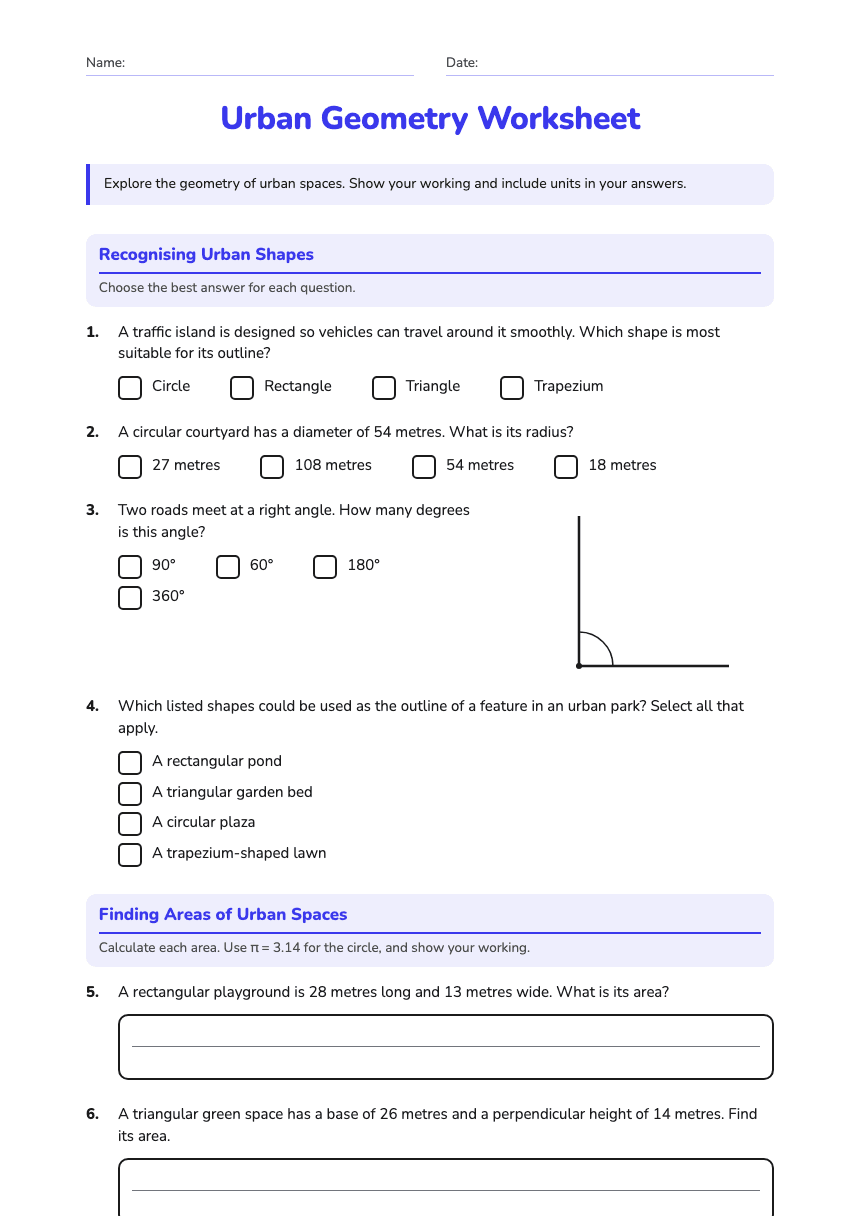
Name:Date:
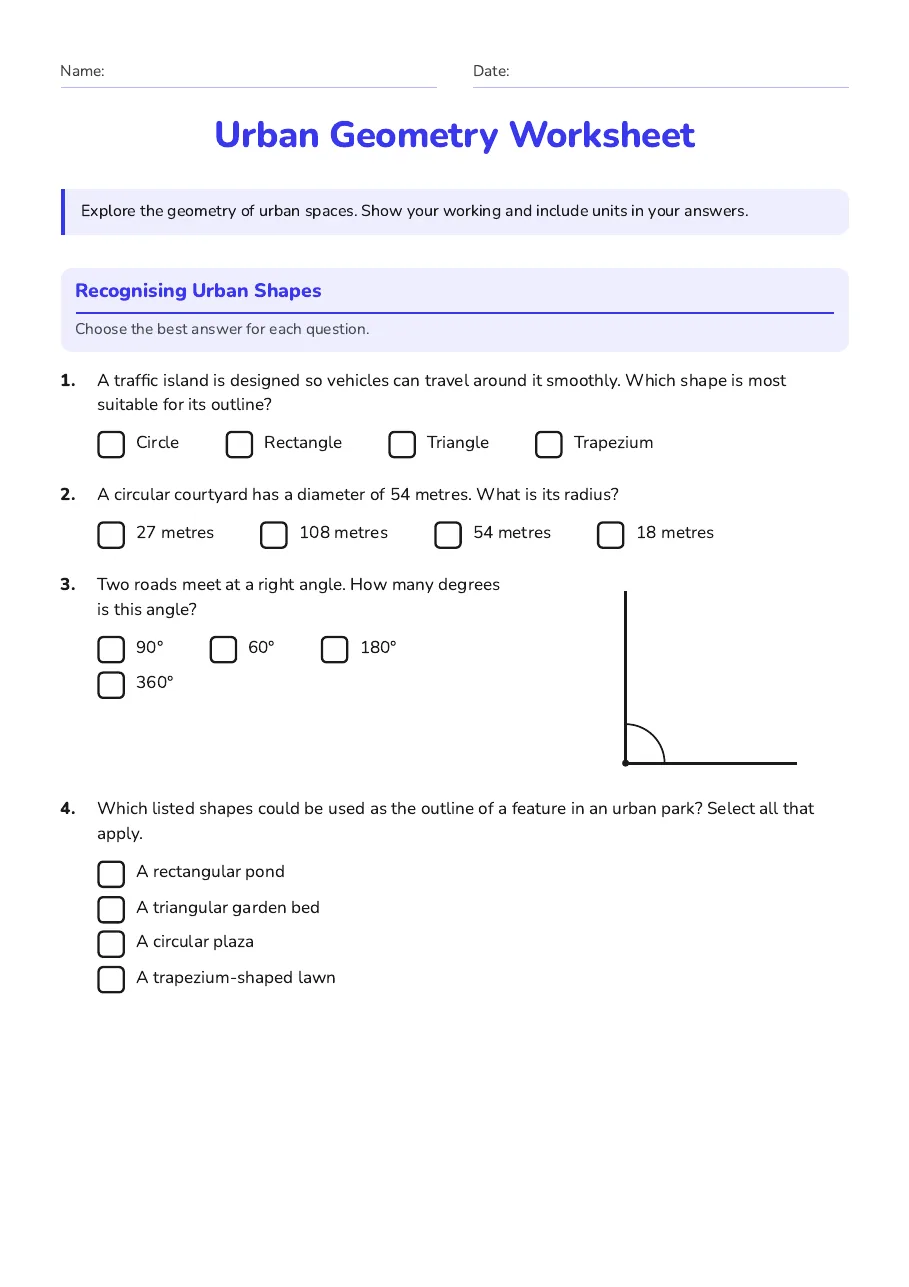
Urban Geometry Worksheet
Explore the geometry of urban spaces. Show your working and include units in your answers.
Recognising Urban Shapes
Choose the best answer for each question.
1.A traffic island is designed so vehicles can travel around it smoothly. Which shape is most suitable for its outline?
- Circle
- Rectangle
- Triangle
- Trapezium
2.A circular courtyard has a diameter of 54 metres. What is its radius?
- 27 metres
- 108 metres
- 54 metres
- 18 metres
3.Two roads meet at a right angle. How many degrees is this angle?
- 90°
- 60°
- 180°
- 360°
4.Which listed shapes could be used as the outline of a feature in an urban park? Select all that apply.
- A rectangular pond
- A triangular garden bed
- A circular plaza
- A trapezium-shaped lawn
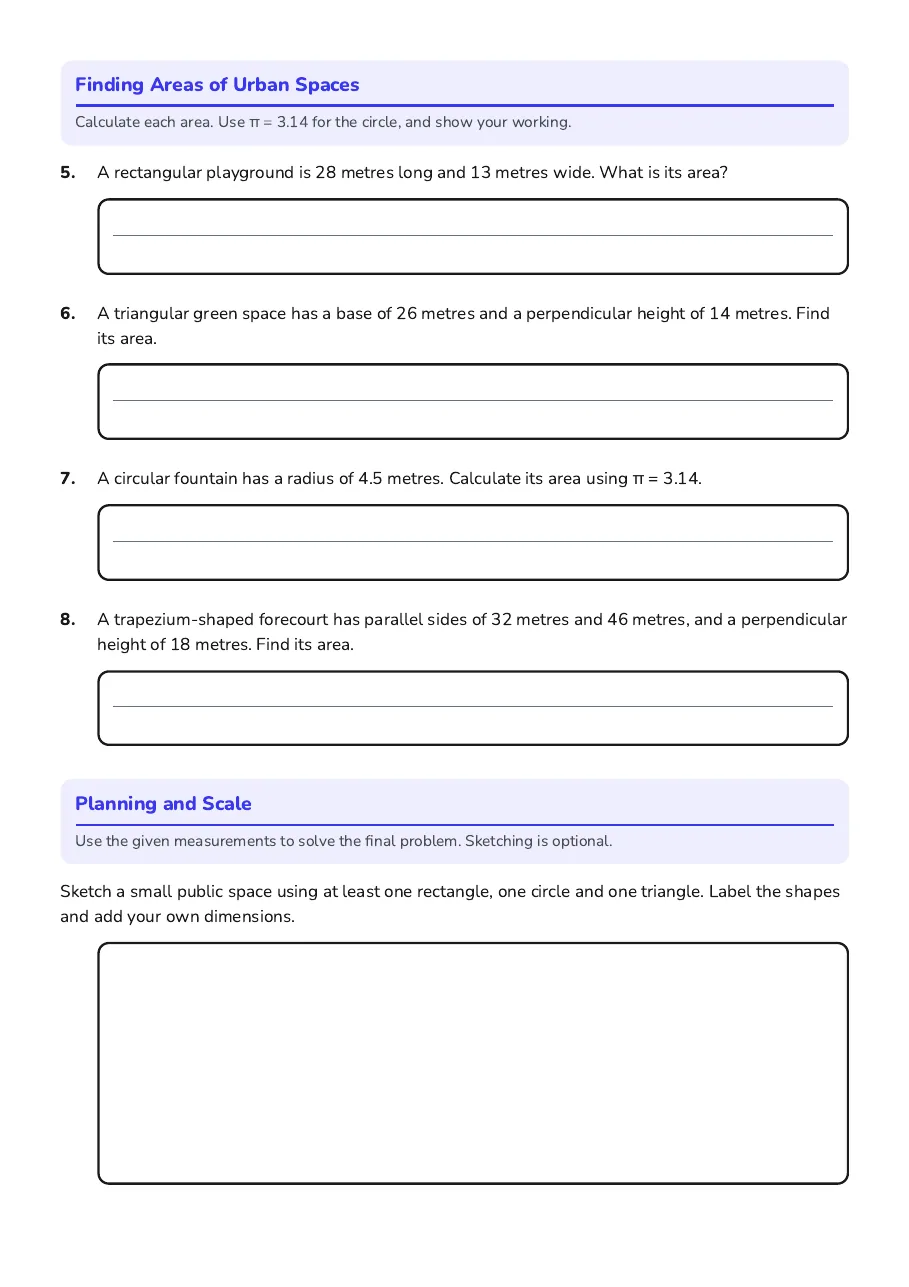
Finding Areas of Urban Spaces
Calculate each area. Use π = 3.14 for the circle, and show your working.
5.A rectangular playground is 28 metres long and 13 metres wide. What is its area?
6.A triangular green space has a base of 26 metres and a perpendicular height of 14 metres. Find its area.
7.A circular fountain has a radius of 4.5 metres. Calculate its area using π = 3.14.
8.A trapezium-shaped forecourt has parallel sides of 32 metres and 46 metres, and a perpendicular height of 18 metres. Find its area.
Planning and Scale
Use the given measurements to solve the final problem. Sketching is optional.
Sketch a small public space using at least one rectangle, one circle and one triangle. Label the shapes and add your own dimensions.
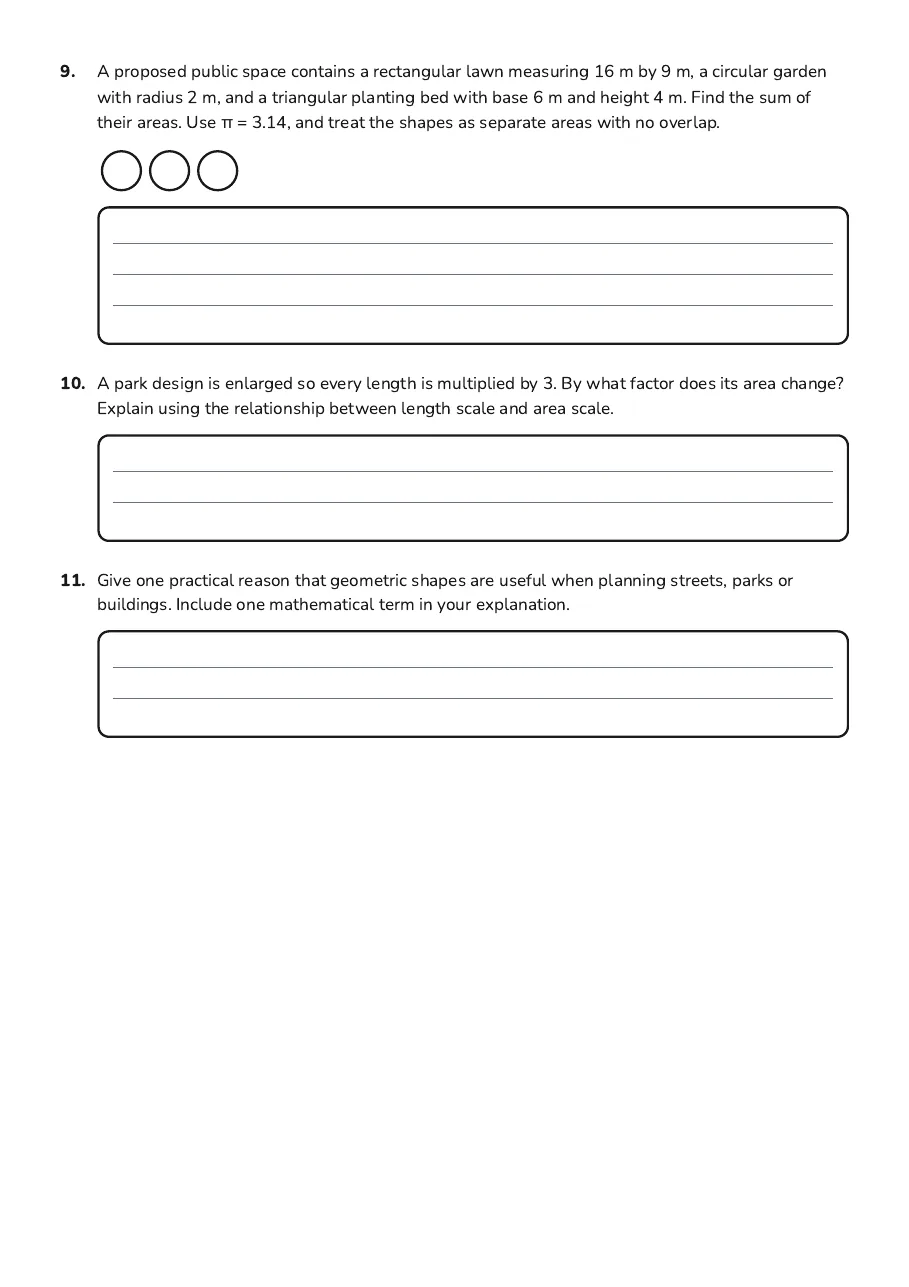
9.A proposed public space contains a rectangular lawn measuring 16 m by 9 m, a circular garden with radius 2 m, and a triangular planting bed with base 6 m and height 4 m. Find the sum of their areas. Use π = 3.14, and treat the shapes as separate areas with no overlap.
10.A park design is enlarged so every length is multiplied by 3. By what factor does its area change? Explain using the relationship between length scale and area scale.
11.Give one practical reason that geometric shapes are useful when planning streets, parks or buildings. Include one mathematical term in your explanation.
3 printable pages
Page 1
Page 2
Page 3
About This Worksheet
Free in Kuraplan
Sign up free, grab the PDF, and customize it for your class.
Print-Ready
Formatted for standard paper. Clean layout, easy to read.
AI-Generated
Created with Kuraplan's AI, designed for real classroom use.
For Teachers & Parents
Use in classrooms, for homework, tutoring, or homeschool.
Need a custom version of this worksheet?
Kuraplan's AI generates custom worksheets in seconds — differentiated for every learner, aligned to your curriculum.
Generate Custom Worksheets — Free No credit card Curriculum-aligned Under 60 seconds