Victorian London Context Analysis
A free english worksheet ready for your classroom. Open in Kuraplan to grab the print-ready PDF, customize it for your students, or generate a fresh version in seconds.
Victorian London Context Analysis
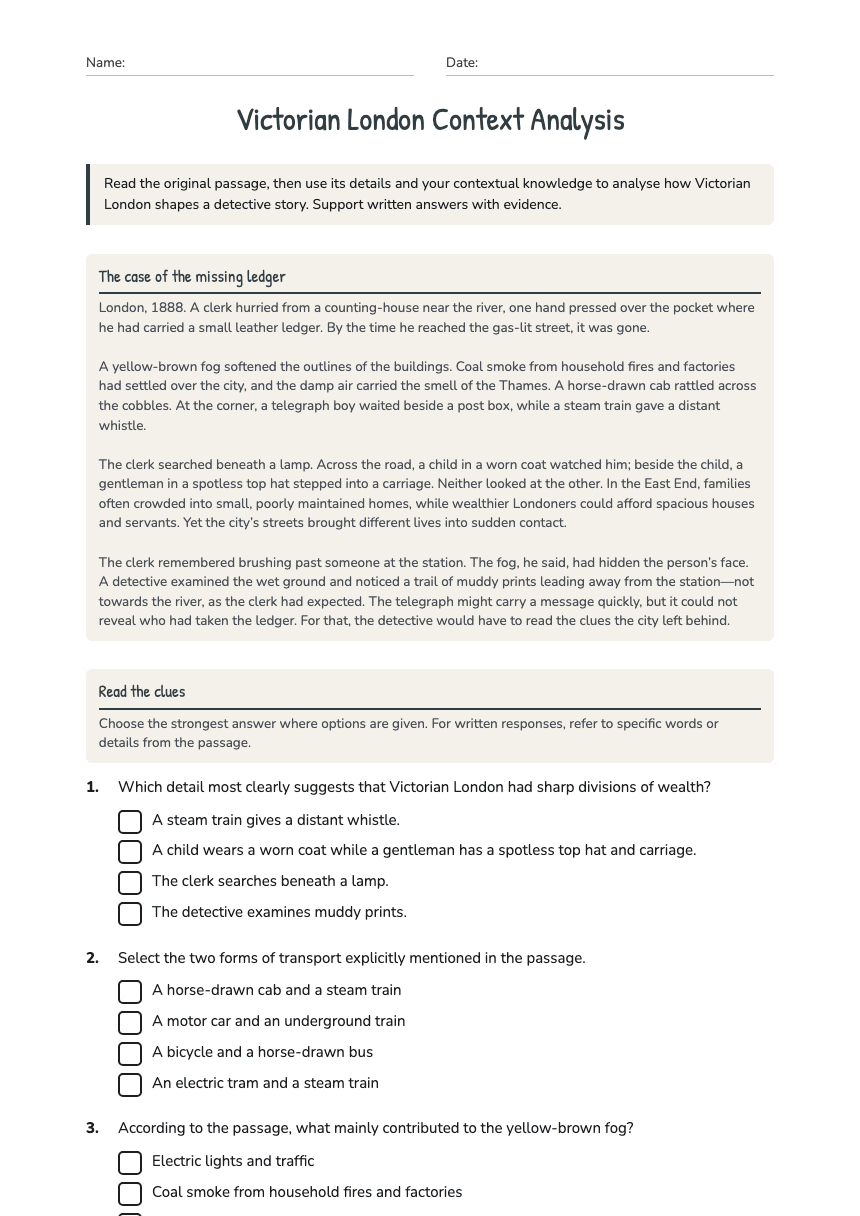
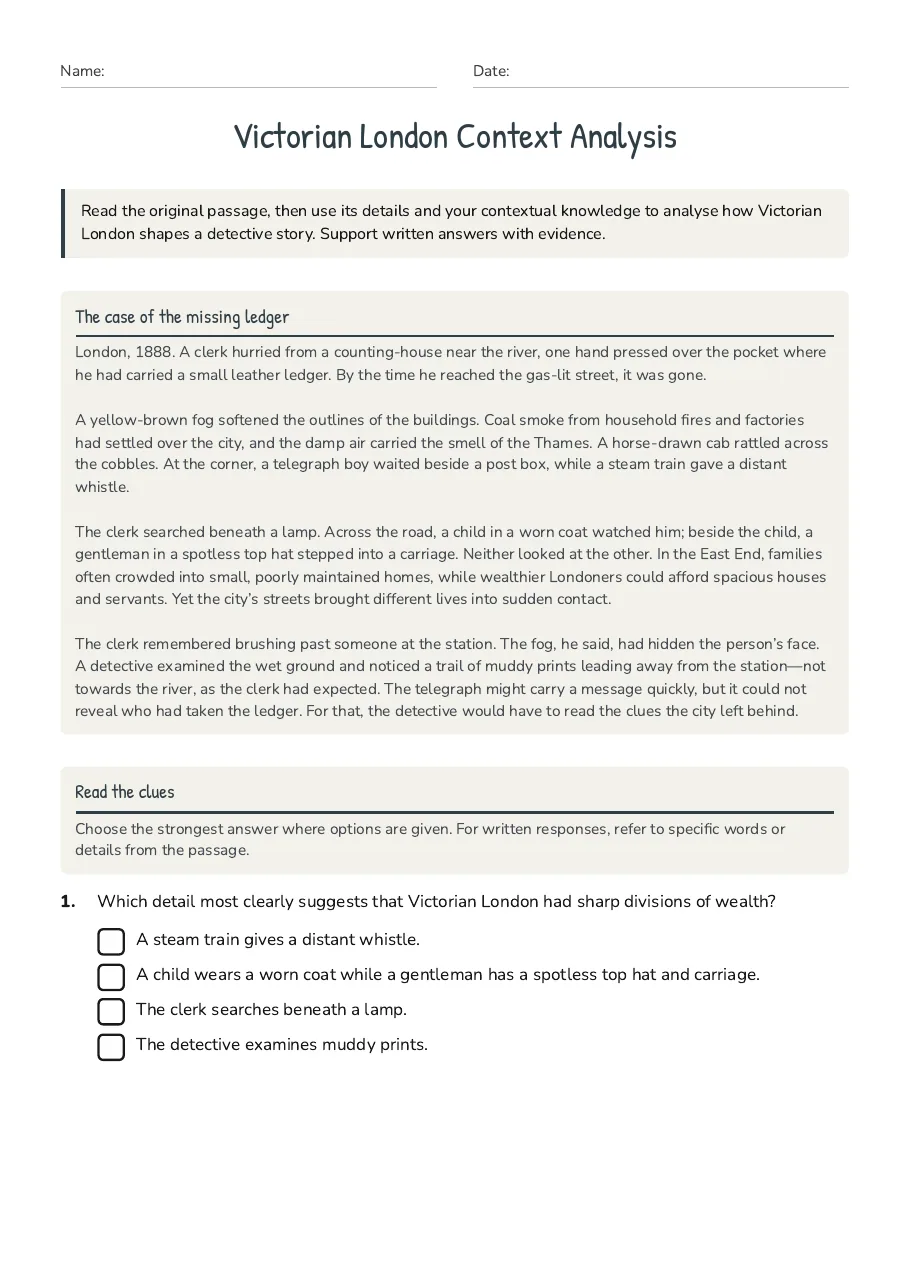
The case of the missing ledger
London, 1888. A clerk hurried from a counting-house near the river, one hand pressed over the pocket where he had carried a small leather ledger. By the time he reached the gas-lit street, it was gone. A yellow-brown fog softened the outlines of the buildings. Coal smoke from household fires and factories had settled over the city, and the damp air carried the smell of the Thames. A horse-drawn cab rattled across the cobbles. At the corner, a telegraph boy waited beside a post box, while a steam train gave a distant whistle. The clerk searched beneath a lamp. Across the road, a child in a worn coat watched him; beside the child, a gentleman in a spotless top hat stepped into a carriage. Neither looked at the other. In the East End, families often crowded into small, poorly maintained homes, while wealthier Londoners could afford spacious houses and servants. Yet the city’s streets brought different lives into sudden contact. The clerk remembered brushing past someone at the station. The fog, he said, had hidden the person’s face. A detective examined the wet ground and noticed a trail of muddy prints leading away from the station—not towards the river, as the clerk had expected. The telegraph might carry a message quickly, but it could not reveal who had taken the ledger. For that, the detective would have to read the clues the city left behind.
Read the clues
Choose the strongest answer where options are given. For written responses, refer to specific words or details from the passage.
- A steam train gives a distant whistle.
- A child wears a worn coat while a gentleman has a spotless top hat and carriage.
- The clerk searches beneath a lamp.
- The detective examines muddy prints.
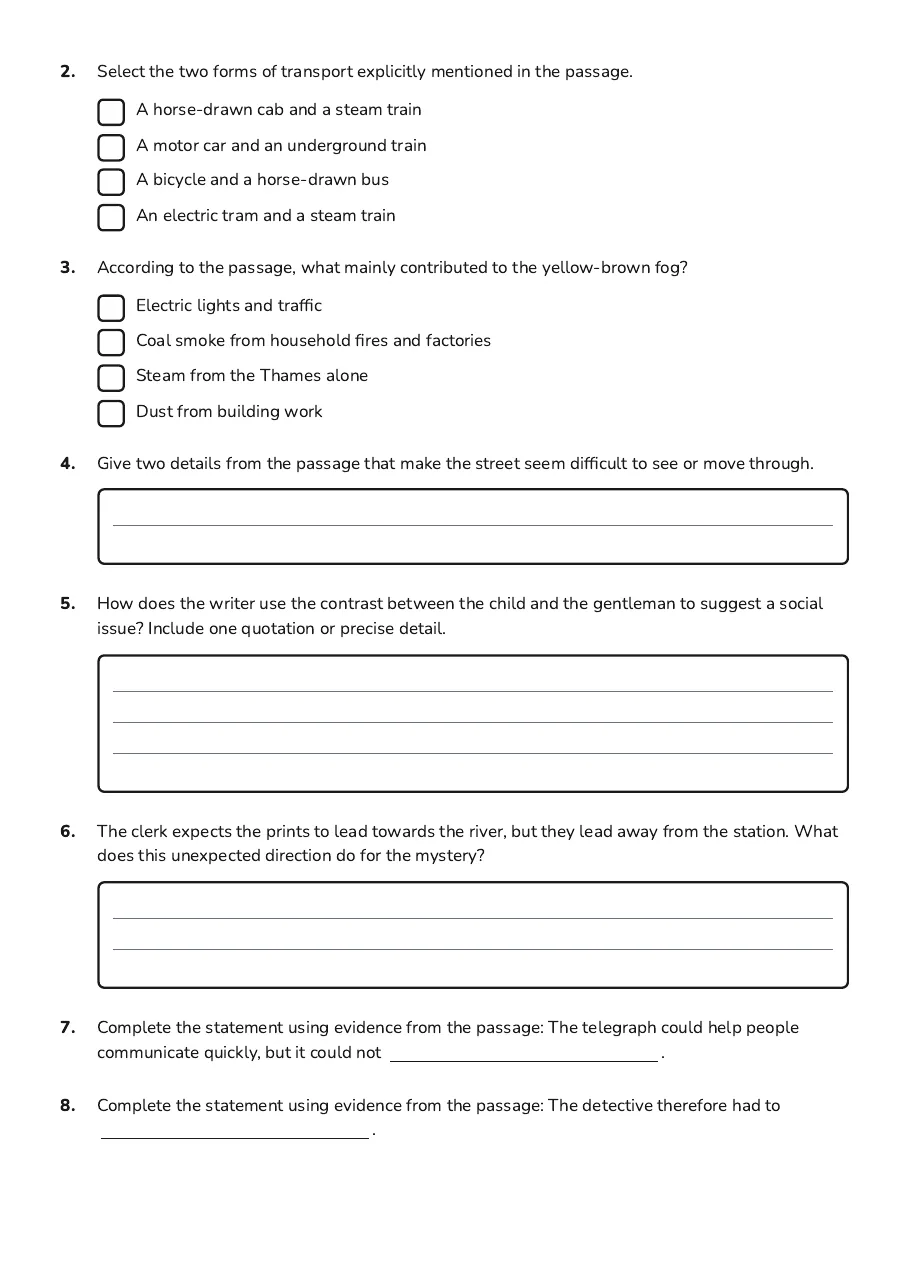
- A horse-drawn cab and a steam train
- A motor car and an underground train
- A bicycle and a horse-drawn bus
- An electric tram and a steam train
- Electric lights and traffic
- Coal smoke from household fires and factories
- Steam from the Thames alone
- Dust from building work
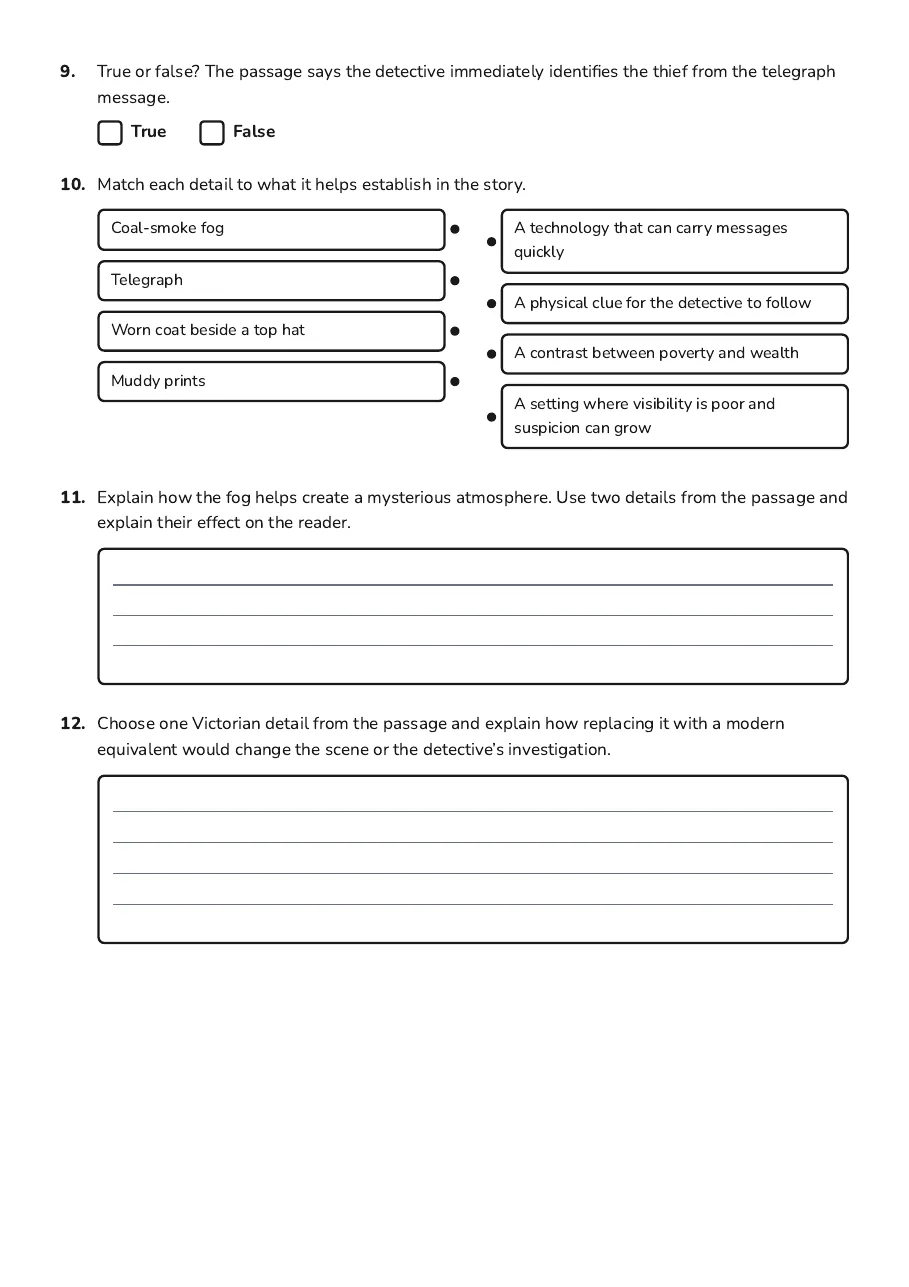
- Coal-smoke fog
- Telegraph
- Worn coat beside a top hat
- Muddy prints
- A technology that can carry messages quickly
- A physical clue for the detective to follow
- A contrast between poverty and wealth
- A setting where visibility is poor and suspicion can grow
3 printable pages
Page 1
Page 2
Page 3
About This Worksheet
Free in Kuraplan
Sign up free, grab the PDF, and customize it for your class.
Print-Ready
Formatted for standard paper. Clean layout, easy to read.
AI-Generated
Created with Kuraplan's AI, designed for real classroom use.
For Teachers & Parents
Use in classrooms, for homework, tutoring, or homeschool.
Need a custom version of this worksheet?
Kuraplan's AI generates custom worksheets in seconds — differentiated for every learner, aligned to your curriculum.
Generate Custom Worksheets — Free