Weathering Rock Breakdown Processes
A free geography worksheet ready for your classroom. Open in Kuraplan to grab the print-ready PDF, customize it for your students, or generate a fresh version in seconds.
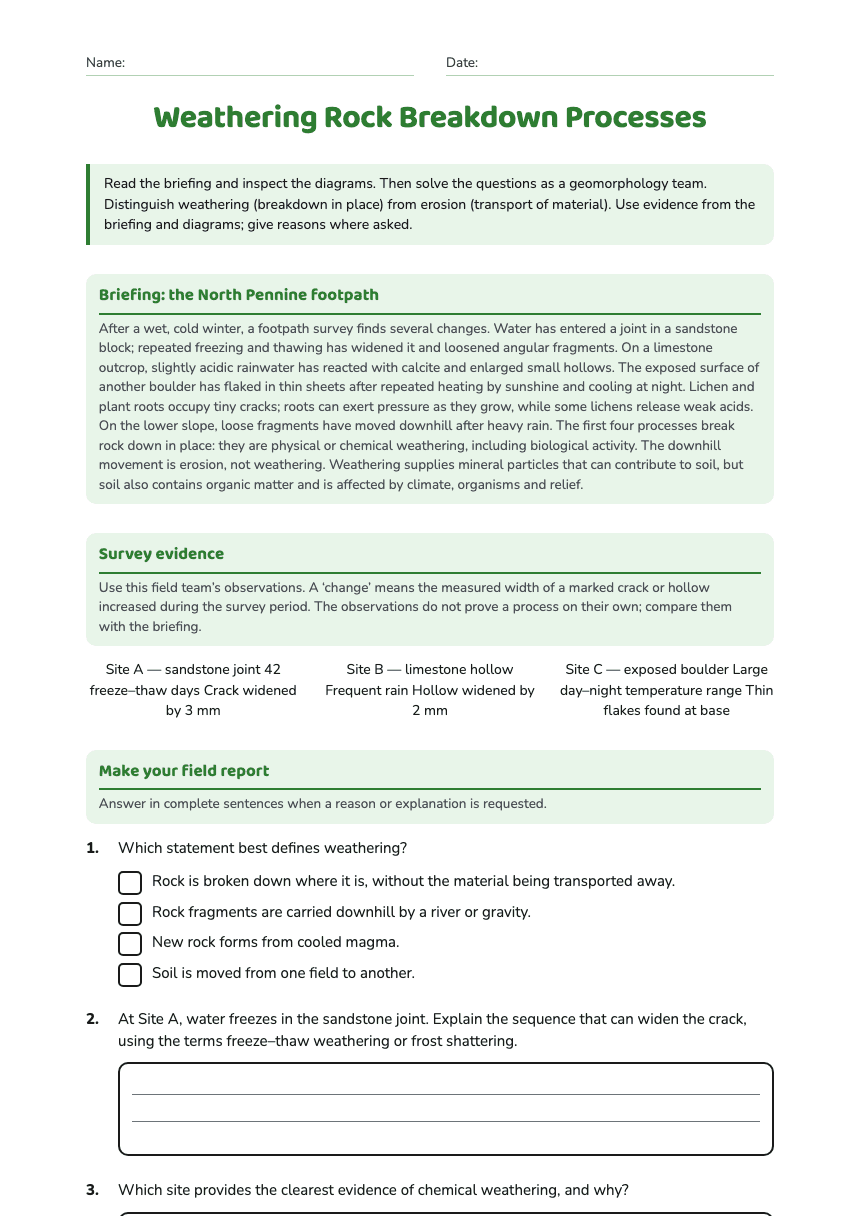
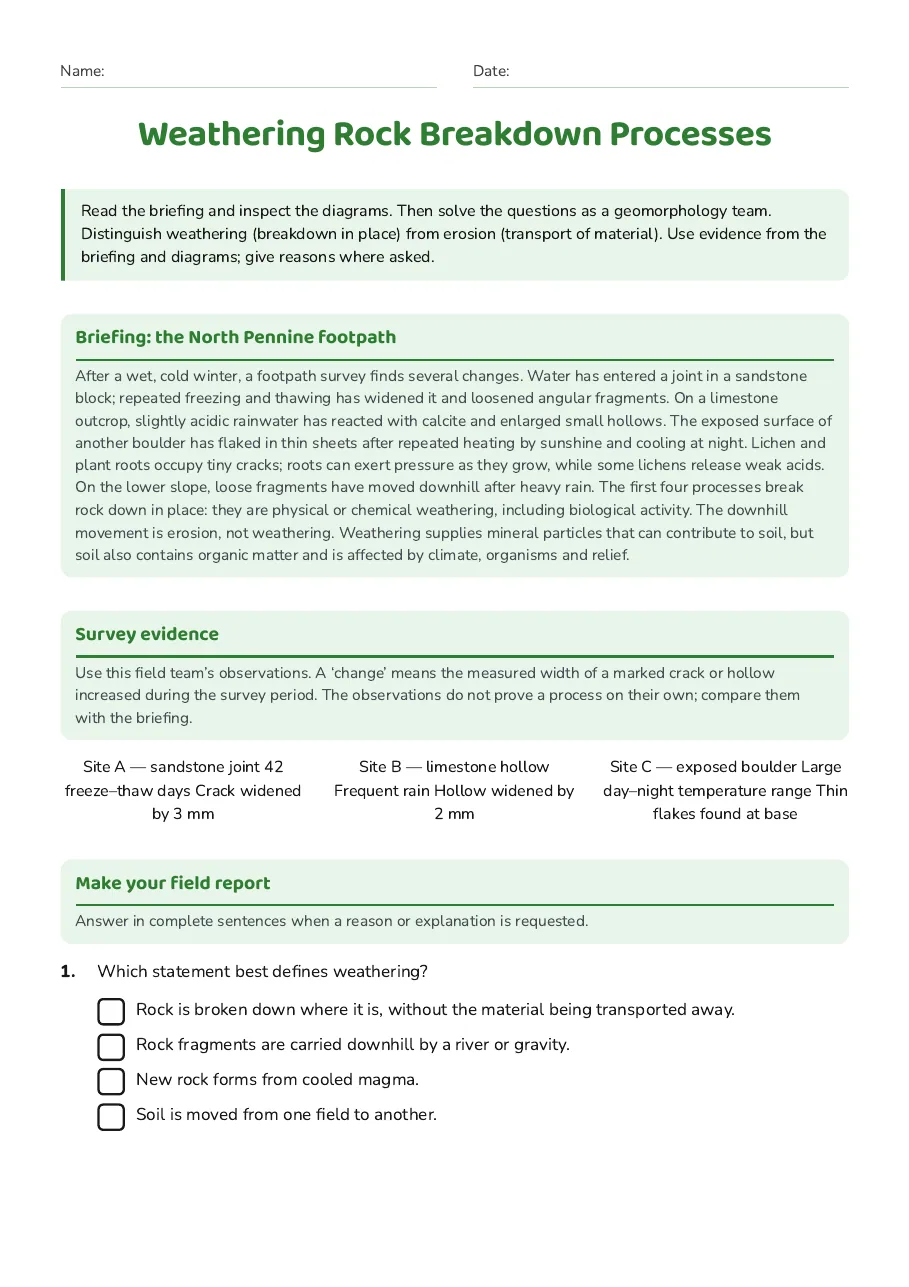
Weathering Rock Breakdown Processes
Briefing: the North Pennine footpath
After a wet, cold winter, a footpath survey finds several changes. Water has entered a joint in a sandstone block; repeated freezing and thawing has widened it and loosened angular fragments. On a limestone outcrop, slightly acidic rainwater has reacted with calcite and enlarged small hollows. The exposed surface of another boulder has flaked in thin sheets after repeated heating by sunshine and cooling at night. Lichen and plant roots occupy tiny cracks; roots can exert pressure as they grow, while some lichens release weak acids. On the lower slope, loose fragments have moved downhill after heavy rain. The first four processes break rock down in place: they are physical or chemical weathering, including biological activity. The downhill movement is erosion, not weathering. Weathering supplies mineral particles that can contribute to soil, but soil also contains organic matter and is affected by climate, organisms and relief.
Survey evidence
Use this field team’s observations. A ‘change’ means the measured width of a marked crack or hollow increased during the survey period. The observations do not prove a process on their own; compare them with the briefing.
Site A — sandstone joint 42 freeze–thaw days Crack widened by 3 mm
Site B — limestone hollow Frequent rain Hollow widened by 2 mm
Site C — exposed boulder Large day–night temperature range Thin flakes found at base
Make your field report
Answer in complete sentences when a reason or explanation is requested.
- Rock is broken down where it is, without the material being transported away.
- Rock fragments are carried downhill by a river or gravity.
- New rock forms from cooled magma.
- Soil is moved from one field to another.
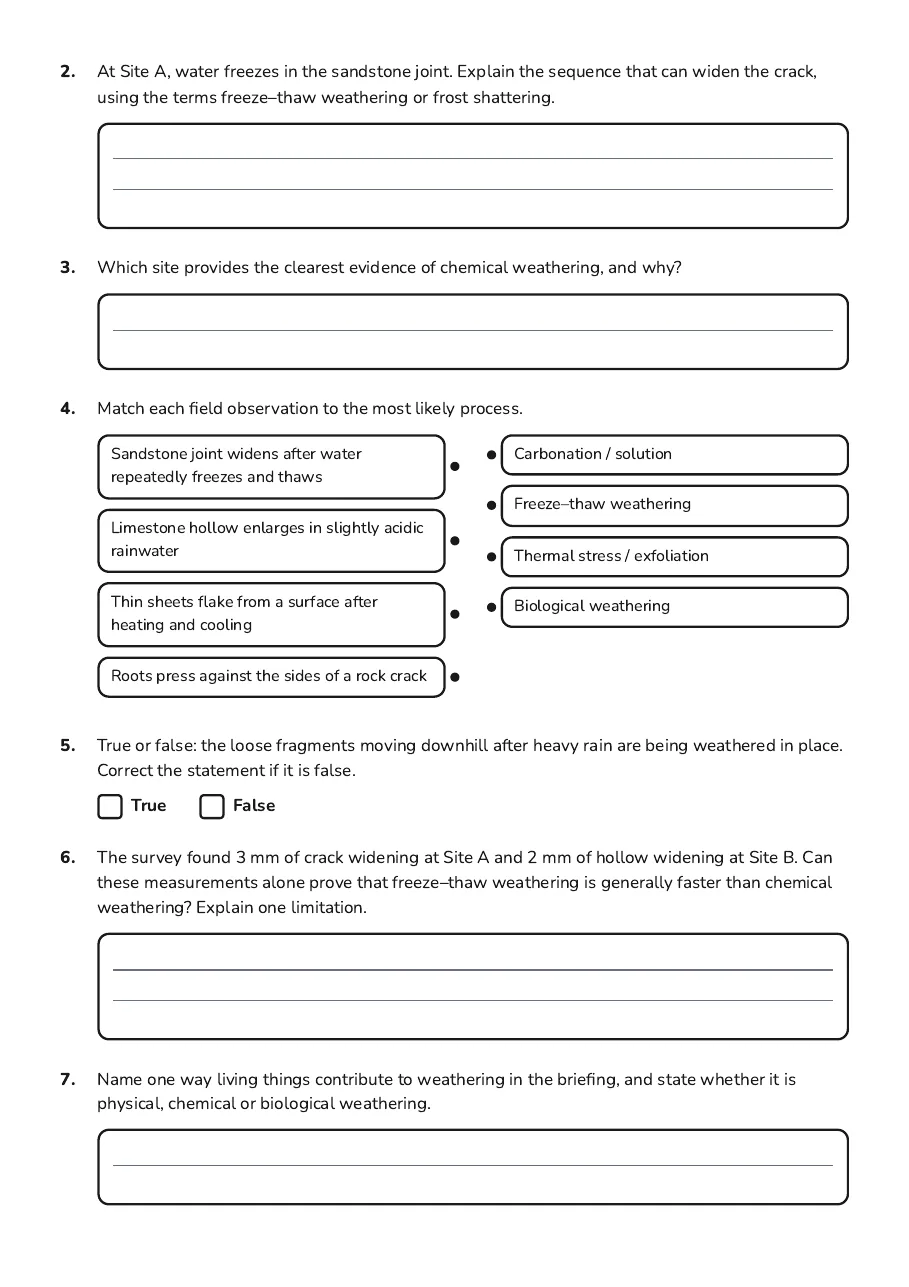
- Sandstone joint widens after water repeatedly freezes and thaws
- Limestone hollow enlarges in slightly acidic rainwater
- Thin sheets flake from a surface after heating and cooling
- Roots press against the sides of a rock crack
- Carbonation / solution
- Freeze–thaw weathering
- Thermal stress / exfoliation
- Biological weathering
3 printable pages
Page 1
Page 2

Page 3
About This Worksheet
Free in Kuraplan
Sign up free, grab the PDF, and customize it for your class.
Print-Ready
Formatted for standard paper. Clean layout, easy to read.
AI-Generated
Created with Kuraplan's AI, designed for real classroom use.
For Teachers & Parents
Use in classrooms, for homework, tutoring, or homeschool.
Need a custom version of this worksheet?
Kuraplan's AI generates custom worksheets in seconds — differentiated for every learner, aligned to your curriculum.
Generate Custom Worksheets — Free