World War 2 Causes
A free social sciences worksheet ready for your classroom. Open in Kuraplan to grab the print-ready PDF, customize it for your students, or generate a fresh version in seconds.

World War 2 Causes
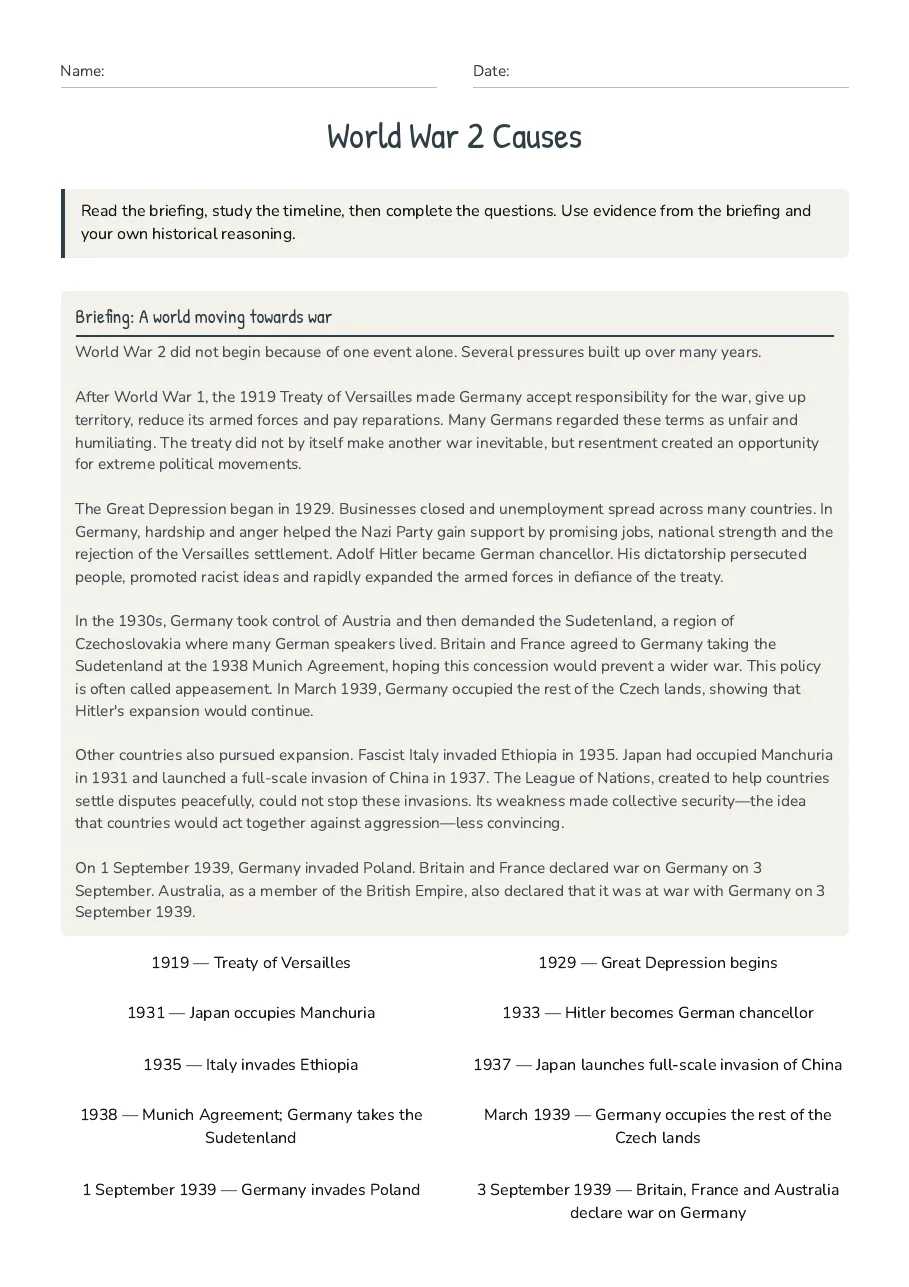
Briefing: A world moving towards war
World War 2 did not begin because of one event alone. Several pressures built up over many years. After World War 1, the 1919 Treaty of Versailles made Germany accept responsibility for the war, give up territory, reduce its armed forces and pay reparations. Many Germans regarded these terms as unfair and humiliating. The treaty did not by itself make another war inevitable, but resentment created an opportunity for extreme political movements. The Great Depression began in 1929. Businesses closed and unemployment spread across many countries. In Germany, hardship and anger helped the Nazi Party gain support by promising jobs, national strength and the rejection of the Versailles settlement. Adolf Hitler became German chancellor. His dictatorship persecuted people, promoted racist ideas and rapidly expanded the armed forces in defiance of the treaty. In the 1930s, Germany took control of Austria and then demanded the Sudetenland, a region of Czechoslovakia where many German speakers lived. Britain and France agreed to Germany taking the Sudetenland at the 1938 Munich Agreement, hoping this concession would prevent a wider war. This policy is often called appeasement. In March 1939, Germany occupied the rest of the Czech lands, showing that Hitler's expansion would continue. Other countries also pursued expansion. Fascist Italy invaded Ethiopia in 1935. Japan had occupied Manchuria in 1931 and launched a full-scale invasion of China in 1937. The League of Nations, created to help countries settle disputes peacefully, could not stop these invasions. Its weakness made collective security—the idea that countries would act together against aggression—less convincing. On 1 September 1939, Germany invaded Poland. Britain and France declared war on Germany on 3 September. Australia, as a member of the British Empire, also declared that it was at war with Germany on 3 September 1939.
1919 — Treaty of Versailles
1929 — Great Depression begins
1931 — Japan occupies Manchuria
1933 — Hitler becomes German chancellor
1935 — Italy invades Ethiopia
1937 — Japan launches full-scale invasion of China
1938 — Munich Agreement; Germany takes the Sudetenland
March 1939 — Germany occupies the rest of the Czech lands
1 September 1939 — Germany invades Poland
3 September 1939 — Britain, France and Australia declare war on Germany
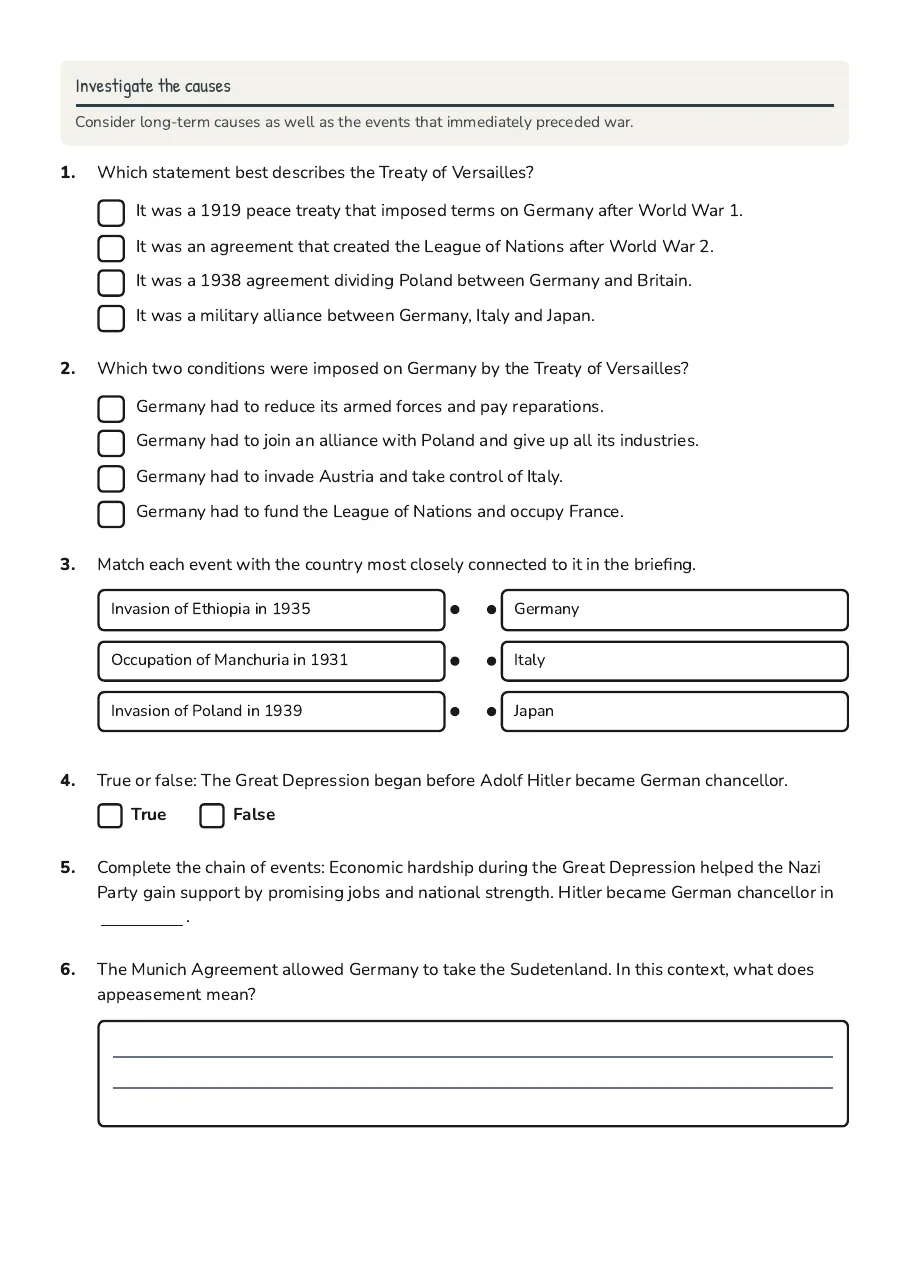
Investigate the causes
Consider long-term causes as well as the events that immediately preceded war.
- It was a 1919 peace treaty that imposed terms on Germany after World War 1.
- It was an agreement that created the League of Nations after World War 2.
- It was a 1938 agreement dividing Poland between Germany and Britain.
- It was a military alliance between Germany, Italy and Japan.
- Germany had to reduce its armed forces and pay reparations.
- Germany had to join an alliance with Poland and give up all its industries.
- Germany had to invade Austria and take control of Italy.
- Germany had to fund the League of Nations and occupy France.
- Invasion of Ethiopia in 1935
- Occupation of Manchuria in 1931
- Invasion of Poland in 1939
- Germany
- Italy
- Japan
3 printable pages
Page 1
Page 2
Page 3
About This Worksheet
Free in Kuraplan
Sign up free, grab the PDF, and customize it for your class.
Print-Ready
Formatted for standard paper. Clean layout, easy to read.
AI-Generated
Created with Kuraplan's AI, designed for real classroom use.
For Teachers & Parents
Use in classrooms, for homework, tutoring, or homeschool.
Need a custom version of this worksheet?
Kuraplan's AI generates custom worksheets in seconds — differentiated for every learner, aligned to your curriculum.
Generate Custom Worksheets — Free