EnglishFreePrintable

Writing Cultural Celebrations

A free english worksheet ready for your classroom. Open in Kuraplan to grab the print-ready PDF, customize it for your students, or generate a fresh version in seconds.

Writing Cultural Celebrations worksheet preview
Name:Date:

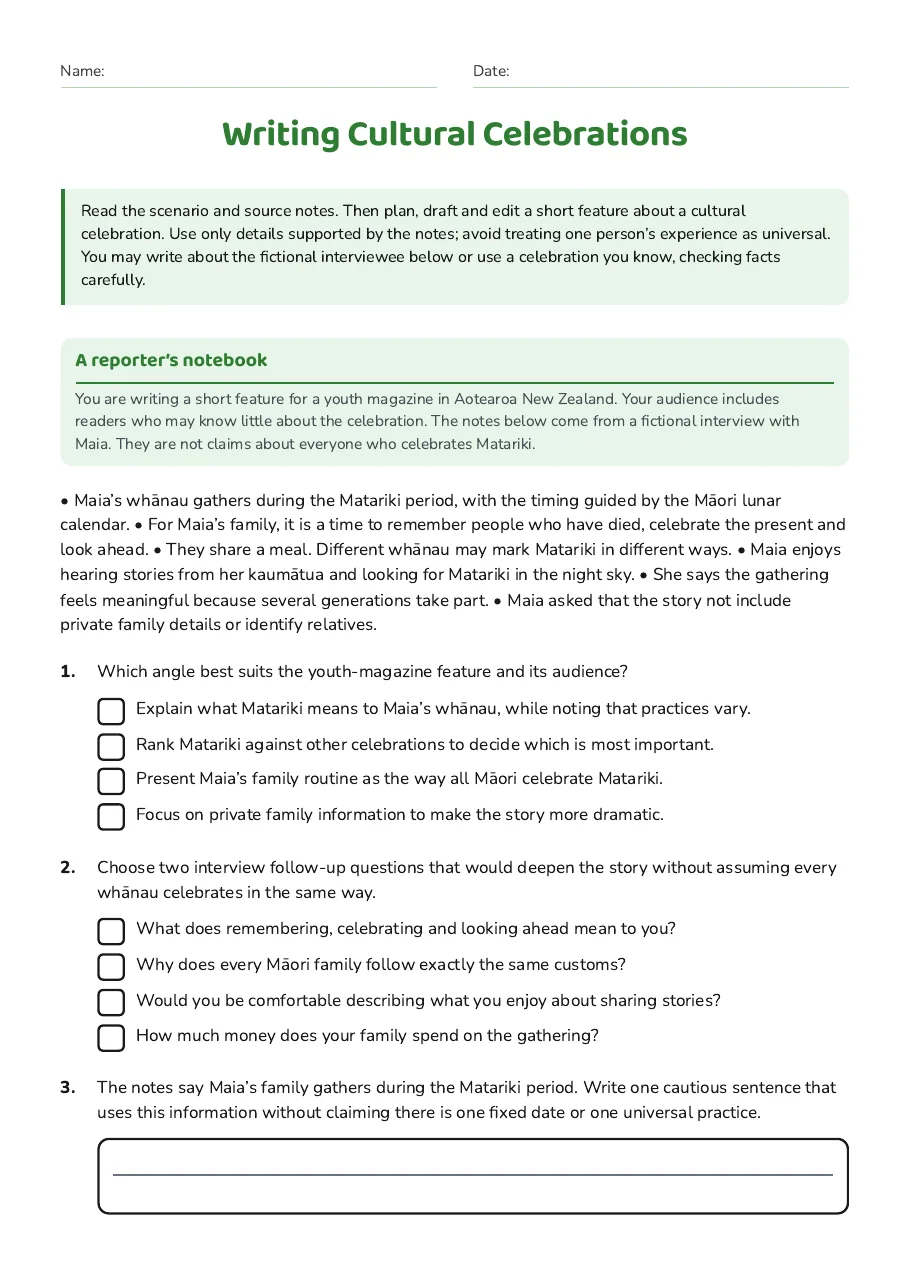
Writing Cultural Celebrations

Read the scenario and source notes. Then plan, draft and edit a short feature about a cultural celebration. Use only details supported by the notes; avoid treating one person’s experience as universal. You may write about the fictional interviewee below or use a celebration you know, checking facts carefully.

A reporter’s notebook

You are writing a short feature for a youth magazine in Aotearoa New Zealand. Your audience includes readers who may know little about the celebration. The notes below come from a fictional interview with Maia. They are not claims about everyone who celebrates Matariki.

• Maia’s whānau gathers during the Matariki period, with the timing guided by the Māori lunar calendar. • For Maia’s family, it is a time to remember people who have died, celebrate the present and look ahead. • They share a meal. Different whānau may mark Matariki in different ways. • Maia enjoys hearing stories from her kaumātua and looking for Matariki in the night sky. • She says the gathering feels meaningful because several generations take part. • Maia asked that the story not include private family details or identify relatives.
1.Which angle best suits the youth-magazine feature and its audience?
  • Explain what Matariki means to Maia’s whānau, while noting that practices vary.
  • Rank Matariki against other celebrations to decide which is most important.
  • Present Maia’s family routine as the way all Māori celebrate Matariki.
  • Focus on private family information to make the story more dramatic.
2.Choose two interview follow-up questions that would deepen the story without assuming every whānau celebrates in the same way.
  • What does remembering, celebrating and looking ahead mean to you?
  • Why does every Māori family follow exactly the same customs?
  • Would you be comfortable describing what you enjoy about sharing stories?
  • How much money does your family spend on the gathering?
3.The notes say Maia’s family gathers during the Matariki period. Write one cautious sentence that uses this information without claiming there is one fixed date or one universal practice.
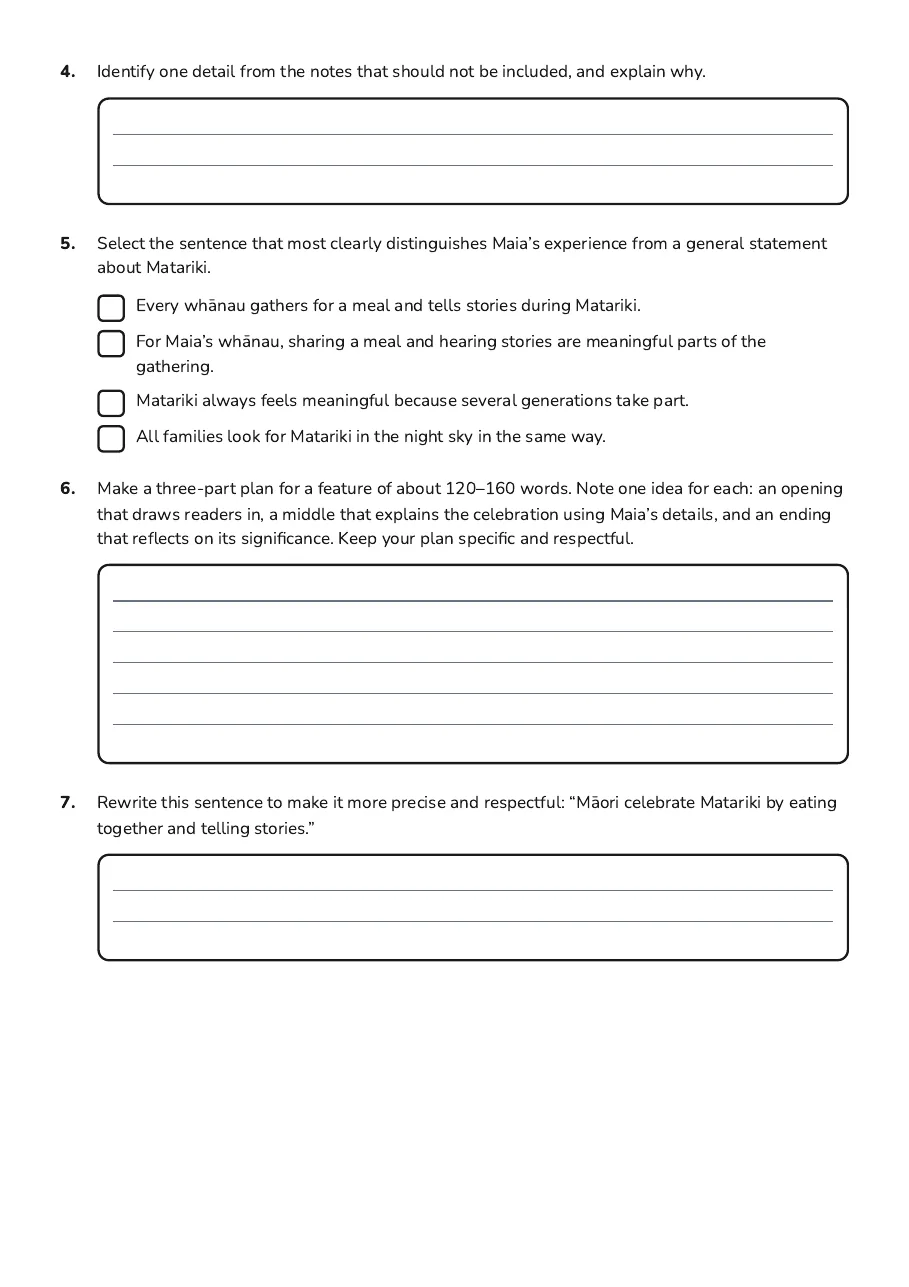
4.Identify one detail from the notes that should not be included, and explain why.
5.Select the sentence that most clearly distinguishes Maia’s experience from a general statement about Matariki.
  • Every whānau gathers for a meal and tells stories during Matariki.
  • For Maia’s whānau, sharing a meal and hearing stories are meaningful parts of the gathering.
  • Matariki always feels meaningful because several generations take part.
  • All families look for Matariki in the night sky in the same way.
6.Make a three-part plan for a feature of about 120–160 words. Note one idea for each: an opening that draws readers in, a middle that explains the celebration using Maia’s details, and an ending that reflects on its significance. Keep your plan specific and respectful.
7.Rewrite this sentence to make it more precise and respectful: “Māori celebrate Matariki by eating together and telling stories.”
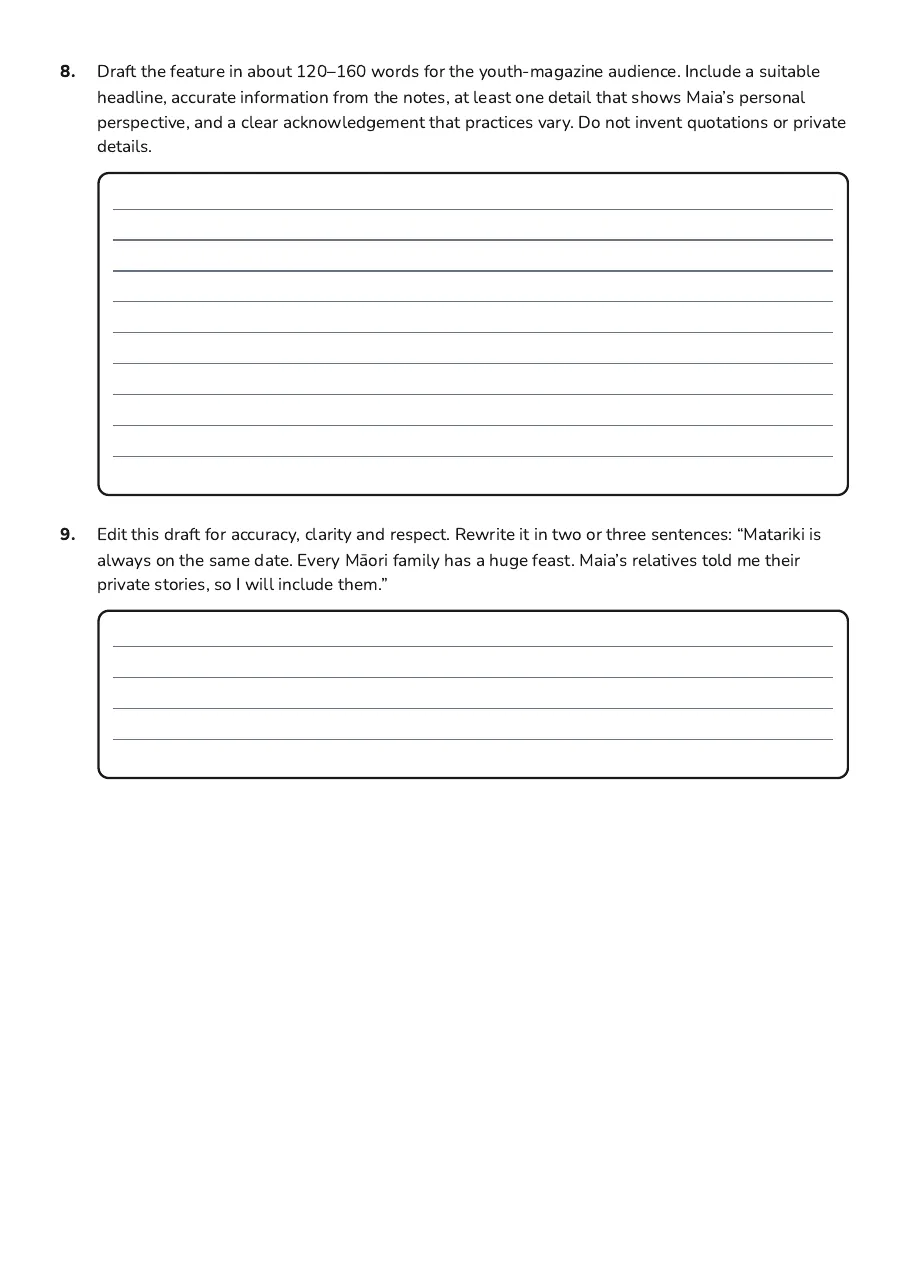
8.Draft the feature in about 120–160 words for the youth-magazine audience. Include a suitable headline, accurate information from the notes, at least one detail that shows Maia’s personal perspective, and a clear acknowledgement that practices vary. Do not invent quotations or private details.
9.Edit this draft for accuracy, clarity and respect. Rewrite it in two or three sentences: “Matariki is always on the same date. Every Māori family has a huge feast. Maia’s relatives told me their private stories, so I will include them.”

3 printable pages

  • Writing Cultural Celebrations, page 1 of 3: A reporter’s notebook

    Page 1

  • Writing Cultural Celebrations, page 2 of 3: 4. Identify one detail from the notes that should not be included, and explain why.

    Page 2

  • Writing Cultural Celebrations, page 3 of 3: 8. Draft the feature in about 120–160 words for the youth-magazine audience. Include a…

    Page 3

About This Worksheet

Free in Kuraplan

Sign up free, grab the PDF, and customize it for your class.

Print-Ready

Formatted for standard paper. Clean layout, easy to read.

AI-Generated

Created with Kuraplan's AI, designed for real classroom use.

For Teachers & Parents

Use in classrooms, for homework, tutoring, or homeschool.

Need a custom version of this worksheet?

Kuraplan's AI generates custom worksheets in seconds — differentiated for every learner, aligned to your curriculum.

Generate Custom Worksheets — Free
No credit card Curriculum-aligned Under 60 seconds