Al Masri Case Study
A free social sciences worksheet ready for your classroom. Open in Kuraplan to grab the print-ready PDF, customize it for your students, or generate a fresh version in seconds.
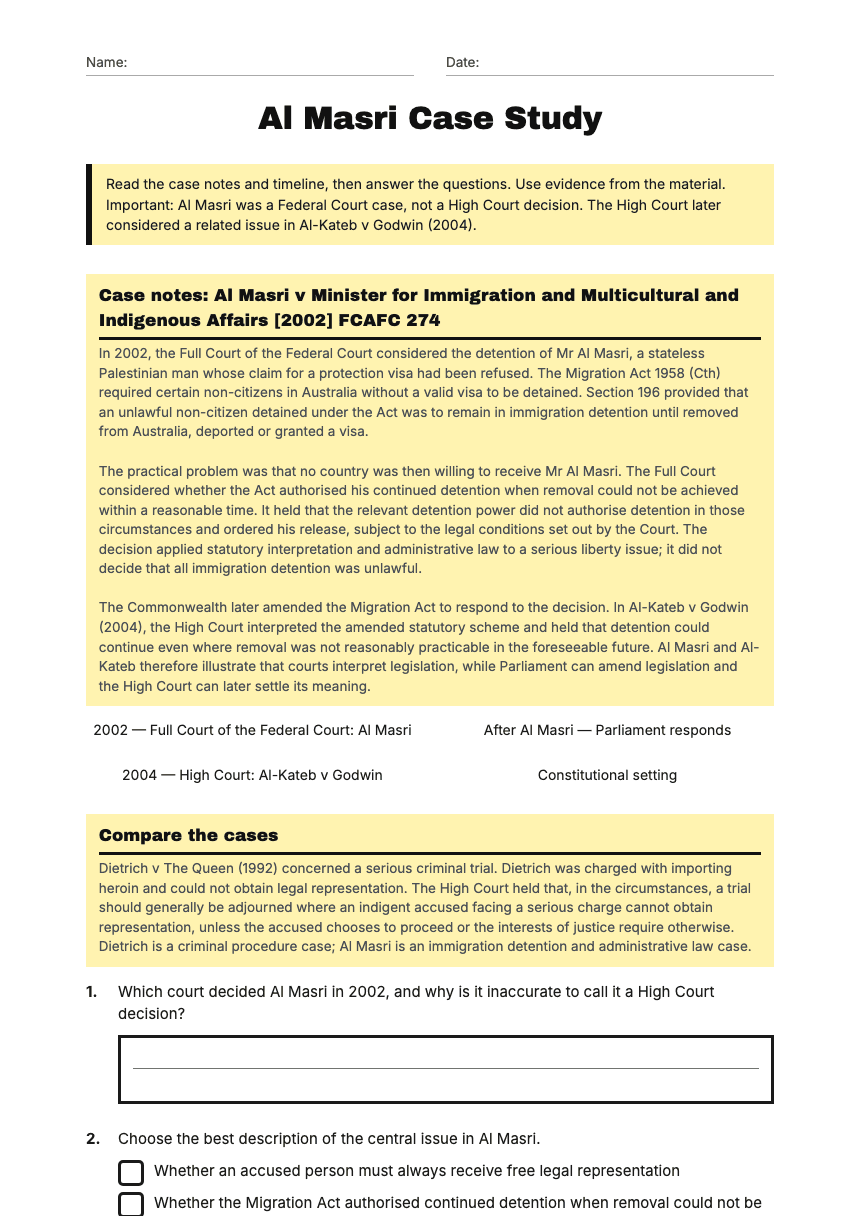
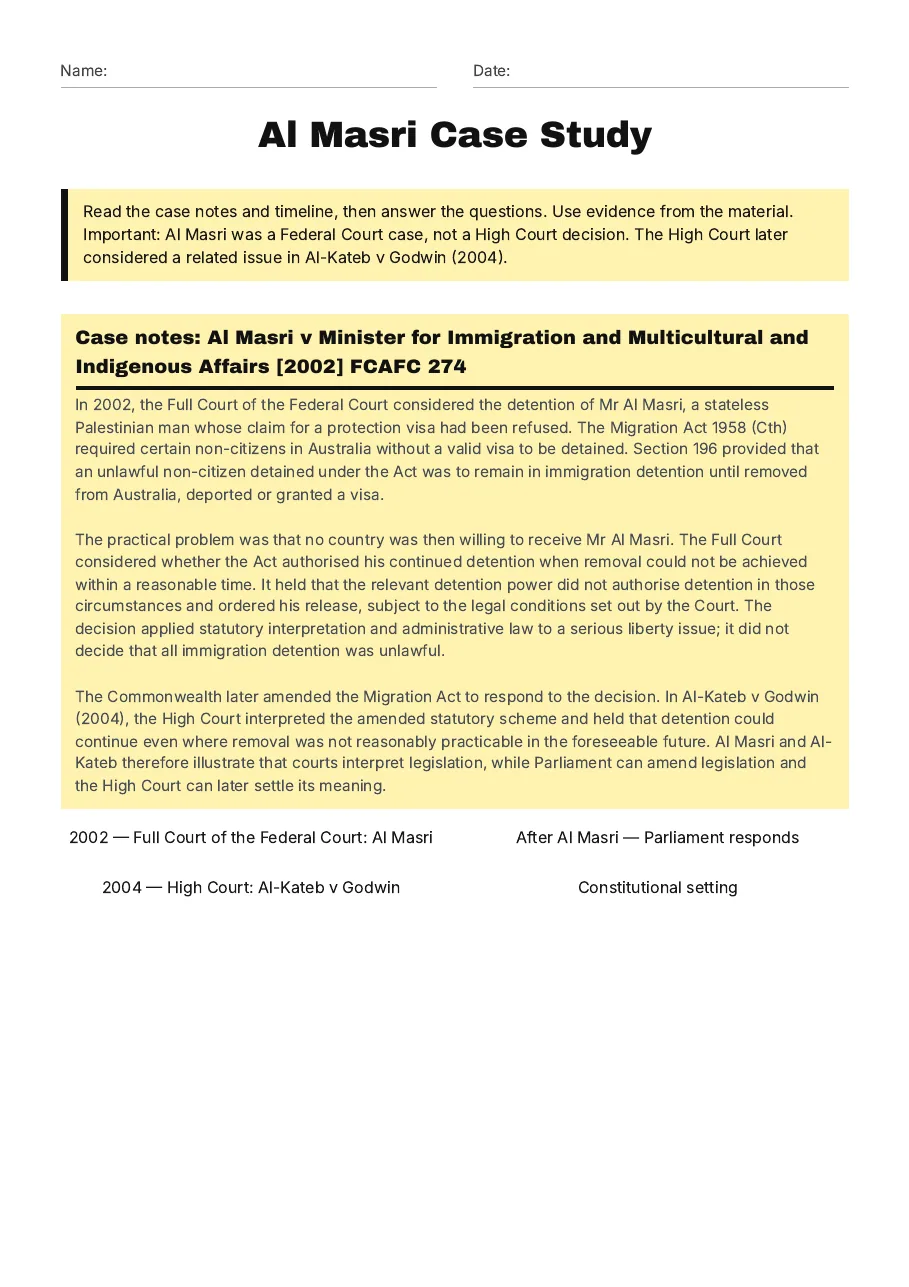
Al Masri Case Study
Case notes: Al Masri v Minister for Immigration and Multicultural and Indigenous Affairs [2002] FCAFC 274
In 2002, the Full Court of the Federal Court considered the detention of Mr Al Masri, a stateless Palestinian man whose claim for a protection visa had been refused. The Migration Act 1958 (Cth) required certain non-citizens in Australia without a valid visa to be detained. Section 196 provided that an unlawful non-citizen detained under the Act was to remain in immigration detention until removed from Australia, deported or granted a visa. The practical problem was that no country was then willing to receive Mr Al Masri. The Full Court considered whether the Act authorised his continued detention when removal could not be achieved within a reasonable time. It held that the relevant detention power did not authorise detention in those circumstances and ordered his release, subject to the legal conditions set out by the Court. The decision applied statutory interpretation and administrative law to a serious liberty issue; it did not decide that all immigration detention was unlawful. The Commonwealth later amended the Migration Act to respond to the decision. In Al-Kateb v Godwin (2004), the High Court interpreted the amended statutory scheme and held that detention could continue even where removal was not reasonably practicable in the foreseeable future. Al Masri and Al-Kateb therefore illustrate that courts interpret legislation, while Parliament can amend legislation and the High Court can later settle its meaning.
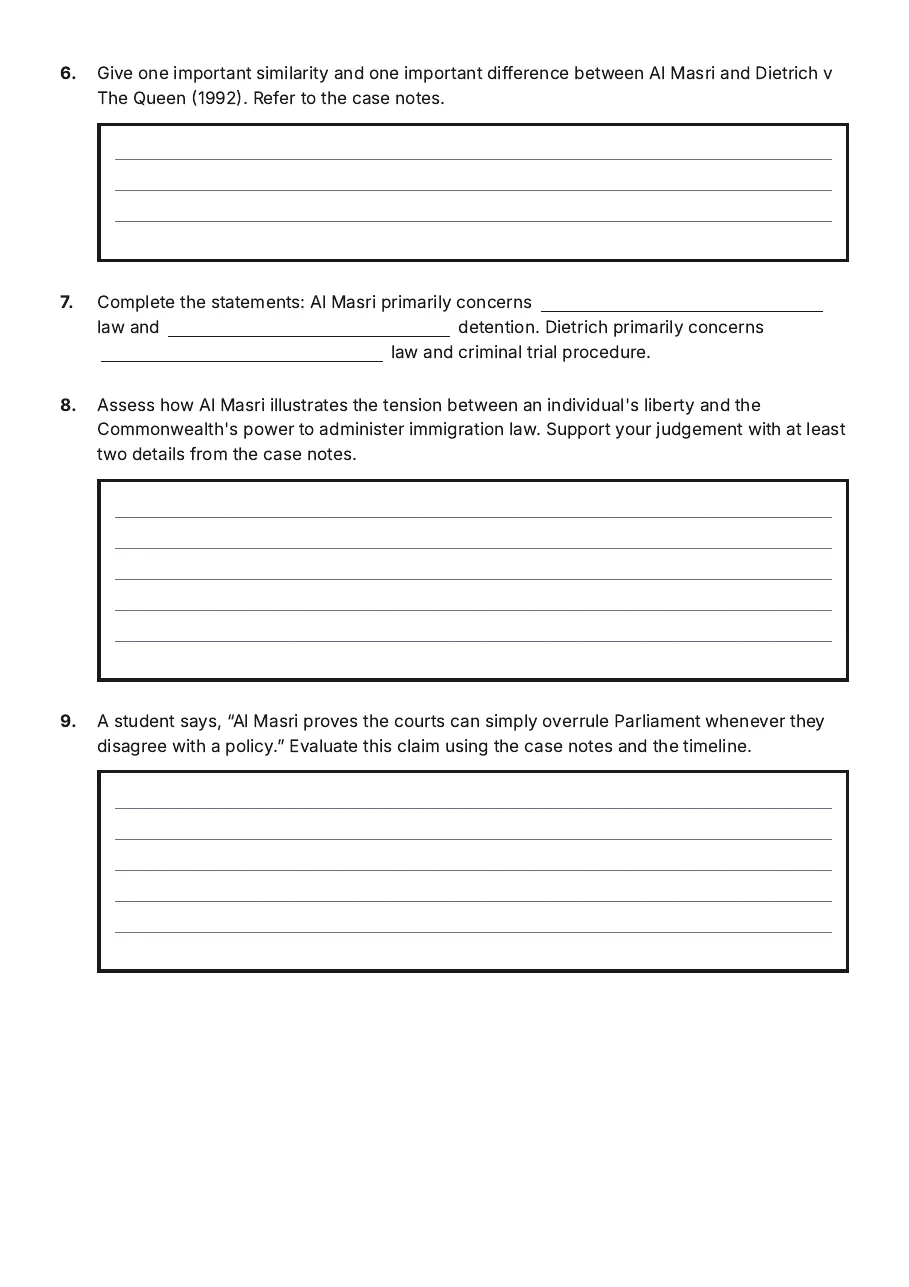
2002 — Full Court of the Federal Court: Al Masri
After Al Masri — Parliament responds
2004 — High Court: Al-Kateb v Godwin
Constitutional setting
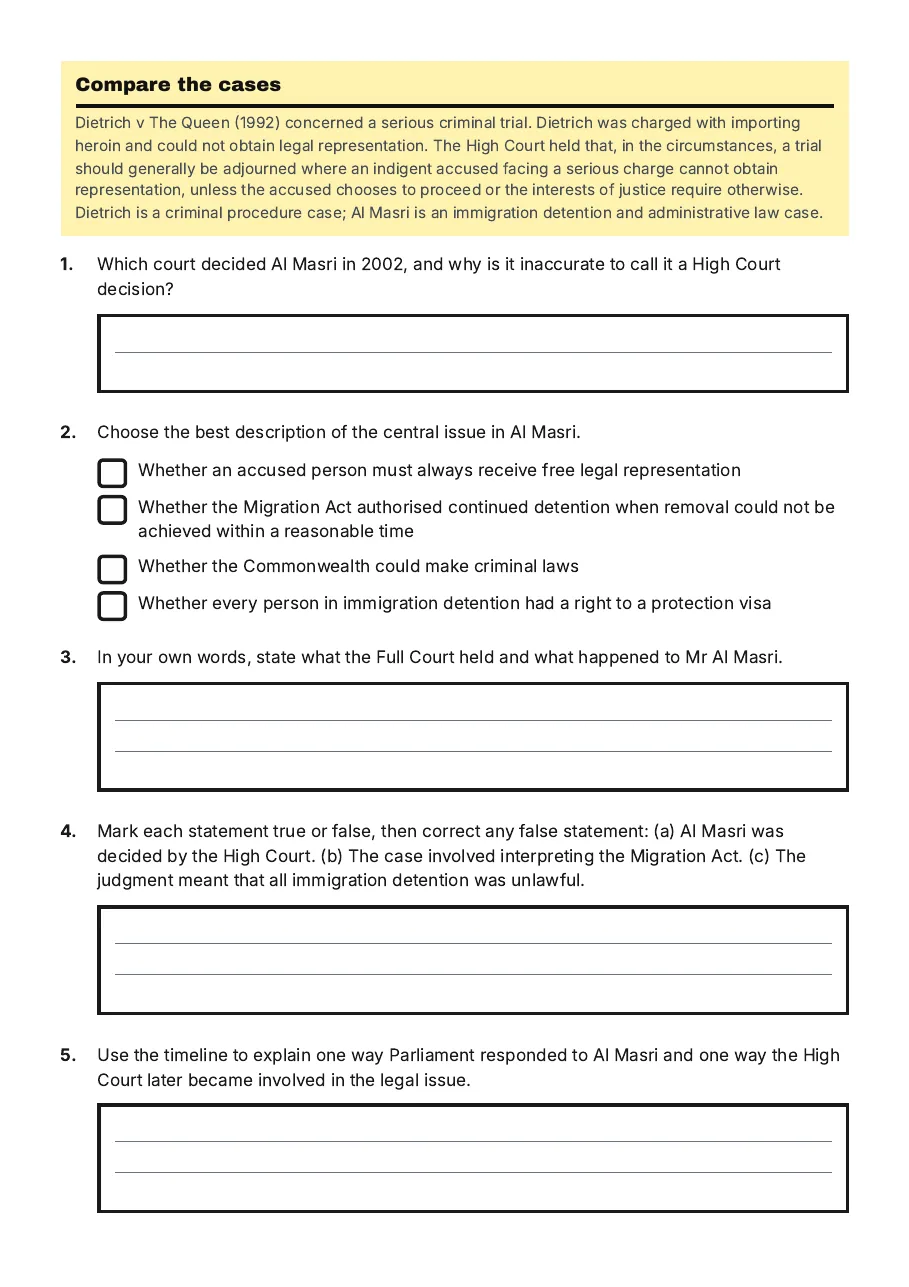
Compare the cases
Dietrich v The Queen (1992) concerned a serious criminal trial. Dietrich was charged with importing heroin and could not obtain legal representation. The High Court held that, in the circumstances, a trial should generally be adjourned where an indigent accused facing a serious charge cannot obtain representation, unless the accused chooses to proceed or the interests of justice require otherwise. Dietrich is a criminal procedure case; Al Masri is an immigration detention and administrative law case.
- Whether an accused person must always receive free legal representation
- Whether the Migration Act authorised continued detention when removal could not be achieved within a reasonable time
- Whether the Commonwealth could make criminal laws
- Whether every person in immigration detention had a right to a protection visa
3 printable pages
Page 1
Page 2
Page 3
About This Worksheet
Free in Kuraplan
Sign up free, grab the PDF, and customize it for your class.
Print-Ready
Formatted for standard paper. Clean layout, easy to read.
AI-Generated
Created with Kuraplan's AI, designed for real classroom use.
For Teachers & Parents
Use in classrooms, for homework, tutoring, or homeschool.
Need a custom version of this worksheet?
Kuraplan's AI generates custom worksheets in seconds — differentiated for every learner, aligned to your curriculum.
Generate Custom Worksheets — FreeMore Social Sciences Worksheets

Community Project Planning
Free
Australian Law Reform Fact Sheets
Free
Human Rights Debate Rubric
Free
Australian Referendums Constitutional Process
Free
Media and Law Reform
Free
Australian Constitution Fundamentals
Free
Commonwealth Constitution Overview
Free