Ambition and Gender Roles
A free english worksheet ready for your classroom. Open in Kuraplan to grab the print-ready PDF, customize it for your students, or generate a fresh version in seconds.
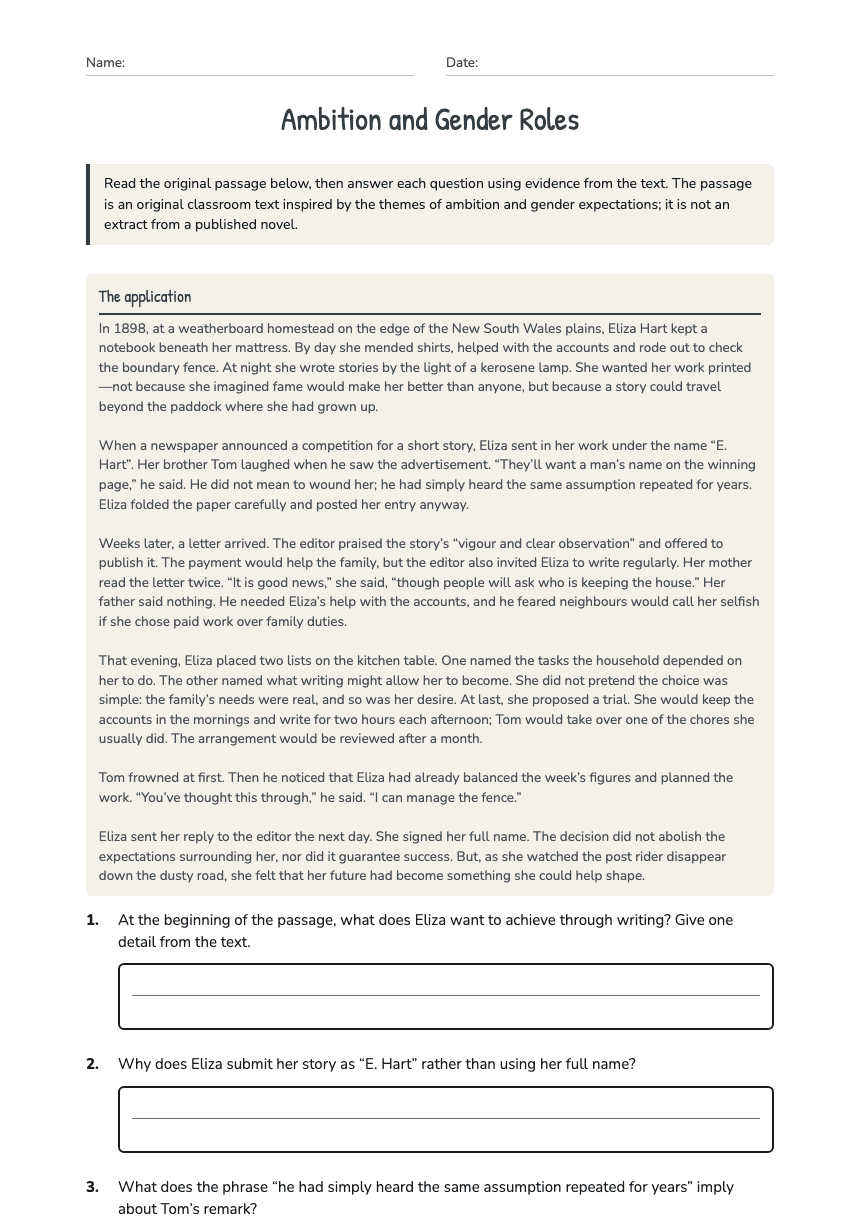
Ambition and Gender Roles
The application
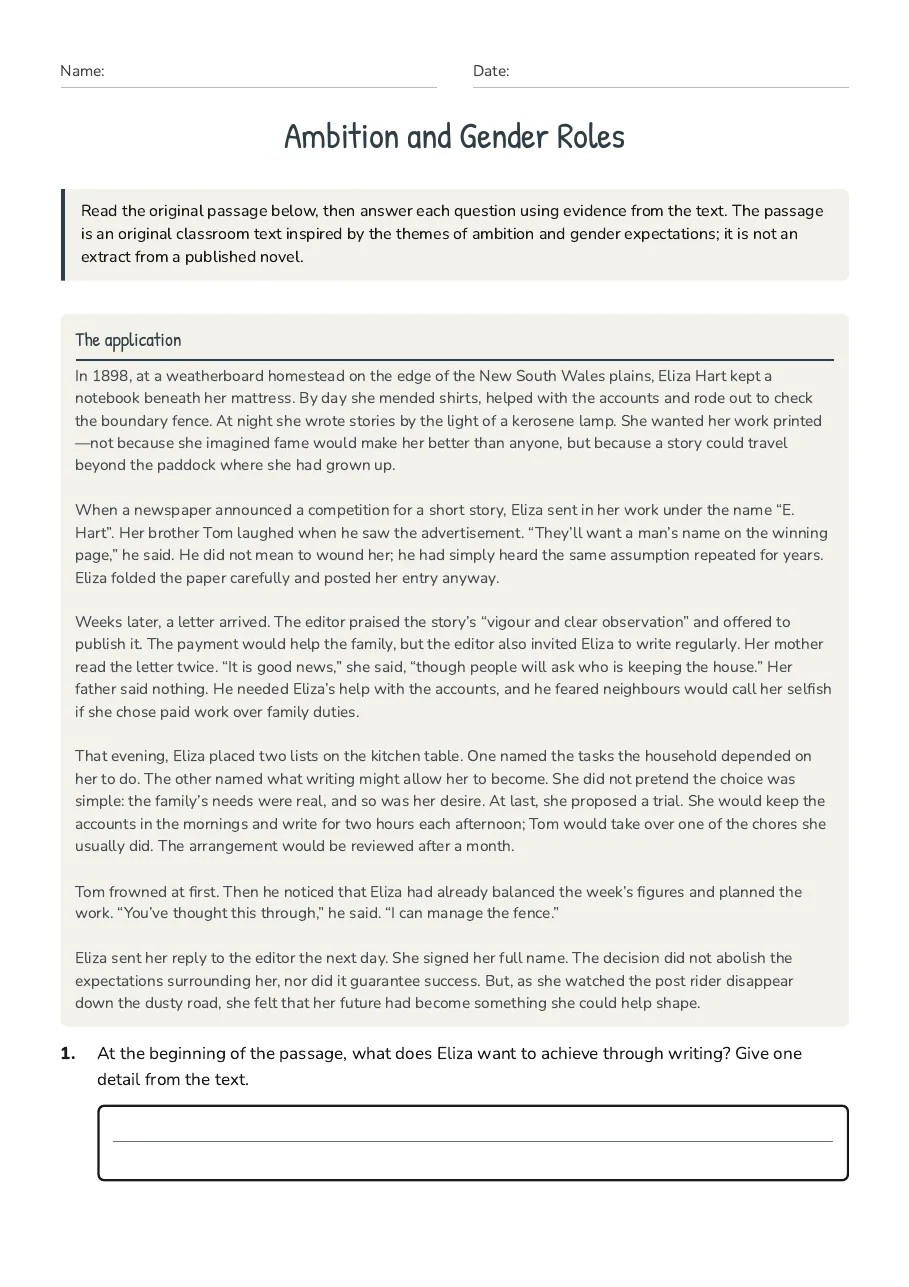
In 1898, at a weatherboard homestead on the edge of the New South Wales plains, Eliza Hart kept a notebook beneath her mattress. By day she mended shirts, helped with the accounts and rode out to check the boundary fence. At night she wrote stories by the light of a kerosene lamp. She wanted her work printed—not because she imagined fame would make her better than anyone, but because a story could travel beyond the paddock where she had grown up. When a newspaper announced a competition for a short story, Eliza sent in her work under the name “E. Hart”. Her brother Tom laughed when he saw the advertisement. “They’ll want a man’s name on the winning page,” he said. He did not mean to wound her; he had simply heard the same assumption repeated for years. Eliza folded the paper carefully and posted her entry anyway. Weeks later, a letter arrived. The editor praised the story’s “vigour and clear observation” and offered to publish it. The payment would help the family, but the editor also invited Eliza to write regularly. Her mother read the letter twice. “It is good news,” she said, “though people will ask who is keeping the house.” Her father said nothing. He needed Eliza’s help with the accounts, and he feared neighbours would call her selfish if she chose paid work over family duties. That evening, Eliza placed two lists on the kitchen table. One named the tasks the household depended on her to do. The other named what writing might allow her to become. She did not pretend the choice was simple: the family’s needs were real, and so was her desire. At last, she proposed a trial. She would keep the accounts in the mornings and write for two hours each afternoon; Tom would take over one of the chores she usually did. The arrangement would be reviewed after a month. Tom frowned at first. Then he noticed that Eliza had already balanced the week’s figures and planned the work. “You’ve thought this through,” he said. “I can manage the fence.” Eliza sent her reply to the editor the next day. She signed her full name. The decision did not abolish the expectations surrounding her, nor did it guarantee success. But, as she watched the post rider disappear down the dusty road, she felt that her future had become something she could help shape.
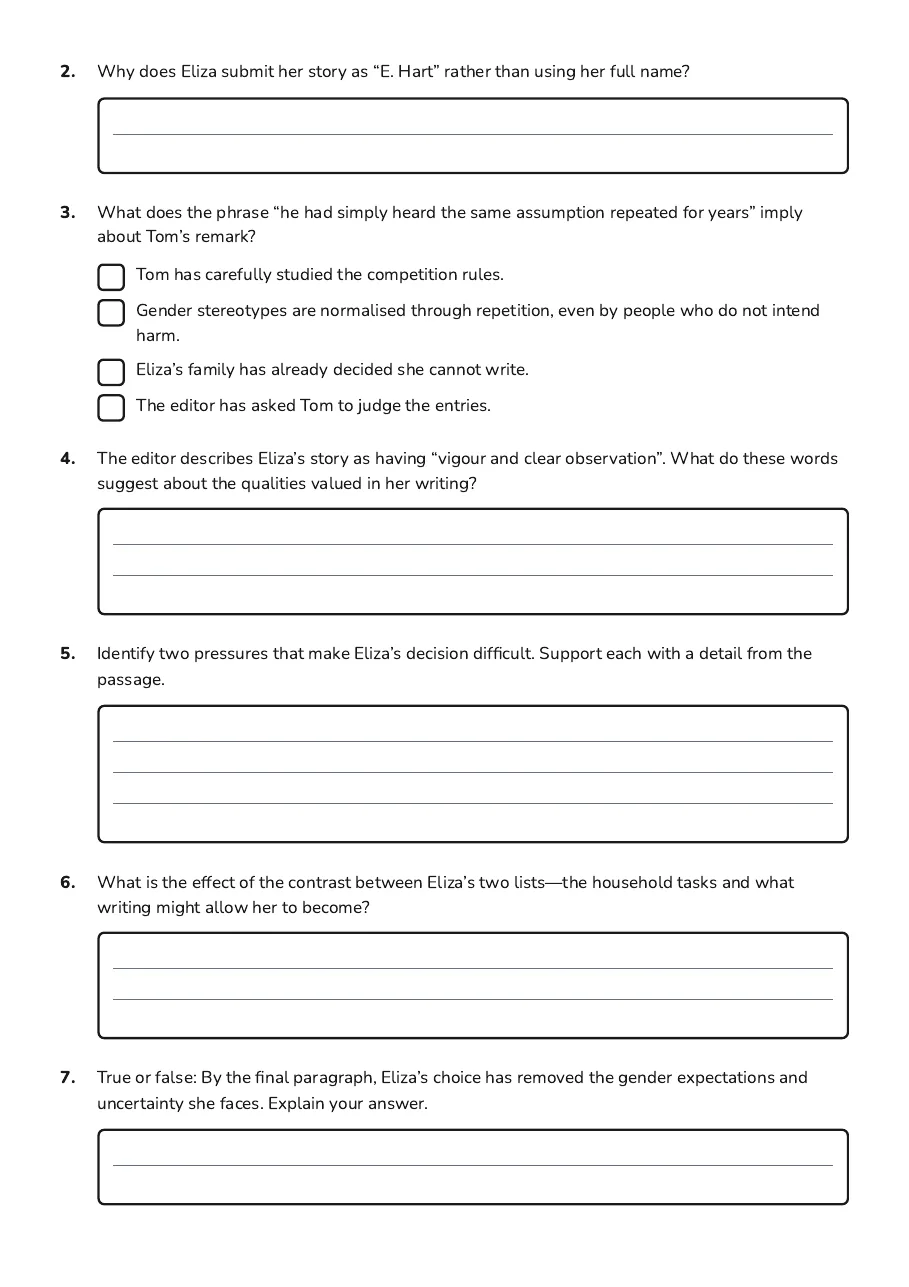
- Tom has carefully studied the competition rules.
- Gender stereotypes are normalised through repetition, even by people who do not intend harm.
- Eliza’s family has already decided she cannot write.
- The editor has asked Tom to judge the entries.
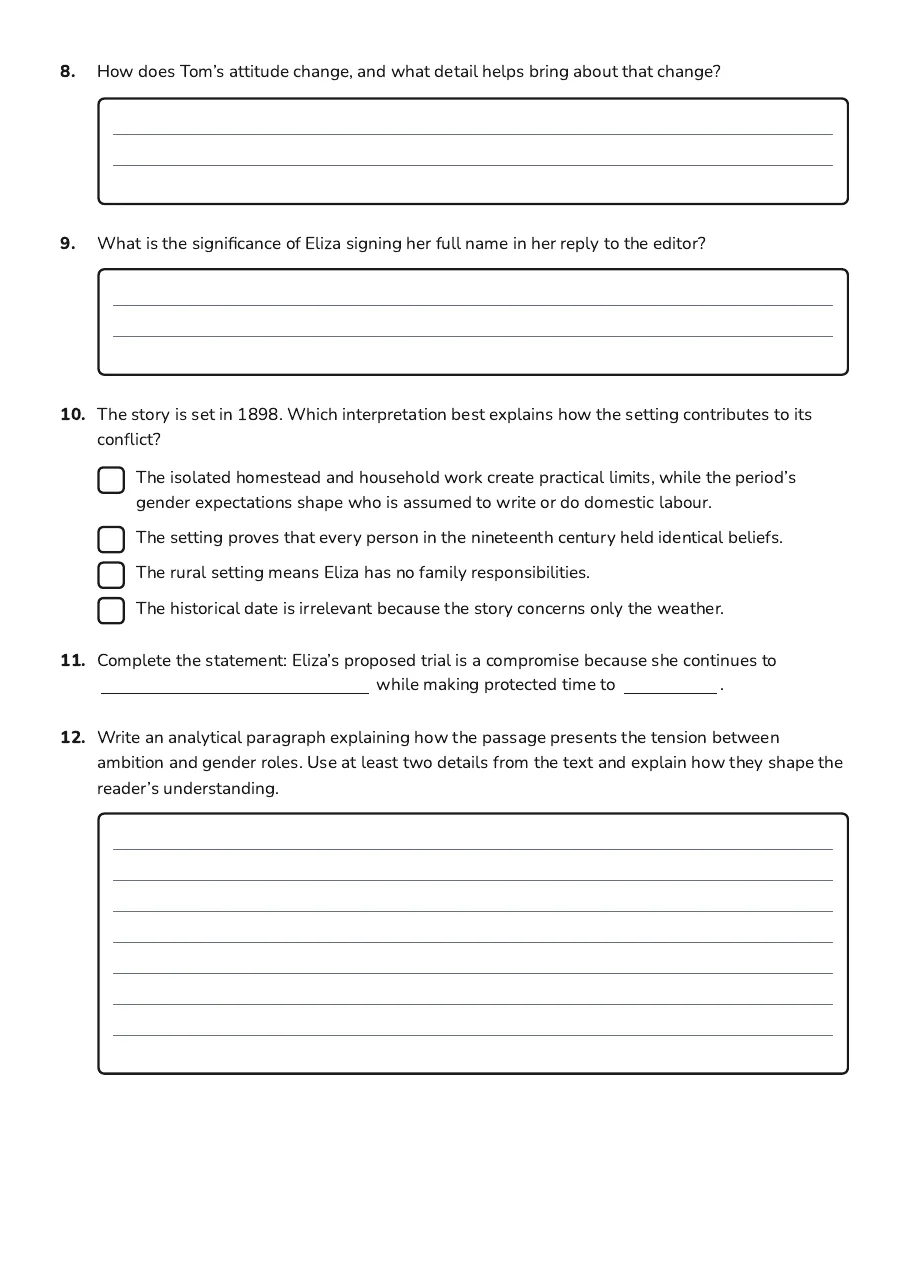
- The isolated homestead and household work create practical limits, while the period’s gender expectations shape who is assumed to write or do domestic labour.
- The setting proves that every person in the nineteenth century held identical beliefs.
- The rural setting means Eliza has no family responsibilities.
- The historical date is irrelevant because the story concerns only the weather.
3 printable pages
Page 1
Page 2
Page 3
About This Worksheet
Free in Kuraplan
Sign up free, grab the PDF, and customize it for your class.
Print-Ready
Formatted for standard paper. Clean layout, easy to read.
AI-Generated
Created with Kuraplan's AI, designed for real classroom use.
For Teachers & Parents
Use in classrooms, for homework, tutoring, or homeschool.
Need a custom version of this worksheet?
Kuraplan's AI generates custom worksheets in seconds — differentiated for every learner, aligned to your curriculum.
Generate Custom Worksheets — Free