Dog Evolution Reading Levels
A free english worksheet ready for your classroom. Open in Kuraplan to grab the print-ready PDF, customize it for your students, or generate a fresh version in seconds.
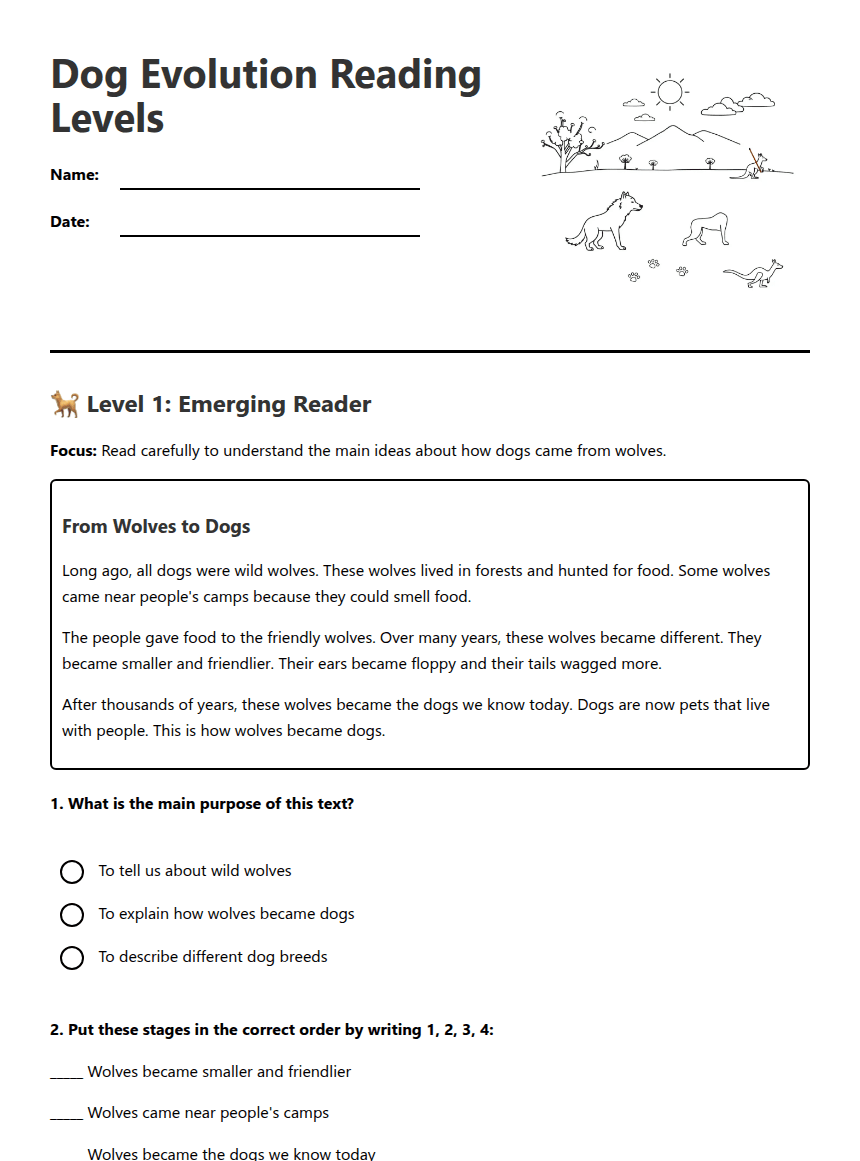
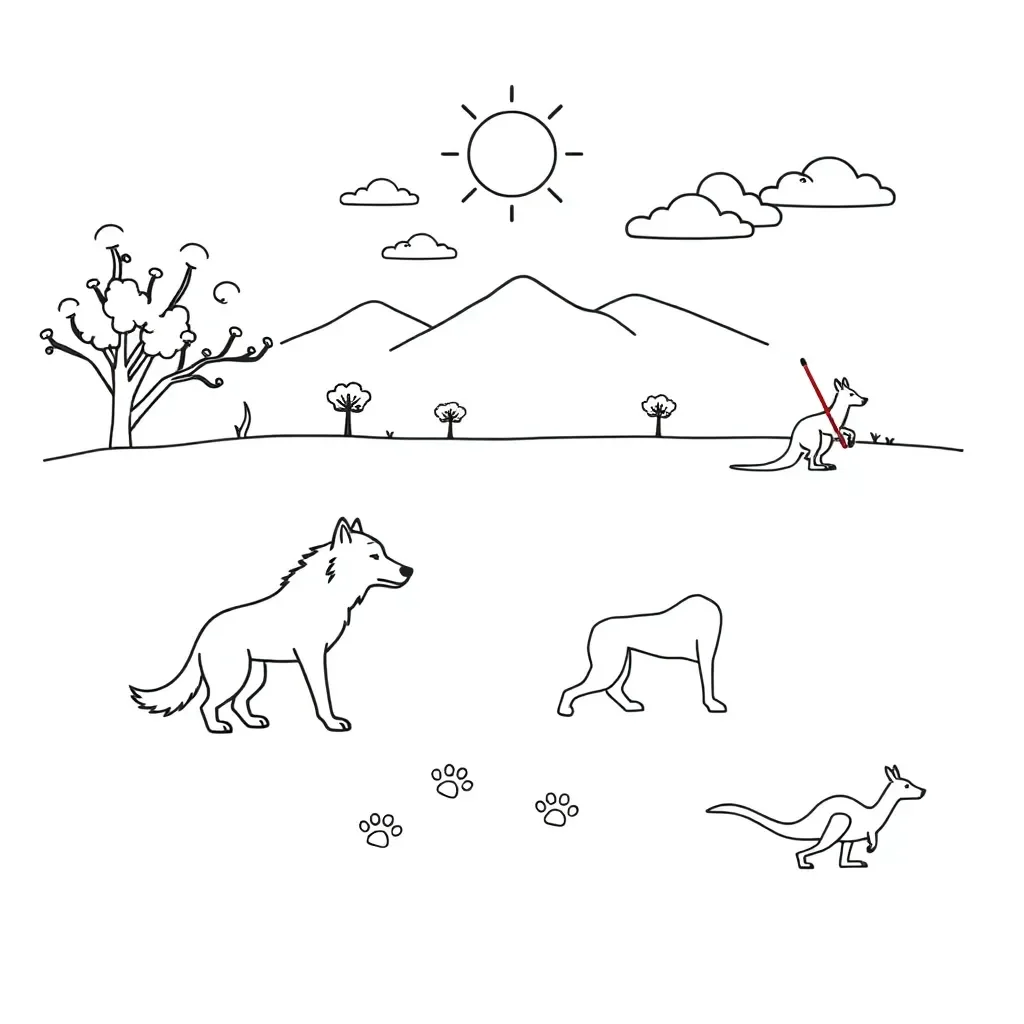
Dog Evolution Reading Levels
🐕 Level 1: Emerging Reader
Focus: Read carefully to understand the main ideas about how dogs came from wolves.
From Wolves to Dogs
Long ago, all dogs were wild wolves. These wolves lived in forests and hunted for food. Some wolves came near people's camps because they could smell food.
The people gave food to the friendly wolves. Over many years, these wolves became different. They became smaller and friendlier. Their ears became floppy and their tails wagged more.
After thousands of years, these wolves became the dogs we know today. Dogs are now pets that live with people. This is how wolves became dogs.
_____ Wolves became smaller and friendlier
_____ Wolves came near people's camps
_____ Wolves became the dogs we know today
_____ People gave food to friendly wolves
🐕 Level 2: Developing Reader
Focus: Identify the explanation structure and understand the process of domestication.
The Evolution of Dogs from Wolves
Thousands of years ago, all domestic dogs descended from grey wolves. This transformation didn't happen overnight but occurred through a gradual process called domestication.
Initially, wolves were attracted to human settlements because of food scraps. The wolves that showed less aggressive behaviour towards humans were more likely to receive food. Over generations, humans began selecting the friendliest wolves to keep around their camps.
As this process continued, these wolves developed different physical characteristics. Their ears became more floppy, their snouts shortened, and their coat colours became more varied. Their behaviour also changed significantly - they became more loyal and responsive to human commands.
Consequently, after approximately 15,000 years of selective breeding and domestication, wolves evolved into the diverse range of dog breeds we see today. This process demonstrates how human intervention can influence animal evolution.
🐕 Level 3: Extending Reader
Focus: Analyse the explanation text structure and evaluate the scientific process described.
Canine Domestication: The Scientific Evolution from Canis Lupus to Canis Familiaris
The domestication of dogs represents one of humanity's most significant achievements in animal husbandry, fundamentally altering the evolutionary trajectory of the grey wolf (Canis lupus) over approximately 15,000-30,000 years.
Archaeological evidence suggests that this process began when wolves, driven by scarcity of natural prey, ventured closer to human settlements to scavenge discarded food. Those individuals displaying reduced neoteny and increased tolerance for human proximity gained a survival advantage through reliable food sources.
Through successive generations of artificial selection, humans inadvertently triggered a phenomenon known as the 'domestication syndrome'. This resulted in profound morphological changes including paedomorphic features (retention of juvenile characteristics), increased phenotypic diversity in coat colour and pattern, and significant behavioural modifications such as enhanced social cognition and reduced fear responses.
Furthermore, genetic analysis reveals that this co-evolutionary relationship produced neurological adaptations, particularly in regions governing social behaviour and stress response. The end result was the emergence of Canis familiaris - a subspecies exhibiting unprecedented genetic plasticity that enabled the development of over 400 distinct breeds, each adapted for specific human purposes.
About This Worksheet
Free in Kuraplan
Sign up free, grab the PDF, and customize it for your class.
Print-Ready
Formatted for standard paper. Clean layout, easy to read.
AI-Generated
Created with Kuraplan's AI, designed for real classroom use.
For Teachers & Parents
Use in classrooms, for homework, tutoring, or homeschool.
Need a custom version of this worksheet?
Kuraplan's AI generates custom worksheets in seconds — differentiated for every learner, aligned to your curriculum.
Generate Custom Worksheets — Free