Ancient China Legalism Worksheet
A free social sciences worksheet ready for your classroom. Open in Kuraplan to grab the print-ready PDF, customize it for your students, or generate a fresh version in seconds.
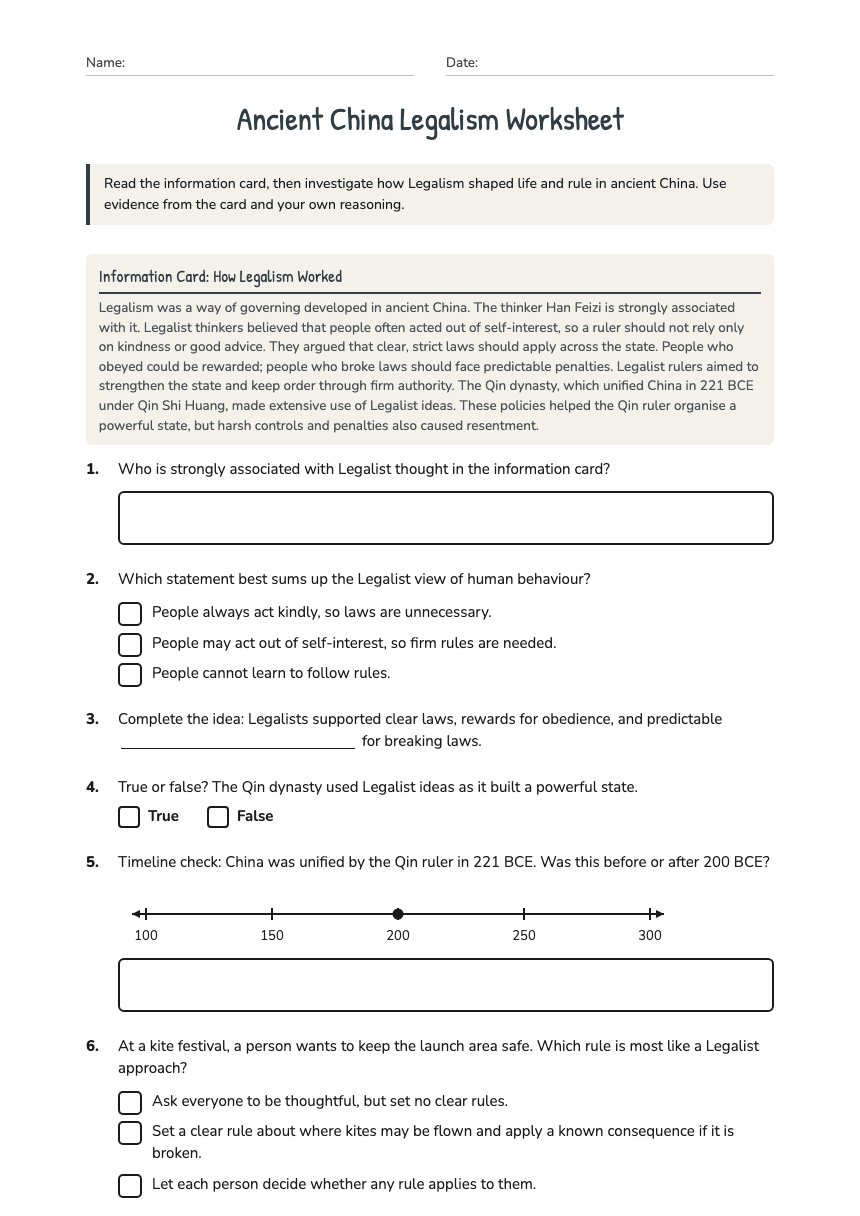
Ancient China Legalism Worksheet
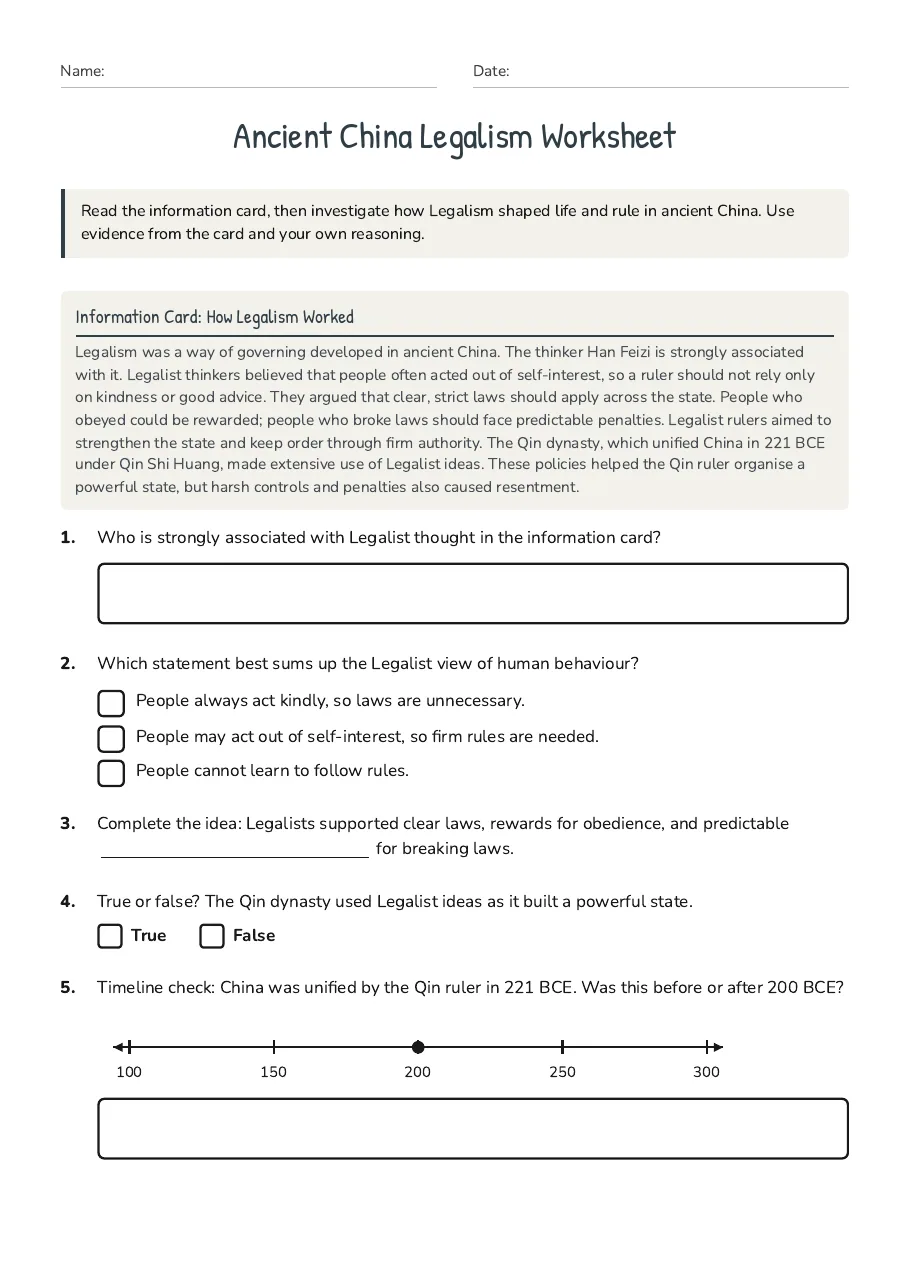
Information Card: How Legalism Worked
Legalism was a way of governing developed in ancient China. The thinker Han Feizi is strongly associated with it. Legalist thinkers believed that people often acted out of self-interest, so a ruler should not rely only on kindness or good advice. They argued that clear, strict laws should apply across the state. People who obeyed could be rewarded; people who broke laws should face predictable penalties. Legalist rulers aimed to strengthen the state and keep order through firm authority. The Qin dynasty, which unified China in 221 BCE under Qin Shi Huang, made extensive use of Legalist ideas. These policies helped the Qin ruler organise a powerful state, but harsh controls and penalties also caused resentment.
- People always act kindly, so laws are unnecessary.
- People may act out of self-interest, so firm rules are needed.
- People cannot learn to follow rules.
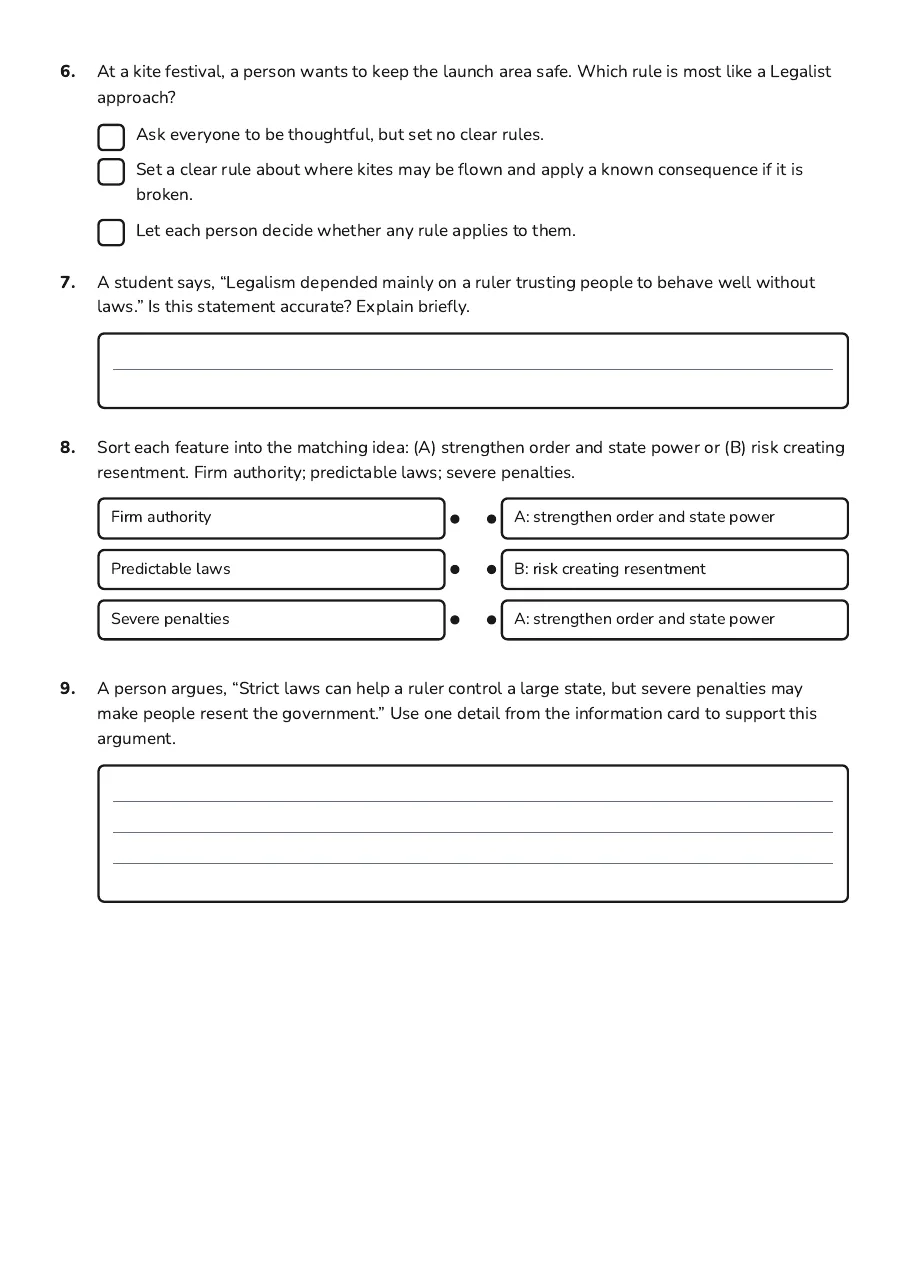
- Ask everyone to be thoughtful, but set no clear rules.
- Set a clear rule about where kites may be flown and apply a known consequence if it is broken.
- Let each person decide whether any rule applies to them.
- Firm authority
- Predictable laws
- Severe penalties
- A: strengthen order and state power
- B: risk creating resentment
- A: strengthen order and state power
2 printable pages
Page 1
Page 2
About This Worksheet
Free in Kuraplan
Sign up free, grab the PDF, and customize it for your class.
Print-Ready
Formatted for standard paper. Clean layout, easy to read.
AI-Generated
Created with Kuraplan's AI, designed for real classroom use.
For Teachers & Parents
Use in classrooms, for homework, tutoring, or homeschool.
Need a custom version of this worksheet?
Kuraplan's AI generates custom worksheets in seconds — differentiated for every learner, aligned to your curriculum.
Generate Custom Worksheets — Free