Ancient Greece Social Structure
A free social sciences worksheet ready for your classroom. Open in Kuraplan to grab the print-ready PDF, customize it for your students, or generate a fresh version in seconds.
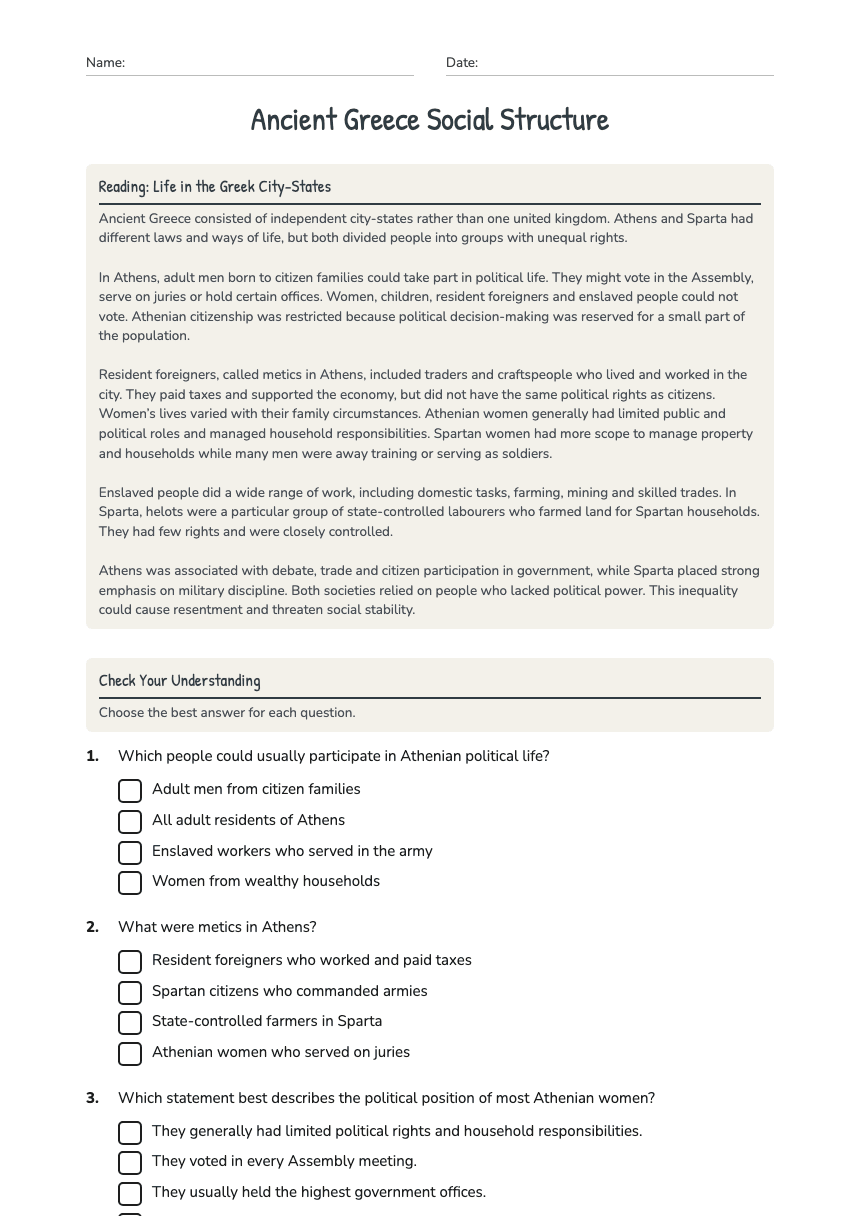
Ancient Greece Social Structure
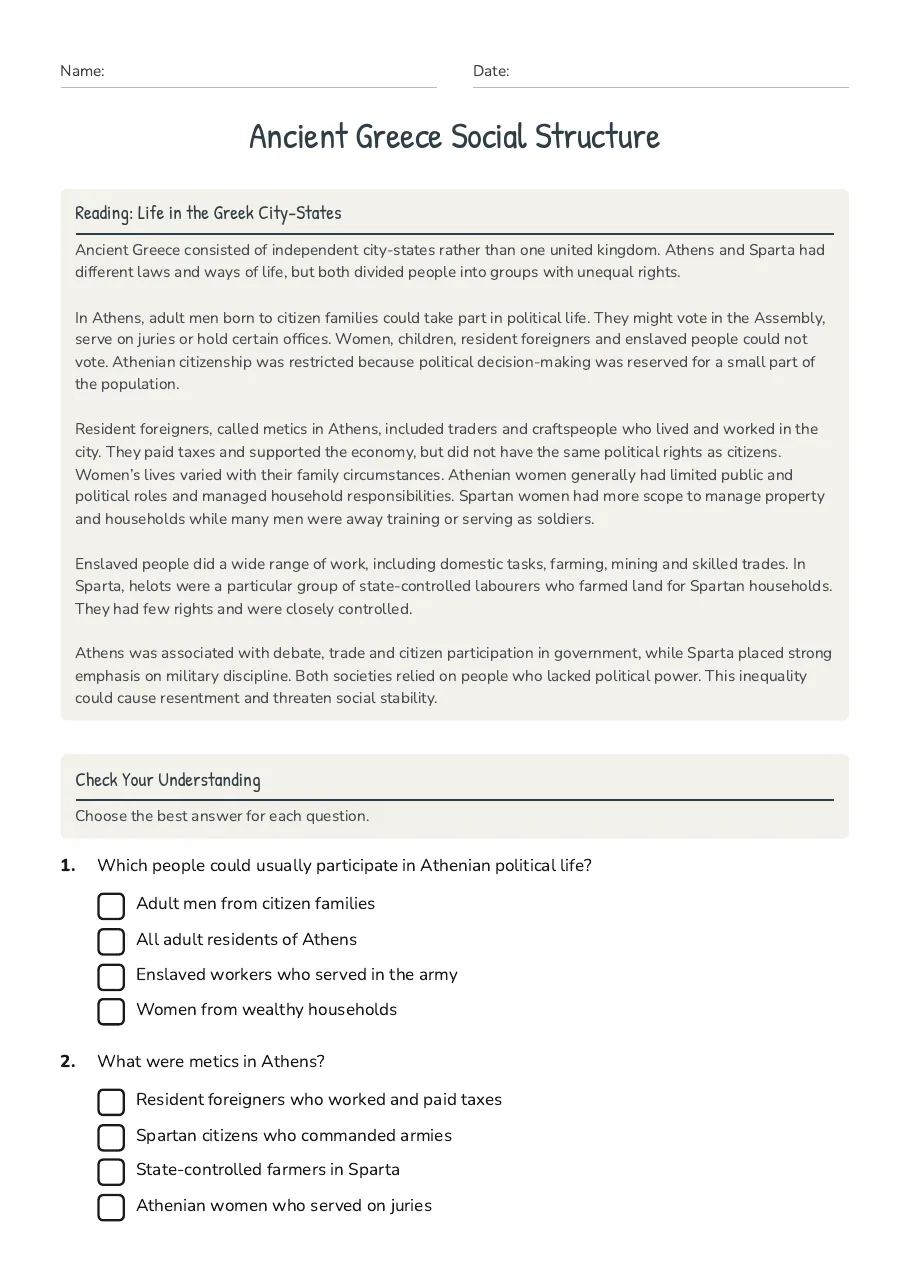
Reading: Life in the Greek City-States
Ancient Greece consisted of independent city-states rather than one united kingdom. Athens and Sparta had different laws and ways of life, but both divided people into groups with unequal rights. In Athens, adult men born to citizen families could take part in political life. They might vote in the Assembly, serve on juries or hold certain offices. Women, children, resident foreigners and enslaved people could not vote. Athenian citizenship was restricted because political decision-making was reserved for a small part of the population. Resident foreigners, called metics in Athens, included traders and craftspeople who lived and worked in the city. They paid taxes and supported the economy, but did not have the same political rights as citizens. Women’s lives varied with their family circumstances. Athenian women generally had limited public and political roles and managed household responsibilities. Spartan women had more scope to manage property and households while many men were away training or serving as soldiers. Enslaved people did a wide range of work, including domestic tasks, farming, mining and skilled trades. In Sparta, helots were a particular group of state-controlled labourers who farmed land for Spartan households. They had few rights and were closely controlled. Athens was associated with debate, trade and citizen participation in government, while Sparta placed strong emphasis on military discipline. Both societies relied on people who lacked political power. This inequality could cause resentment and threaten social stability.
Check Your Understanding
Choose the best answer for each question.
- Adult men from citizen families
- All adult residents of Athens
- Enslaved workers who served in the army
- Women from wealthy households
- Resident foreigners who worked and paid taxes
- Spartan citizens who commanded armies
- State-controlled farmers in Sparta
- Athenian women who served on juries
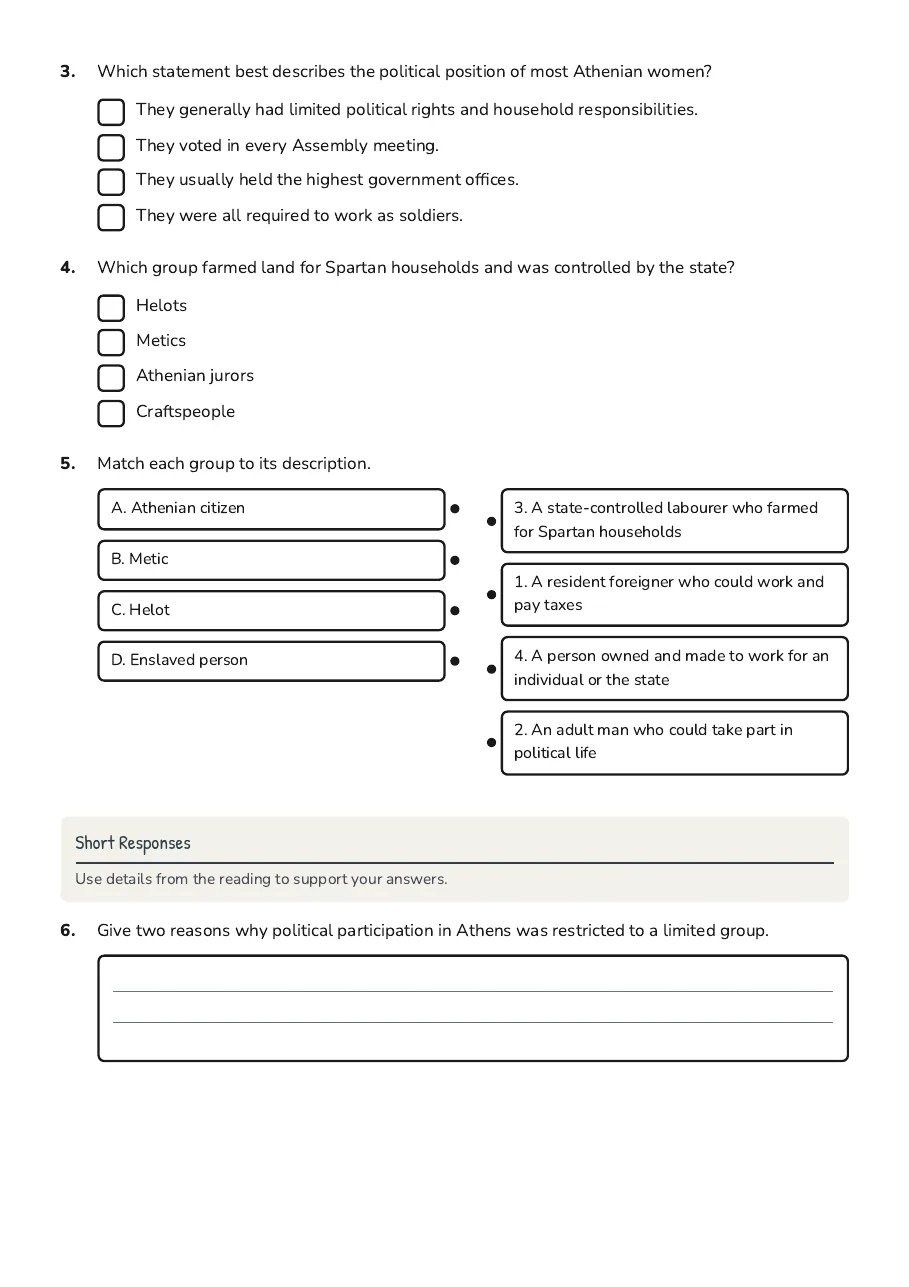
- They generally had limited political rights and household responsibilities.
- They voted in every Assembly meeting.
- They usually held the highest government offices.
- They were all required to work as soldiers.
- Helots
- Metics
- Athenian jurors
- Craftspeople
- A. Athenian citizen
- B. Metic
- C. Helot
- D. Enslaved person
- 3. A state-controlled labourer who farmed for Spartan households
- 1. A resident foreigner who could work and pay taxes
- 4. A person owned and made to work for an individual or the state
- 2. An adult man who could take part in political life
Short Responses
Use details from the reading to support your answers.
3 printable pages
Page 1
Page 2
Page 3
About This Worksheet
Free in Kuraplan
Sign up free, grab the PDF, and customize it for your class.
Print-Ready
Formatted for standard paper. Clean layout, easy to read.
AI-Generated
Created with Kuraplan's AI, designed for real classroom use.
For Teachers & Parents
Use in classrooms, for homework, tutoring, or homeschool.
Need a custom version of this worksheet?
Kuraplan's AI generates custom worksheets in seconds — differentiated for every learner, aligned to your curriculum.
Generate Custom Worksheets — Free