POW Experiences in WWII
A free social sciences worksheet ready for your classroom. Open in Kuraplan to grab the print-ready PDF, customize it for your students, or generate a fresh version in seconds.
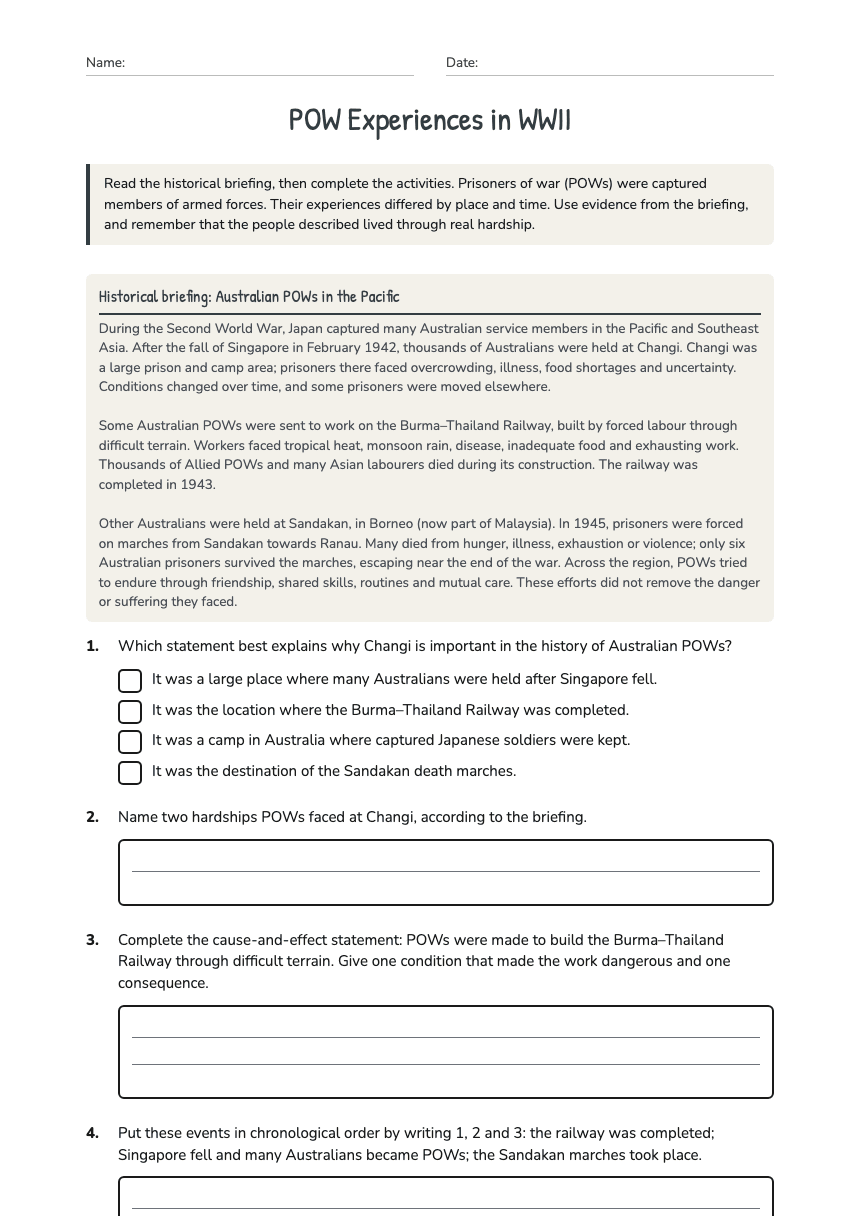
POW Experiences in WWII
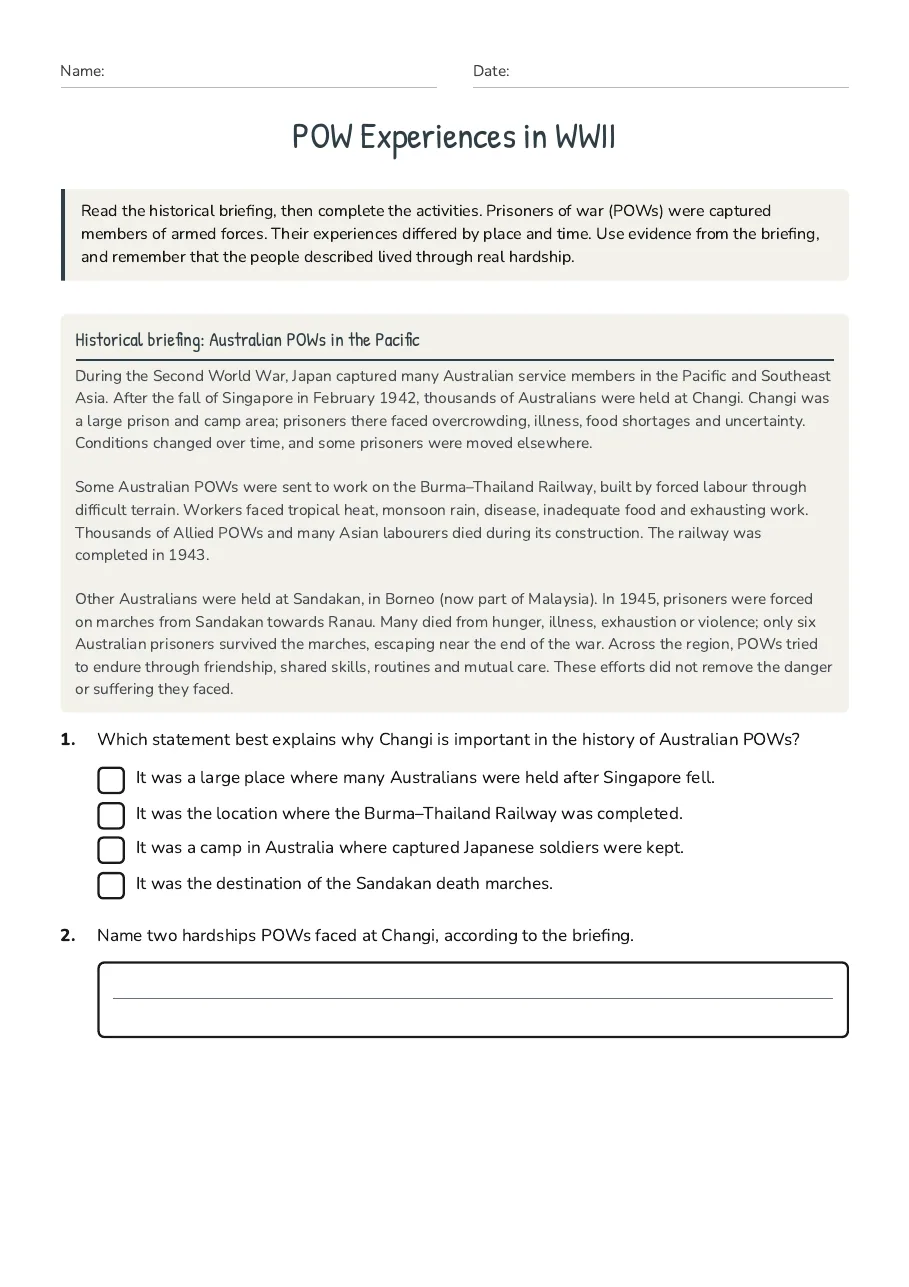
Historical briefing: Australian POWs in the Pacific
During the Second World War, Japan captured many Australian service members in the Pacific and Southeast Asia. After the fall of Singapore in February 1942, thousands of Australians were held at Changi. Changi was a large prison and camp area; prisoners there faced overcrowding, illness, food shortages and uncertainty. Conditions changed over time, and some prisoners were moved elsewhere. Some Australian POWs were sent to work on the Burma–Thailand Railway, built by forced labour through difficult terrain. Workers faced tropical heat, monsoon rain, disease, inadequate food and exhausting work. Thousands of Allied POWs and many Asian labourers died during its construction. The railway was completed in 1943. Other Australians were held at Sandakan, in Borneo (now part of Malaysia). In 1945, prisoners were forced on marches from Sandakan towards Ranau. Many died from hunger, illness, exhaustion or violence; only six Australian prisoners survived the marches, escaping near the end of the war. Across the region, POWs tried to endure through friendship, shared skills, routines and mutual care. These efforts did not remove the danger or suffering they faced.
- It was a large place where many Australians were held after Singapore fell.
- It was the location where the Burma–Thailand Railway was completed.
- It was a camp in Australia where captured Japanese soldiers were kept.
- It was the destination of the Sandakan death marches.
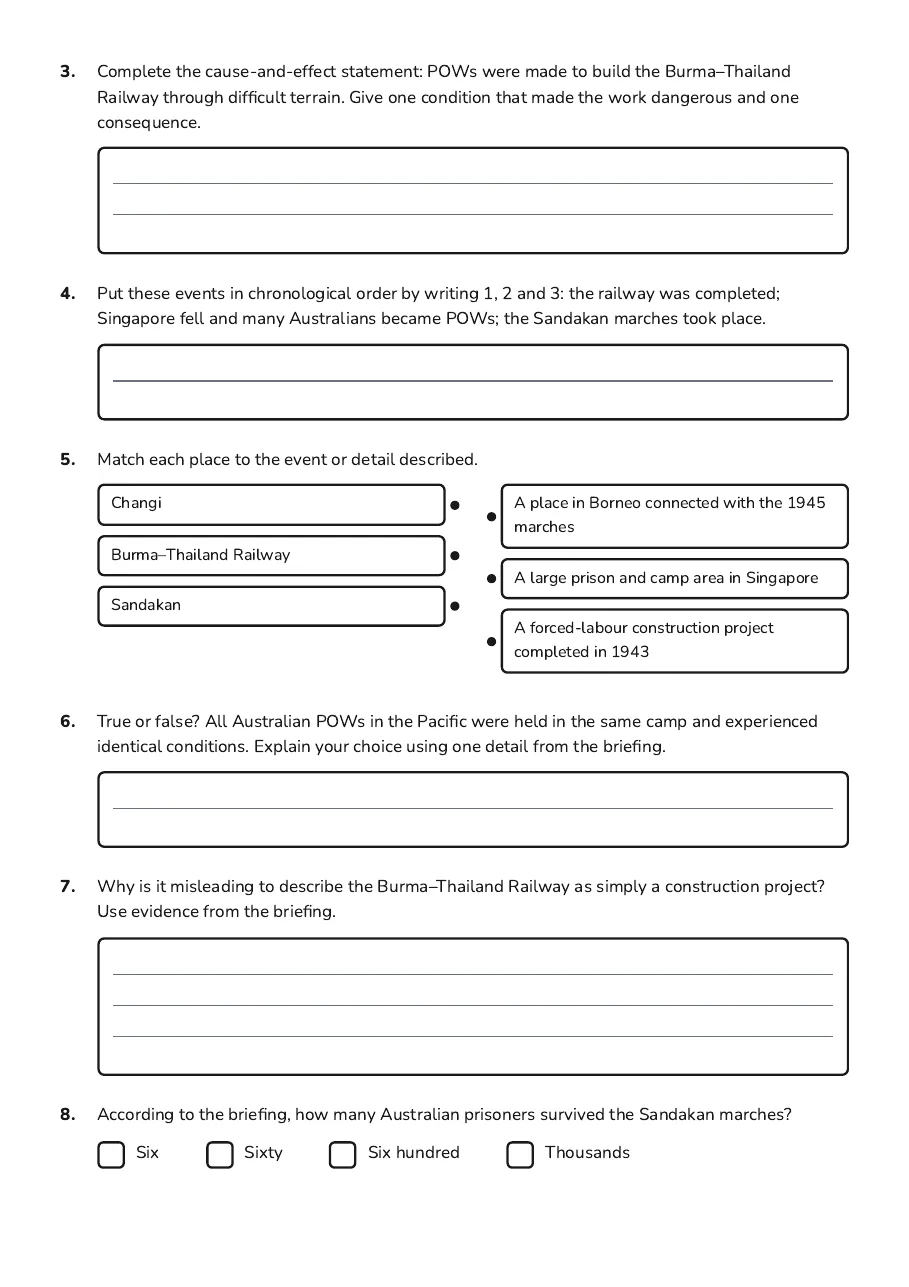
- Changi
- Burma–Thailand Railway
- Sandakan
- A place in Borneo connected with the 1945 marches
- A large prison and camp area in Singapore
- A forced-labour construction project completed in 1943
- Six
- Sixty
- Six hundred
- Thousands
3 printable pages
Page 1
Page 2
Page 3
About This Worksheet
Free in Kuraplan
Sign up free, grab the PDF, and customize it for your class.
Print-Ready
Formatted for standard paper. Clean layout, easy to read.
AI-Generated
Created with Kuraplan's AI, designed for real classroom use.
For Teachers & Parents
Use in classrooms, for homework, tutoring, or homeschool.
Need a custom version of this worksheet?
Kuraplan's AI generates custom worksheets in seconds — differentiated for every learner, aligned to your curriculum.
Generate Custom Worksheets — Free