Social SciencesFreePrintable
Archaeological Tools
A free social sciences worksheet ready for your classroom. Open in Kuraplan to grab the print-ready PDF, customize it for your students, or generate a fresh version in seconds.
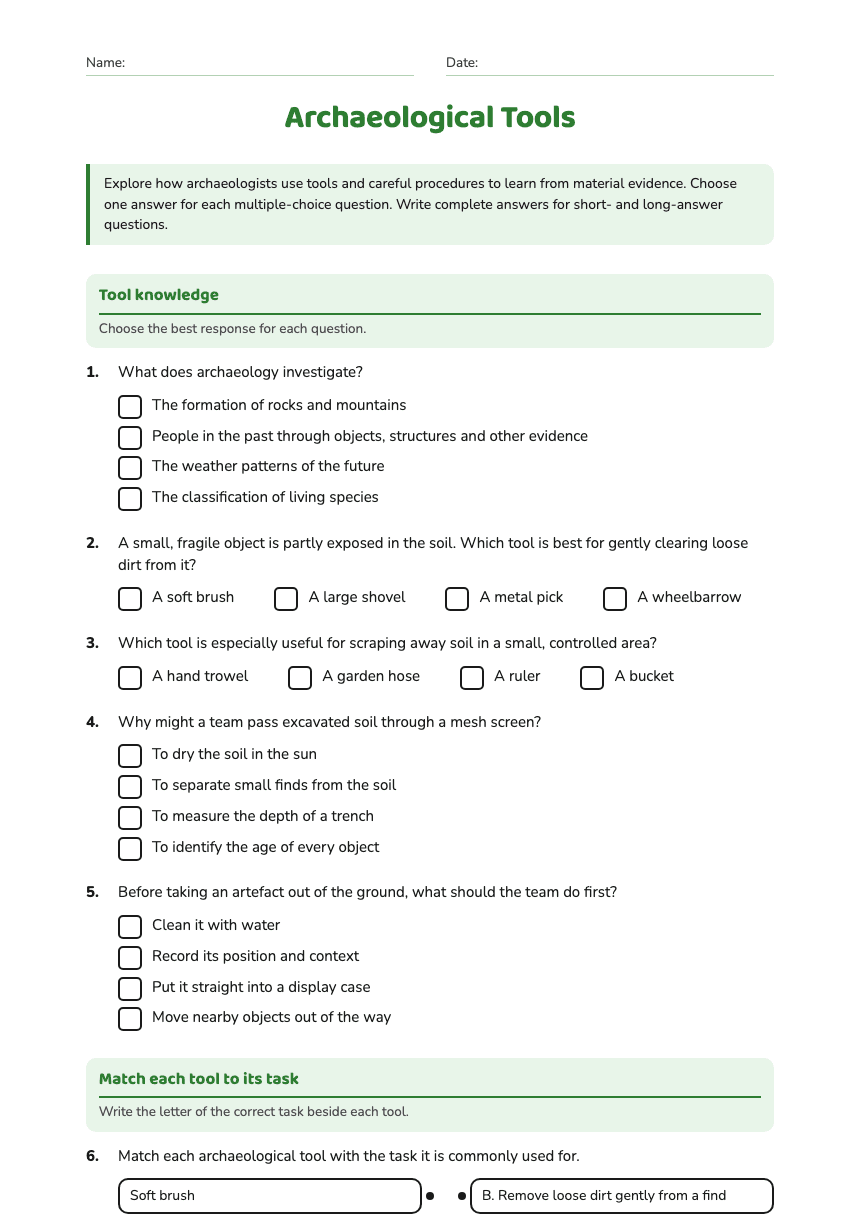
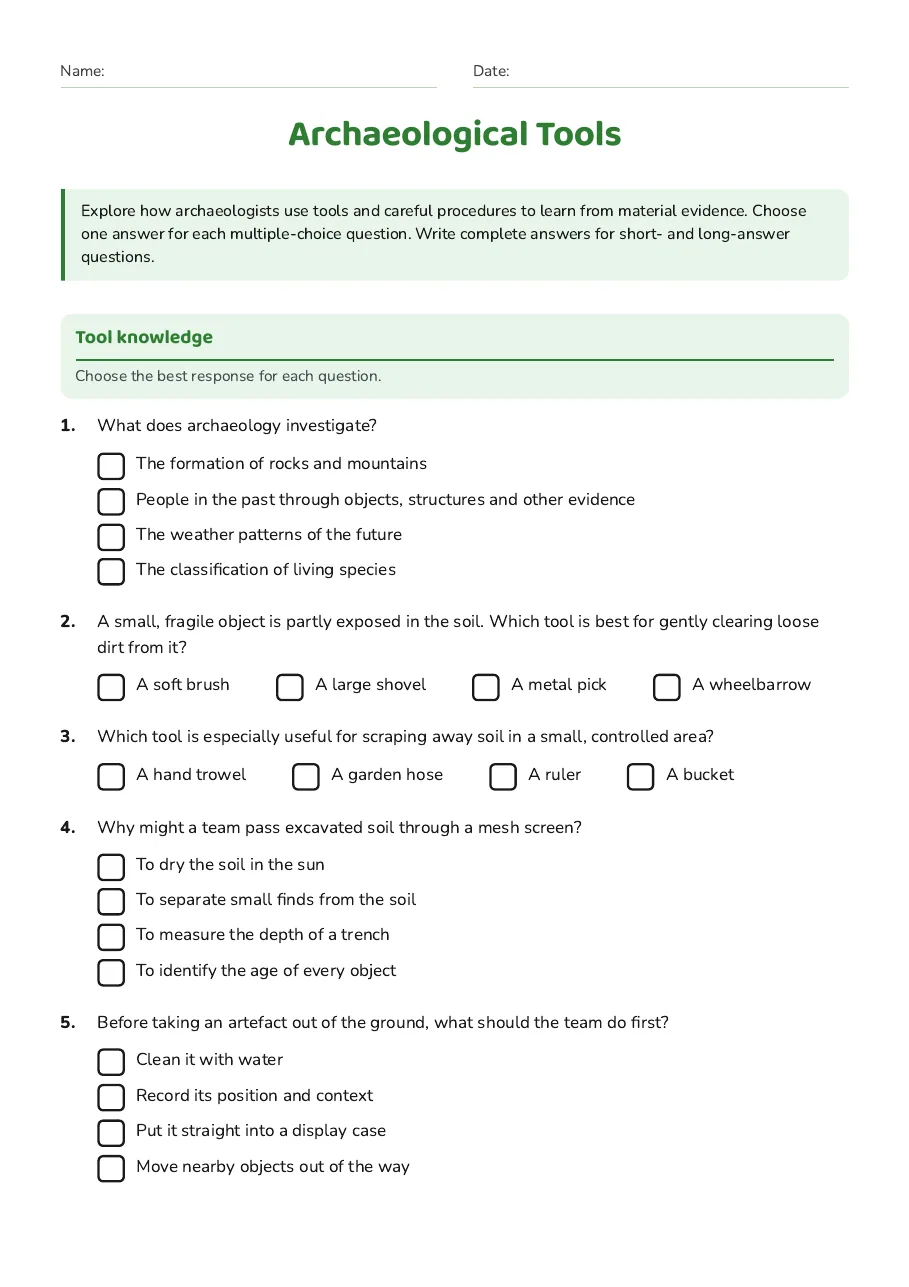
Name:Date:
Archaeological Tools
Explore how archaeologists use tools and careful procedures to learn from material evidence. Choose one answer for each multiple-choice question. Write complete answers for short- and long-answer questions.
Tool knowledge
Choose the best response for each question.
1.What does archaeology investigate?
- The formation of rocks and mountains
- People in the past through objects, structures and other evidence
- The weather patterns of the future
- The classification of living species
2.A small, fragile object is partly exposed in the soil. Which tool is best for gently clearing loose dirt from it?
- A soft brush
- A large shovel
- A metal pick
- A wheelbarrow
3.Which tool is especially useful for scraping away soil in a small, controlled area?
- A hand trowel
- A garden hose
- A ruler
- A bucket
4.Why might a team pass excavated soil through a mesh screen?
- To dry the soil in the sun
- To separate small finds from the soil
- To measure the depth of a trench
- To identify the age of every object
5.Before taking an artefact out of the ground, what should the team do first?
- Clean it with water
- Record its position and context
- Put it straight into a display case
- Move nearby objects out of the way
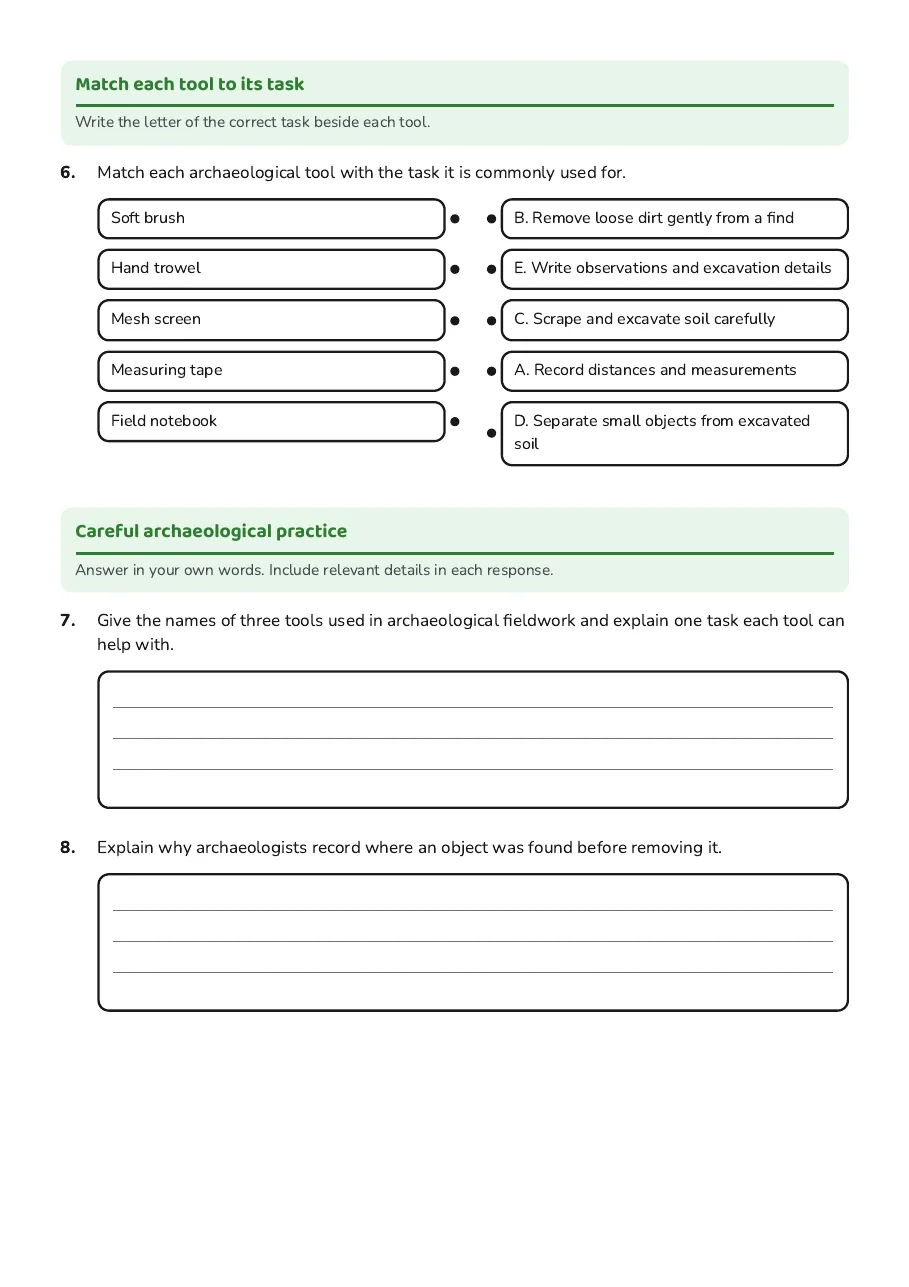
Match each tool to its task
Write the letter of the correct task beside each tool.
6.Match each archaeological tool with the task it is commonly used for.
- Soft brush
- Hand trowel
- Mesh screen
- Measuring tape
- Field notebook
- B. Remove loose dirt gently from a find
- E. Write observations and excavation details
- C. Scrape and excavate soil carefully
- A. Record distances and measurements
- D. Separate small objects from excavated soil
Careful archaeological practice
Answer in your own words. Include relevant details in each response.
7.Give the names of three tools used in archaeological fieldwork and explain one task each tool can help with.
8.Explain why archaeologists record where an object was found before removing it.
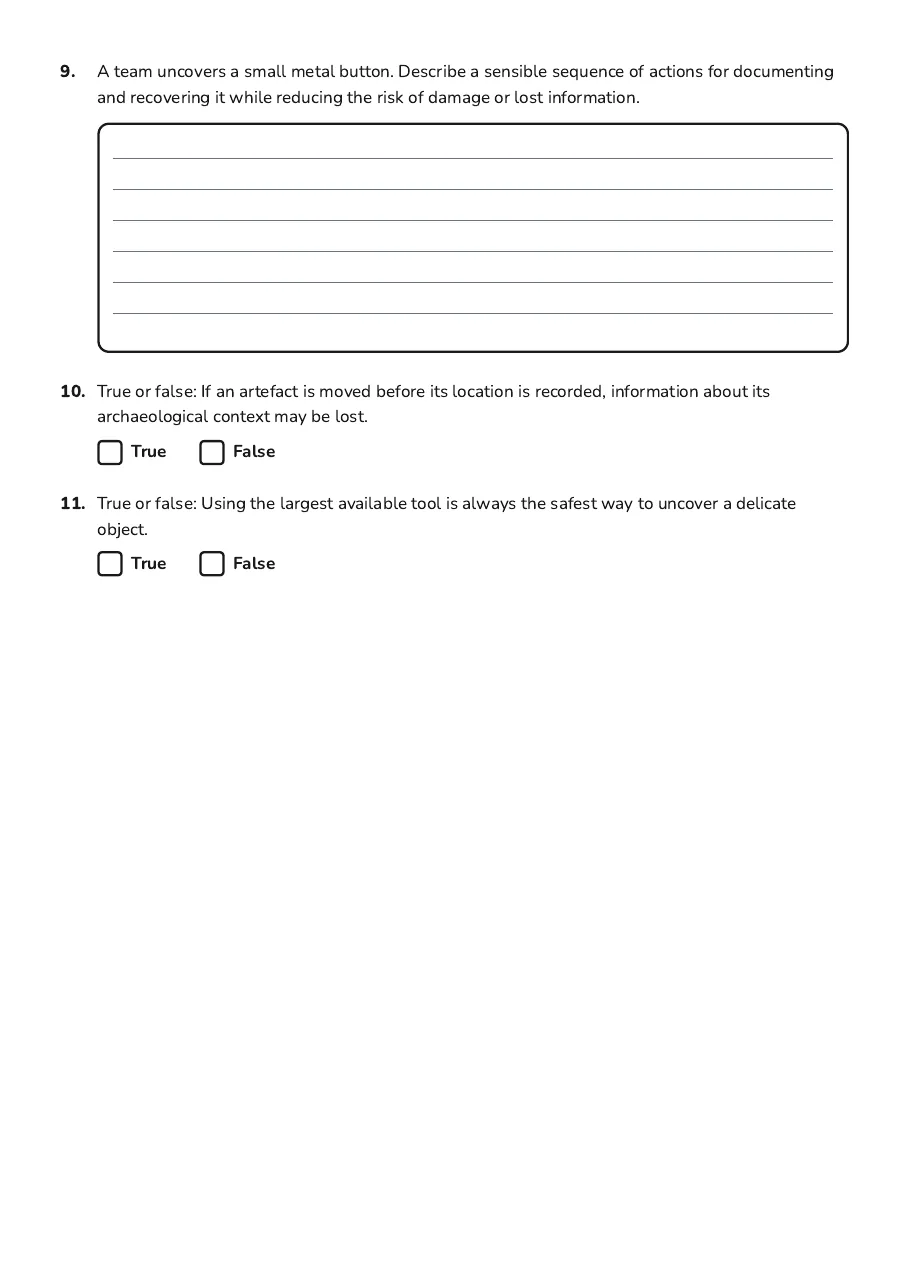
9.A team uncovers a small metal button. Describe a sensible sequence of actions for documenting and recovering it while reducing the risk of damage or lost information.
10.True or false: If an artefact is moved before its location is recorded, information about its archaeological context may be lost.
TrueFalse
11.True or false: Using the largest available tool is always the safest way to uncover a delicate object.
TrueFalse
3 printable pages
Page 1
Page 2
Page 3
About This Worksheet
Free in Kuraplan
Sign up free, grab the PDF, and customize it for your class.
Print-Ready
Formatted for standard paper. Clean layout, easy to read.
AI-Generated
Created with Kuraplan's AI, designed for real classroom use.
For Teachers & Parents
Use in classrooms, for homework, tutoring, or homeschool.
Need a custom version of this worksheet?
Kuraplan's AI generates custom worksheets in seconds — differentiated for every learner, aligned to your curriculum.
Generate Custom Worksheets — Free No credit card Curriculum-aligned Under 60 seconds