Eatock v Bolt Case
A free social sciences worksheet ready for your classroom. Open in Kuraplan to grab the print-ready PDF, customize it for your students, or generate a fresh version in seconds.
Eatock v Bolt Case
📖 Overview of the Case
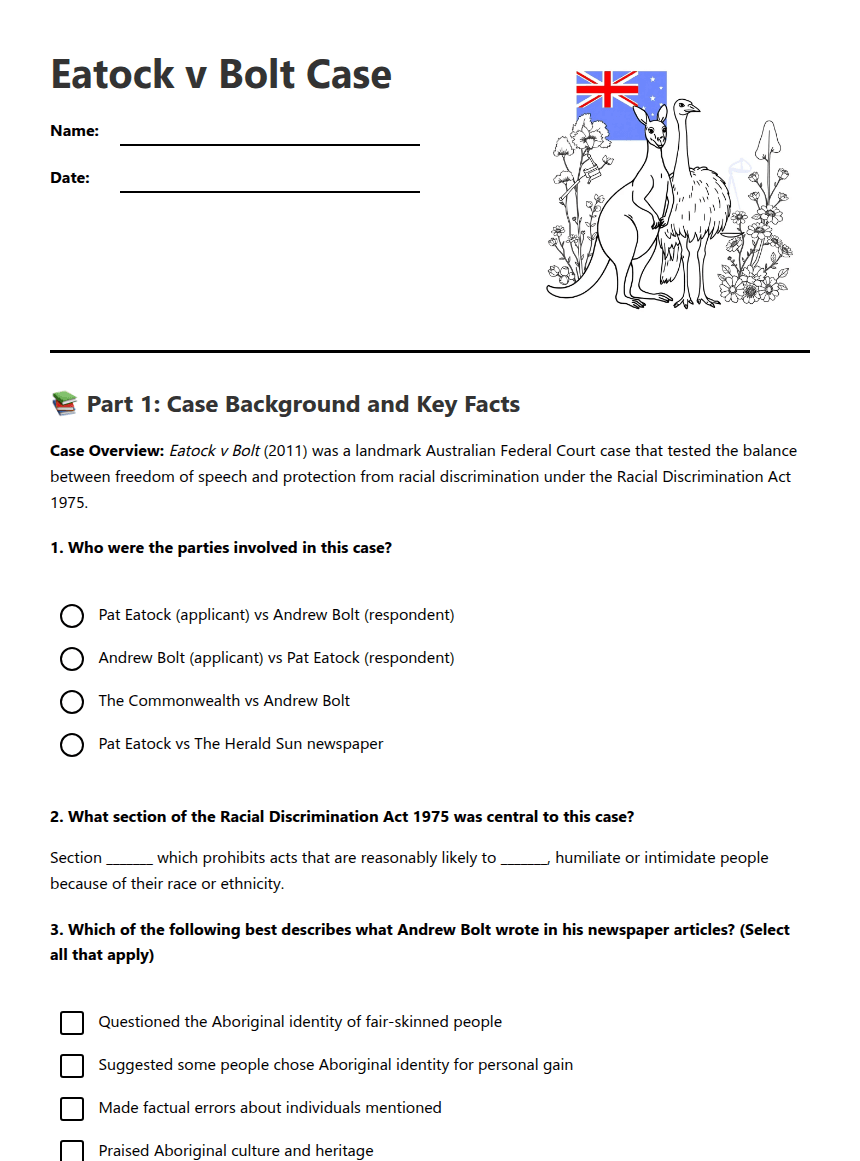
The Eatock v Bolt case, decided in 2011, was a significant legal battle in Australia that examined the conflict between freedom of speech and racial discrimination protections under the Racial Discrimination Act 1975. The case was heard in the Australian Federal Court, highlighting the complexities of balancing these fundamental rights.
📚 Part 1: Case Background and Key Facts
Case Overview: Eatock v Bolt (2011) was a landmark Australian Federal Court case that tested the balance between freedom of speech and protection from racial discrimination under the Racial Discrimination Act 1975.
Section _______ which prohibits acts that are reasonably likely to _______, humiliate or intimidate people because of their race or ethnicity.
⚖️ Part 2: Legal Decision and Reasoning
The court found that Bolt's articles were not protected by Section 18D because they contained _____________ and were not written in _____________ _____________.
🏛️ Part 3: Significance and Impact
Right 1: _________________________________
Right 2: _________________________________
About This Worksheet
Free in Kuraplan
Sign up free, grab the PDF, and customize it for your class.
Print-Ready
Formatted for standard paper. Clean layout, easy to read.
AI-Generated
Created with Kuraplan's AI, designed for real classroom use.
For Teachers & Parents
Use in classrooms, for homework, tutoring, or homeschool.
Need a custom version of this worksheet?
Kuraplan's AI generates custom worksheets in seconds — differentiated for every learner, aligned to your curriculum.
Generate Custom Worksheets — FreeMore Social Sciences Worksheets
Australian Diversity Categories
Free
Commonwealth Constitution Overview
Free
Community Helpers Action Plan
Free
Acknowledgement of Country Exploration
Free
Democracy Benefits and Responsibilities
Free
Democracy in Action Diagram
Free
Treaty Principles Today
Free