EnglishFreePrintable

Audience Awareness Analysis

A free english worksheet ready for your classroom. Open in Kuraplan to grab the print-ready PDF, customize it for your students, or generate a fresh version in seconds.
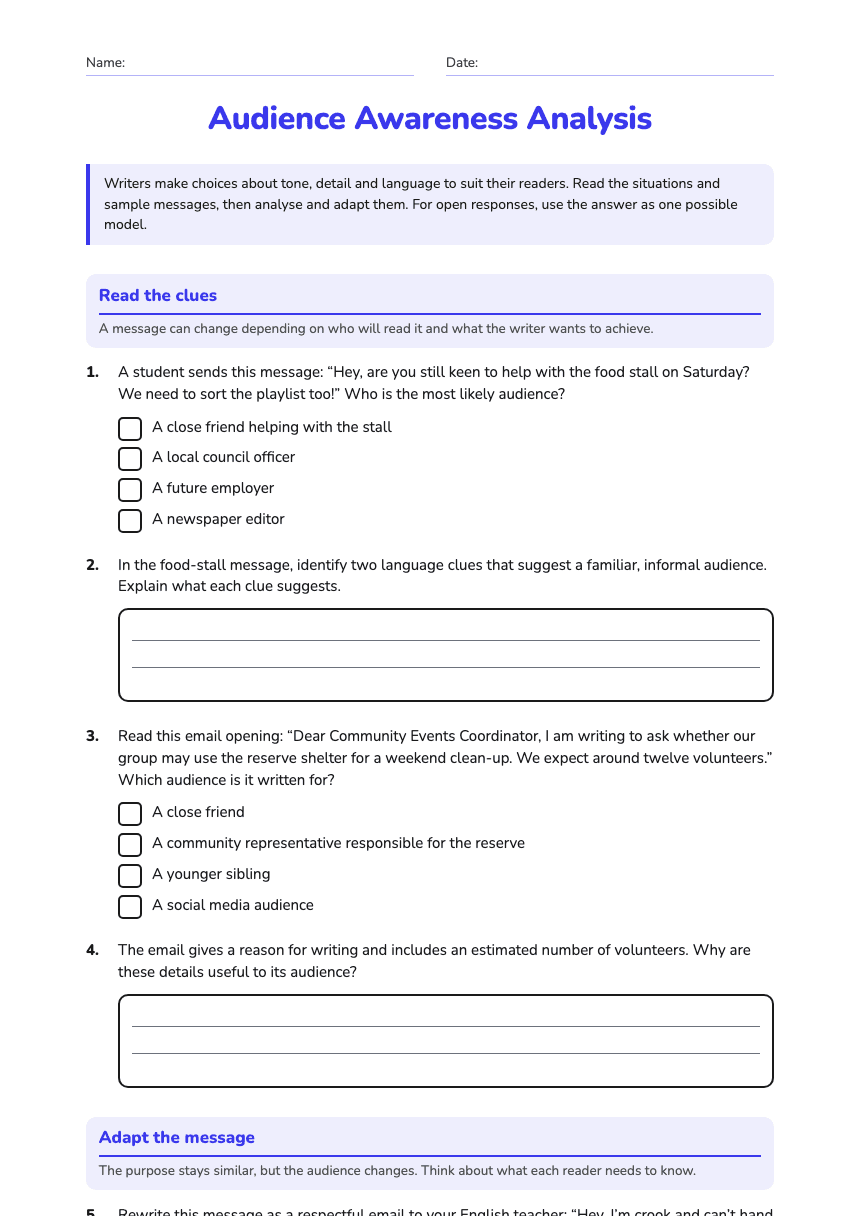
Audience Awareness Analysis worksheet preview
Name:Date:

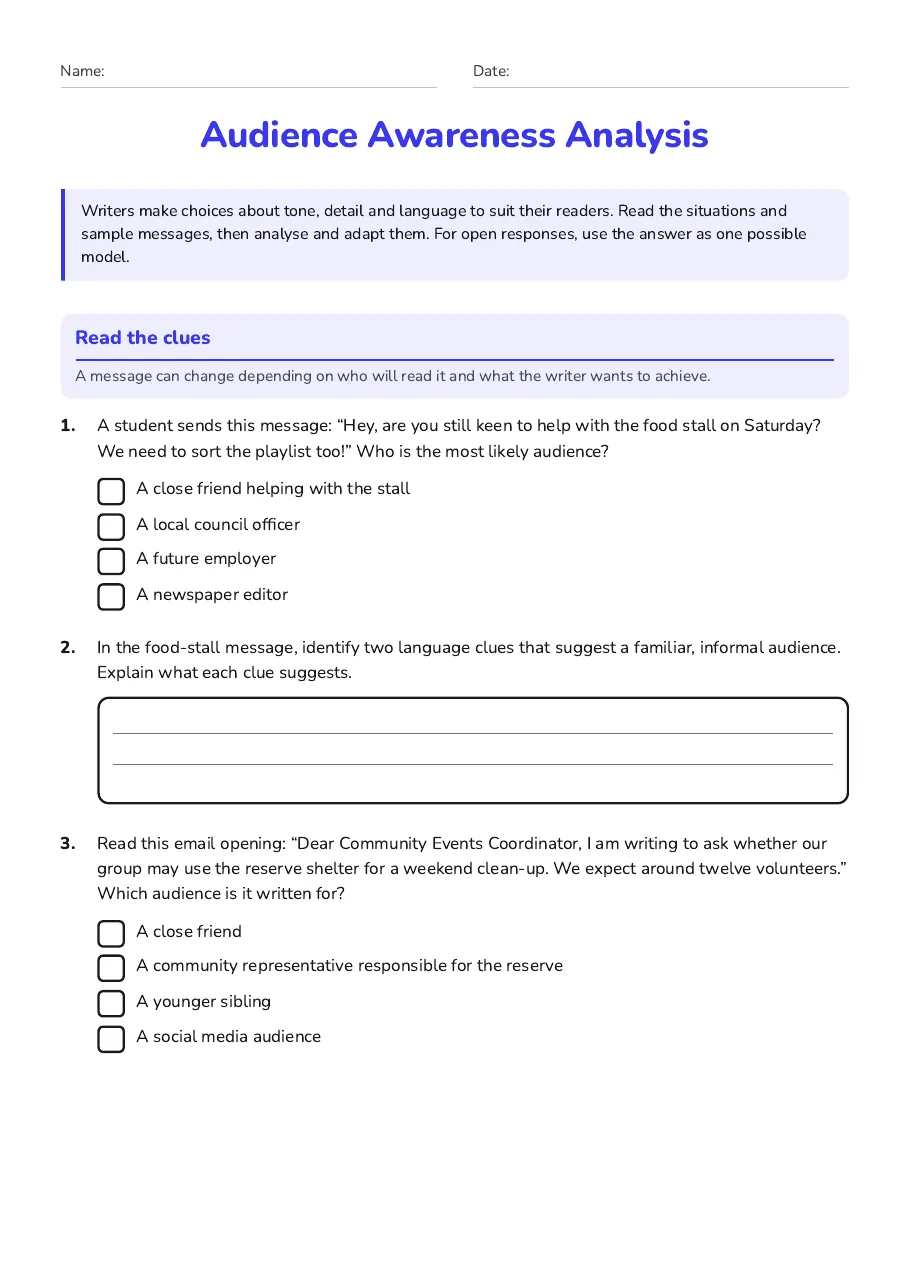
Audience Awareness Analysis

Writers make choices about tone, detail and language to suit their readers. Read the situations and sample messages, then analyse and adapt them. For open responses, use the answer as one possible model.

Read the clues

A message can change depending on who will read it and what the writer wants to achieve.

1.A student sends this message: “Hey, are you still keen to help with the food stall on Saturday? We need to sort the playlist too!” Who is the most likely audience?
  • A close friend helping with the stall
  • A local council officer
  • A future employer
  • A newspaper editor
2.In the food-stall message, identify two language clues that suggest a familiar, informal audience. Explain what each clue suggests.
3.Read this email opening: “Dear Community Events Coordinator, I am writing to ask whether our group may use the reserve shelter for a weekend clean-up. We expect around twelve volunteers.” Which audience is it written for?
  • A close friend
  • A community representative responsible for the reserve
  • A younger sibling
  • A social media audience
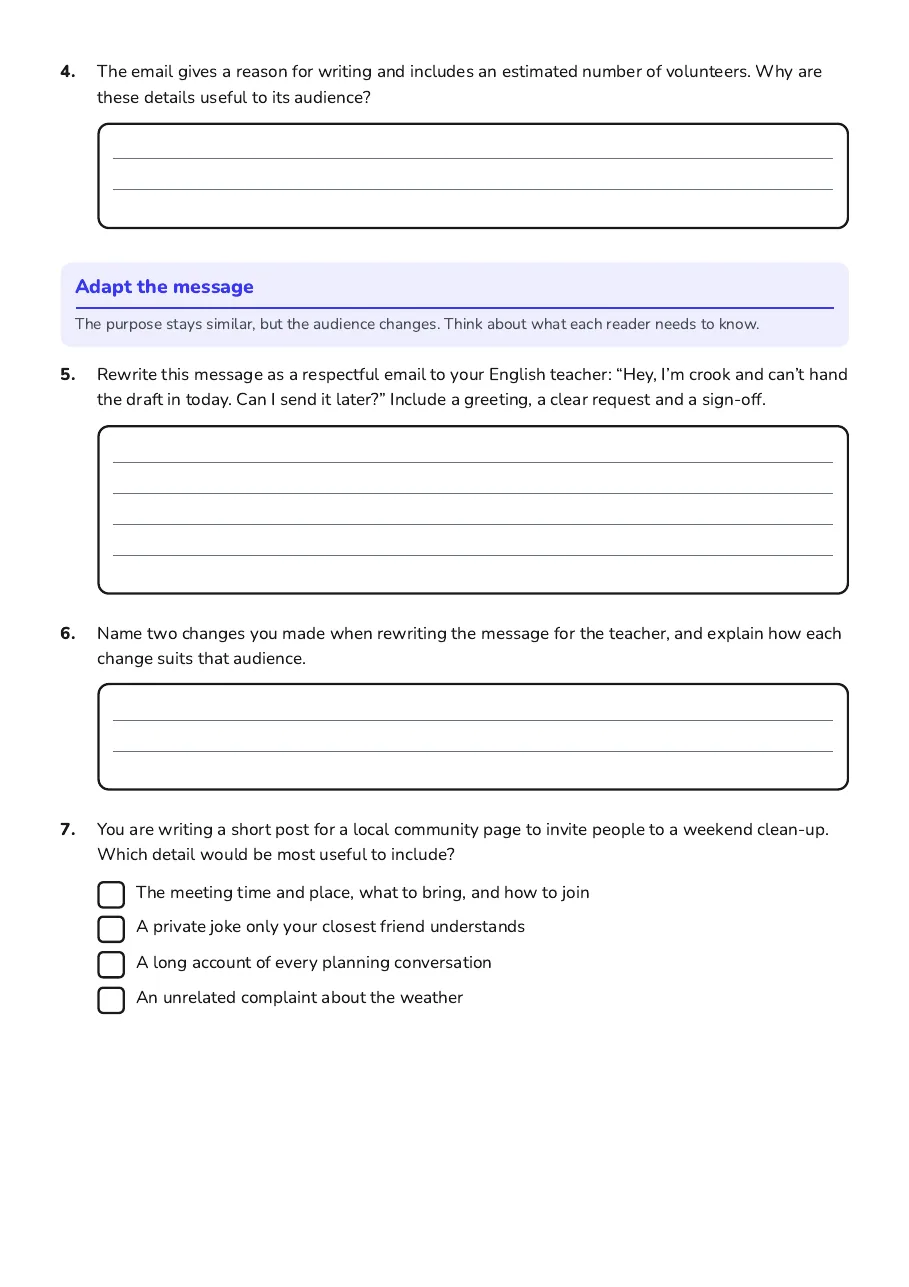
4.The email gives a reason for writing and includes an estimated number of volunteers. Why are these details useful to its audience?

Adapt the message

The purpose stays similar, but the audience changes. Think about what each reader needs to know.

5.Rewrite this message as a respectful email to your English teacher: “Hey, I’m crook and can’t hand the draft in today. Can I send it later?” Include a greeting, a clear request and a sign-off.
6.Name two changes you made when rewriting the message for the teacher, and explain how each change suits that audience.
7.You are writing a short post for a local community page to invite people to a weekend clean-up. Which detail would be most useful to include?
  • The meeting time and place, what to bring, and how to join
  • A private joke only your closest friend understands
  • A long account of every planning conversation
  • An unrelated complaint about the weather
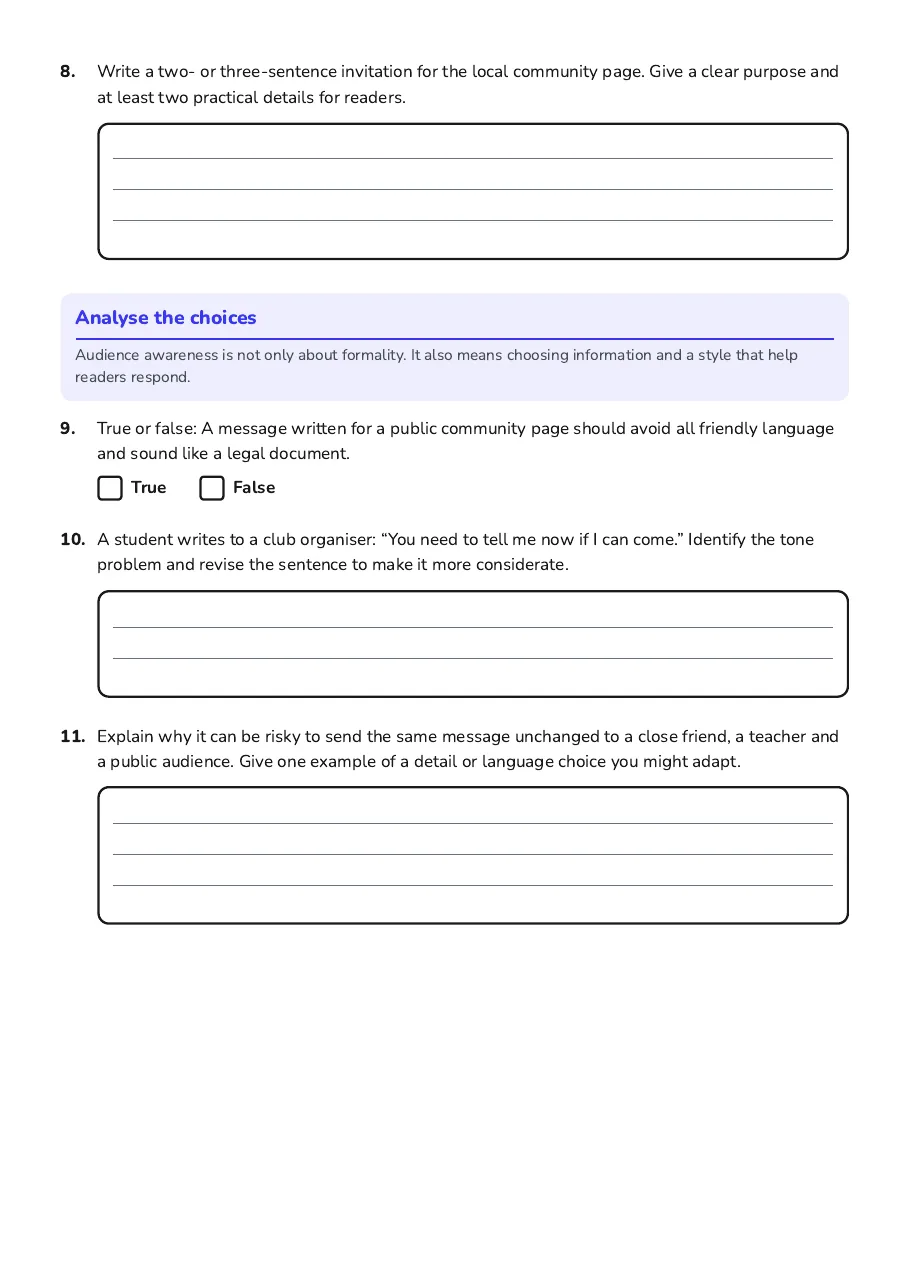
8.Write a two- or three-sentence invitation for the local community page. Give a clear purpose and at least two practical details for readers.

Analyse the choices

Audience awareness is not only about formality. It also means choosing information and a style that help readers respond.

9.True or false: A message written for a public community page should avoid all friendly language and sound like a legal document.
TrueFalse
10.A student writes to a club organiser: “You need to tell me now if I can come.” Identify the tone problem and revise the sentence to make it more considerate.
11.Explain why it can be risky to send the same message unchanged to a close friend, a teacher and a public audience. Give one example of a detail or language choice you might adapt.

3 printable pages

  • Audience Awareness Analysis, page 1 of 3: Read the clues

    Page 1

  • Audience Awareness Analysis, page 2 of 3: Adapt the message

    Page 2

  • Audience Awareness Analysis, page 3 of 3: Analyse the choices

    Page 3

About This Worksheet

Free in Kuraplan

Sign up free, grab the PDF, and customize it for your class.

Print-Ready

Formatted for standard paper. Clean layout, easy to read.

AI-Generated

Created with Kuraplan's AI, designed for real classroom use.

For Teachers & Parents

Use in classrooms, for homework, tutoring, or homeschool.

Need a custom version of this worksheet?

Kuraplan's AI generates custom worksheets in seconds — differentiated for every learner, aligned to your curriculum.

Generate Custom Worksheets — Free
No credit card Curriculum-aligned Under 60 seconds