ScienceFreePrintable

Australian Ecosystem Food Chains

A free science worksheet ready for your classroom. Open in Kuraplan to grab the print-ready PDF, customize it for your students, or generate a fresh version in seconds.
Australian Ecosystem Food Chains worksheet preview
Name:Date:

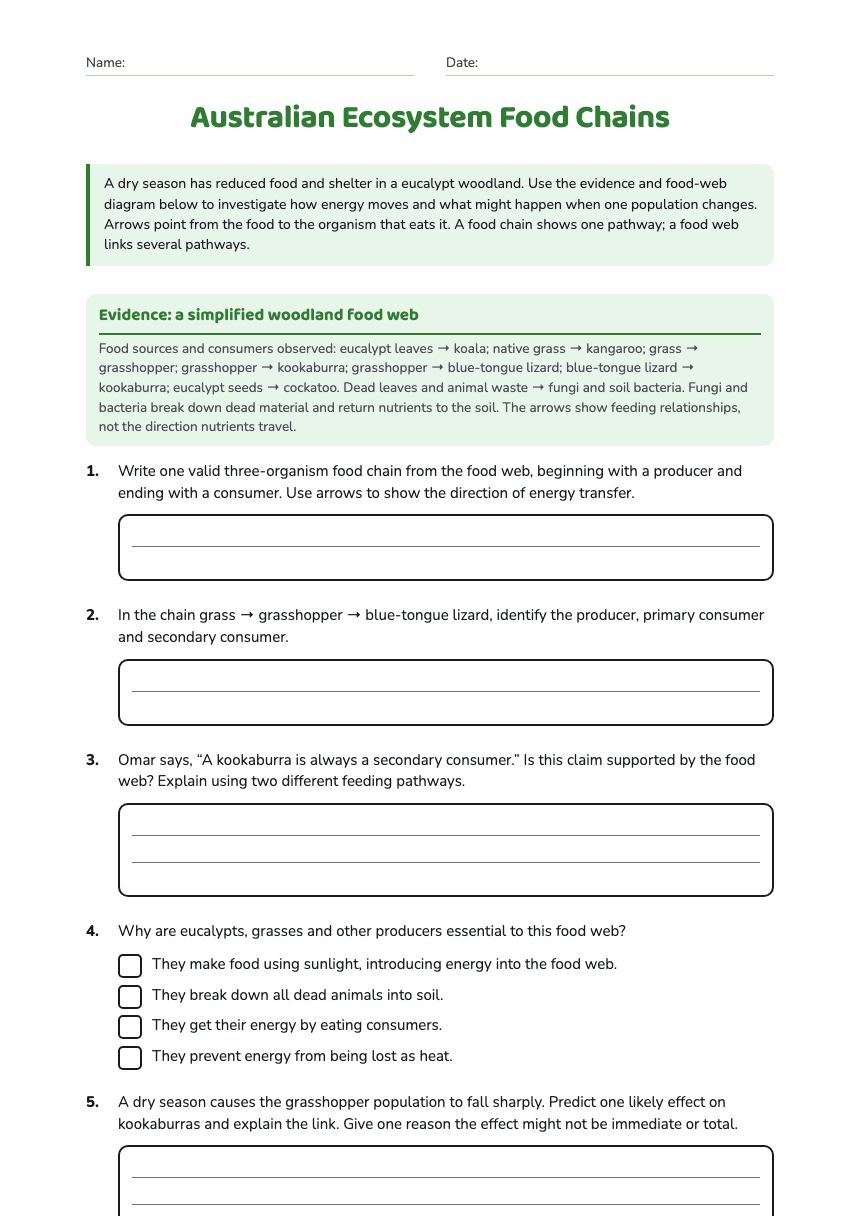
Australian Ecosystem Food Chains

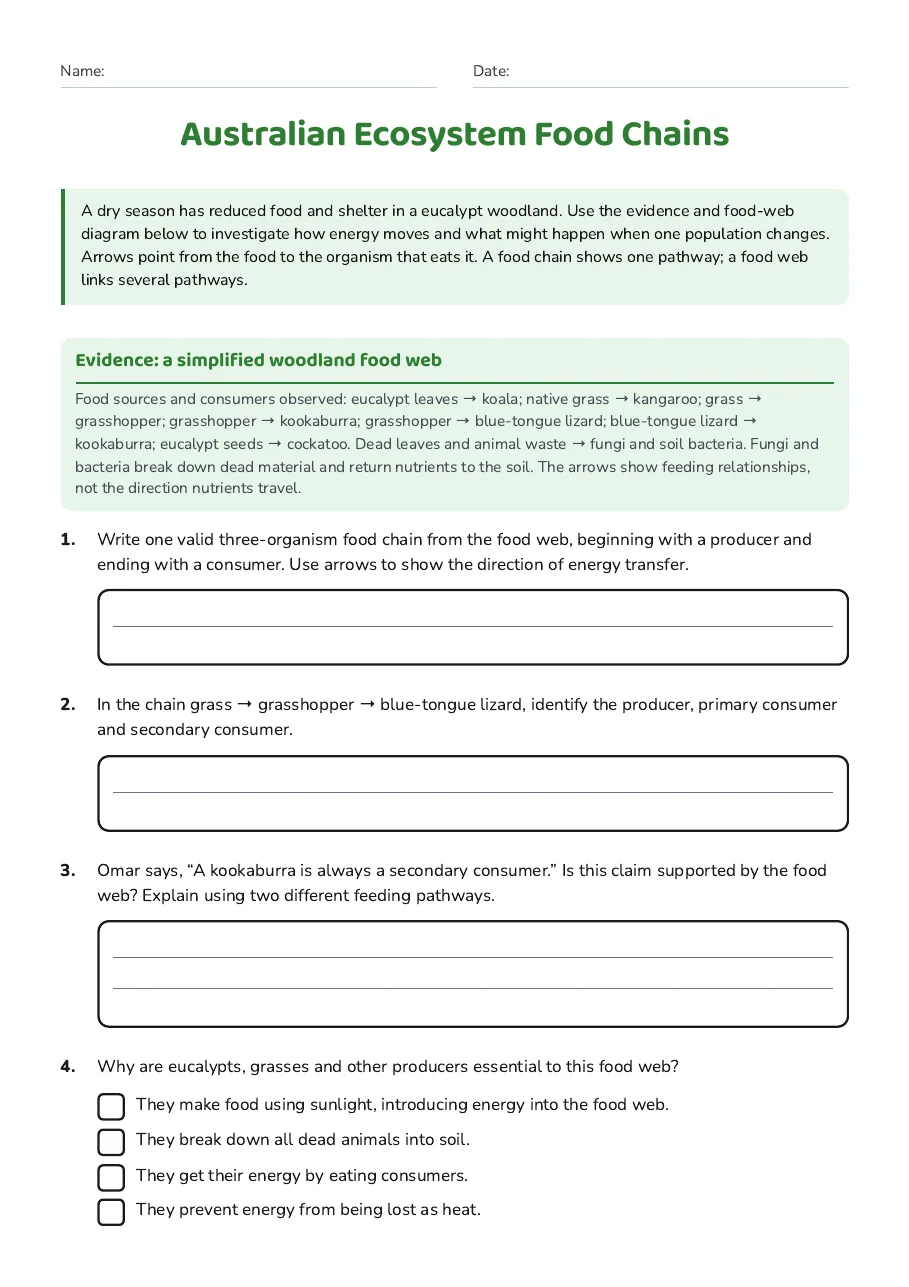
A dry season has reduced food and shelter in a eucalypt woodland. Use the evidence and food-web diagram below to investigate how energy moves and what might happen when one population changes. Arrows point from the food to the organism that eats it. A food chain shows one pathway; a food web links several pathways.

Evidence: a simplified woodland food web

Food sources and consumers observed: eucalypt leaves → koala; native grass → kangaroo; grass → grasshopper; grasshopper → kookaburra; grasshopper → blue-tongue lizard; blue-tongue lizard → kookaburra; eucalypt seeds → cockatoo. Dead leaves and animal waste → fungi and soil bacteria. Fungi and bacteria break down dead material and return nutrients to the soil. The arrows show feeding relationships, not the direction nutrients travel.

1.Write one valid three-organism food chain from the food web, beginning with a producer and ending with a consumer. Use arrows to show the direction of energy transfer.
2.In the chain grass → grasshopper → blue-tongue lizard, identify the producer, primary consumer and secondary consumer.
3.Omar says, “A kookaburra is always a secondary consumer.” Is this claim supported by the food web? Explain using two different feeding pathways.
4.Why are eucalypts, grasses and other producers essential to this food web?
  • They make food using sunlight, introducing energy into the food web.
  • They break down all dead animals into soil.
  • They get their energy by eating consumers.
  • They prevent energy from being lost as heat.
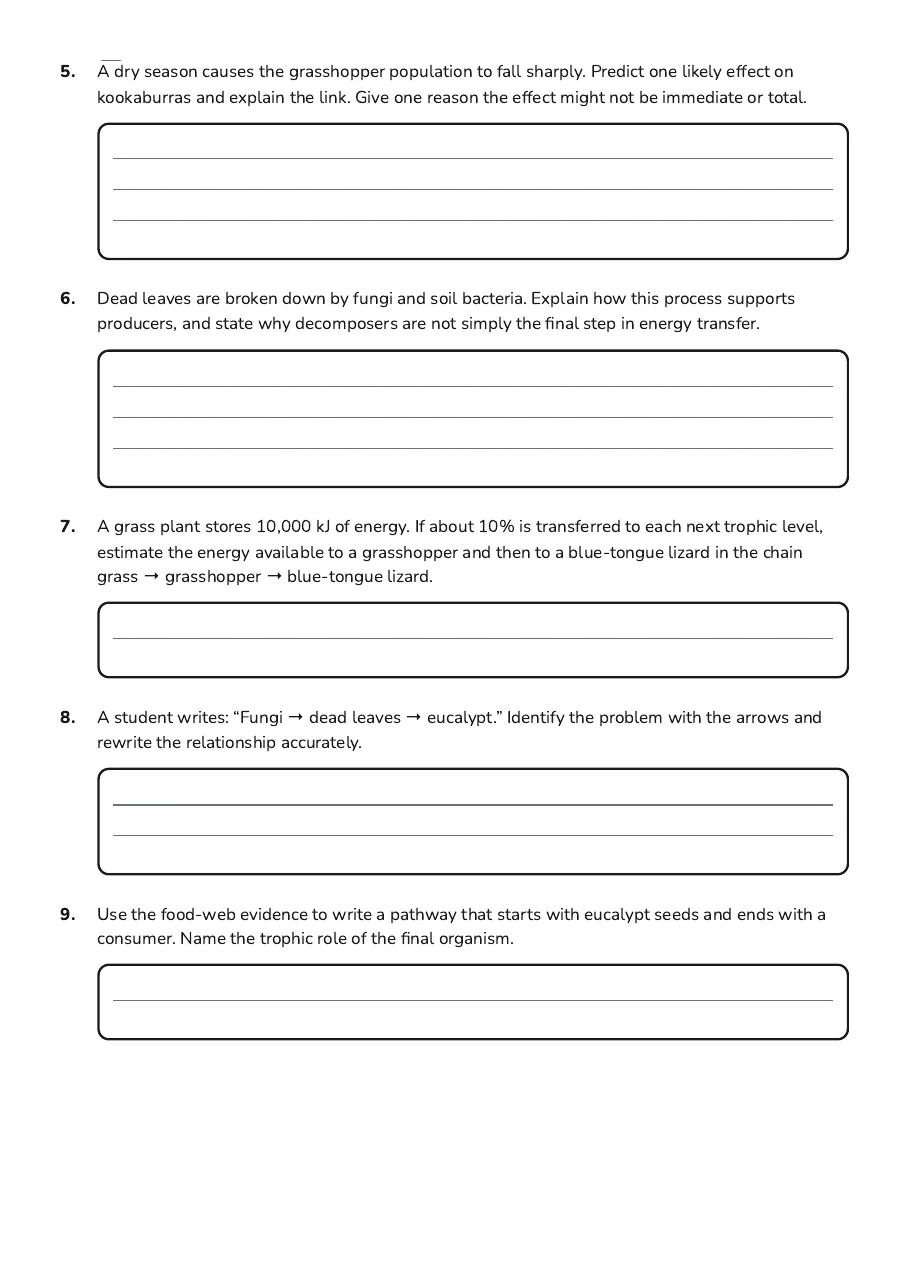
5.A dry season causes the grasshopper population to fall sharply. Predict one likely effect on kookaburras and explain the link. Give one reason the effect might not be immediate or total.
6.Dead leaves are broken down by fungi and soil bacteria. Explain how this process supports producers, and state why decomposers are not simply the final step in energy transfer.
7.A grass plant stores 10,000 kJ of energy. If about 10% is transferred to each next trophic level, estimate the energy available to a grasshopper and then to a blue-tongue lizard in the chain grass → grasshopper → blue-tongue lizard.
8.A student writes: “Fungi → dead leaves → eucalypt.” Identify the problem with the arrows and rewrite the relationship accurately.
9.Use the food-web evidence to write a pathway that starts with eucalypt seeds and ends with a consumer. Name the trophic role of the final organism.
10.In your own words, distinguish a food chain from a food web. Use one example from the woodland evidence.

3 printable pages

  • Australian Ecosystem Food Chains, page 1 of 3: Evidence: a simplified woodland food web

    Page 1

  • Australian Ecosystem Food Chains, page 2 of 3: 5. A dry season causes the grasshopper population to fall sharply. Predict one likely…

    Page 2

  • Australian Ecosystem Food Chains, page 3 of 3: 10. In your own words, distinguish a food chain from a food web. Use one example from the

    Page 3

About This Worksheet

Free in Kuraplan

Sign up free, grab the PDF, and customize it for your class.

Print-Ready

Formatted for standard paper. Clean layout, easy to read.

AI-Generated

Created with Kuraplan's AI, designed for real classroom use.

For Teachers & Parents

Use in classrooms, for homework, tutoring, or homeschool.

Need a custom version of this worksheet?

Kuraplan's AI generates custom worksheets in seconds — differentiated for every learner, aligned to your curriculum.

Generate Custom Worksheets — Free
No credit card Curriculum-aligned Under 60 seconds