Social SciencesFreePrintable

Australia's Constitution Worksheet

A free social sciences worksheet ready for your classroom. Open in Kuraplan to grab the print-ready PDF, customize it for your students, or generate a fresh version in seconds.

Australia's Constitution Worksheet worksheet preview

Australia's Constitution Worksheet

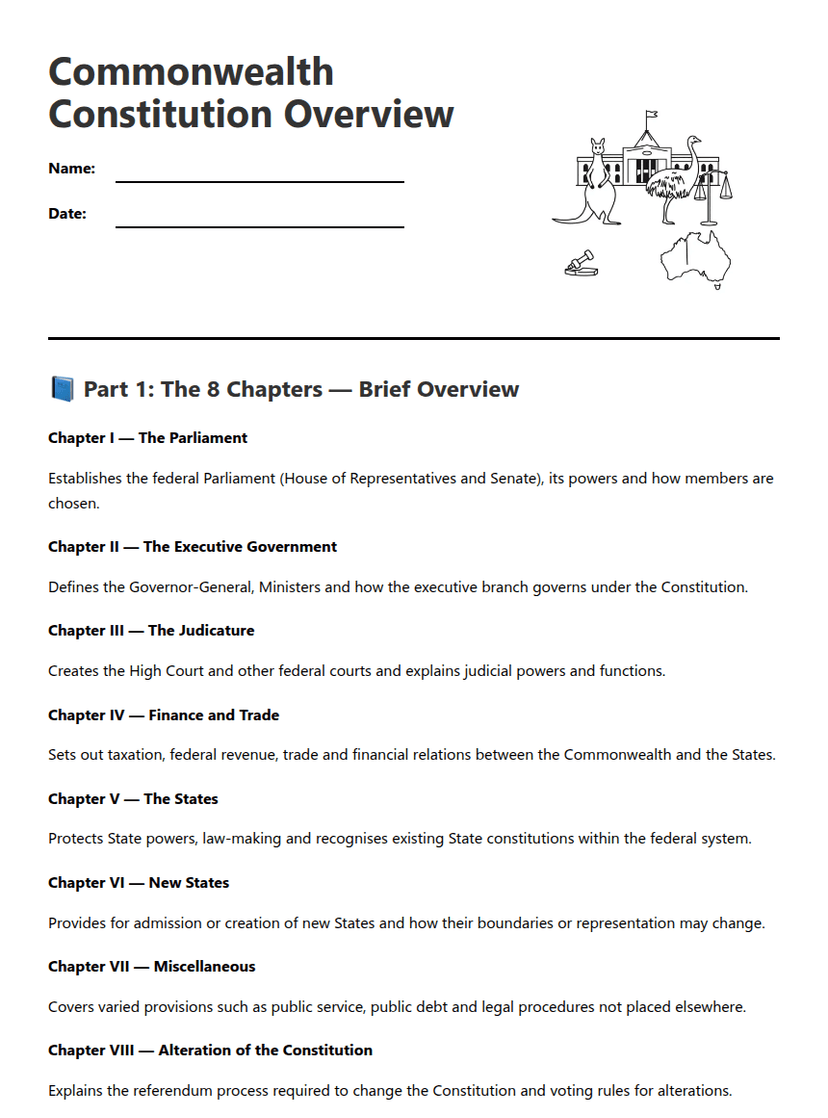
Australian Constitution and High Court building

📚 Part 1: Constitutional Knowledge & Vocabulary

1. Which year did the Australian Constitution come into effect?

1900

1901

1902

1899

2. The separation of powers divides government into three branches. Select all three branches:

Legislative (Parliament)

Executive (Government Ministers)

Judicial (Courts)

Administrative (Public Service)

3. Which court is the final interpreter of the Australian Constitution?

Federal Court of Australia

High Court of Australia

Supreme Court of Queensland

Family Court of Australia

4. Vocabulary Matching: Match each constitutional term with its correct definition by writing the letter in the box.
□ Federalism
□ Implied Rights
□ Concurrent Powers
□ Section 51
A. Powers shared by Commonwealth and State governments
B. Constitutional rights not explicitly written but interpreted by courts
C. Division of power between national and state governments
D. Lists the specific powers of the Commonwealth Parliament

⚖️ Part 2: Case Study Analysis - Koowarta v Bjelke-Petersen (1982)

Background: John Koowarta, an Aboriginal man, attempted to purchase land for his community in Queensland. The Queensland Premier Jock Bjelke-Petersen refused to grant the necessary approval. The Commonwealth Government passed the Racial Discrimination Act 1975, but Queensland argued the Commonwealth had no constitutional power to make such laws.

5. What constitutional power did the Commonwealth Government rely on to pass the Racial Discrimination Act 1975?

Section 51(i) - Trade and commerce power

Section 51(xxix) - External affairs power

Section 51(xxvi) - Race power

Section 109 - Inconsistency clause

6. Explain why this case demonstrates the principle of federalism in action. Include reference to Commonwealth vs State powers.
7. The High Court's decision in Koowarta expanded the Commonwealth's external affairs power. Explain how international treaties can now influence Australian domestic law as a result of this case.
8. Critical Analysis: Do you think the High Court made the correct decision in this case? Provide two reasons to support your view, considering both legal principles and social justice outcomes.

🏛️ Part 3: Constitutional Principles in Practice

9. Complete the following statement about Section 109 of the Constitution:

When a Commonwealth law and a State law are _________________, the _________________ law prevails to the extent of the inconsistency.

10. Explain how the separation of powers protects democracy in Australia. Give one specific example of how this works in practice.
11. Constitutional Amendment: Describe the process required to change the Australian Constitution and explain why this process makes constitutional change difficult to achieve.

Success Criteria:

• Demonstrate understanding of key constitutional principles
• Analyse the Koowarta case and its significance for federalism
• Explain the role of the High Court in constitutional interpretation
• Use appropriate legal terminology accurately

About This Worksheet

Free in Kuraplan

Sign up free, grab the PDF, and customize it for your class.

Print-Ready

Formatted for standard paper. Clean layout, easy to read.

AI-Generated

Created with Kuraplan's AI, designed for real classroom use.

For Teachers & Parents

Use in classrooms, for homework, tutoring, or homeschool.

Need a custom version of this worksheet?

Kuraplan's AI generates custom worksheets in seconds — differentiated for every learner, aligned to your curriculum.

Generate Custom Worksheets — Free
No credit card Curriculum-aligned Under 60 seconds