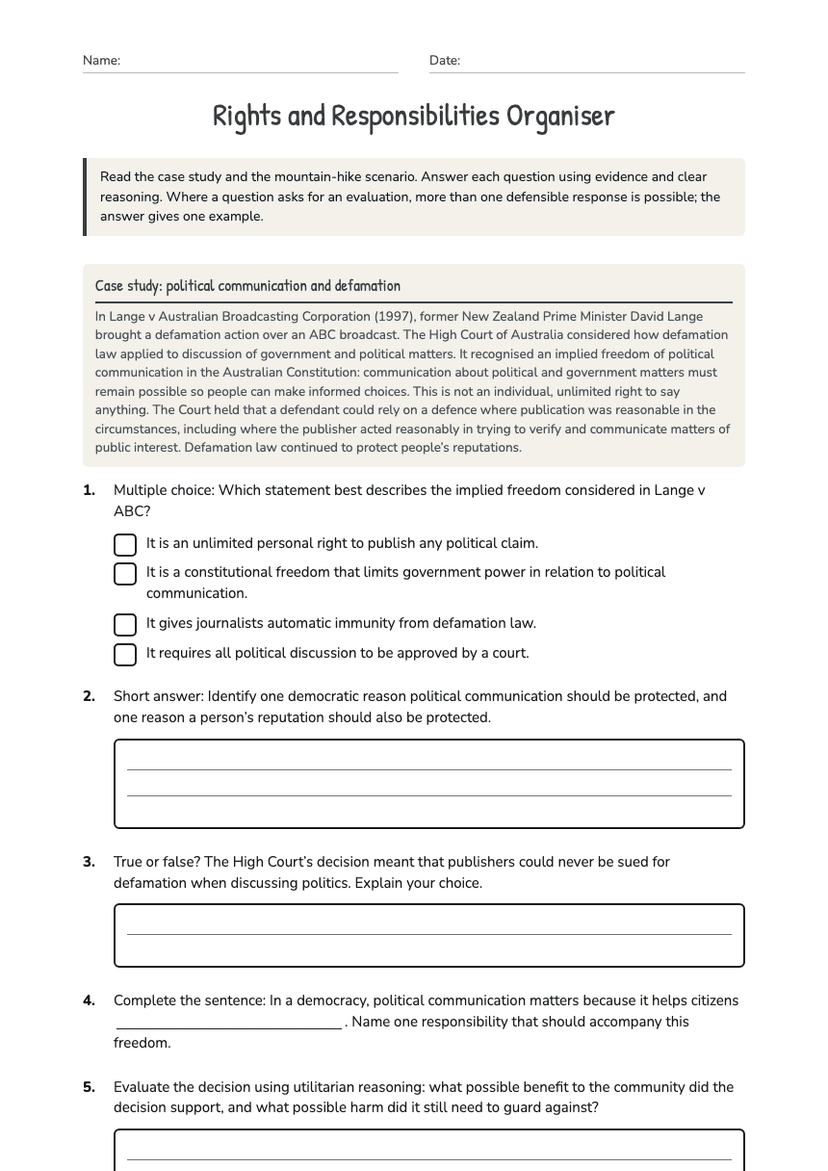
Law Reform Evaluation Organiser
A free social sciences worksheet ready for your classroom. Open in Kuraplan to grab the print-ready PDF, customize it for your students, or generate a fresh version in seconds.
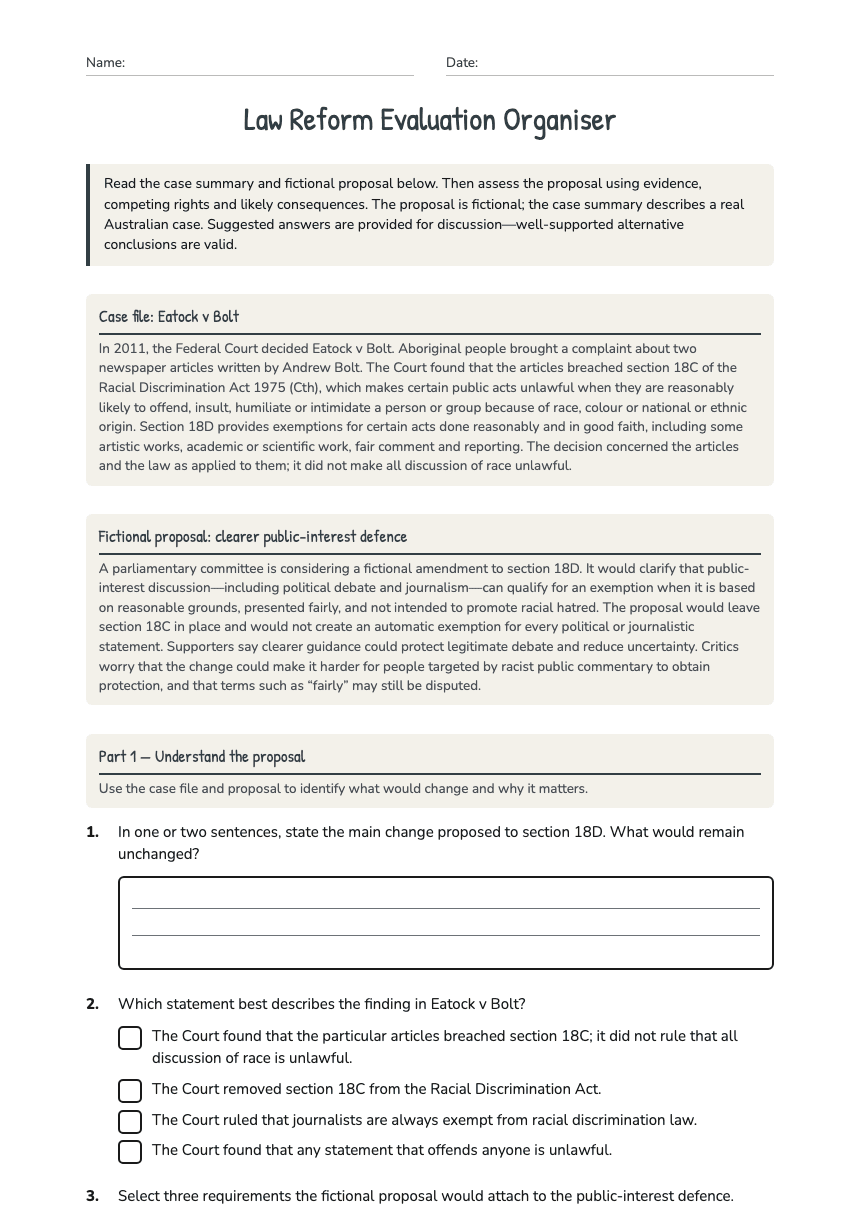
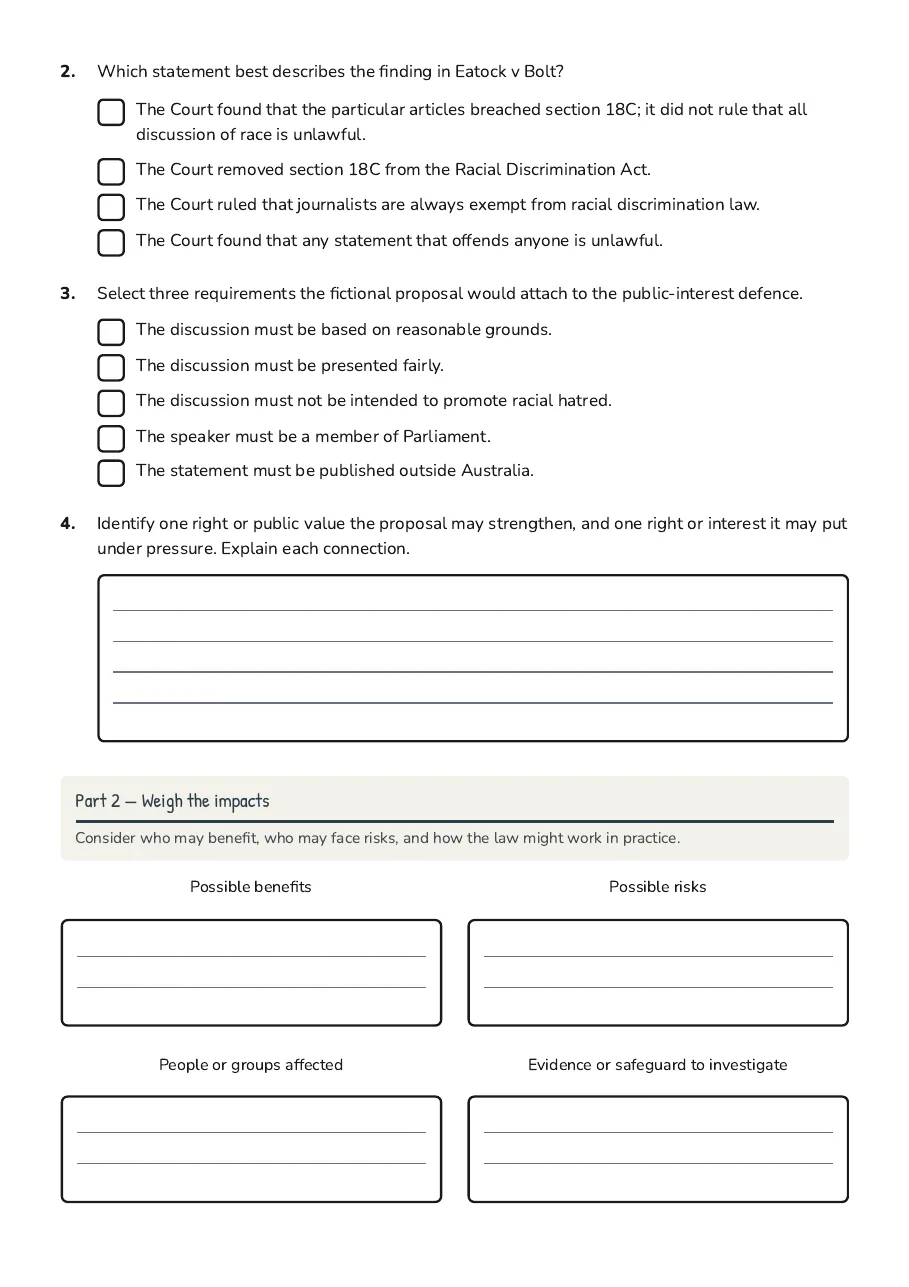
Law Reform Evaluation Organiser
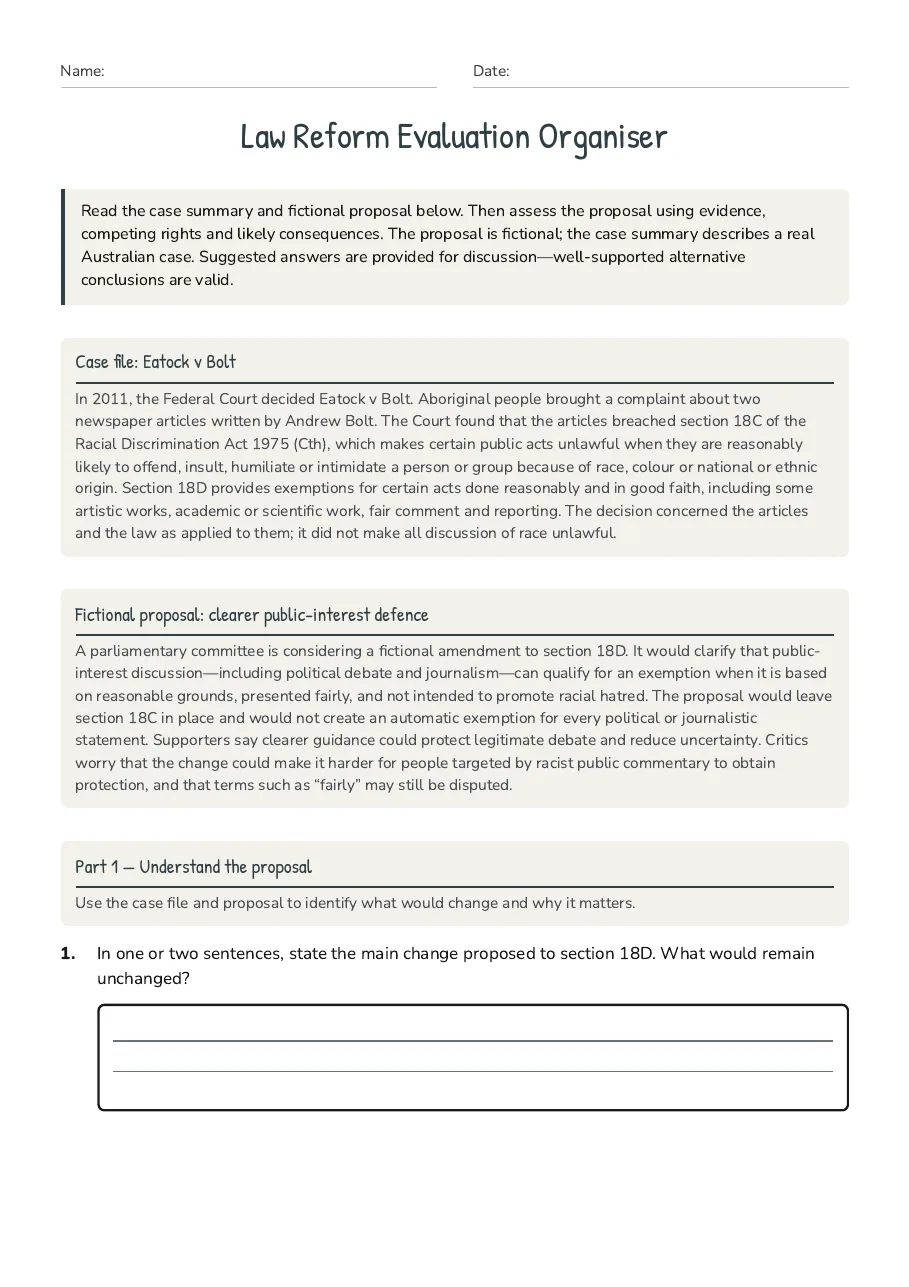
Case file: Eatock v Bolt
In 2011, the Federal Court decided Eatock v Bolt. Aboriginal people brought a complaint about two newspaper articles written by Andrew Bolt. The Court found that the articles breached section 18C of the Racial Discrimination Act 1975 (Cth), which makes certain public acts unlawful when they are reasonably likely to offend, insult, humiliate or intimidate a person or group because of race, colour or national or ethnic origin. Section 18D provides exemptions for certain acts done reasonably and in good faith, including some artistic works, academic or scientific work, fair comment and reporting. The decision concerned the articles and the law as applied to them; it did not make all discussion of race unlawful.
Fictional proposal: clearer public-interest defence
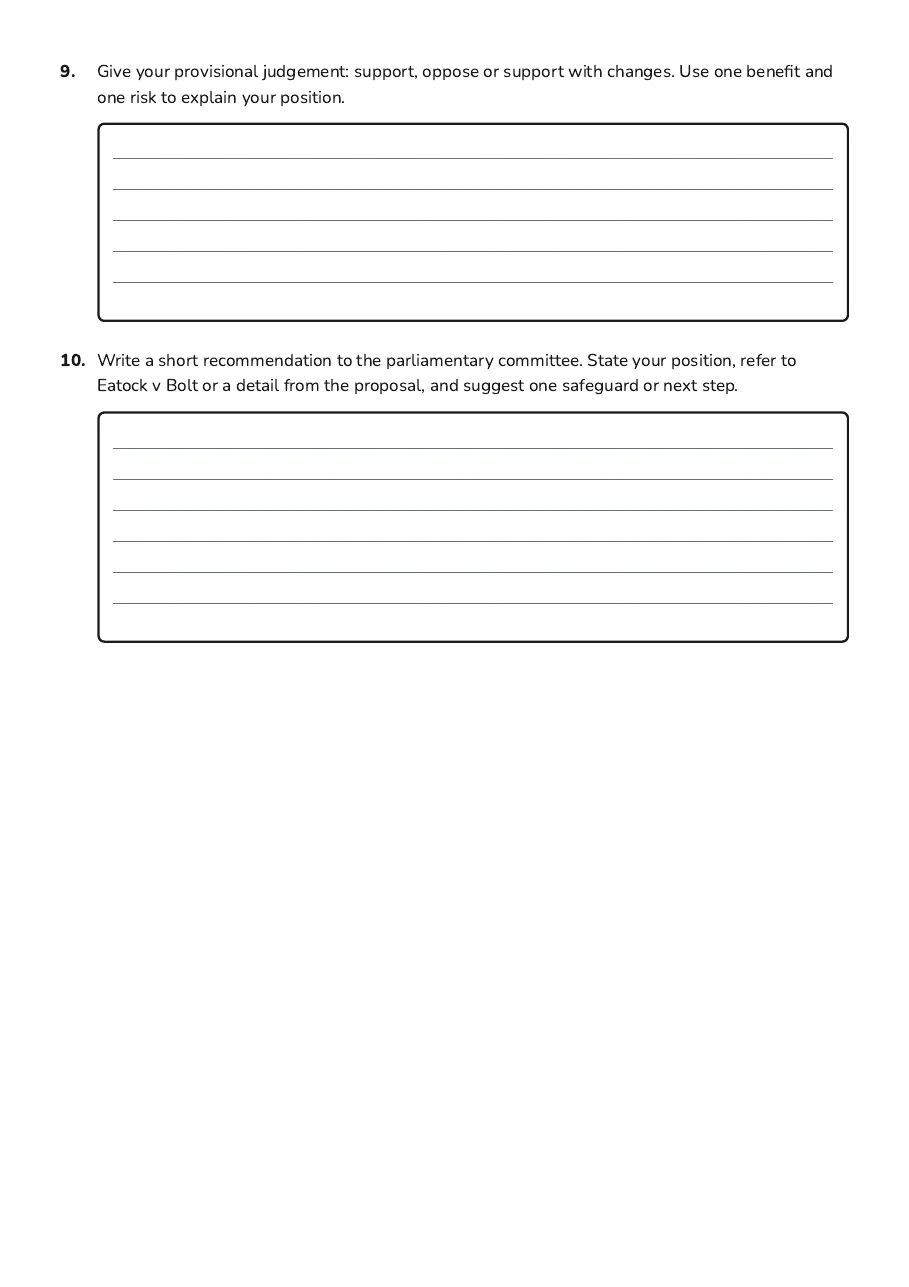
A parliamentary committee is considering a fictional amendment to section 18D. It would clarify that public-interest discussion—including political debate and journalism—can qualify for an exemption when it is based on reasonable grounds, presented fairly, and not intended to promote racial hatred. The proposal would leave section 18C in place and would not create an automatic exemption for every political or journalistic statement. Supporters say clearer guidance could protect legitimate debate and reduce uncertainty. Critics worry that the change could make it harder for people targeted by racist public commentary to obtain protection, and that terms such as “fairly” may still be disputed.
Part 1 — Understand the proposal
Use the case file and proposal to identify what would change and why it matters.
- The Court found that the particular articles breached section 18C; it did not rule that all discussion of race is unlawful.
- The Court removed section 18C from the Racial Discrimination Act.
- The Court ruled that journalists are always exempt from racial discrimination law.
- The Court found that any statement that offends anyone is unlawful.
- The discussion must be based on reasonable grounds.
- The discussion must be presented fairly.
- The discussion must not be intended to promote racial hatred.
- The speaker must be a member of Parliament.
- The statement must be published outside Australia.
Part 2 — Weigh the impacts
Consider who may benefit, who may face risks, and how the law might work in practice.
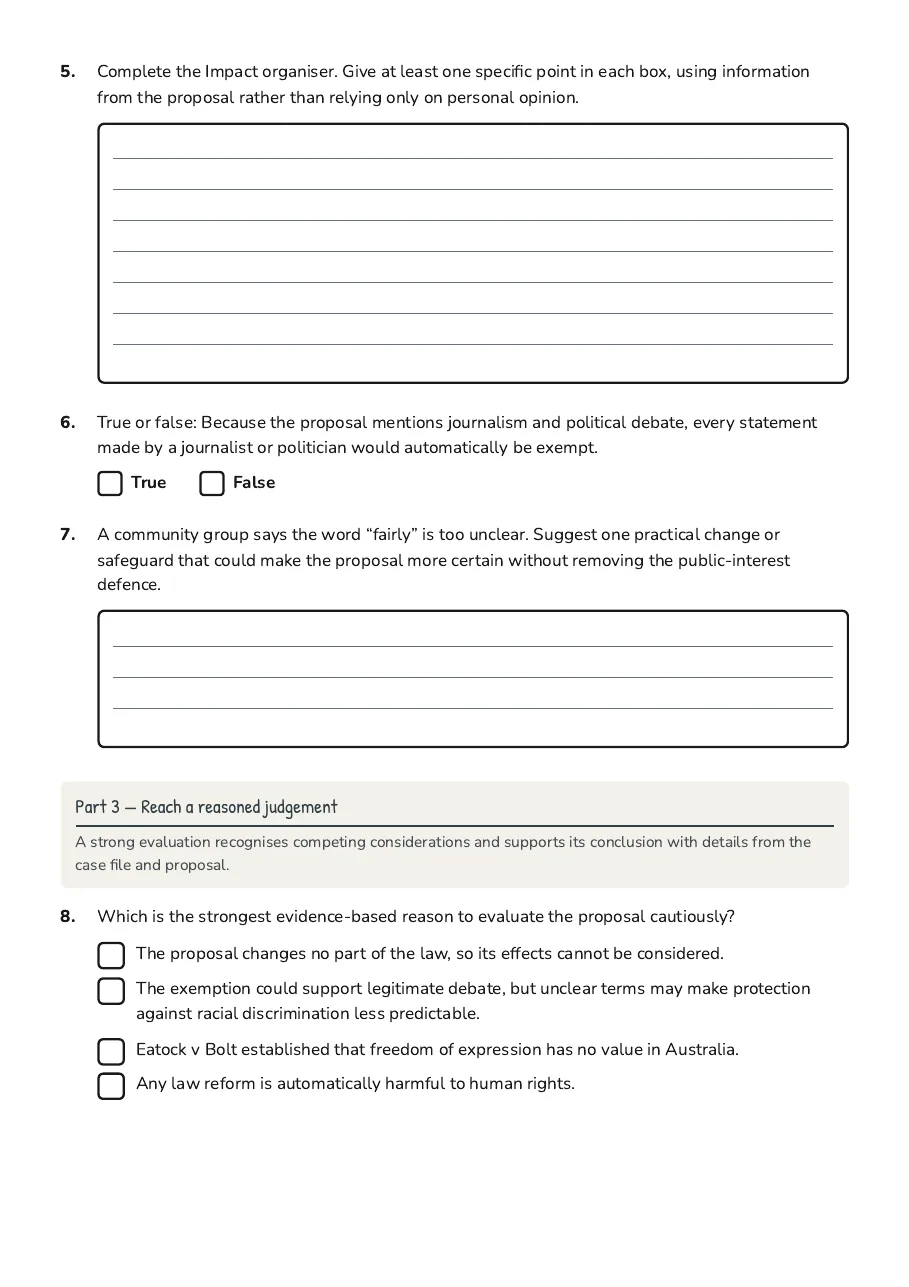
Possible benefits
Possible risks
People or groups affected
Evidence or safeguard to investigate
Part 3 — Reach a reasoned judgement
A strong evaluation recognises competing considerations and supports its conclusion with details from the case file and proposal.
- The proposal changes no part of the law, so its effects cannot be considered.
- The exemption could support legitimate debate, but unclear terms may make protection against racial discrimination less predictable.
- Eatock v Bolt established that freedom of expression has no value in Australia.
- Any law reform is automatically harmful to human rights.
4 printable pages
Page 1
Page 2
Page 3
Page 4
About This Worksheet
Free in Kuraplan
Sign up free, grab the PDF, and customize it for your class.
Print-Ready
Formatted for standard paper. Clean layout, easy to read.
AI-Generated
Created with Kuraplan's AI, designed for real classroom use.
For Teachers & Parents
Use in classrooms, for homework, tutoring, or homeschool.
Need a custom version of this worksheet?
Kuraplan's AI generates custom worksheets in seconds — differentiated for every learner, aligned to your curriculum.
Generate Custom Worksheets — FreeMore Social Sciences Worksheets
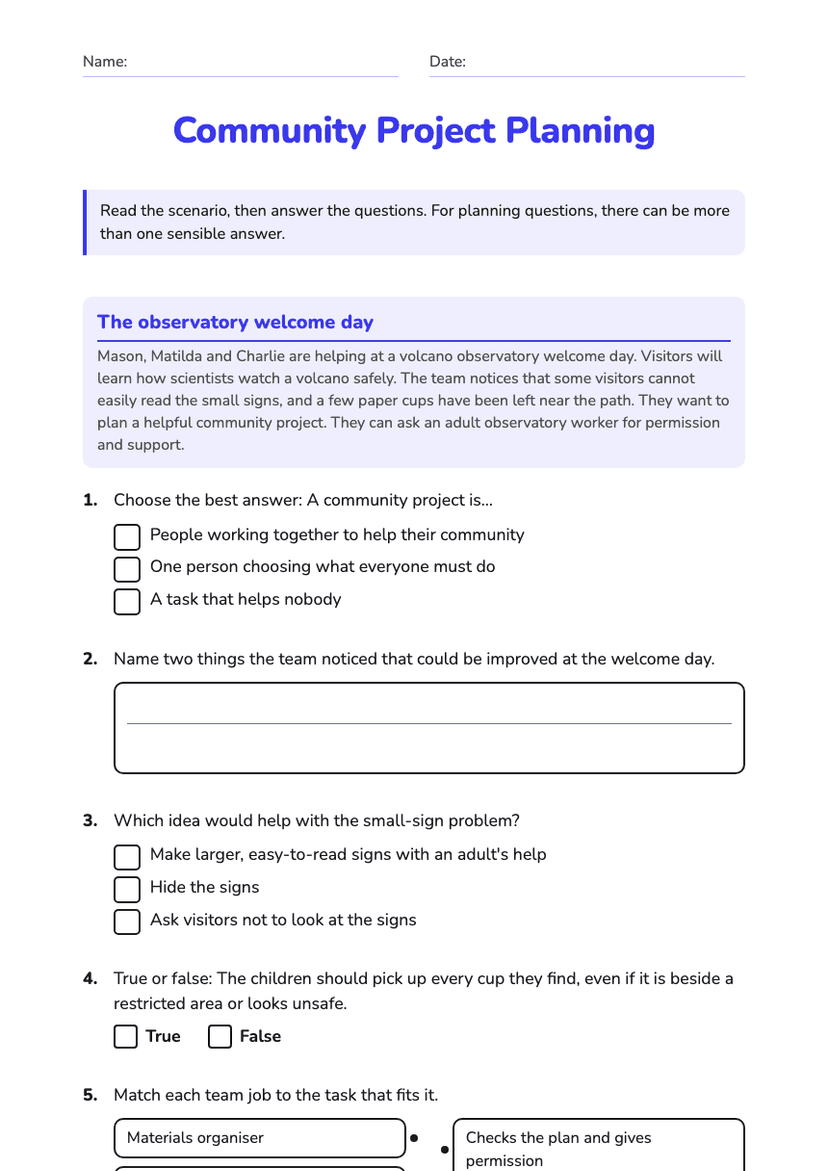
Community Project Planning
Free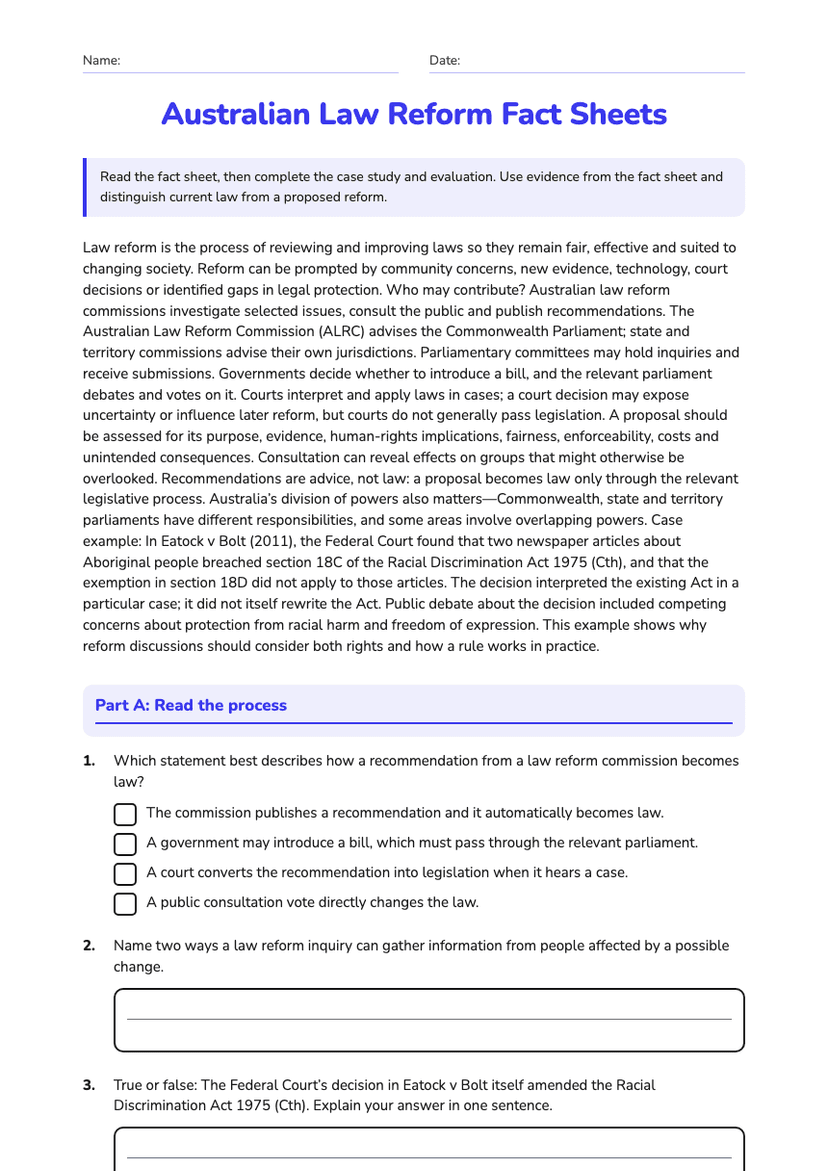
Australian Law Reform Fact Sheets
Free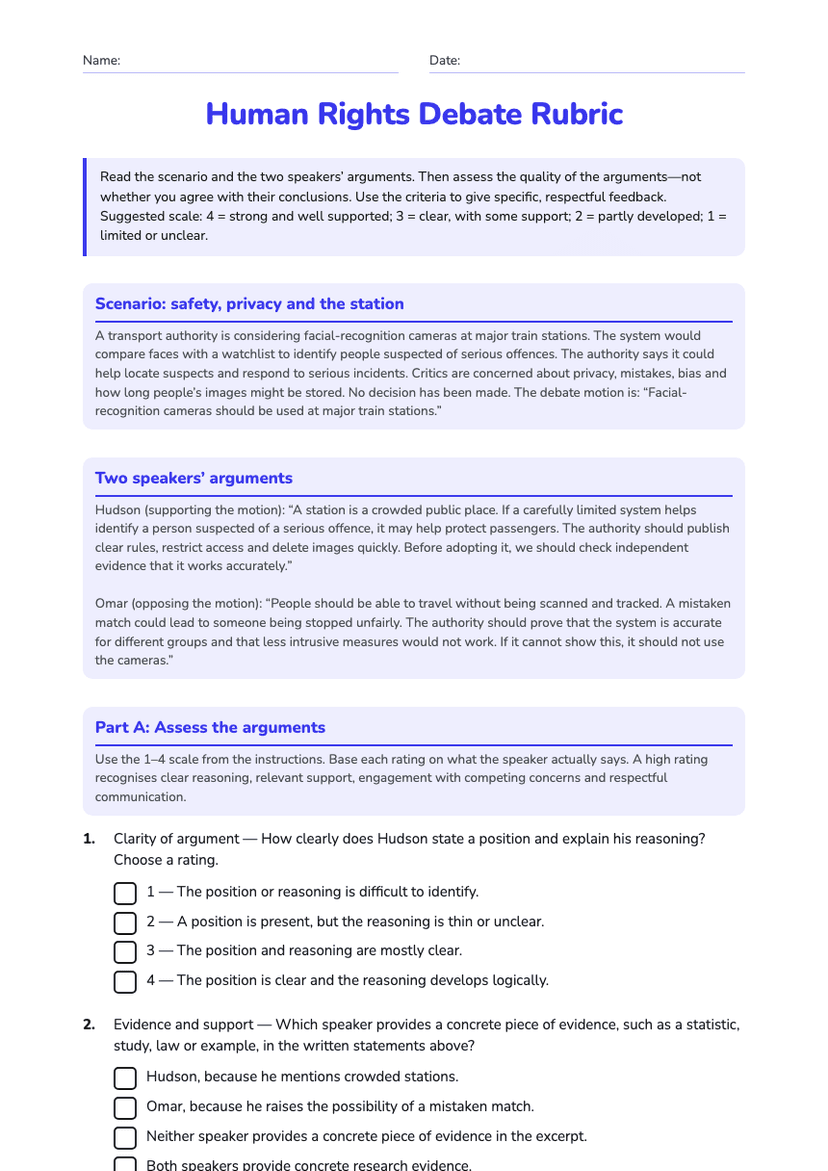
Human Rights Debate Rubric
Free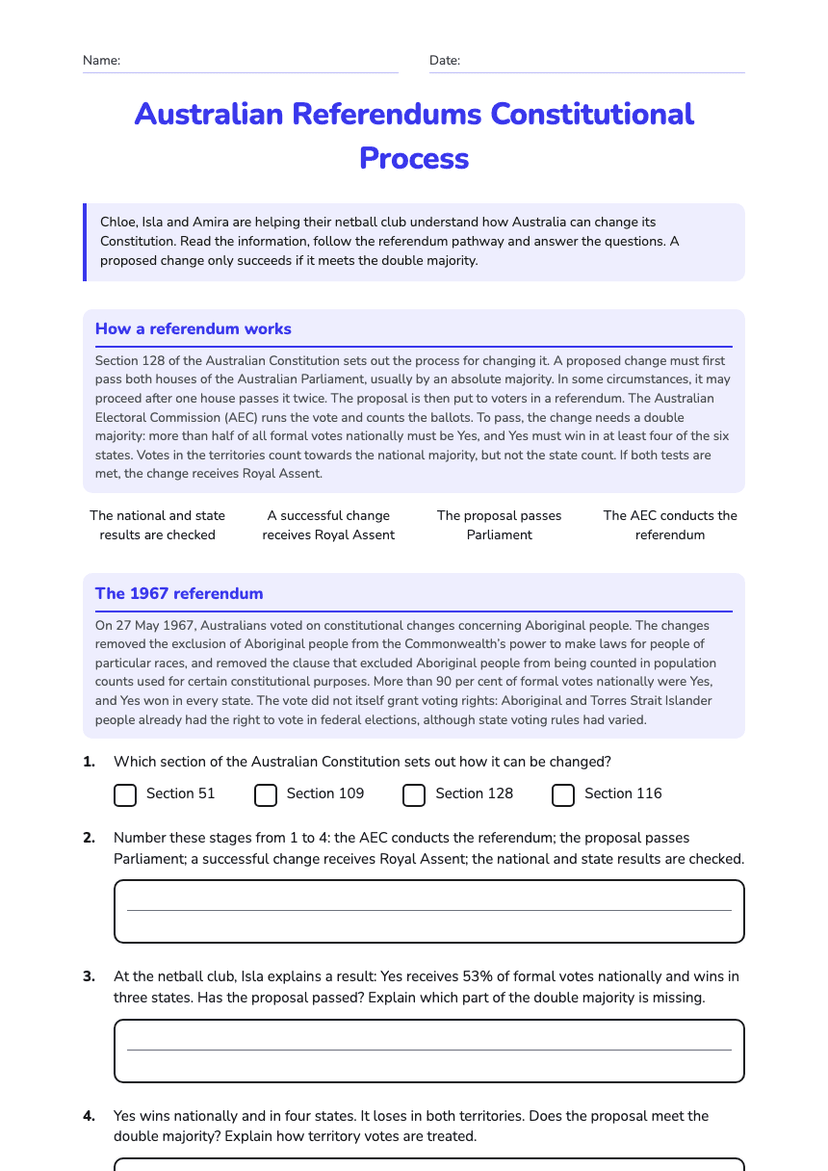
Australian Referendums Constitutional Process
Free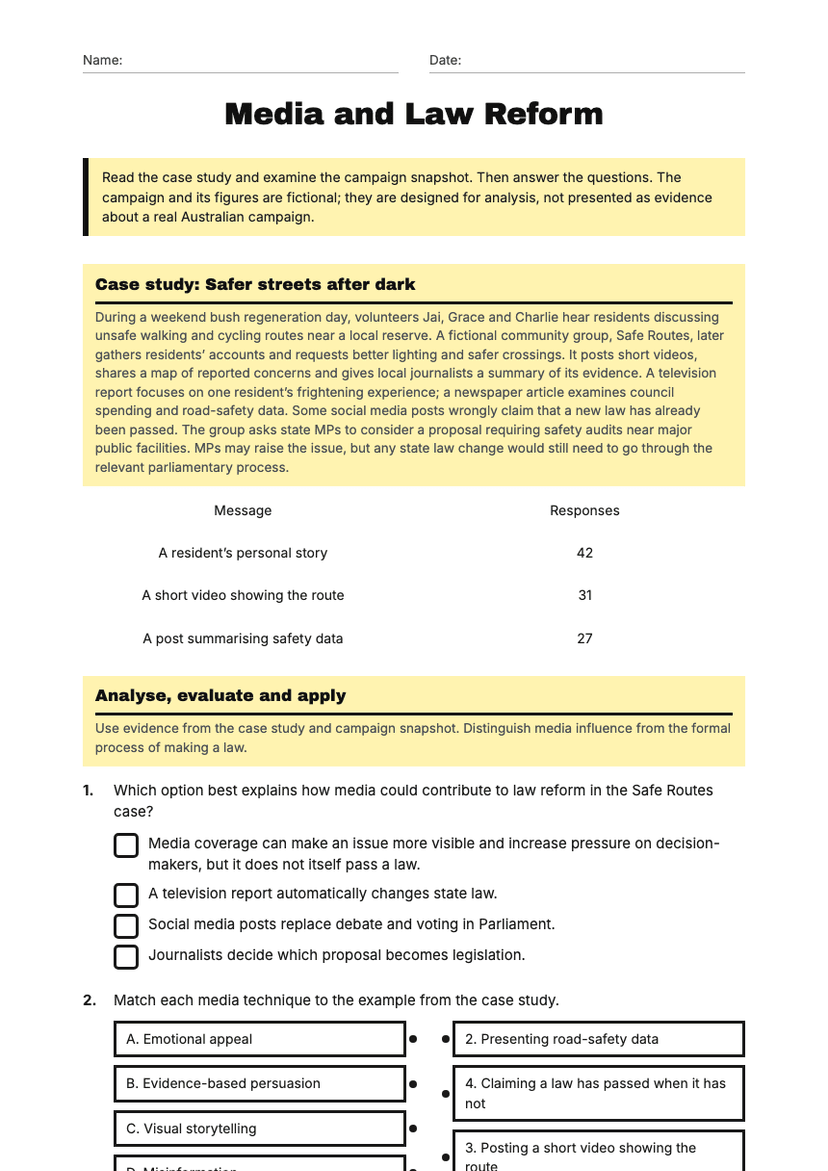
Media and Law Reform
Free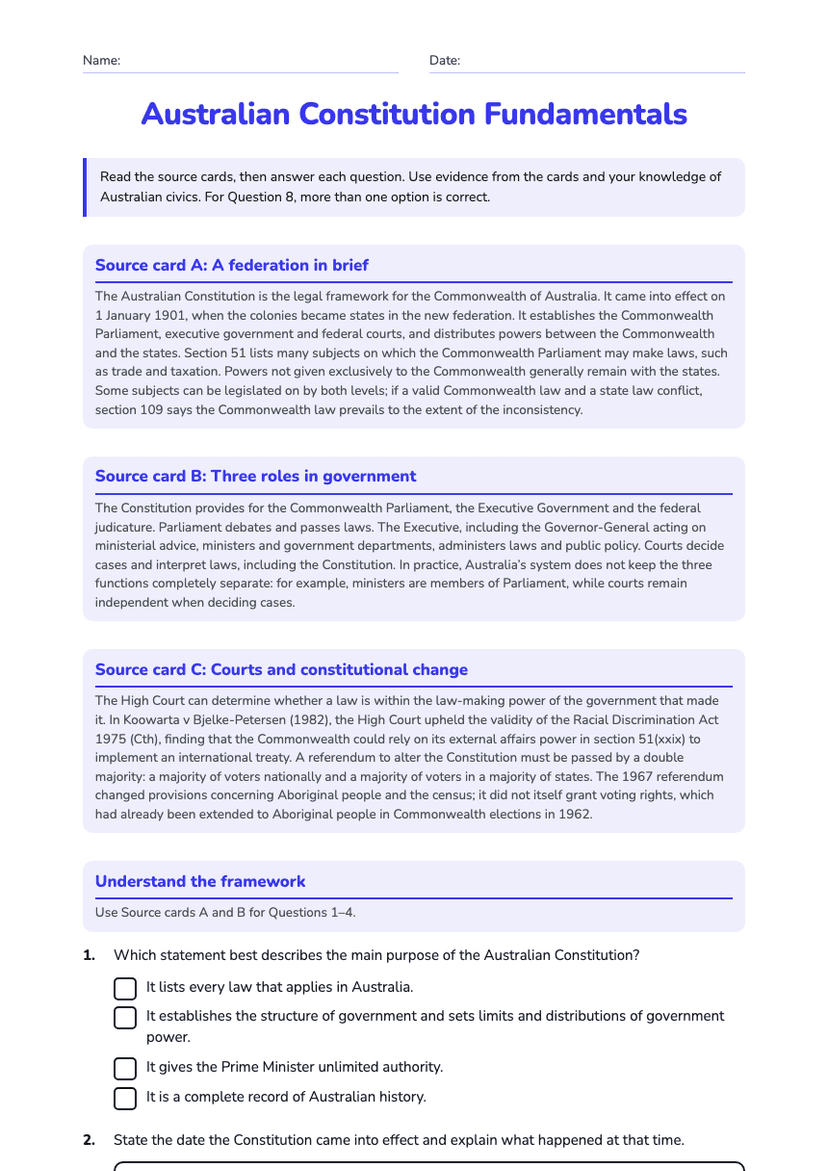
Australian Constitution Fundamentals
Free
Commonwealth Constitution Overview
Free