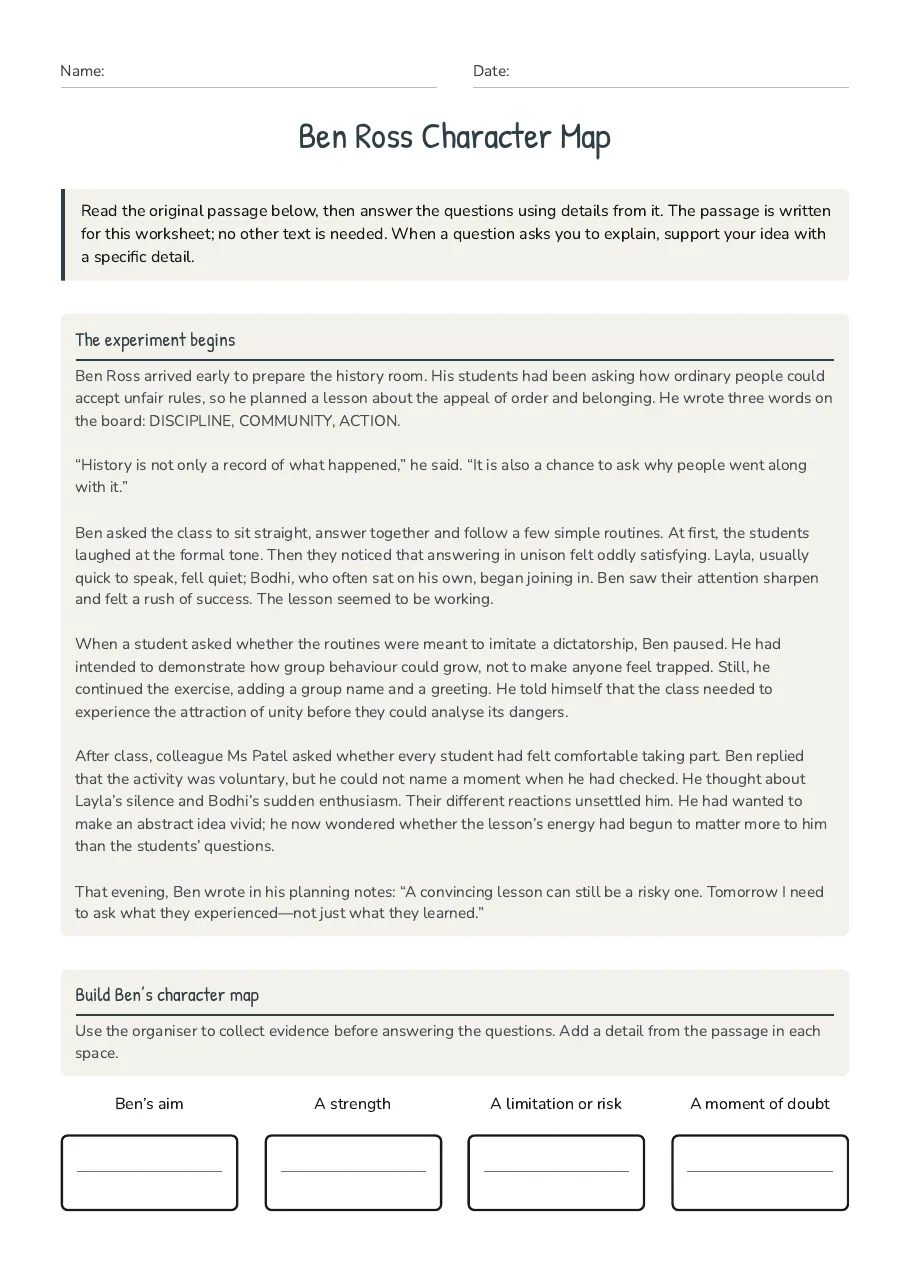
Ben Ross Character Map
A free english worksheet ready for your classroom. Open in Kuraplan to grab the print-ready PDF, customize it for your students, or generate a fresh version in seconds.
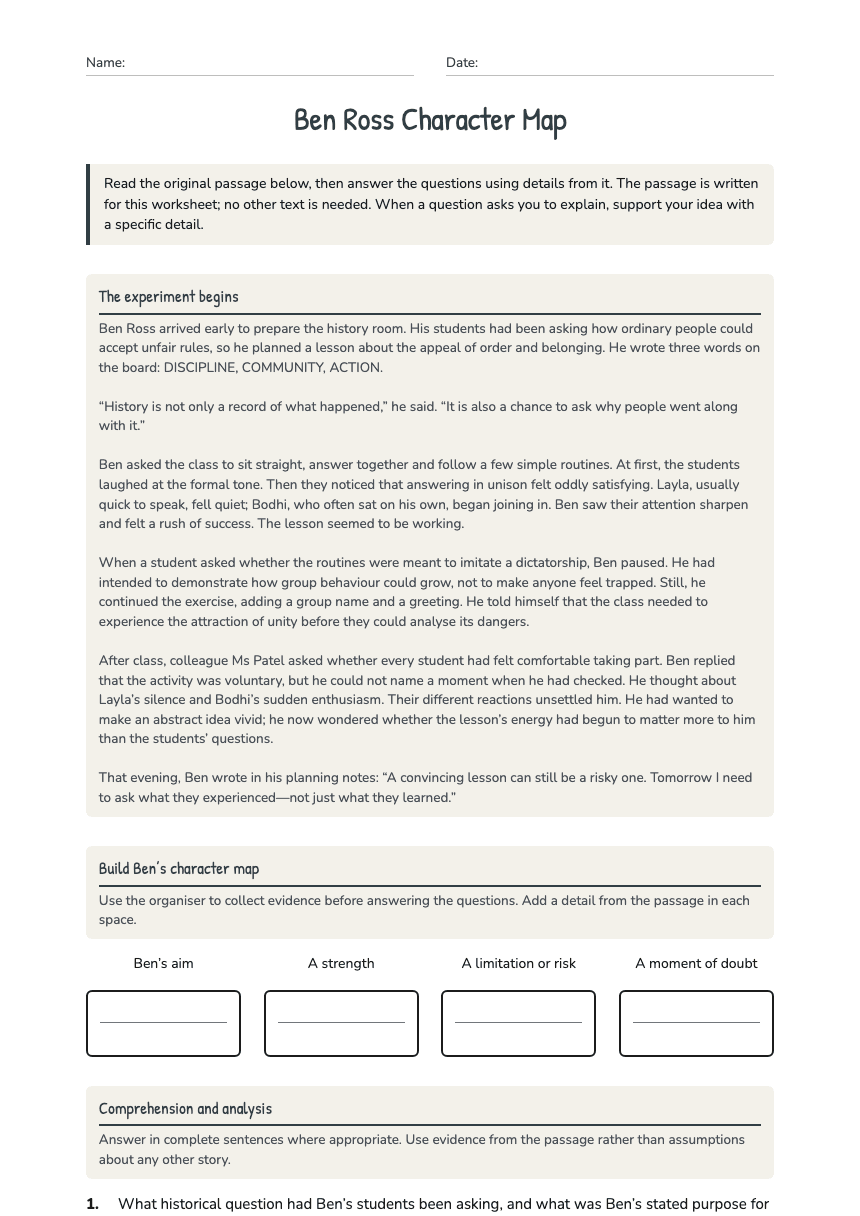
Ben Ross Character Map
The experiment begins
Ben Ross arrived early to prepare the history room. His students had been asking how ordinary people could accept unfair rules, so he planned a lesson about the appeal of order and belonging. He wrote three words on the board: DISCIPLINE, COMMUNITY, ACTION. “History is not only a record of what happened,” he said. “It is also a chance to ask why people went along with it.” Ben asked the class to sit straight, answer together and follow a few simple routines. At first, the students laughed at the formal tone. Then they noticed that answering in unison felt oddly satisfying. Layla, usually quick to speak, fell quiet; Bodhi, who often sat on his own, began joining in. Ben saw their attention sharpen and felt a rush of success. The lesson seemed to be working. When a student asked whether the routines were meant to imitate a dictatorship, Ben paused. He had intended to demonstrate how group behaviour could grow, not to make anyone feel trapped. Still, he continued the exercise, adding a group name and a greeting. He told himself that the class needed to experience the attraction of unity before they could analyse its dangers. After class, colleague Ms Patel asked whether every student had felt comfortable taking part. Ben replied that the activity was voluntary, but he could not name a moment when he had checked. He thought about Layla’s silence and Bodhi’s sudden enthusiasm. Their different reactions unsettled him. He had wanted to make an abstract idea vivid; he now wondered whether the lesson’s energy had begun to matter more to him than the students’ questions. That evening, Ben wrote in his planning notes: “A convincing lesson can still be a risky one. Tomorrow I need to ask what they experienced—not just what they learned.”
Build Ben’s character map
Use the organiser to collect evidence before answering the questions. Add a detail from the passage in each space.
Ben’s aim
A strength
A limitation or risk
A moment of doubt
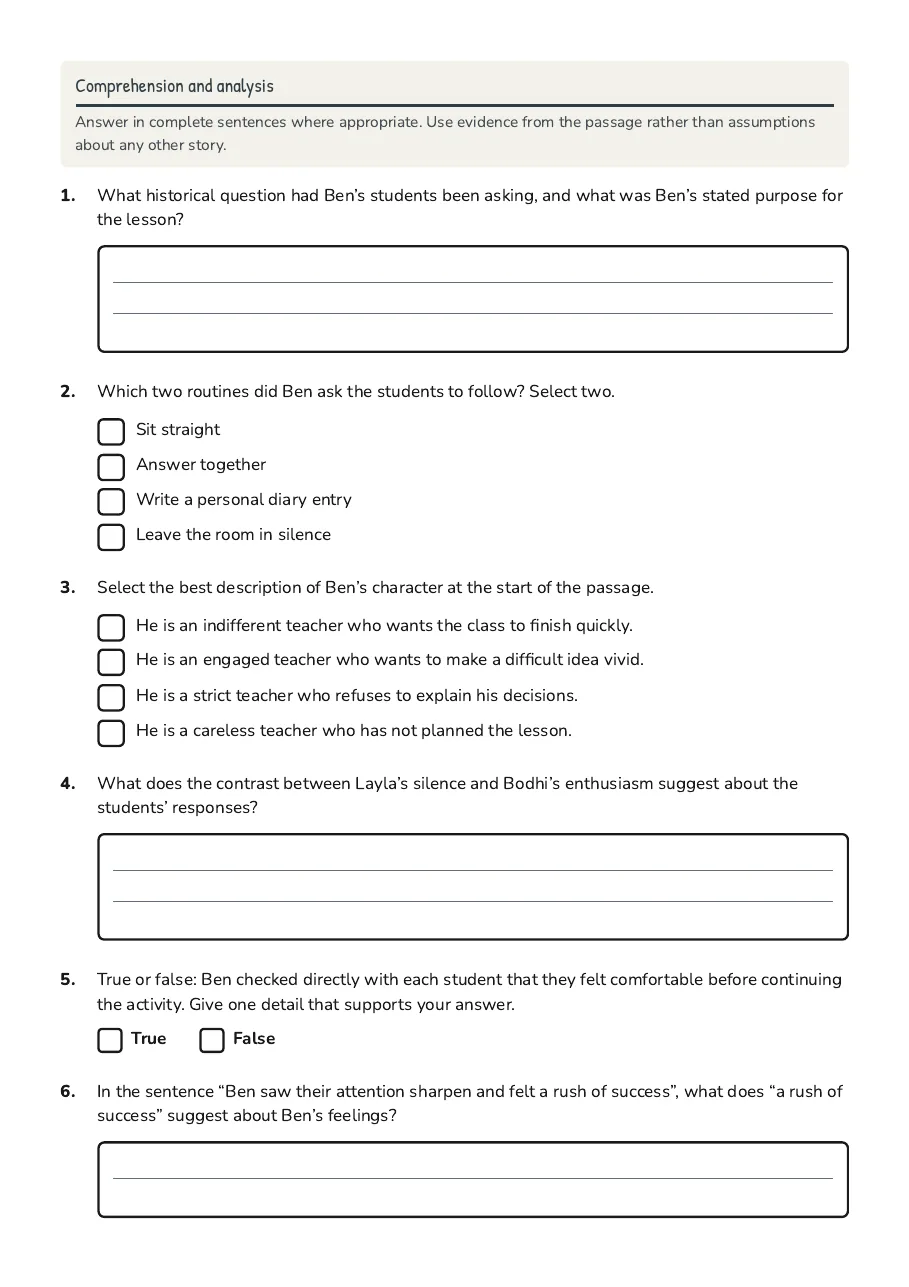
Comprehension and analysis
Answer in complete sentences where appropriate. Use evidence from the passage rather than assumptions about any other story.
- Sit straight
- Answer together
- Write a personal diary entry
- Leave the room in silence
- He is an indifferent teacher who wants the class to finish quickly.
- He is an engaged teacher who wants to make a difficult idea vivid.
- He is a strict teacher who refuses to explain his decisions.
- He is a careless teacher who has not planned the lesson.
3 printable pages
Page 1
Page 2
Page 3
About This Worksheet
Free in Kuraplan
Sign up free, grab the PDF, and customize it for your class.
Print-Ready
Formatted for standard paper. Clean layout, easy to read.
AI-Generated
Created with Kuraplan's AI, designed for real classroom use.
For Teachers & Parents
Use in classrooms, for homework, tutoring, or homeschool.
Need a custom version of this worksheet?
Kuraplan's AI generates custom worksheets in seconds — differentiated for every learner, aligned to your curriculum.
Generate Custom Worksheets — Free