Body Systems Poster Assessment
A free science worksheet ready for your classroom. Open in Kuraplan to grab the print-ready PDF, customize it for your students, or generate a fresh version in seconds.

Body Systems Poster Assessment
Part 1: Task Overview and Planning
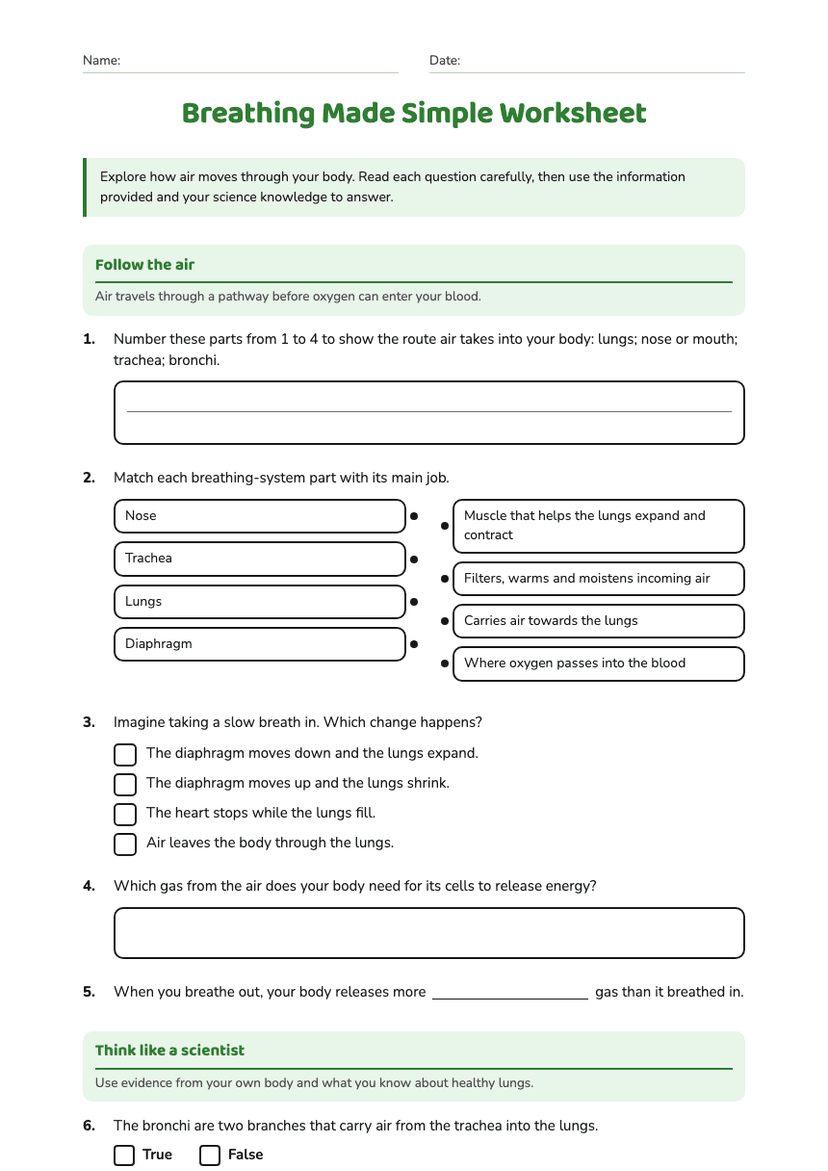
Task: Create and submit an informative poster about one body system: Digestive, Respiratory or Circulatory.
Your poster must explain at least four organs or components. For each organ or component, explain:
What it is – identify and describe it. What it does – explain its function. Why it is important – link it to the overall function of the body system.
WALT (We Are Learning To): We are learning to explain how organs and components work together in a body system and communicate scientific information accurately.
Success criteria: I can select one body system, identify at least four organs or components, explain each one clearly, use accurate scientific vocabulary, and organise information in a readable poster.
Poster requirements:
• Include a clear, relevant title and useful headings.
• Include accurate scientific information about at least four organs or components.
• Include a labelled diagram or labelled images.
• Use appropriate scientific vocabulary and explain unfamiliar terms where needed.
• Show how the organs or components work together.
• Include a list of reliable sources.
• Submit the completed poster by the date set by your teacher.
Planning Table
Use this plan before creating your poster. Add at least four organs or components.
What it does and why it is important: Complete these explanations for each component in your own planning notes or on a separate page.
Part 2: Submission Checklist and Learning Support
Before submitting, check each requirement:
I have selected one system: Digestive, Respiratory or Circulatory. My poster has a clear title and helpful headings. I have included at least four organs or components. For each one, I explained what it is, what it does and why it is important. My diagram or images are labelled accurately. I used scientific vocabulary correctly. My information is accurate, organised and easy to read. I included a list of sources.Differentiation Strategies
Support: Use a word bank, labelled diagrams, teacher-approved information sources and a planning conference. Students may use sentence starters such as “This organ is…”, “Its function is…” and “It is important because…”.
Access: Students may draft ideas using dot points, use speech-to-text or typing tools, enlarge text and diagrams, or work from a reduced choice of teacher-provided organs.
Extension: Compare the chosen system with another body system, explain a disease or disorder affecting it, or include a detailed explanation of how substances move through the system.
NSW Syllabus Alignment
SC4-LIV-01: Students explain how the structures and functions of living things support life processes.
SC4-WS-08: Students communicate scientific understanding using appropriate representations, scientific language and evidence from sources.
Part 3: Teacher Assessment
Analytic Marking Rubric: Circle or record one level for each criterion. Total score: ____ / 25
5 Outstanding: Information is comprehensive, precise and scientifically accurate.
4 High: Information is accurate with only minor gaps or errors.
3 Sound: Information is generally accurate but some explanations are basic.
2 Developing: Information includes several gaps or scientific errors.
1 Beginning: Information is very limited or mostly inaccurate.
5 Outstanding: Four or more relevant organs or components are clearly identified and connected.
4 High: Four or more relevant organs or components are identified with clear connections.
3 Sound: At least four organs or components are included, with some missing detail.
2 Developing: Fewer than four organs or components, or identifications are unclear.
1 Beginning: Very few organs or components are identified.
5 Outstanding: Every organ or component clearly explains what it is, what it does and why it is important.
4 High: Most explanations are complete and clearly linked to the system.
3 Sound: Explanations address the requirements but lack detail in places.
2 Developing: Some required explanations are incomplete or unclear.
1 Beginning: Required explanations are mostly missing.
5 Outstanding: Highly organised, visually clear, readable and supported by an accurate labelled diagram or images.
4 High: Well organised and readable, with an effective labelled diagram or images.
3 Sound: Organisation and design are suitable but some sections are crowded or unclear.
2 Developing: Poster is difficult to follow or has limited labels and visual support.
1 Beginning: Poster is incomplete, poorly organised or difficult to read.
5 Outstanding: Scientific vocabulary is used precisely and a complete list of reliable sources is provided.
4 High: Scientific vocabulary is mostly accurate and reliable sources are listed.
3 Sound: Some scientific vocabulary is used correctly and sources are included.
2 Developing: Vocabulary is limited or sometimes incorrect; source list is incomplete.
1 Beginning: Little scientific vocabulary is used and sources are missing or unsuitable.
Teacher Feedback
Final result: ____ / 25
Teacher: ______________________________
About This Worksheet
Free in Kuraplan
Sign up free, grab the PDF, and customize it for your class.
Print-Ready
Formatted for standard paper. Clean layout, easy to read.
AI-Generated
Created with Kuraplan's AI, designed for real classroom use.
For Teachers & Parents
Use in classrooms, for homework, tutoring, or homeschool.
Need a custom version of this worksheet?
Kuraplan's AI generates custom worksheets in seconds — differentiated for every learner, aligned to your curriculum.
Generate Custom Worksheets — Free