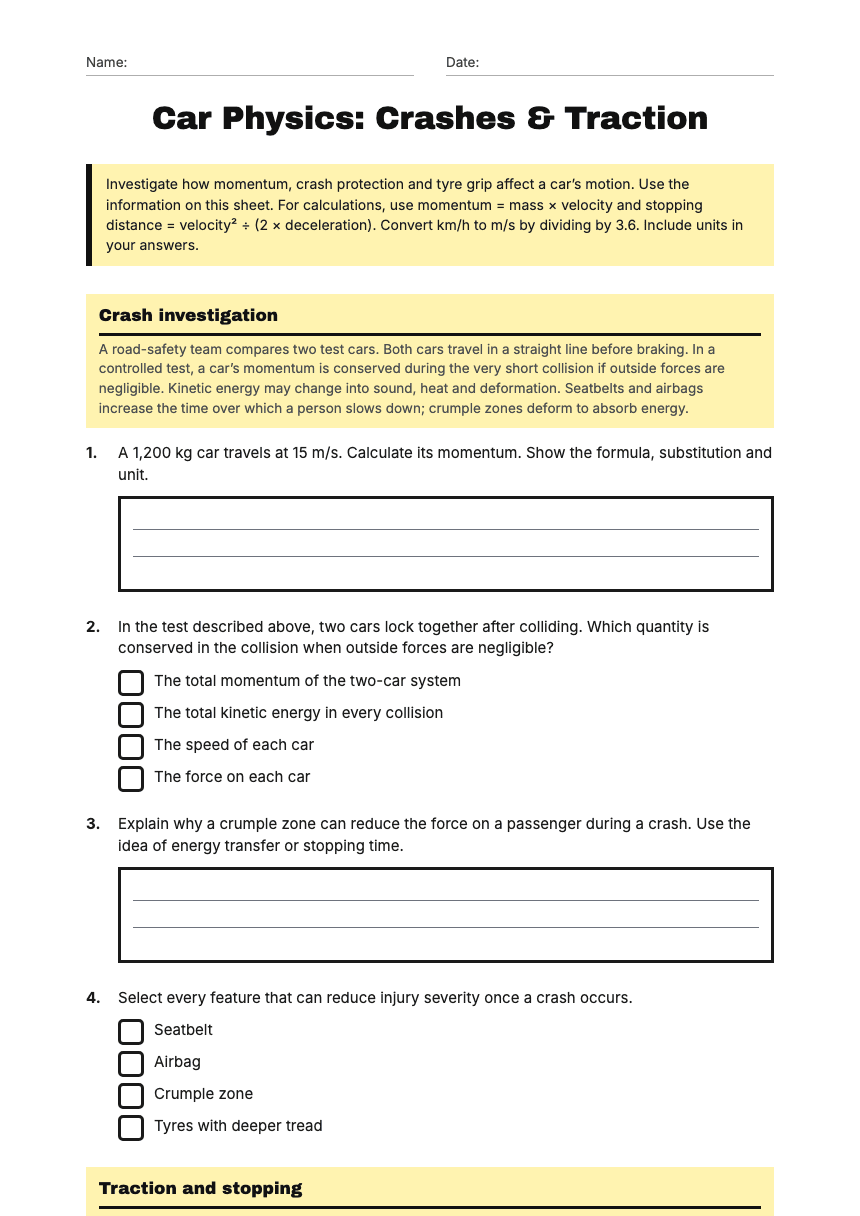
Car Physics: Crashes & Traction
A free science worksheet ready for your classroom. Open in Kuraplan to grab the print-ready PDF, customize it for your students, or generate a fresh version in seconds.
Car Physics: Crashes & Traction
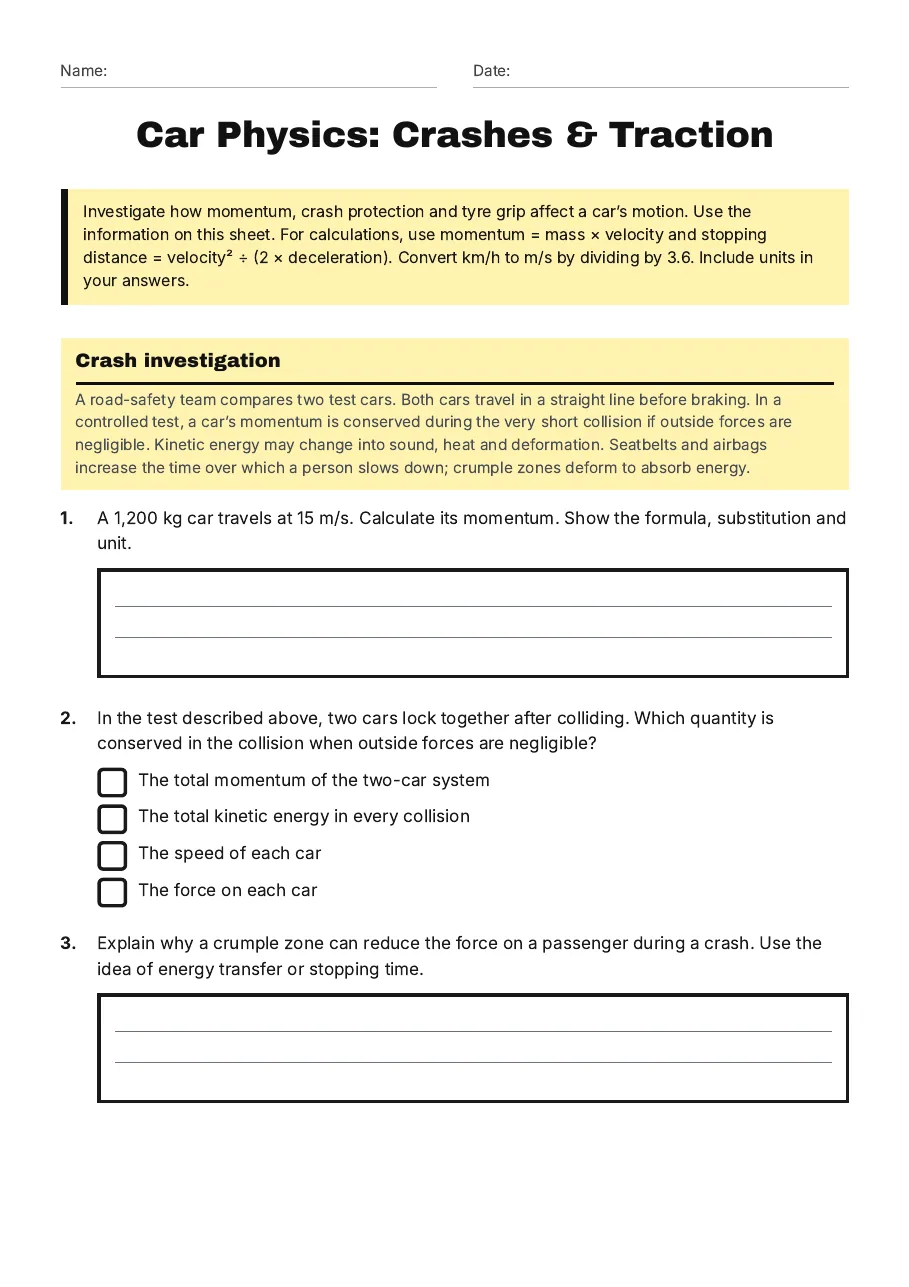
Crash investigation
A road-safety team compares two test cars. Both cars travel in a straight line before braking. In a controlled test, a car’s momentum is conserved during the very short collision if outside forces are negligible. Kinetic energy may change into sound, heat and deformation. Seatbelts and airbags increase the time over which a person slows down; crumple zones deform to absorb energy.
- The total momentum of the two-car system
- The total kinetic energy in every collision
- The speed of each car
- The force on each car
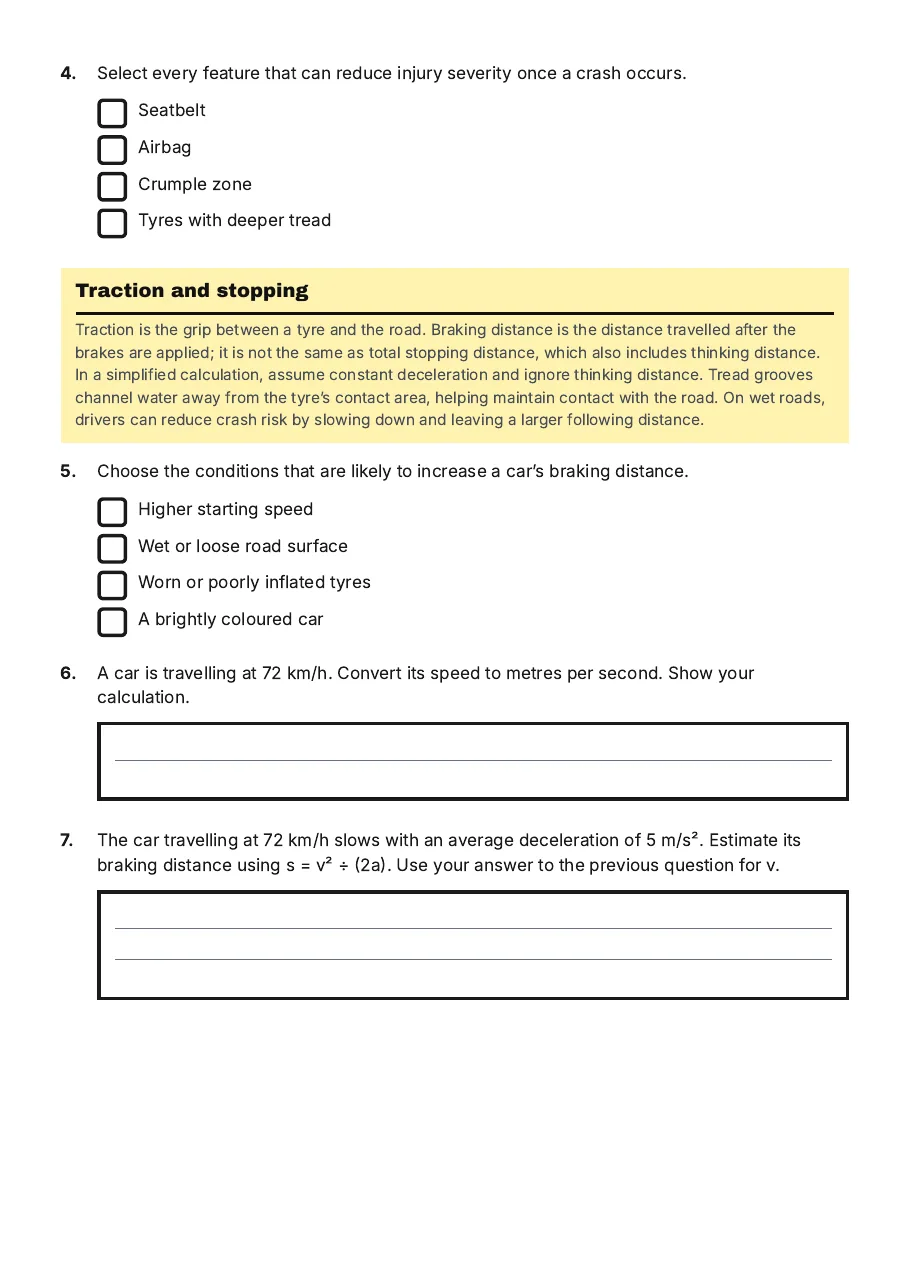
- Seatbelt
- Airbag
- Crumple zone
- Tyres with deeper tread
Traction and stopping
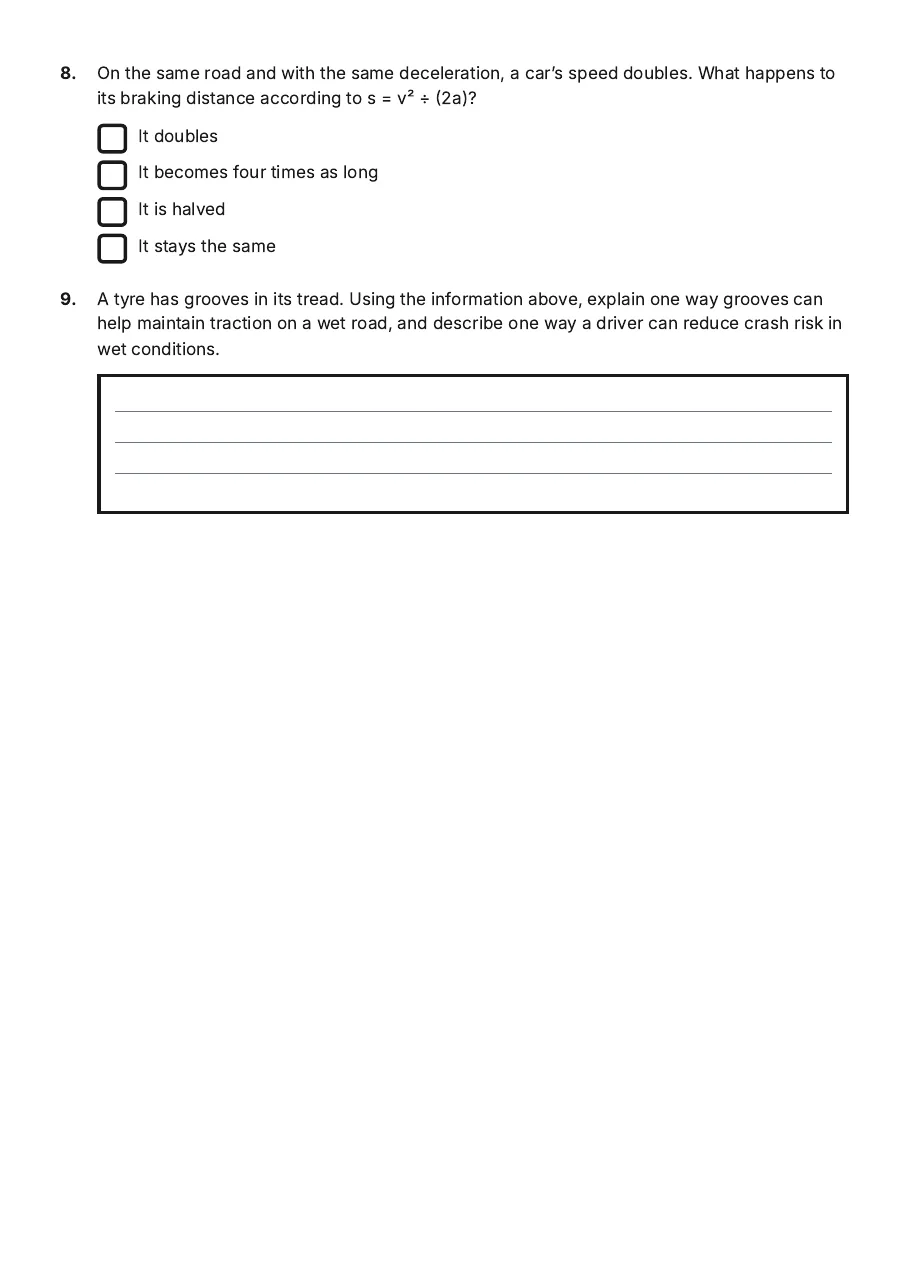
Traction is the grip between a tyre and the road. Braking distance is the distance travelled after the brakes are applied; it is not the same as total stopping distance, which also includes thinking distance. In a simplified calculation, assume constant deceleration and ignore thinking distance. Tread grooves channel water away from the tyre’s contact area, helping maintain contact with the road. On wet roads, drivers can reduce crash risk by slowing down and leaving a larger following distance.
- Higher starting speed
- Wet or loose road surface
- Worn or poorly inflated tyres
- A brightly coloured car
- It doubles
- It becomes four times as long
- It is halved
- It stays the same
3 printable pages
Page 1
Page 2
Page 3
About This Worksheet
Free in Kuraplan
Sign up free, grab the PDF, and customize it for your class.
Print-Ready
Formatted for standard paper. Clean layout, easy to read.
AI-Generated
Created with Kuraplan's AI, designed for real classroom use.
For Teachers & Parents
Use in classrooms, for homework, tutoring, or homeschool.
Need a custom version of this worksheet?
Kuraplan's AI generates custom worksheets in seconds — differentiated for every learner, aligned to your curriculum.
Generate Custom Worksheets — Free