ScienceFreePrintable

Chemical Reactions Review

A free science worksheet ready for your classroom. Open in Kuraplan to grab the print-ready PDF, customize it for your students, or generate a fresh version in seconds.
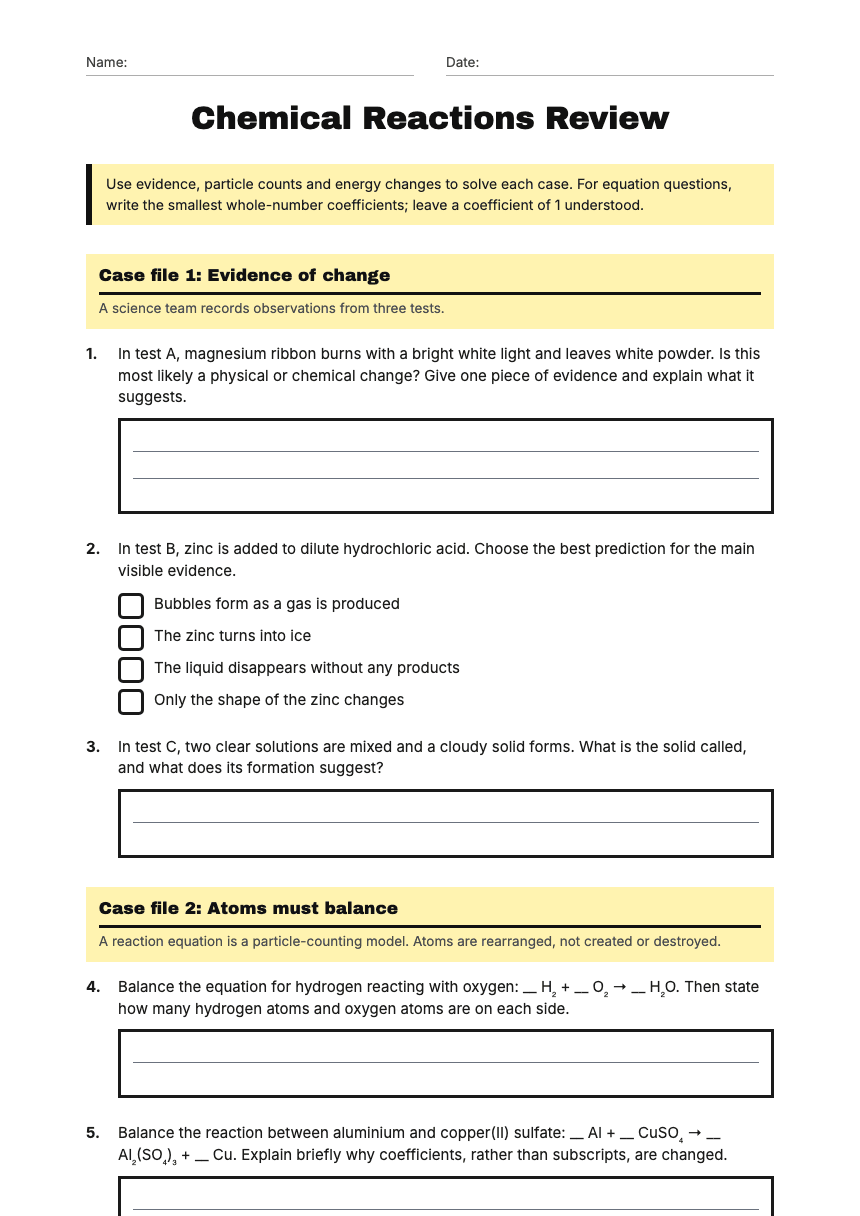
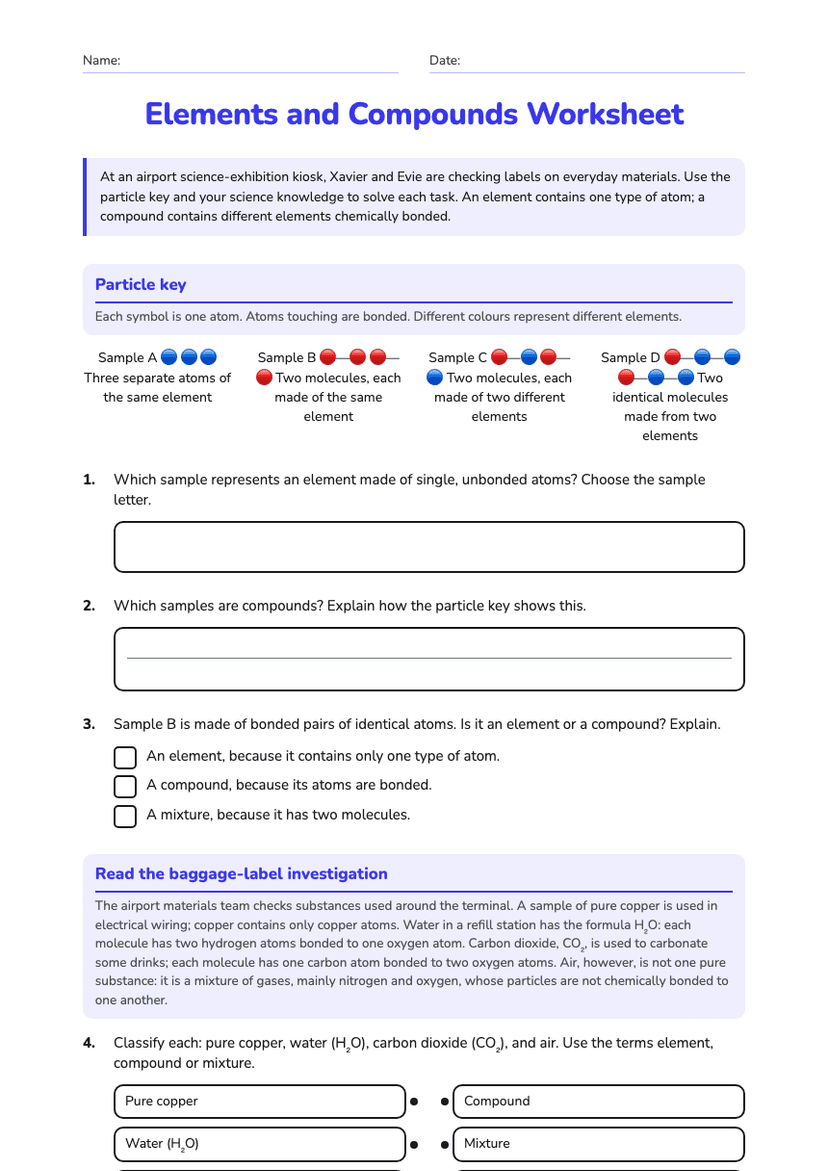
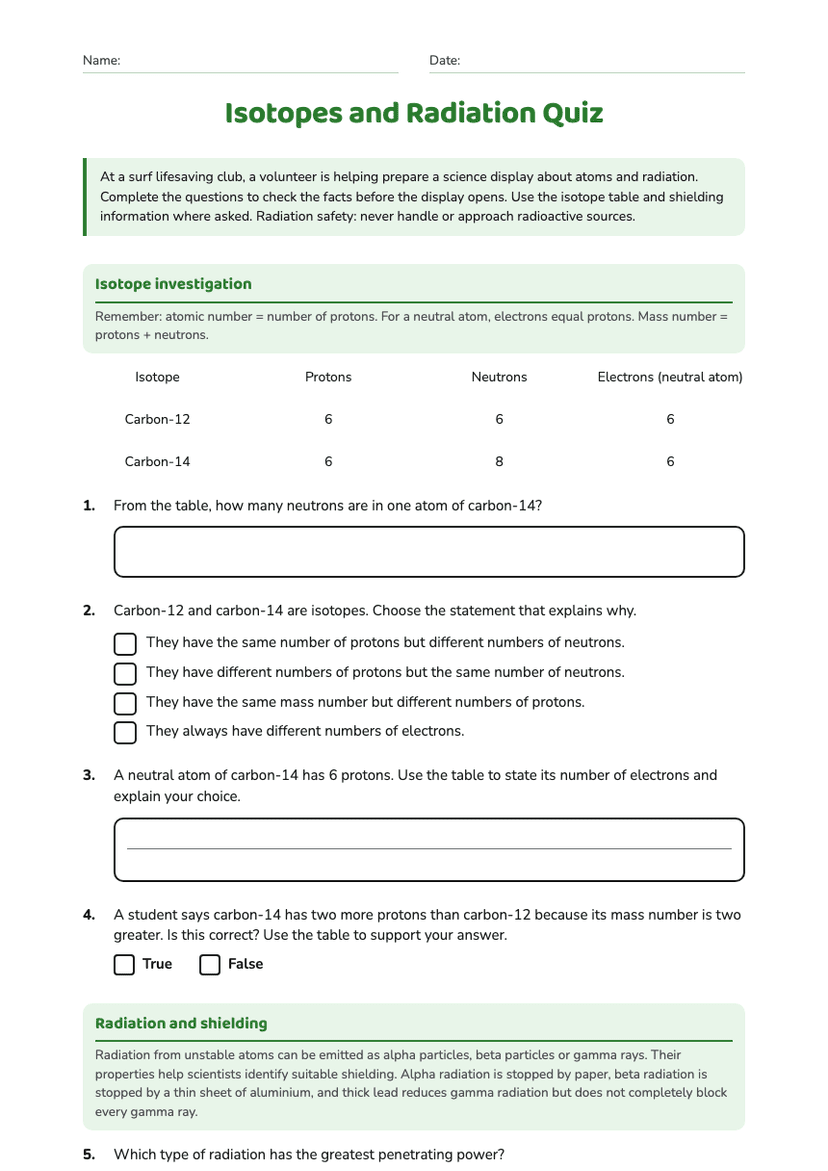
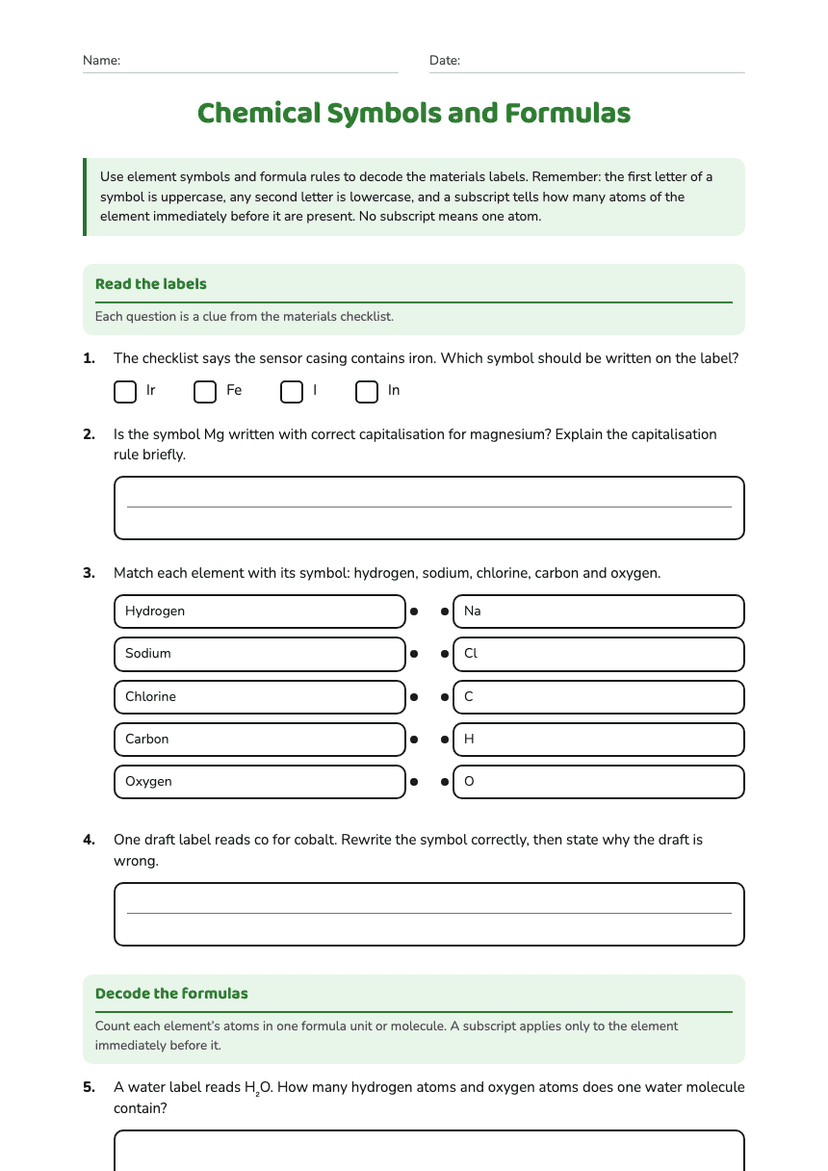
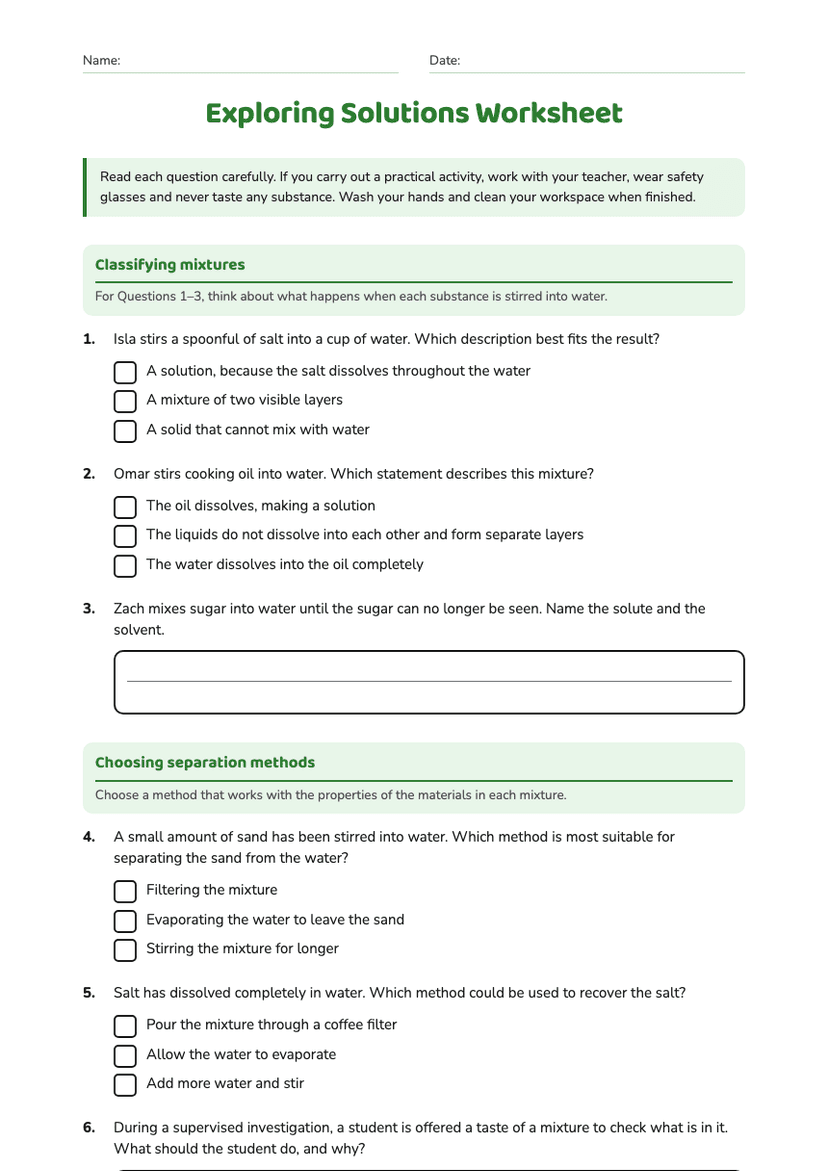
Chemical Reactions Review worksheet preview
Name:Date:

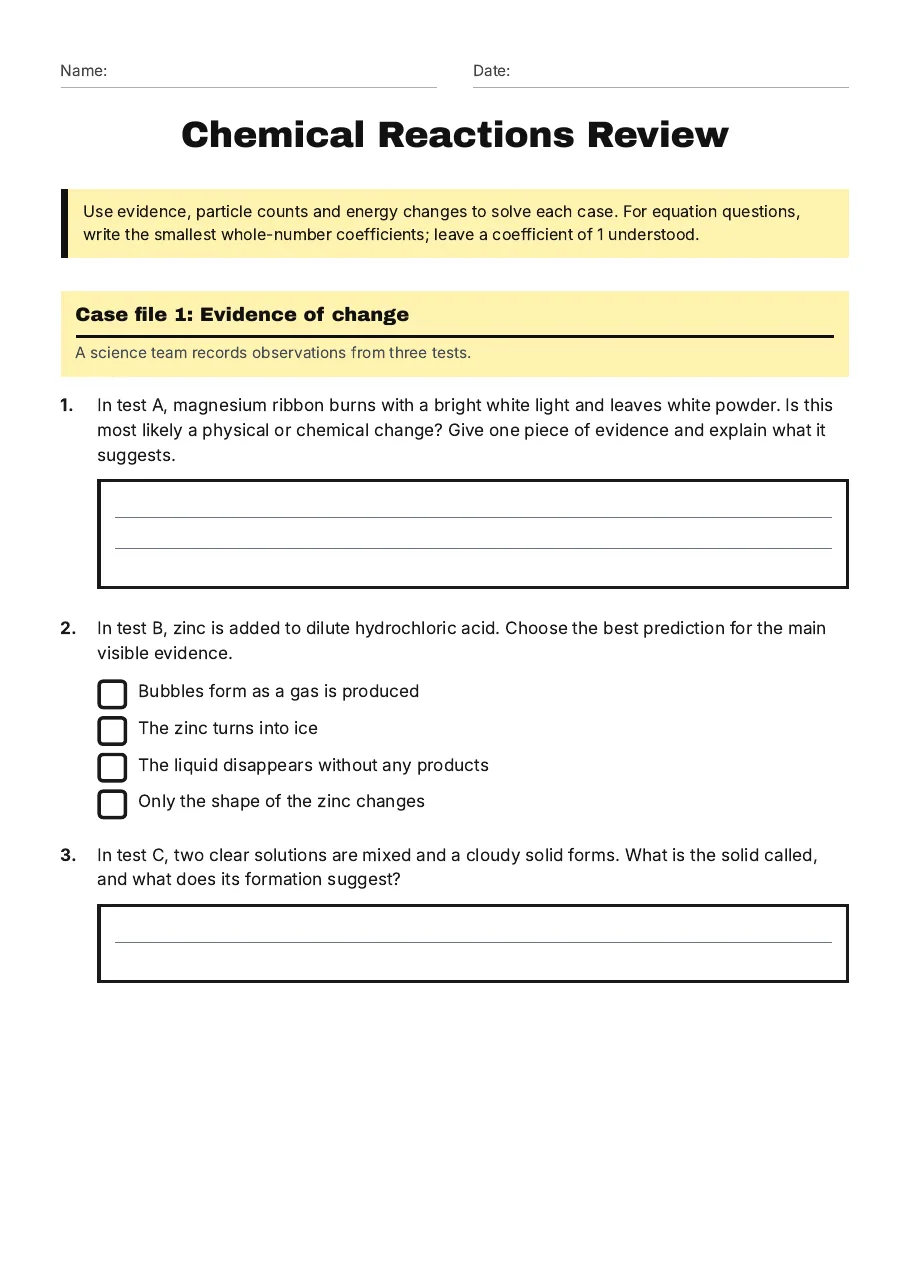
Chemical Reactions Review

Use evidence, particle counts and energy changes to solve each case. For equation questions, write the smallest whole-number coefficients; leave a coefficient of 1 understood.

Case file 1: Evidence of change

A science team records observations from three tests.

1.In test A, magnesium ribbon burns with a bright white light and leaves white powder. Is this most likely a physical or chemical change? Give one piece of evidence and explain what it suggests.
2.In test B, zinc is added to dilute hydrochloric acid. Choose the best prediction for the main visible evidence.
  • Bubbles form as a gas is produced
  • The zinc turns into ice
  • The liquid disappears without any products
  • Only the shape of the zinc changes
3.In test C, two clear solutions are mixed and a cloudy solid forms. What is the solid called, and what does its formation suggest?

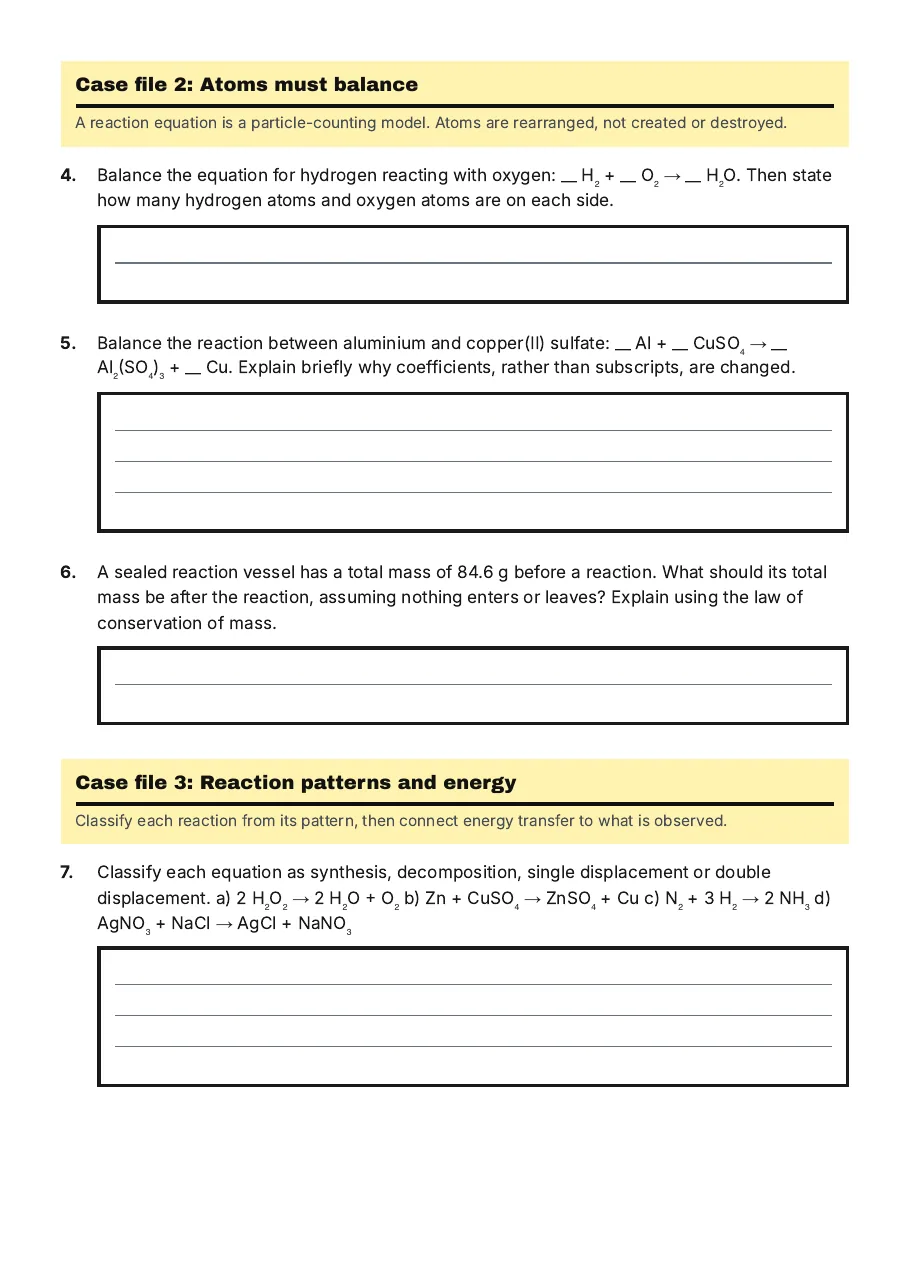
Case file 2: Atoms must balance

A reaction equation is a particle-counting model. Atoms are rearranged, not created or destroyed.

4.Balance the equation for hydrogen reacting with oxygen: __ H₂ + __ O₂ → __ H₂O. Then state how many hydrogen atoms and oxygen atoms are on each side.
5.Balance the reaction between aluminium and copper(II) sulfate: __ Al + __ CuSO₄ → __ Al₂(SO₄)₃ + __ Cu. Explain briefly why coefficients, rather than subscripts, are changed.
6.A sealed reaction vessel has a total mass of 84.6 g before a reaction. What should its total mass be after the reaction, assuming nothing enters or leaves? Explain using the law of conservation of mass.

Case file 3: Reaction patterns and energy

Classify each reaction from its pattern, then connect energy transfer to what is observed.

7.Classify each equation as synthesis, decomposition, single displacement or double displacement. a) 2 H₂O₂ → 2 H₂O + O₂ b) Zn + CuSO₄ → ZnSO₄ + Cu c) N₂ + 3 H₂ → 2 NH₃ d) AgNO₃ + NaCl → AgCl + NaNO₃
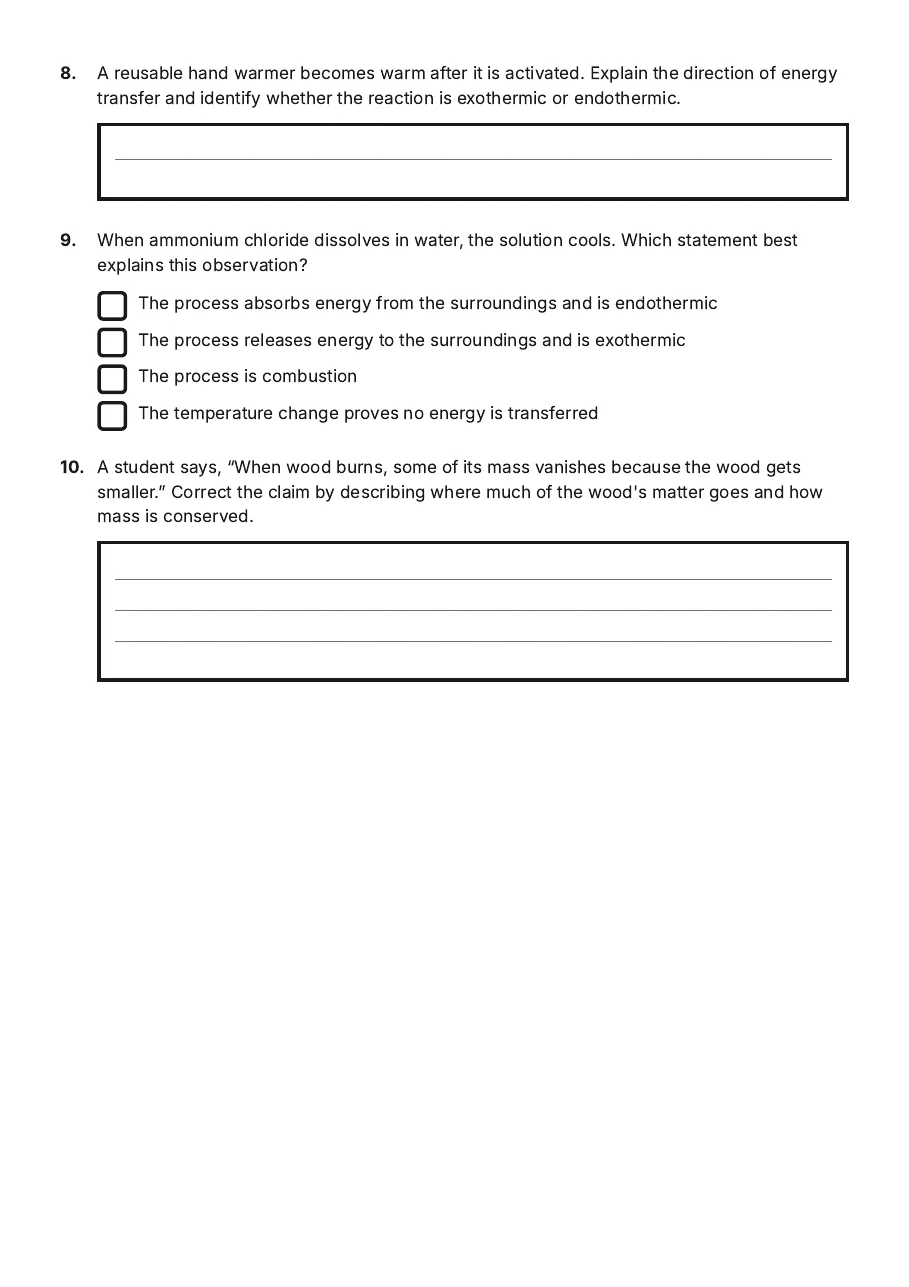
8.A reusable hand warmer becomes warm after it is activated. Explain the direction of energy transfer and identify whether the reaction is exothermic or endothermic.
9.When ammonium chloride dissolves in water, the solution cools. Which statement best explains this observation?
  • The process absorbs energy from the surroundings and is endothermic
  • The process releases energy to the surroundings and is exothermic
  • The process is combustion
  • The temperature change proves no energy is transferred
10.A student says, “When wood burns, some of its mass vanishes because the wood gets smaller.” Correct the claim by describing where much of the wood's matter goes and how mass is conserved.

3 printable pages

  • Chemical Reactions Review, page 1 of 3: Case file 1: Evidence of change

    Page 1

  • Chemical Reactions Review, page 2 of 3: Case file 2: Atoms must balance, Case file 3: Reaction patterns and energy

    Page 2

  • Chemical Reactions Review, page 3 of 3: 8. A reusable hand warmer becomes warm after it is activated. Explain the direction of…

    Page 3

About This Worksheet

Free in Kuraplan

Sign up free, grab the PDF, and customize it for your class.

Print-Ready

Formatted for standard paper. Clean layout, easy to read.

AI-Generated

Created with Kuraplan's AI, designed for real classroom use.

For Teachers & Parents

Use in classrooms, for homework, tutoring, or homeschool.

Need a custom version of this worksheet?

Kuraplan's AI generates custom worksheets in seconds — differentiated for every learner, aligned to your curriculum.

Generate Custom Worksheets — Free
No credit card Curriculum-aligned Under 60 seconds