Complex Chemical Equation Balancing
A free science worksheet ready for your classroom. Open in Kuraplan to grab the print-ready PDF, customize it for your students, or generate a fresh version in seconds.
Complex Chemical Equation Balancing
⚖️ Part 1: Understanding the Law of Conservation of Mass
The law of conservation of mass states that matter cannot be _____________ or _____________ in a chemical reaction. This means the total _____________ of reactants must equal the total _____________ of products.
Reactants: _________________________________
Products: __________________________________
🔢 Part 2: Balancing Simple to Complex Equations
a) _____ H₂ + _____ O₂ → _____ H₂O
b) _____ C₃H₈ + _____ O₂ → _____ CO₂ + _____ H₂O
c) _____ Al + _____ CuSO₄ → _____ Al₂(SO₄)₃ + _____ Cu
d) _____ Ca(OH)₂ + _____ H₃PO₄ → _____ Ca₃(PO₄)₂ + _____ H₂O
C₄H₁₀ + O₂ → CO₂ + H₂O
🧮 Part 3: Atom Counting and Verification
Count the atoms on each side to verify the equation is balanced:
Reactants:
Carbon atoms: _____ Hydrogen atoms: _____ Oxygen atoms: _____
Products:
Carbon atoms: _____ Hydrogen atoms: _____ Oxygen atoms: _____
🔬 Part 4: Complex Multi-Step Balancing
a) _____ NH₃ + _____ O₂ → _____ NO + _____ H₂O
b) _____ KClO₃ → _____ KCl + _____ O₂
c) _____ C₂H₆ + _____ O₂ → _____ CO₂ + _____ H₂O
🏭 Part 5: Real-World Applications
🎯 Part 6: Challenge Problems
_____ Ca(NO₃)₂ + _____ Na₃PO₄ → _____ Ca₃(PO₄)₂ + _____ NaNO₃
_____ C₂H₄ + _____ O₂ → _____ CO₂ + _____ H₂O
About This Worksheet
Free in Kuraplan
Sign up free, grab the PDF, and customize it for your class.
Print-Ready
Formatted for standard paper. Clean layout, easy to read.
AI-Generated
Created with Kuraplan's AI, designed for real classroom use.
For Teachers & Parents
Use in classrooms, for homework, tutoring, or homeschool.
Need a custom version of this worksheet?
Kuraplan's AI generates custom worksheets in seconds — differentiated for every learner, aligned to your curriculum.
Generate Custom Worksheets — FreeMore Science Worksheets
Atomic Theory Research Worksheet
Free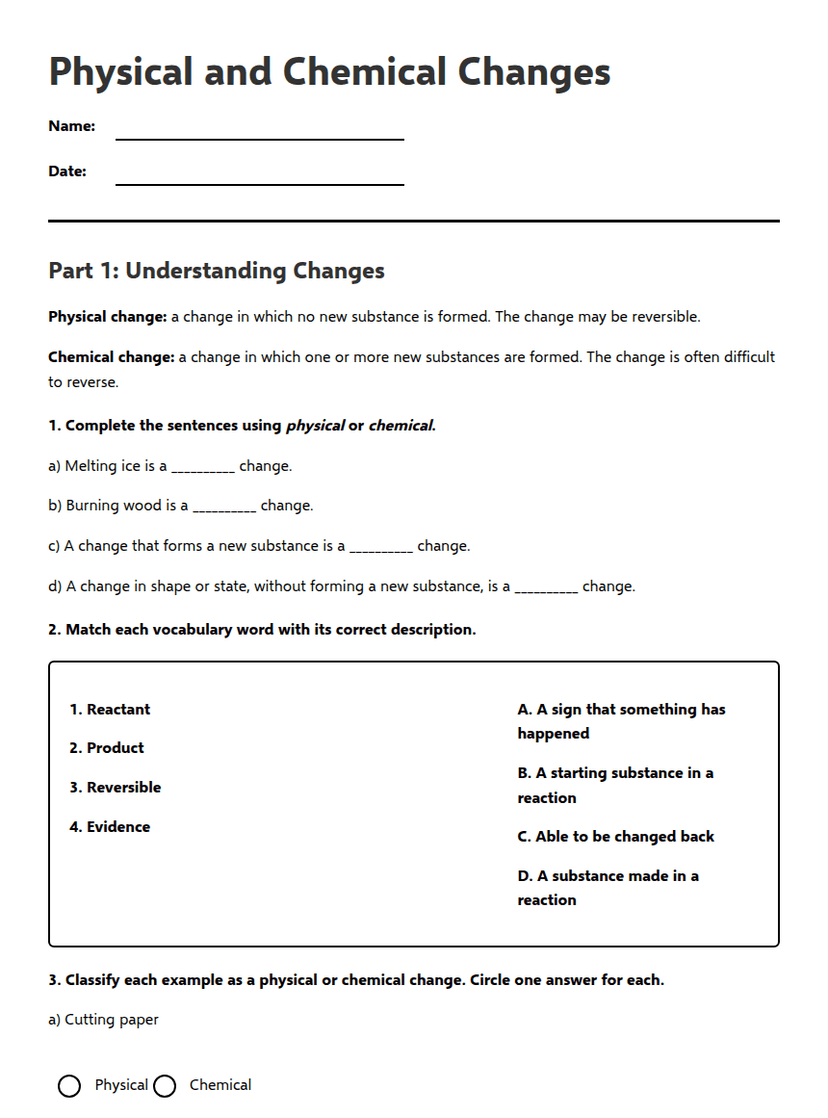
Physical and Chemical Changes
Free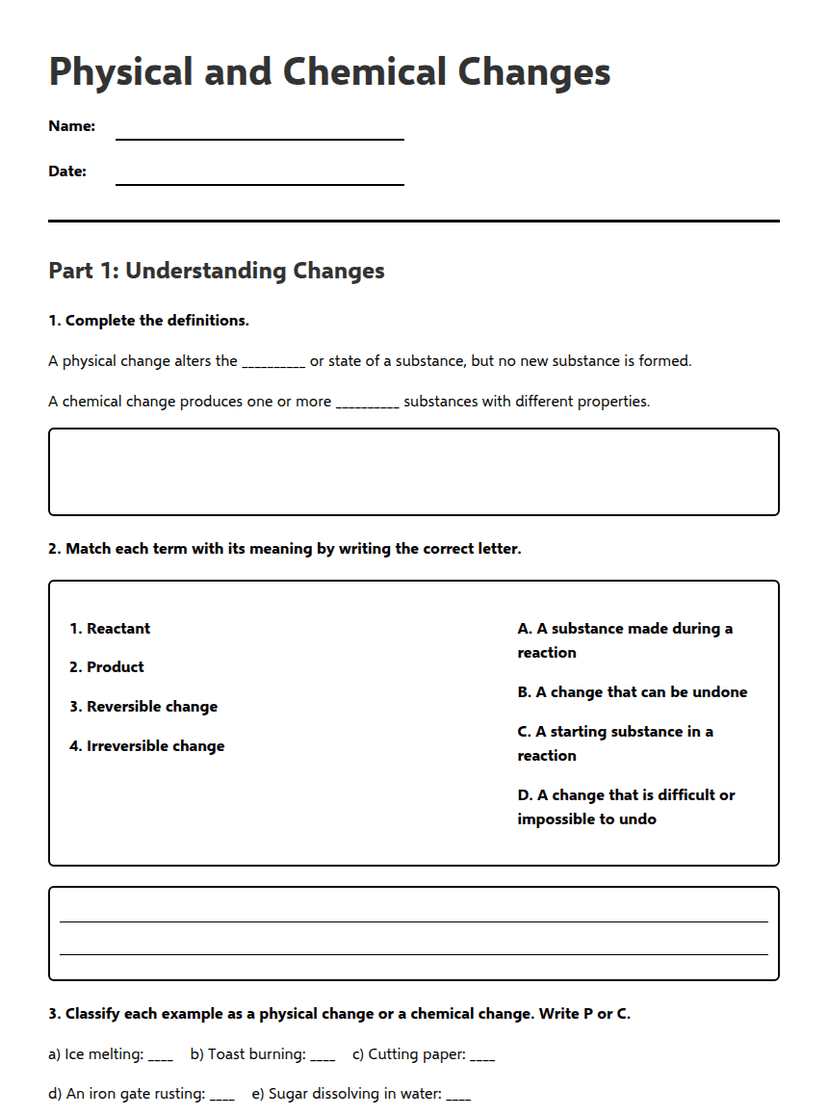
Physical and Chemical Changes
Free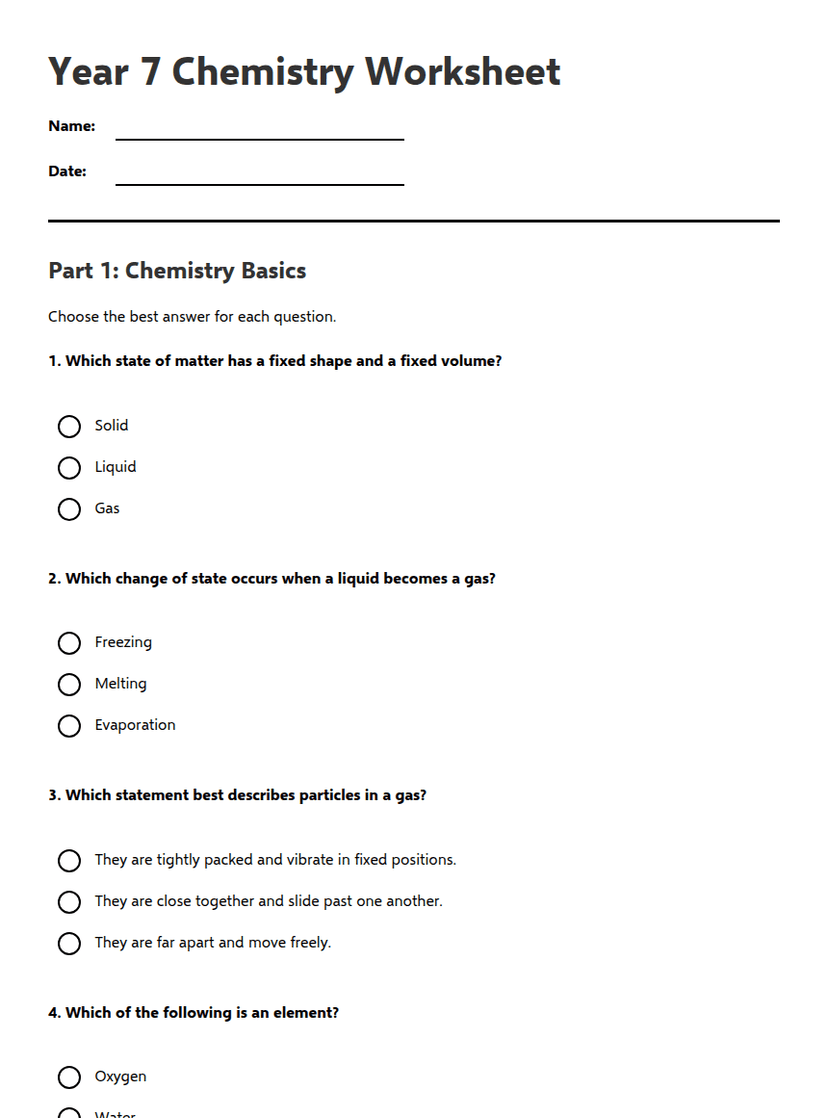
Year 7 Chemistry Worksheet
Free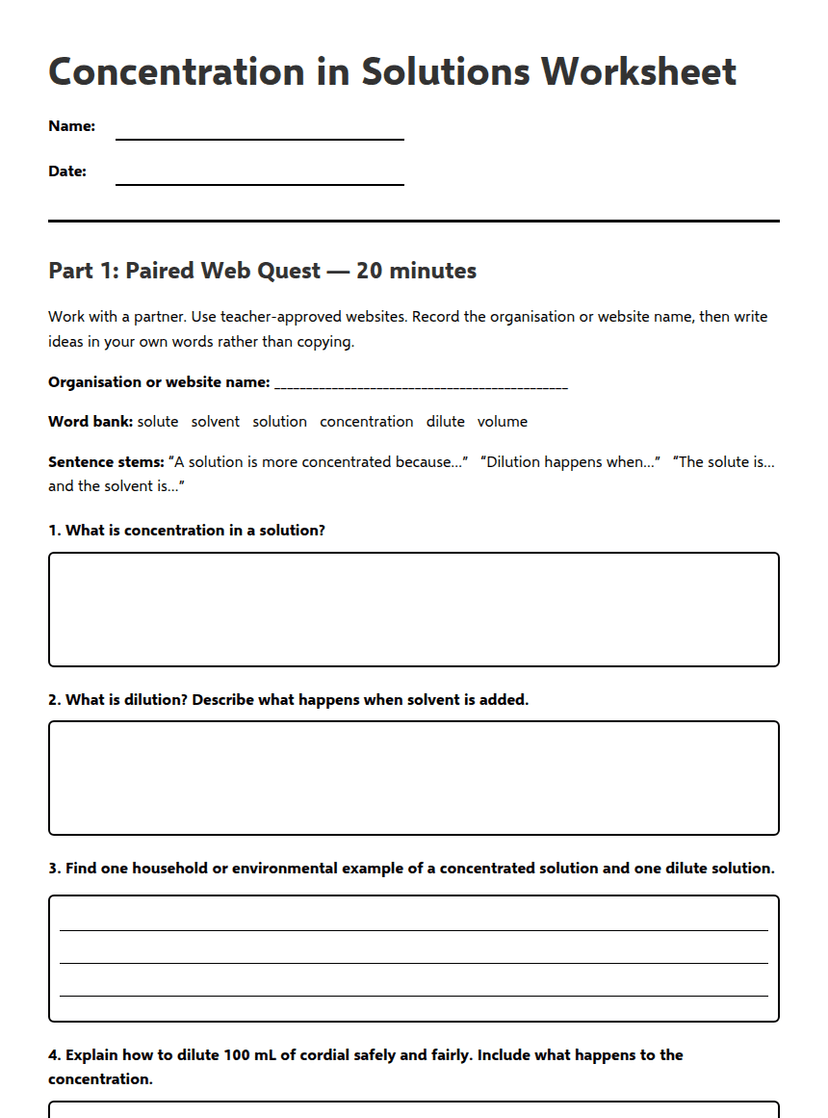
Concentration in Solutions Worksheet
Free
Combustion and Conservation of Mass
Free
Collision Theory and Reaction Rates
Free