Chinese Miners and Colonisation
A free social sciences worksheet ready for your classroom. Open in Kuraplan to grab the print-ready PDF, customize it for your students, or generate a fresh version in seconds.
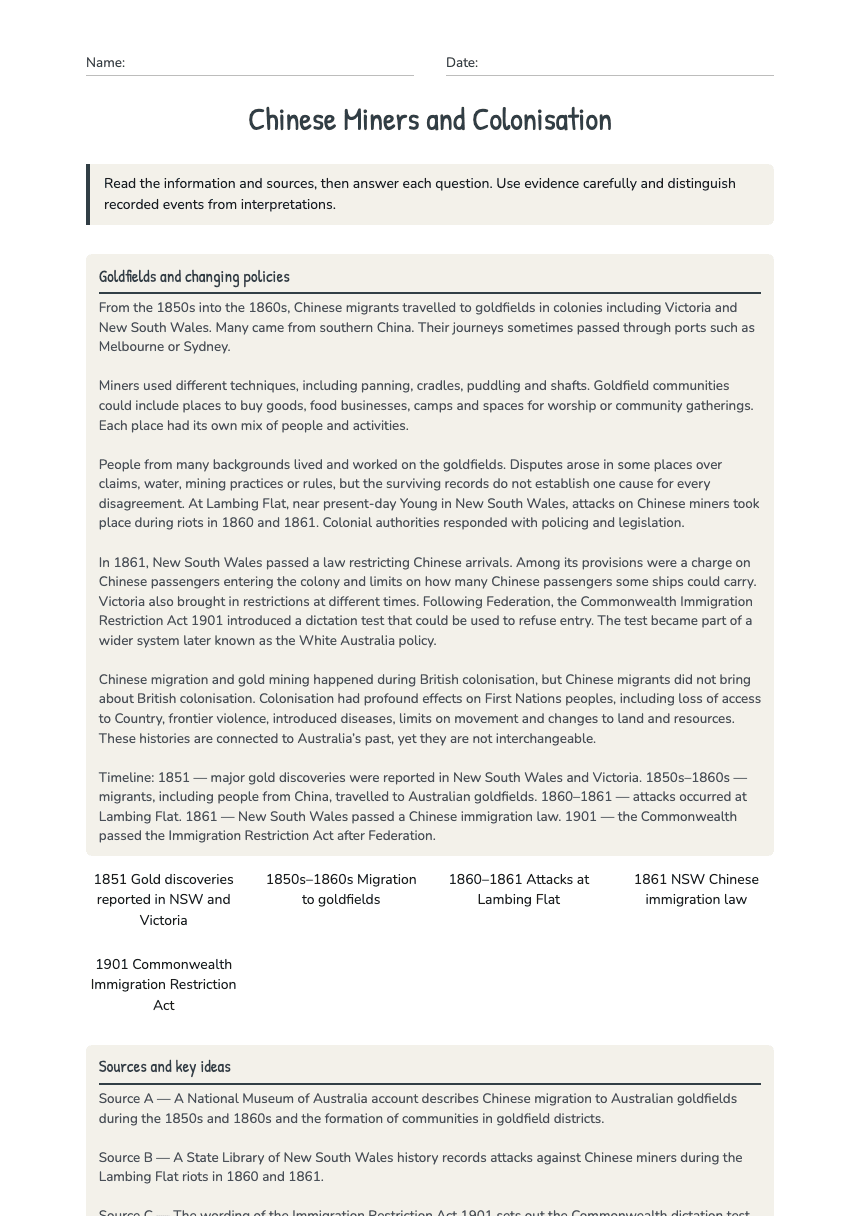
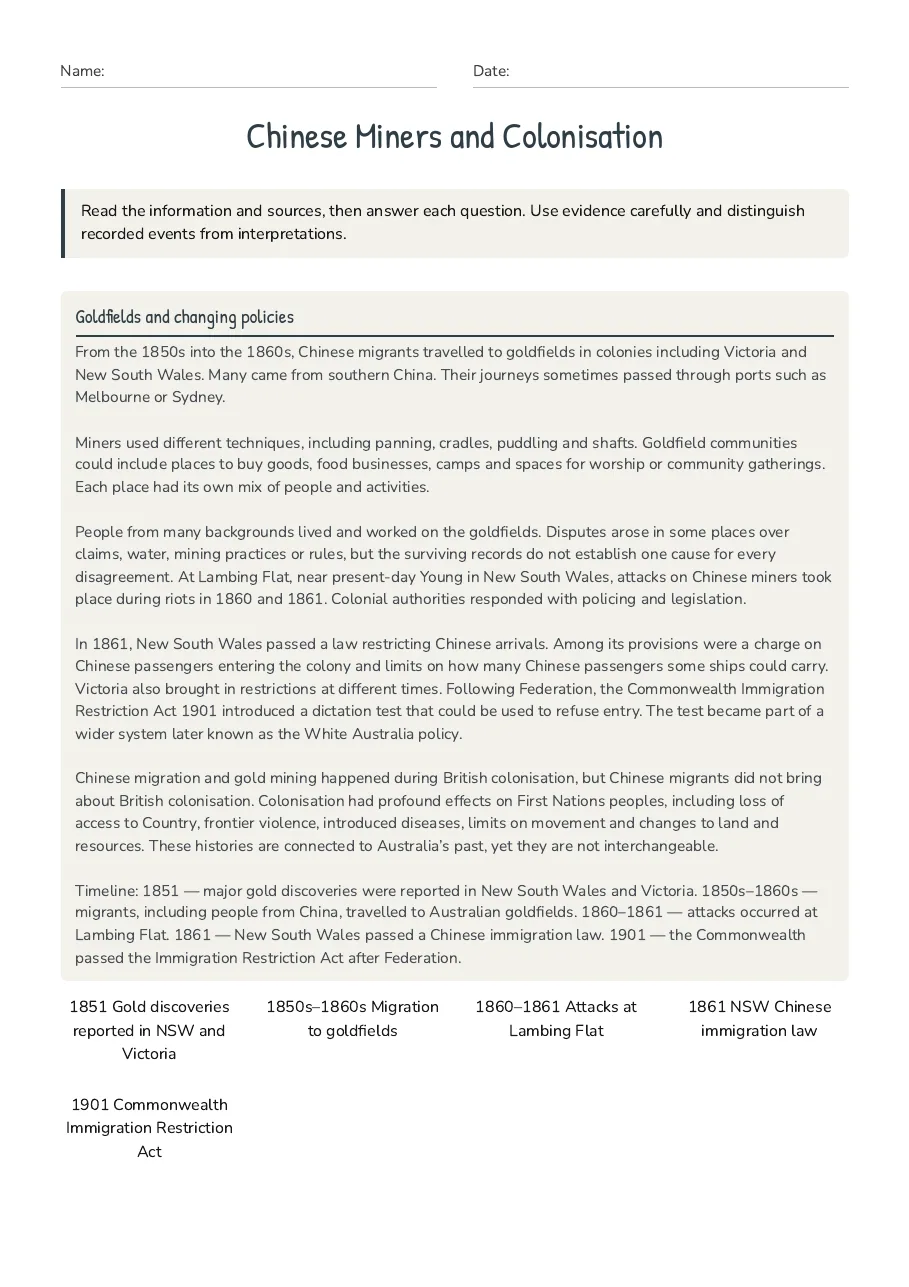
Chinese Miners and Colonisation
Goldfields and changing policies
From the 1850s into the 1860s, Chinese migrants travelled to goldfields in colonies including Victoria and New South Wales. Many came from southern China. Their journeys sometimes passed through ports such as Melbourne or Sydney. Miners used different techniques, including panning, cradles, puddling and shafts. Goldfield communities could include places to buy goods, food businesses, camps and spaces for worship or community gatherings. Each place had its own mix of people and activities. People from many backgrounds lived and worked on the goldfields. Disputes arose in some places over claims, water, mining practices or rules, but the surviving records do not establish one cause for every disagreement. At Lambing Flat, near present-day Young in New South Wales, attacks on Chinese miners took place during riots in 1860 and 1861. Colonial authorities responded with policing and legislation. In 1861, New South Wales passed a law restricting Chinese arrivals. Among its provisions were a charge on Chinese passengers entering the colony and limits on how many Chinese passengers some ships could carry. Victoria also brought in restrictions at different times. Following Federation, the Commonwealth Immigration Restriction Act 1901 introduced a dictation test that could be used to refuse entry. The test became part of a wider system later known as the White Australia policy. Chinese migration and gold mining happened during British colonisation, but Chinese migrants did not bring about British colonisation. Colonisation had profound effects on First Nations peoples, including loss of access to Country, frontier violence, introduced diseases, limits on movement and changes to land and resources. These histories are connected to Australia’s past, yet they are not interchangeable. Timeline: 1851 — major gold discoveries were reported in New South Wales and Victoria. 1850s–1860s — migrants, including people from China, travelled to Australian goldfields. 1860–1861 — attacks occurred at Lambing Flat. 1861 — New South Wales passed a Chinese immigration law. 1901 — the Commonwealth passed the Immigration Restriction Act after Federation.
1851 Gold discoveries reported in NSW and Victoria
1850s–1860s Migration to goldfields
1860–1861 Attacks at Lambing Flat
1861 NSW Chinese immigration law
1901 Commonwealth Immigration Restriction Act
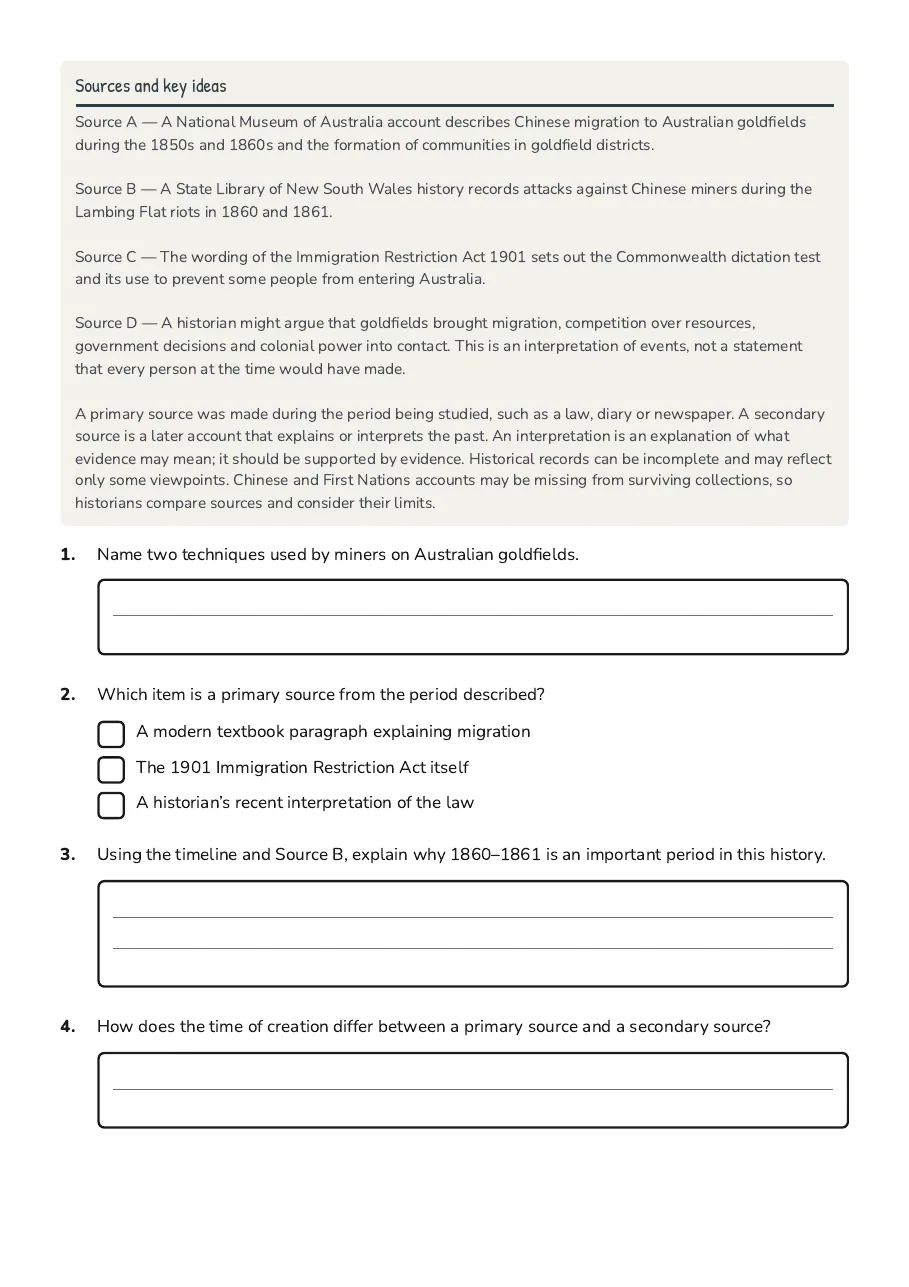
Sources and key ideas
Source A — A National Museum of Australia account describes Chinese migration to Australian goldfields during the 1850s and 1860s and the formation of communities in goldfield districts. Source B — A State Library of New South Wales history records attacks against Chinese miners during the Lambing Flat riots in 1860 and 1861. Source C — The wording of the Immigration Restriction Act 1901 sets out the Commonwealth dictation test and its use to prevent some people from entering Australia. Source D — A historian might argue that goldfields brought migration, competition over resources, government decisions and colonial power into contact. This is an interpretation of events, not a statement that every person at the time would have made. A primary source was made during the period being studied, such as a law, diary or newspaper. A secondary source is a later account that explains or interprets the past. An interpretation is an explanation of what evidence may mean; it should be supported by evidence. Historical records can be incomplete and may reflect only some viewpoints. Chinese and First Nations accounts may be missing from surviving collections, so historians compare sources and consider their limits.
- A modern textbook paragraph explaining migration
- The 1901 Immigration Restriction Act itself
- A historian’s recent interpretation of the law
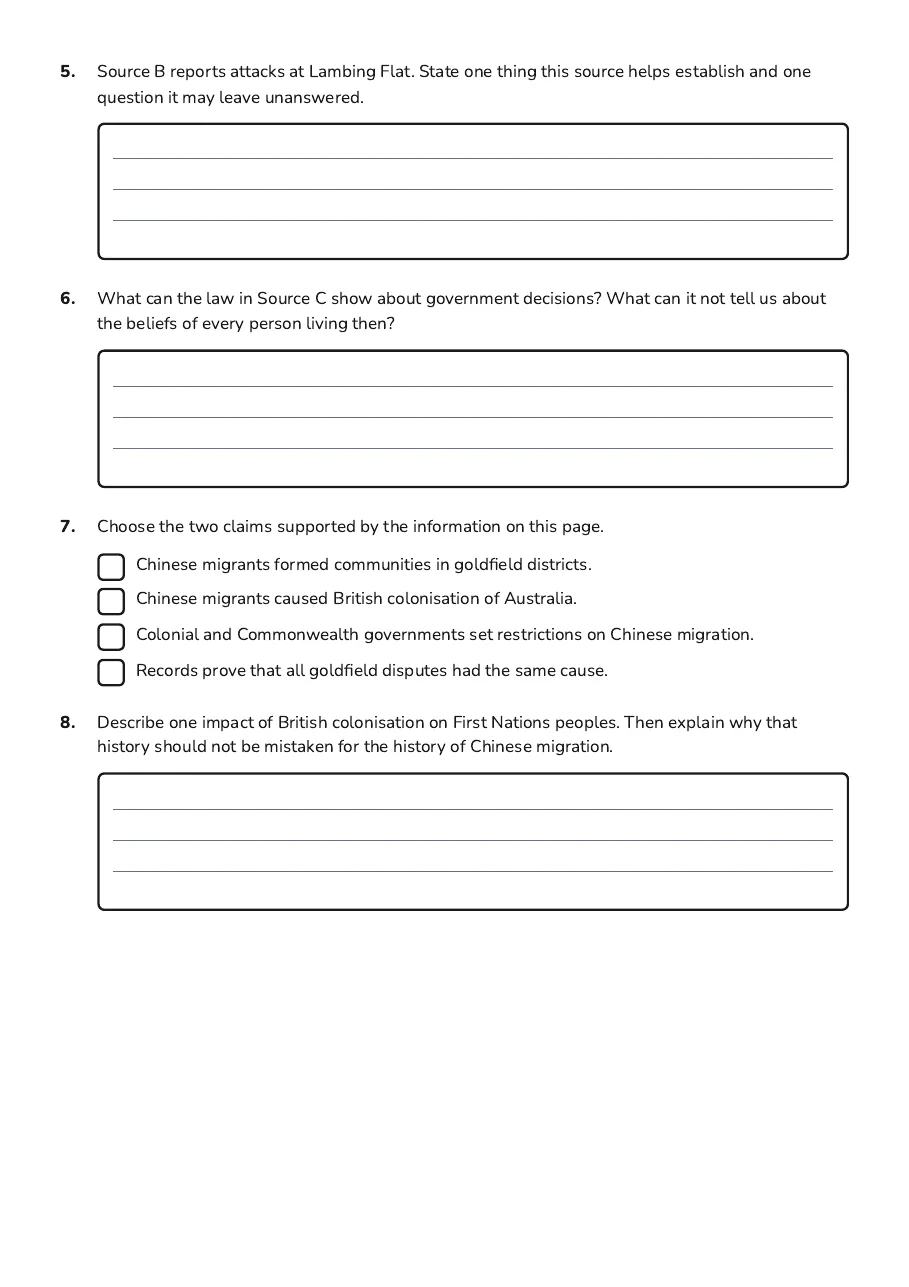
- Chinese migrants formed communities in goldfield districts.
- Chinese migrants caused British colonisation of Australia.
- Colonial and Commonwealth governments set restrictions on Chinese migration.
- Records prove that all goldfield disputes had the same cause.
4 printable pages
Page 1
Page 2
Page 3
Page 4
About This Worksheet
Free in Kuraplan
Sign up free, grab the PDF, and customize it for your class.
Print-Ready
Formatted for standard paper. Clean layout, easy to read.
AI-Generated
Created with Kuraplan's AI, designed for real classroom use.
For Teachers & Parents
Use in classrooms, for homework, tutoring, or homeschool.
Need a custom version of this worksheet?
Kuraplan's AI generates custom worksheets in seconds — differentiated for every learner, aligned to your curriculum.
Generate Custom Worksheets — Free