WW1 Significant People
A free social sciences worksheet ready for your classroom. Open in Kuraplan to grab the print-ready PDF, customize it for your students, or generate a fresh version in seconds.
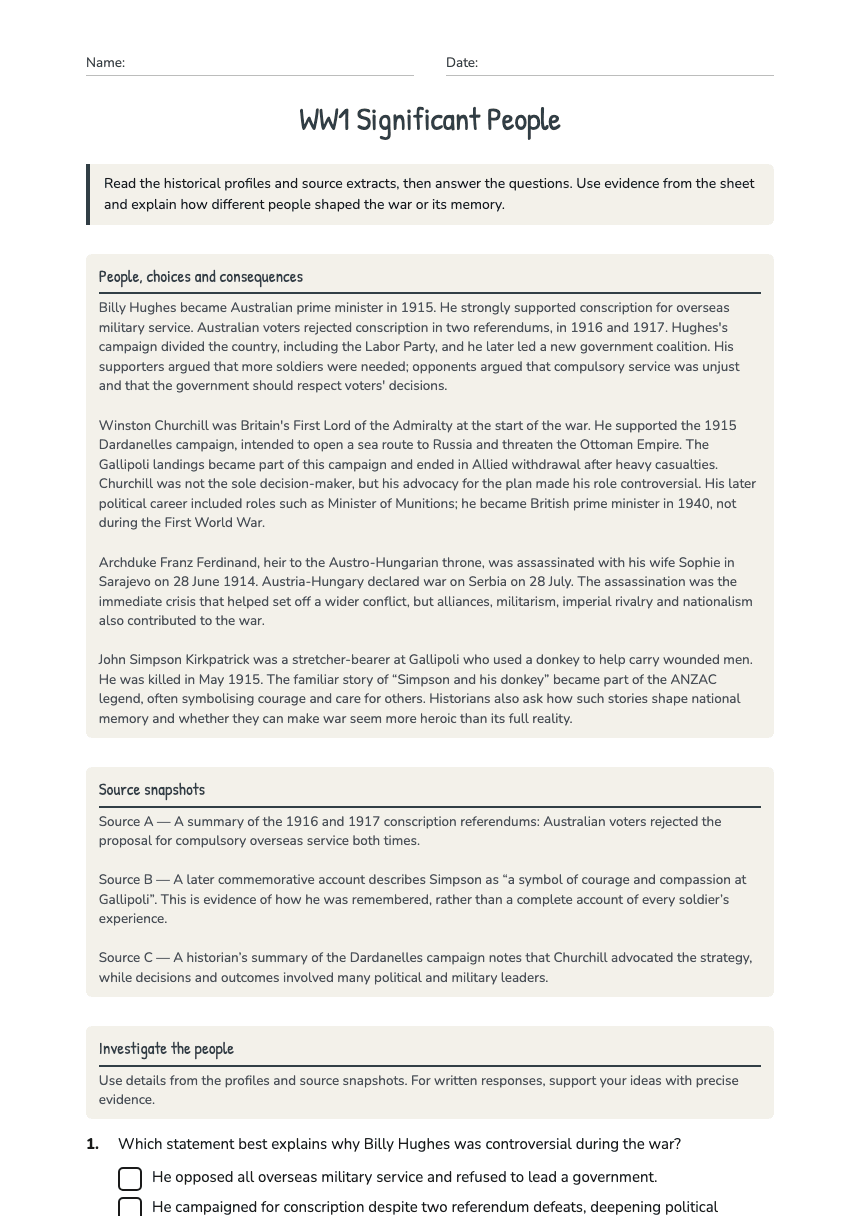
WW1 Significant People
People, choices and consequences
Billy Hughes became Australian prime minister in 1915. He strongly supported conscription for overseas military service. Australian voters rejected conscription in two referendums, in 1916 and 1917. Hughes's campaign divided the country, including the Labor Party, and he later led a new government coalition. His supporters argued that more soldiers were needed; opponents argued that compulsory service was unjust and that the government should respect voters' decisions. Winston Churchill was Britain's First Lord of the Admiralty at the start of the war. He supported the 1915 Dardanelles campaign, intended to open a sea route to Russia and threaten the Ottoman Empire. The Gallipoli landings became part of this campaign and ended in Allied withdrawal after heavy casualties. Churchill was not the sole decision-maker, but his advocacy for the plan made his role controversial. His later political career included roles such as Minister of Munitions; he became British prime minister in 1940, not during the First World War. Archduke Franz Ferdinand, heir to the Austro-Hungarian throne, was assassinated with his wife Sophie in Sarajevo on 28 June 1914. Austria-Hungary declared war on Serbia on 28 July. The assassination was the immediate crisis that helped set off a wider conflict, but alliances, militarism, imperial rivalry and nationalism also contributed to the war. John Simpson Kirkpatrick was a stretcher-bearer at Gallipoli who used a donkey to help carry wounded men. He was killed in May 1915. The familiar story of “Simpson and his donkey” became part of the ANZAC legend, often symbolising courage and care for others. Historians also ask how such stories shape national memory and whether they can make war seem more heroic than its full reality.
Source snapshots
Source A — A summary of the 1916 and 1917 conscription referendums: Australian voters rejected the proposal for compulsory overseas service both times. Source B — A later commemorative account describes Simpson as “a symbol of courage and compassion at Gallipoli”. This is evidence of how he was remembered, rather than a complete account of every soldier’s experience. Source C — A historian’s summary of the Dardanelles campaign notes that Churchill advocated the strategy, while decisions and outcomes involved many political and military leaders.
Investigate the people
Use details from the profiles and source snapshots. For written responses, support your ideas with precise evidence.
- He opposed all overseas military service and refused to lead a government.
- He campaigned for conscription despite two referendum defeats, deepening political divisions.
- He commanded the Allied troops at Gallipoli.
- He was the heir to the Austro-Hungarian throne.
4 printable pages

Page 1
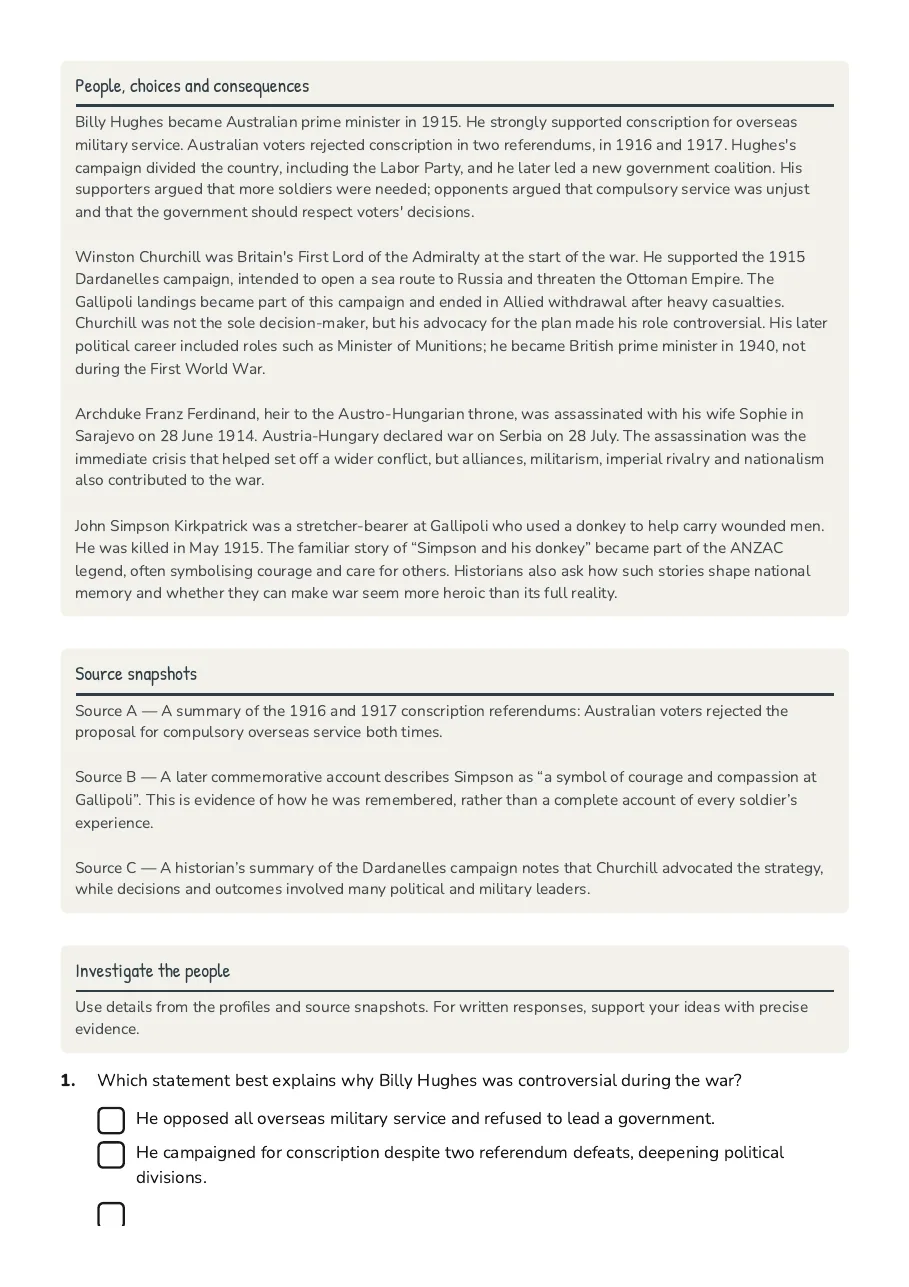
Page 2
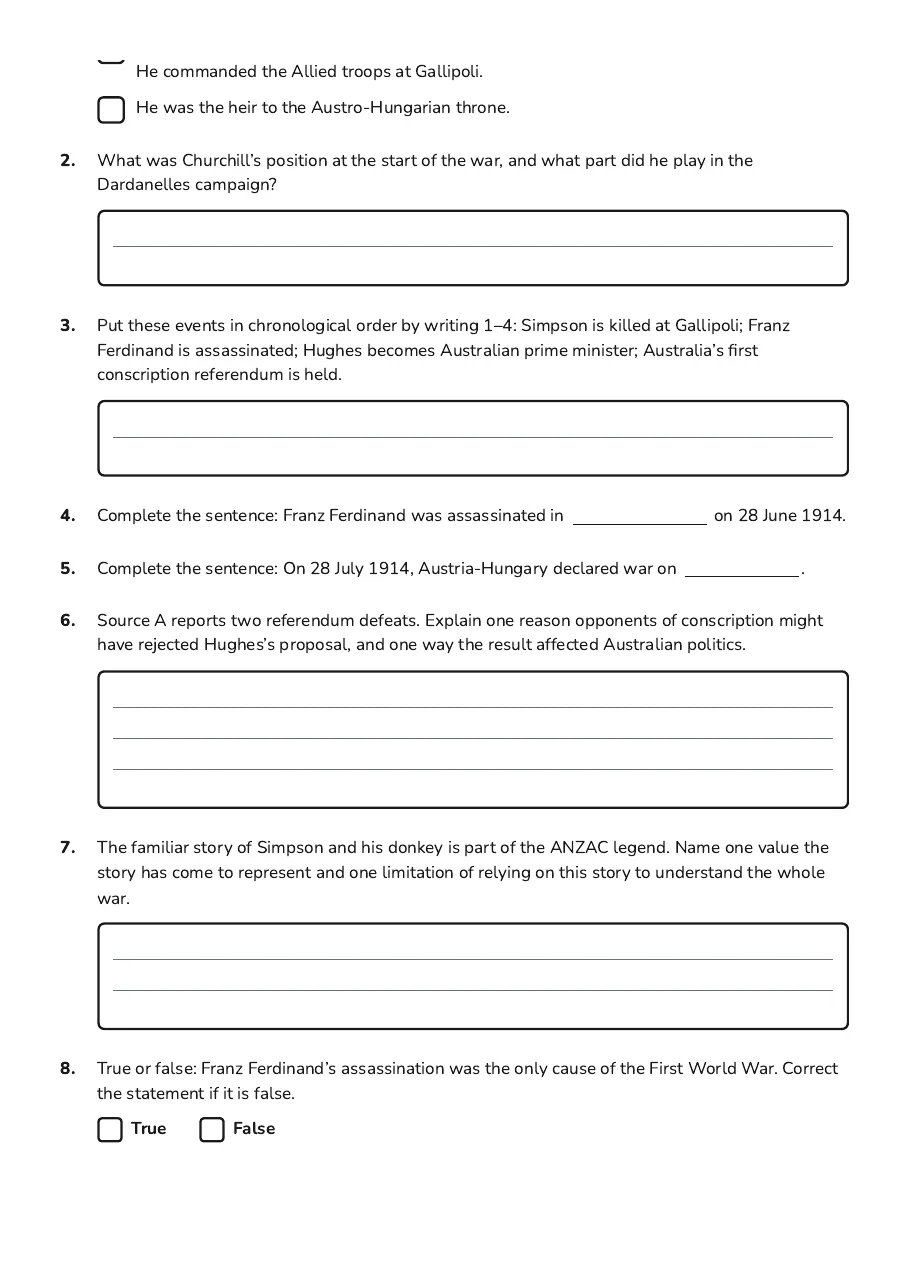
Page 3
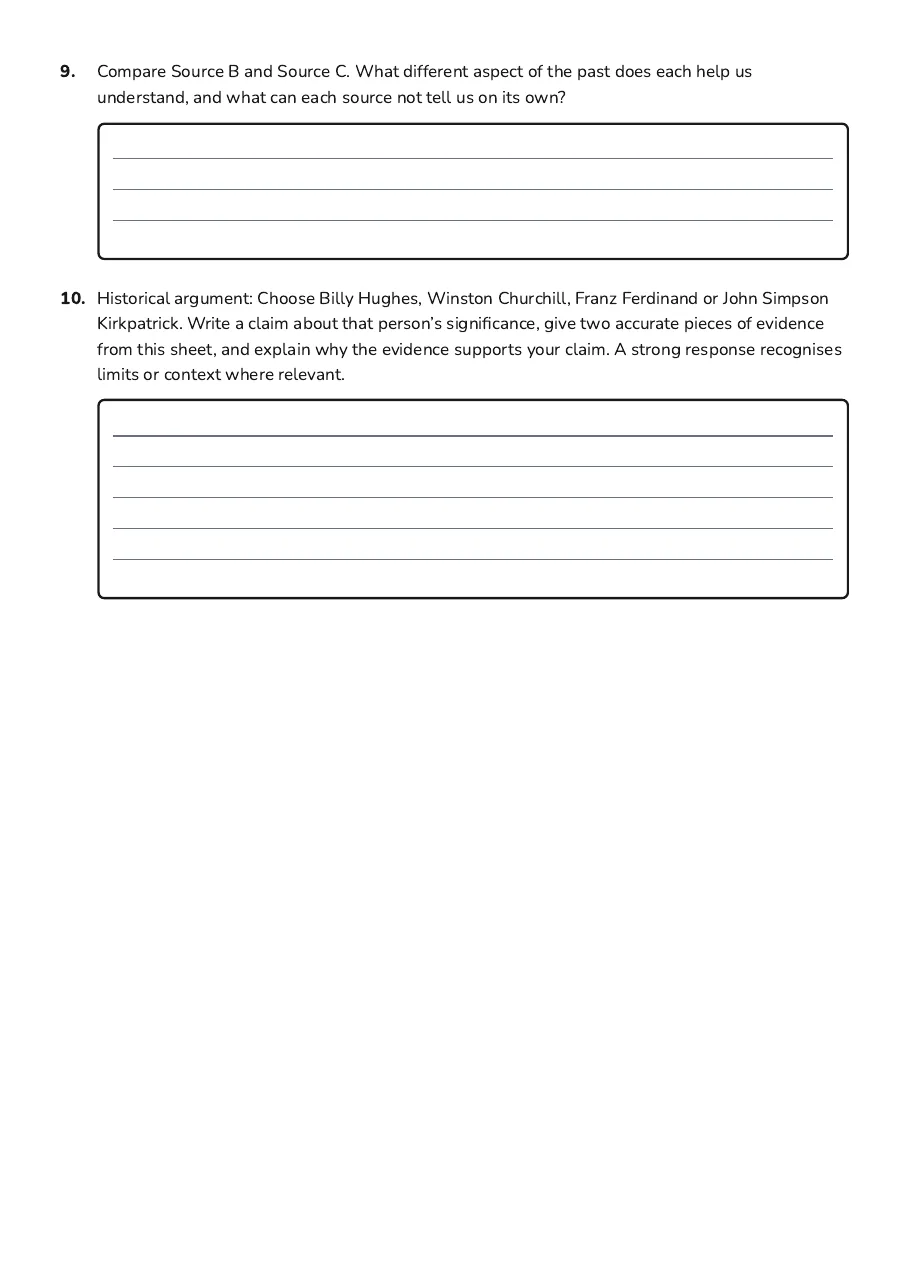
Page 4
About This Worksheet
Free in Kuraplan
Sign up free, grab the PDF, and customize it for your class.
Print-Ready
Formatted for standard paper. Clean layout, easy to read.
AI-Generated
Created with Kuraplan's AI, designed for real classroom use.
For Teachers & Parents
Use in classrooms, for homework, tutoring, or homeschool.
Need a custom version of this worksheet?
Kuraplan's AI generates custom worksheets in seconds — differentiated for every learner, aligned to your curriculum.
Generate Custom Worksheets — Free