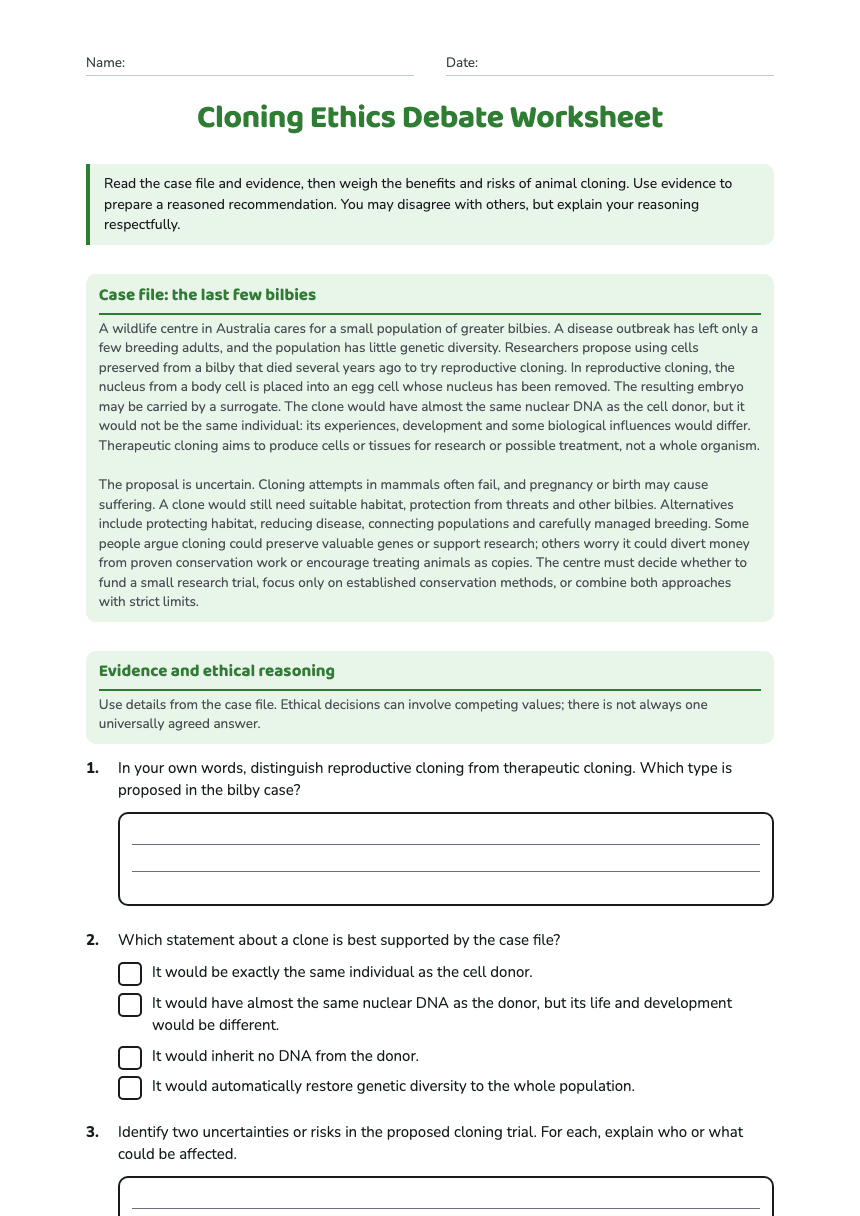
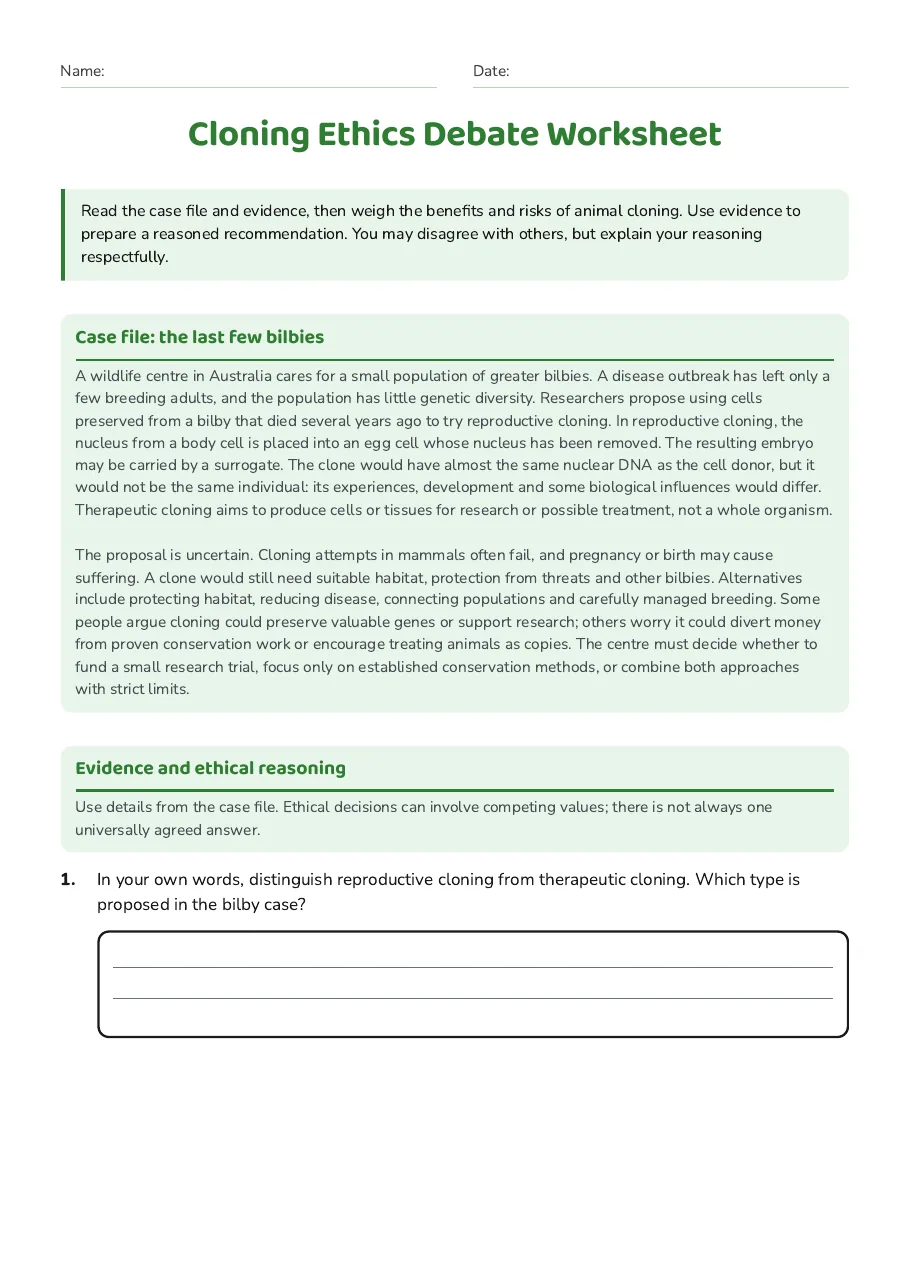
Cloning Ethics Debate Worksheet
A free science worksheet ready for your classroom. Open in Kuraplan to grab the print-ready PDF, customize it for your students, or generate a fresh version in seconds.
Cloning Ethics Debate Worksheet
Case file: the last few bilbies
A wildlife centre in Australia cares for a small population of greater bilbies. A disease outbreak has left only a few breeding adults, and the population has little genetic diversity. Researchers propose using cells preserved from a bilby that died several years ago to try reproductive cloning. In reproductive cloning, the nucleus from a body cell is placed into an egg cell whose nucleus has been removed. The resulting embryo may be carried by a surrogate. The clone would have almost the same nuclear DNA as the cell donor, but it would not be the same individual: its experiences, development and some biological influences would differ. Therapeutic cloning aims to produce cells or tissues for research or possible treatment, not a whole organism. The proposal is uncertain. Cloning attempts in mammals often fail, and pregnancy or birth may cause suffering. A clone would still need suitable habitat, protection from threats and other bilbies. Alternatives include protecting habitat, reducing disease, connecting populations and carefully managed breeding. Some people argue cloning could preserve valuable genes or support research; others worry it could divert money from proven conservation work or encourage treating animals as copies. The centre must decide whether to fund a small research trial, focus only on established conservation methods, or combine both approaches with strict limits.
Evidence and ethical reasoning
Use details from the case file. Ethical decisions can involve competing values; there is not always one universally agreed answer.
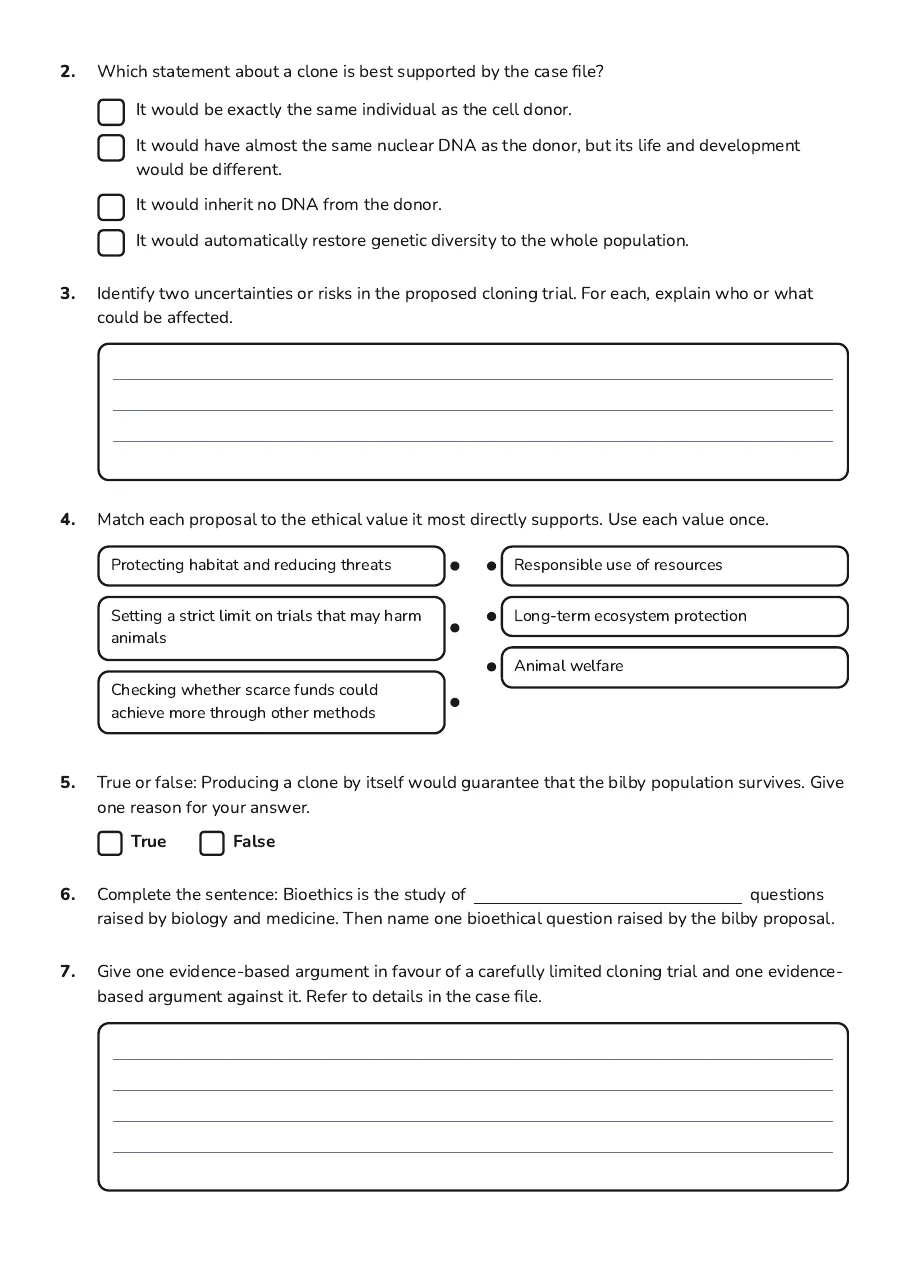
- It would be exactly the same individual as the cell donor.
- It would have almost the same nuclear DNA as the donor, but its life and development would be different.
- It would inherit no DNA from the donor.
- It would automatically restore genetic diversity to the whole population.
- Protecting habitat and reducing threats
- Setting a strict limit on trials that may harm animals
- Checking whether scarce funds could achieve more through other methods
- Responsible use of resources
- Long-term ecosystem protection
- Animal welfare
3 printable pages
Page 1
Page 2
Page 3
About This Worksheet
Free in Kuraplan
Sign up free, grab the PDF, and customize it for your class.
Print-Ready
Formatted for standard paper. Clean layout, easy to read.
AI-Generated
Created with Kuraplan's AI, designed for real classroom use.
For Teachers & Parents
Use in classrooms, for homework, tutoring, or homeschool.
Need a custom version of this worksheet?
Kuraplan's AI generates custom worksheets in seconds — differentiated for every learner, aligned to your curriculum.
Generate Custom Worksheets — Free