ScienceFreePrintable

Dichotomous Key Classification

A free science worksheet ready for your classroom. Open in Kuraplan to grab the print-ready PDF, customize it for your students, or generate a fresh version in seconds.

Dichotomous Key Classification worksheet preview

Dichotomous Key Classification

Dichotomous Key Classification

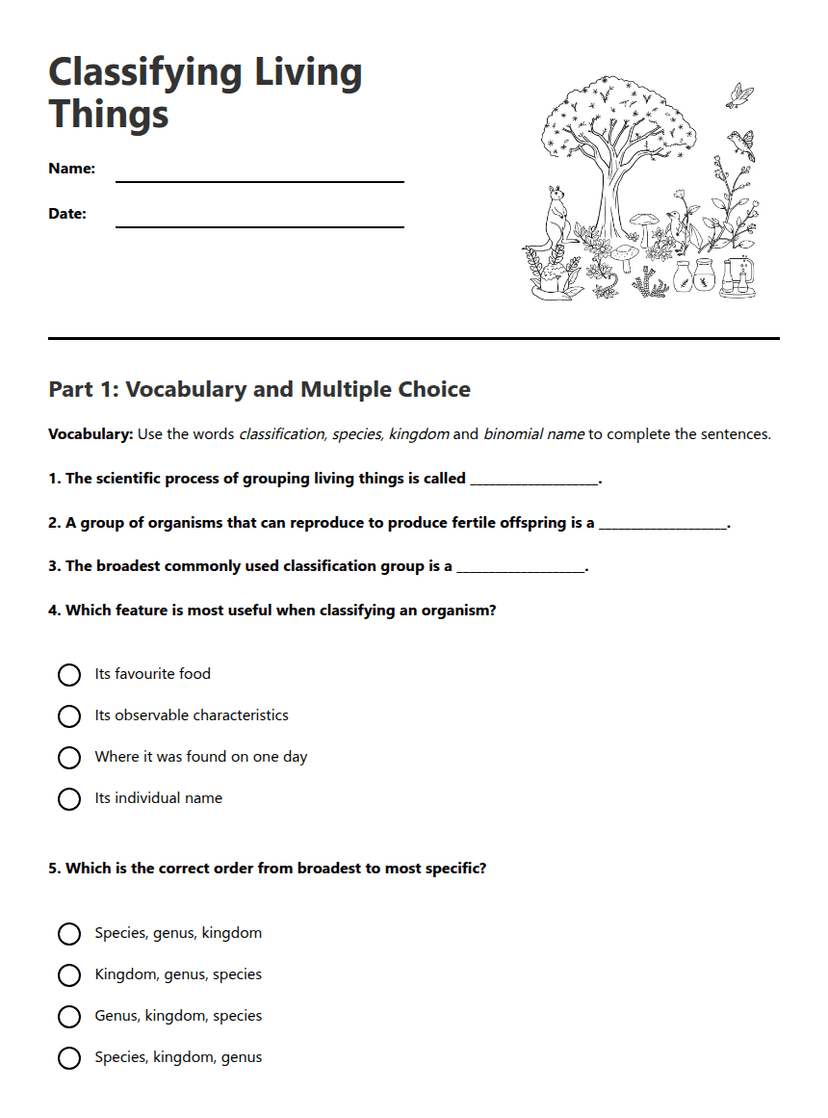
Classification and dichotomous key illustration

Part 1: Understanding Classification

1. What is classification in science?
2. Why do scientists use classification systems? Give two reasons.
3. Circle the correct answer: A dichotomous key uses how many choices at each step?

One choice

Two choices

Three choices

Four choices

Part 2: Features for Classification

4. Check all the features that could be used to classify leaves:

Shape

Edge type (smooth or serrated)

Colour

Texture

Size

The tree it came from

5. Fill in the blanks about good classification features:

Good features for classification should be ____________ to observe and create ____________ differences between groups. Features that change with ____________ or ____________ are not reliable for classification.

6. Match the leaf edge types with their descriptions:
1. Smooth
2. Serrated
3. Lobed
A. Has tooth-like edges
B. Has rounded projections
C. Has no bumps or teeth

Part 3: Creating Your Dichotomous Key

7. You have been given a set of objects/leaves at your station. List the main features you can observe:
8. Create your dichotomous key below. Start with "1a" and "1b" for your first pair of choices:
9. Test your key with a partner. Did it work correctly?

Yes, it worked perfectly

Mostly, but needed small changes

No, it needed major changes

10. What changes did you make to improve your key?

Part 4: Using Dichotomous Keys

11. Use the dichotomous key provided by another group. Record which object/leaf you identified and the steps you followed:

Object identified: ____________________

Steps followed: ____________________

12. Draw one of the objects or leaves you classified, labelling its key features:
13. Circle the most challenging part of creating a dichotomous key:

Choosing good features to observe

Writing clear descriptions

Making sure each step has only two choices

Testing the key with different objects

Part 5: Cultural Perspectives and Reflection

14. How might First Nations Australians classify plants differently from modern scientific classification?
15. Give an example of how cultural knowledge might influence classification systems:
16. Why is it important to respect different classification systems and ways of understanding nature?
17. Reflection: What was the most interesting thing you learned about classification today?

About This Worksheet

Free in Kuraplan

Sign up free, grab the PDF, and customize it for your class.

Print-Ready

Formatted for standard paper. Clean layout, easy to read.

AI-Generated

Created with Kuraplan's AI, designed for real classroom use.

For Teachers & Parents

Use in classrooms, for homework, tutoring, or homeschool.

Need a custom version of this worksheet?

Kuraplan's AI generates custom worksheets in seconds — differentiated for every learner, aligned to your curriculum.

Generate Custom Worksheets — Free
No credit card Curriculum-aligned Under 60 seconds