Dietrich Case Analysis Worksheet
A free social sciences worksheet ready for your classroom. Open in Kuraplan to grab the print-ready PDF, customize it for your students, or generate a fresh version in seconds.
Dietrich Case Analysis Worksheet
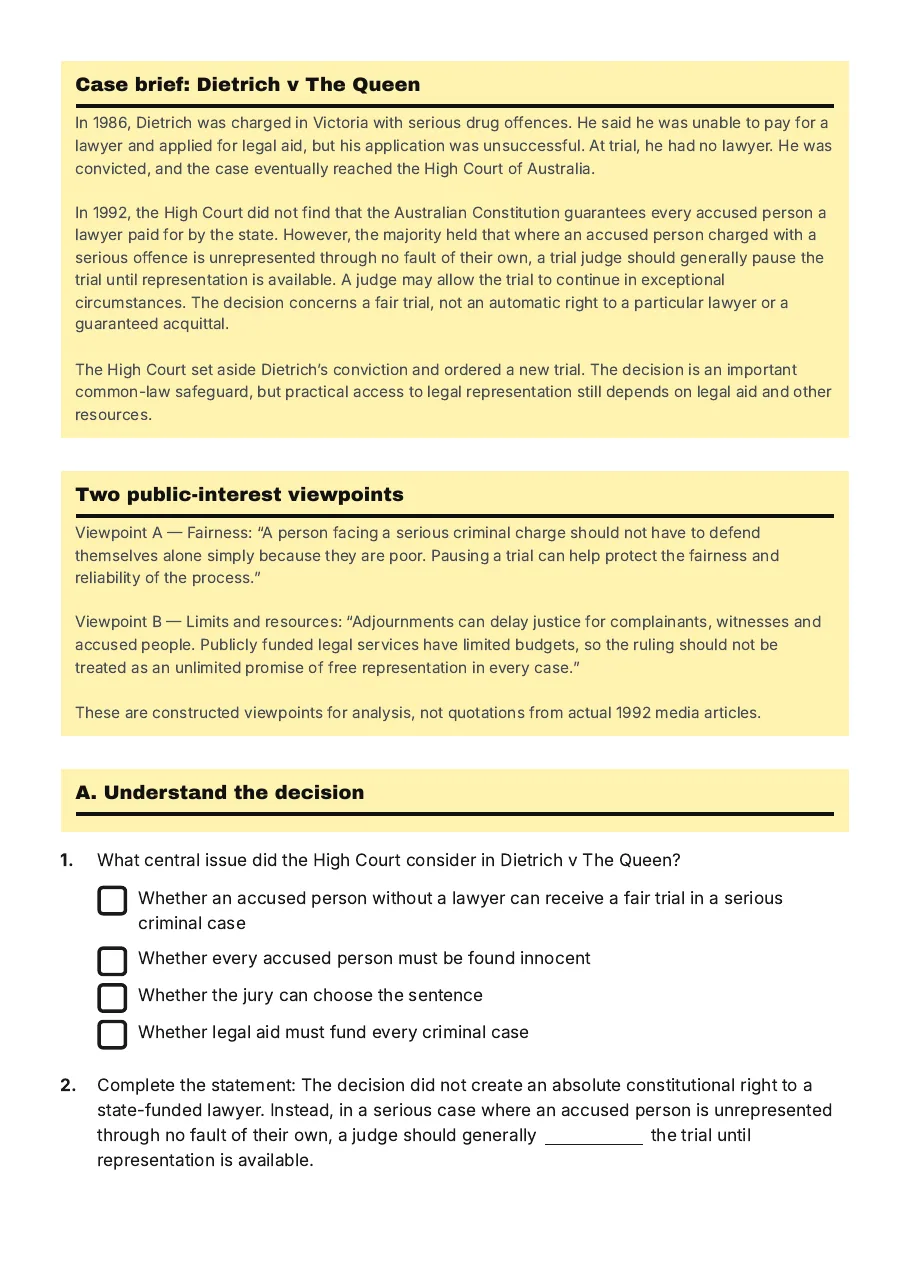
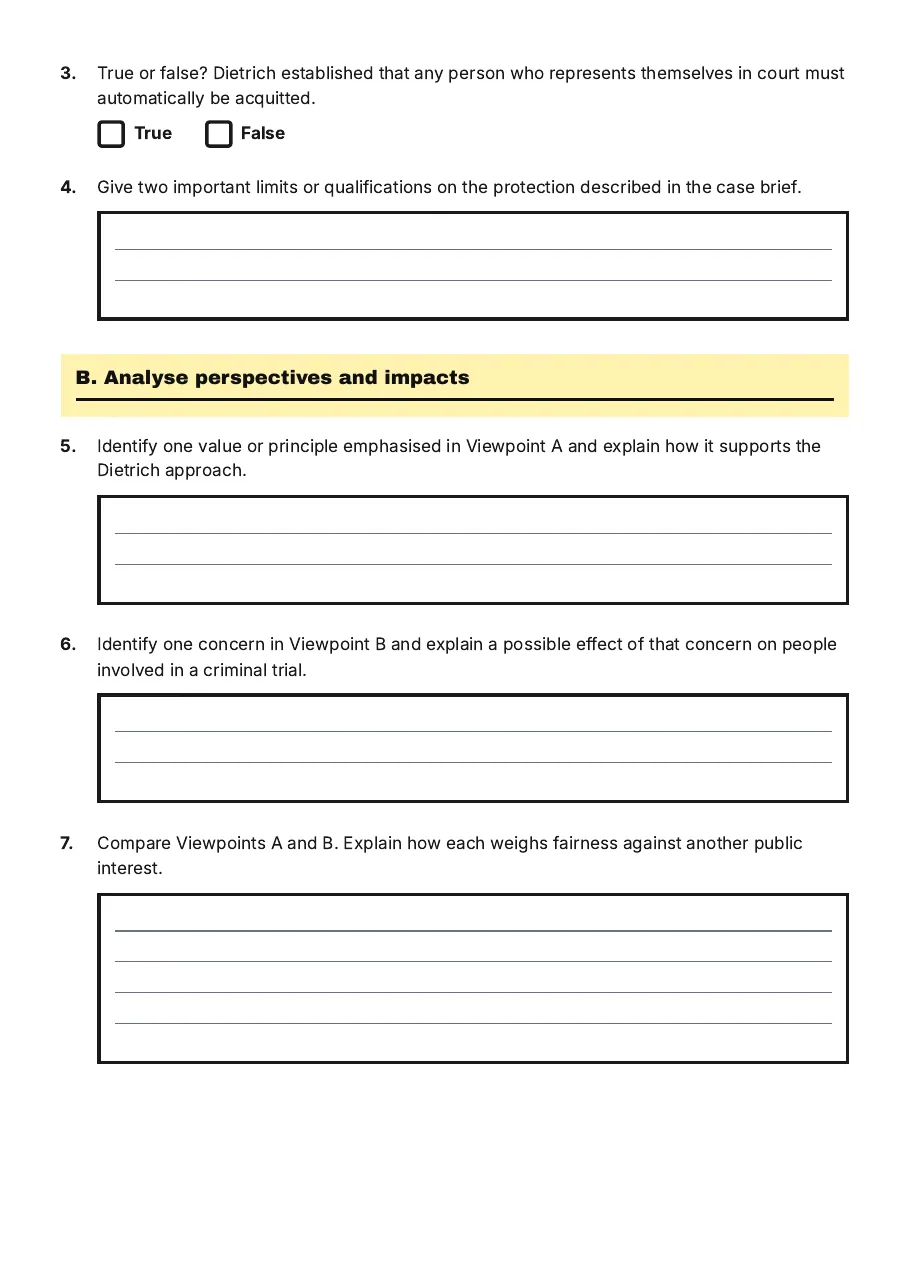
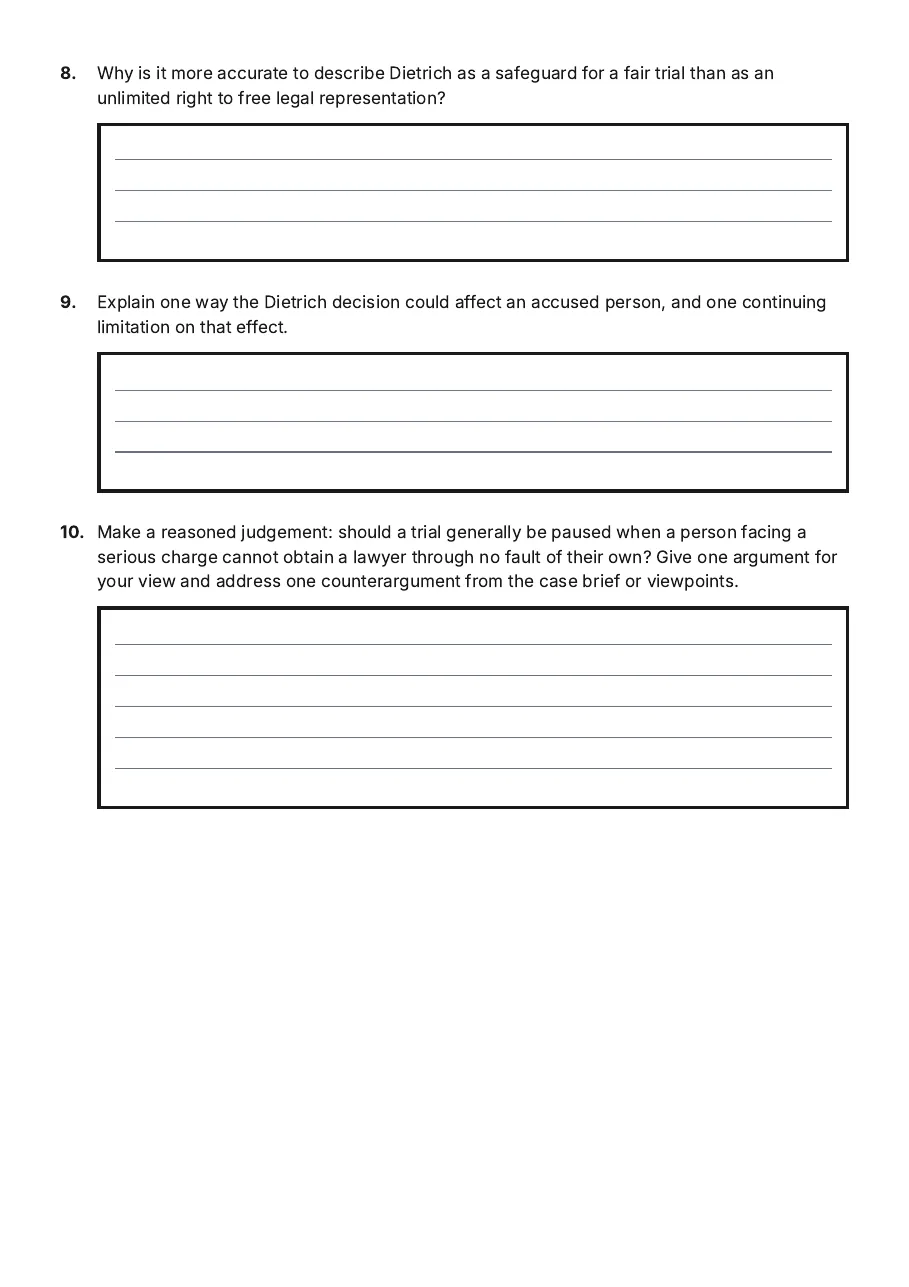
Case brief: Dietrich v The Queen
In 1986, Dietrich was charged in Victoria with serious drug offences. He said he was unable to pay for a lawyer and applied for legal aid, but his application was unsuccessful. At trial, he had no lawyer. He was convicted, and the case eventually reached the High Court of Australia. In 1992, the High Court did not find that the Australian Constitution guarantees every accused person a lawyer paid for by the state. However, the majority held that where an accused person charged with a serious offence is unrepresented through no fault of their own, a trial judge should generally pause the trial until representation is available. A judge may allow the trial to continue in exceptional circumstances. The decision concerns a fair trial, not an automatic right to a particular lawyer or a guaranteed acquittal. The High Court set aside Dietrich’s conviction and ordered a new trial. The decision is an important common-law safeguard, but practical access to legal representation still depends on legal aid and other resources.
Two public-interest viewpoints
Viewpoint A — Fairness: “A person facing a serious criminal charge should not have to defend themselves alone simply because they are poor. Pausing a trial can help protect the fairness and reliability of the process.” Viewpoint B — Limits and resources: “Adjournments can delay justice for complainants, witnesses and accused people. Publicly funded legal services have limited budgets, so the ruling should not be treated as an unlimited promise of free representation in every case.” These are constructed viewpoints for analysis, not quotations from actual 1992 media articles.
A. Understand the decision
- Whether an accused person without a lawyer can receive a fair trial in a serious criminal case
- Whether every accused person must be found innocent
- Whether the jury can choose the sentence
- Whether legal aid must fund every criminal case
B. Analyse perspectives and impacts
4 printable pages
Page 1
Page 2
Page 3
Page 4
About This Worksheet
Free in Kuraplan
Sign up free, grab the PDF, and customize it for your class.
Print-Ready
Formatted for standard paper. Clean layout, easy to read.
AI-Generated
Created with Kuraplan's AI, designed for real classroom use.
For Teachers & Parents
Use in classrooms, for homework, tutoring, or homeschool.
Need a custom version of this worksheet?
Kuraplan's AI generates custom worksheets in seconds — differentiated for every learner, aligned to your curriculum.
Generate Custom Worksheets — FreeMore Social Sciences Worksheets
Community Project Planning
Free
Australian Law Reform Fact Sheets
Free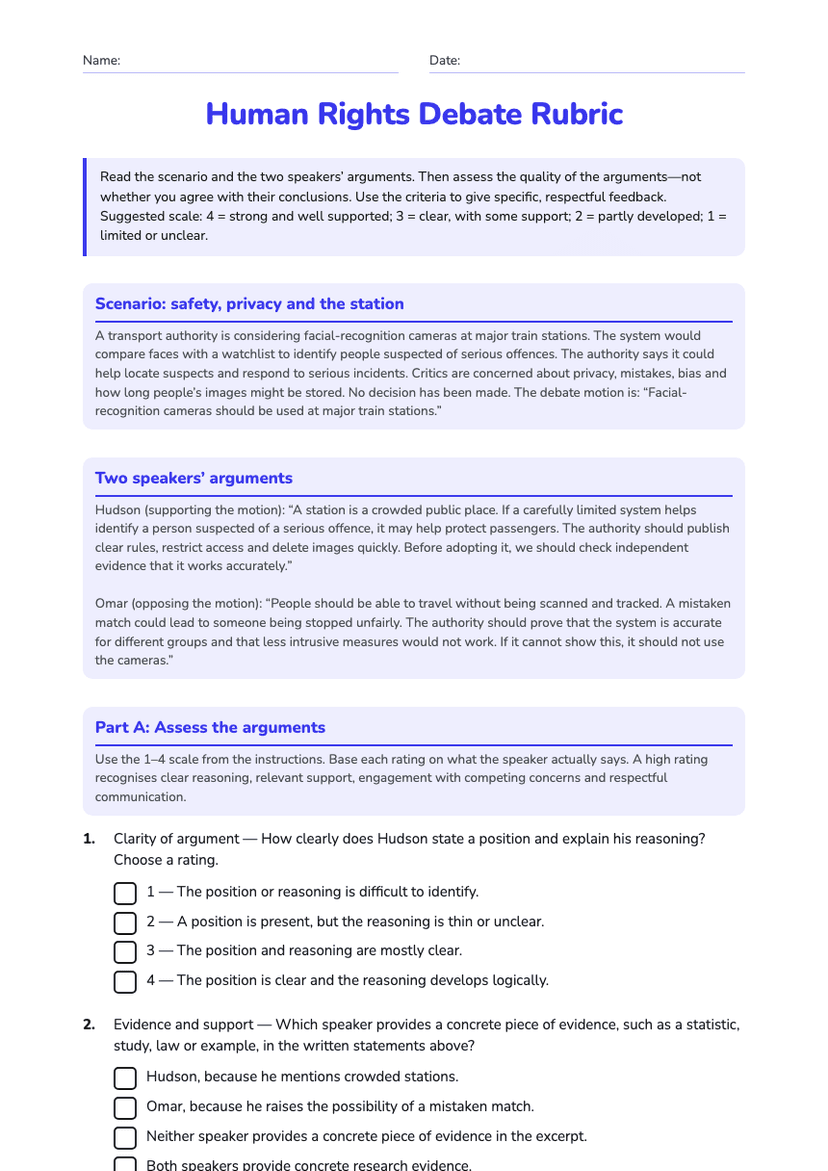
Human Rights Debate Rubric
Free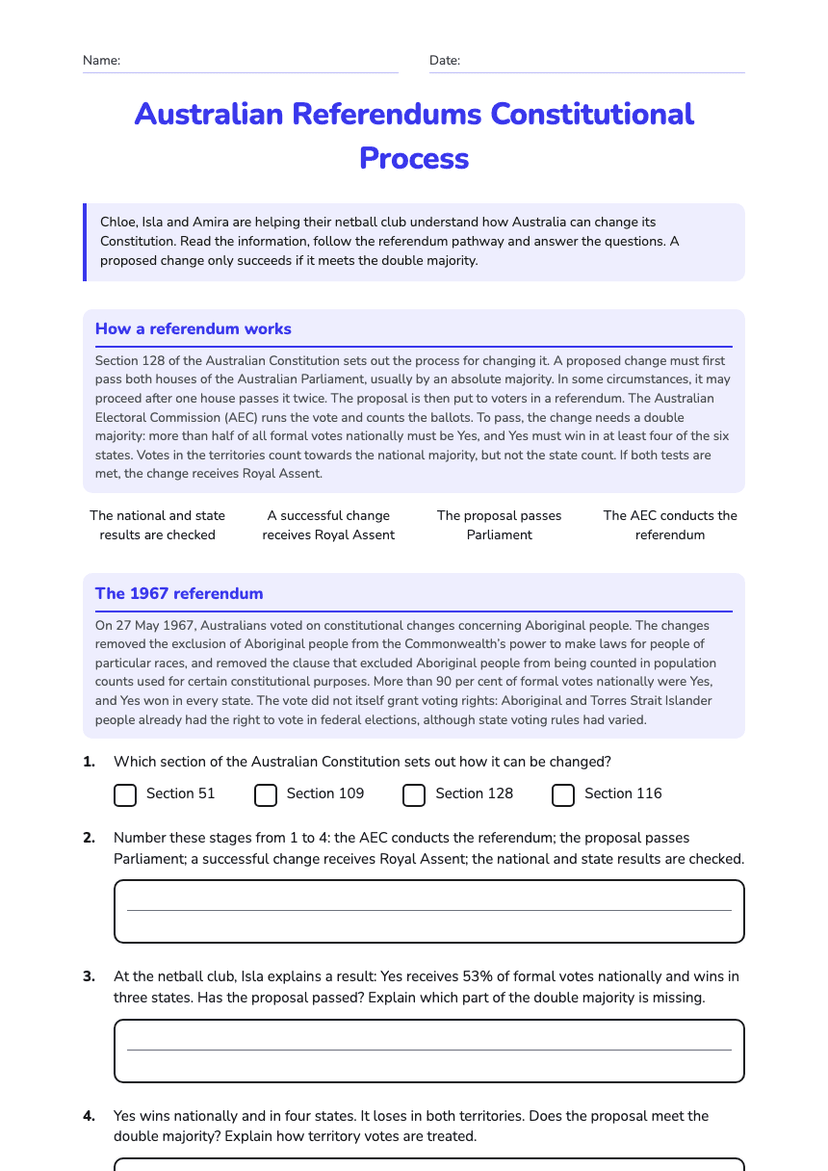
Australian Referendums Constitutional Process
Free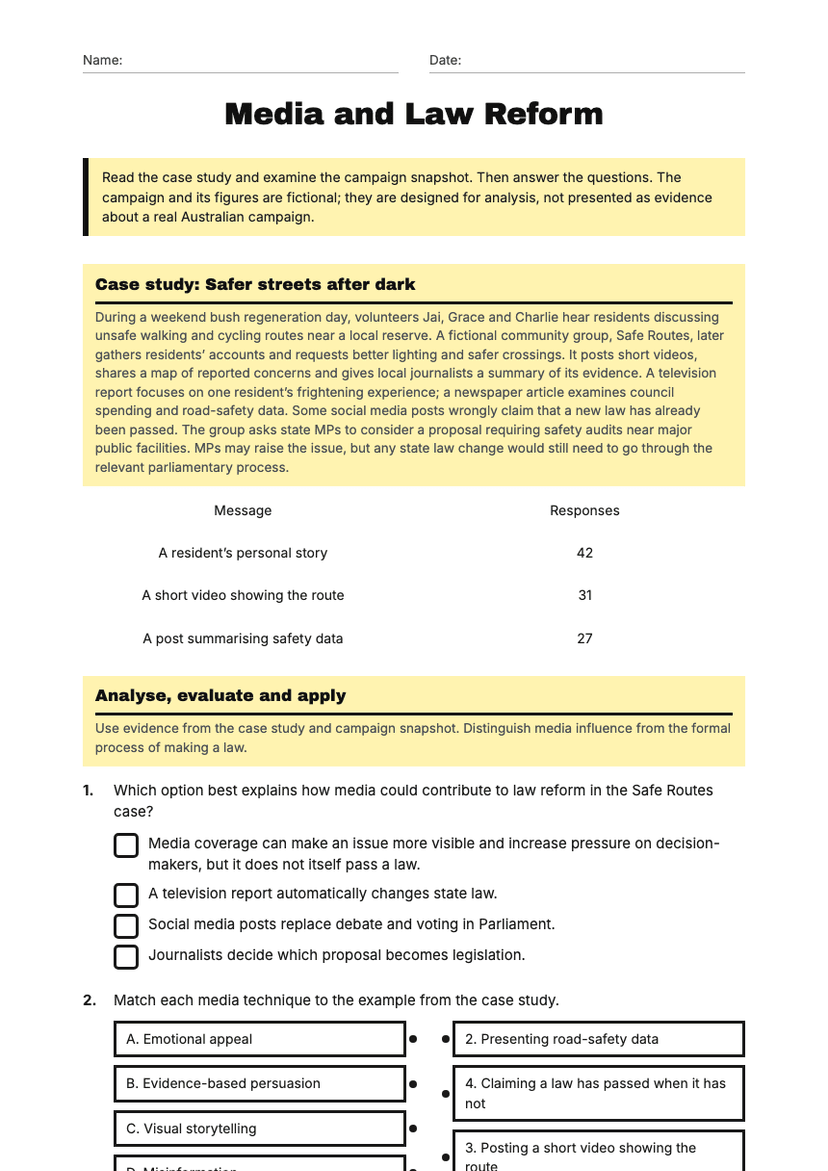
Media and Law Reform
Free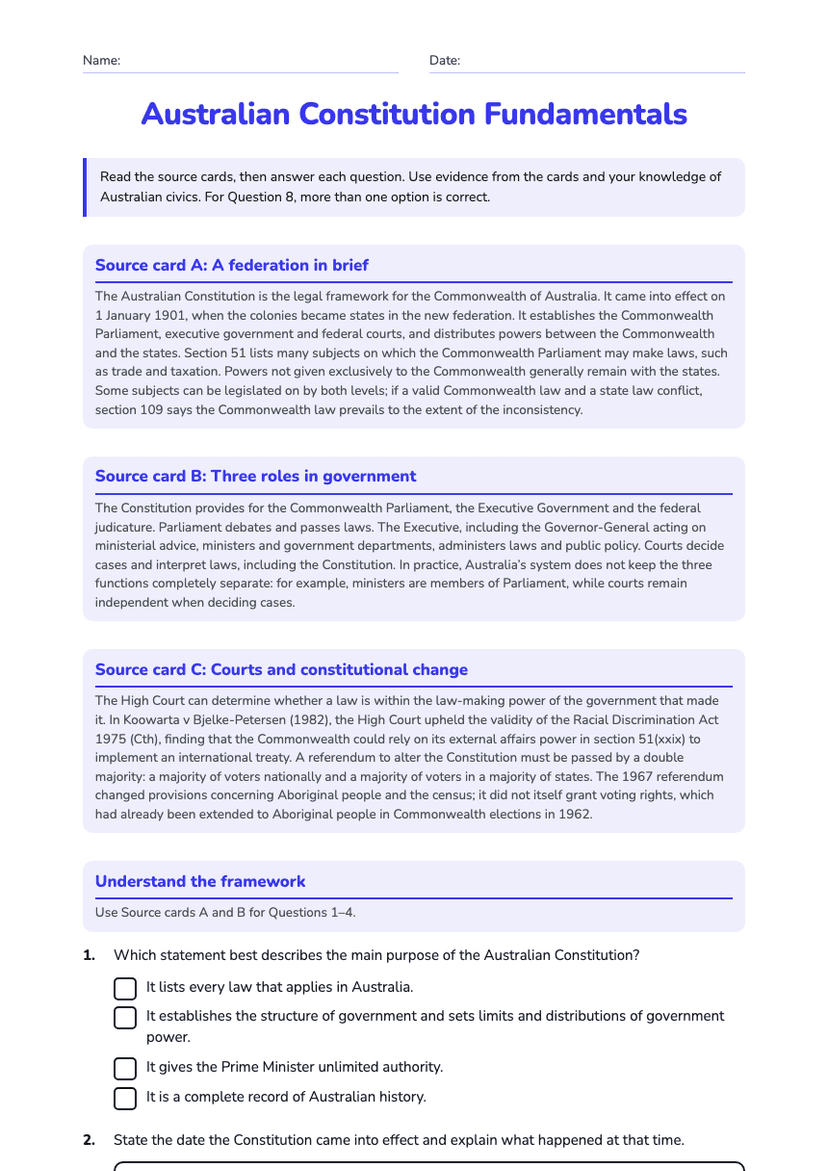
Australian Constitution Fundamentals
Free
Commonwealth Constitution Overview
Free