ScienceFreePrintable
Energy Efficiency and Conservation
A free science worksheet ready for your classroom. Open in Kuraplan to grab the print-ready PDF, customize it for your students, or generate a fresh version in seconds.

Name:Date:
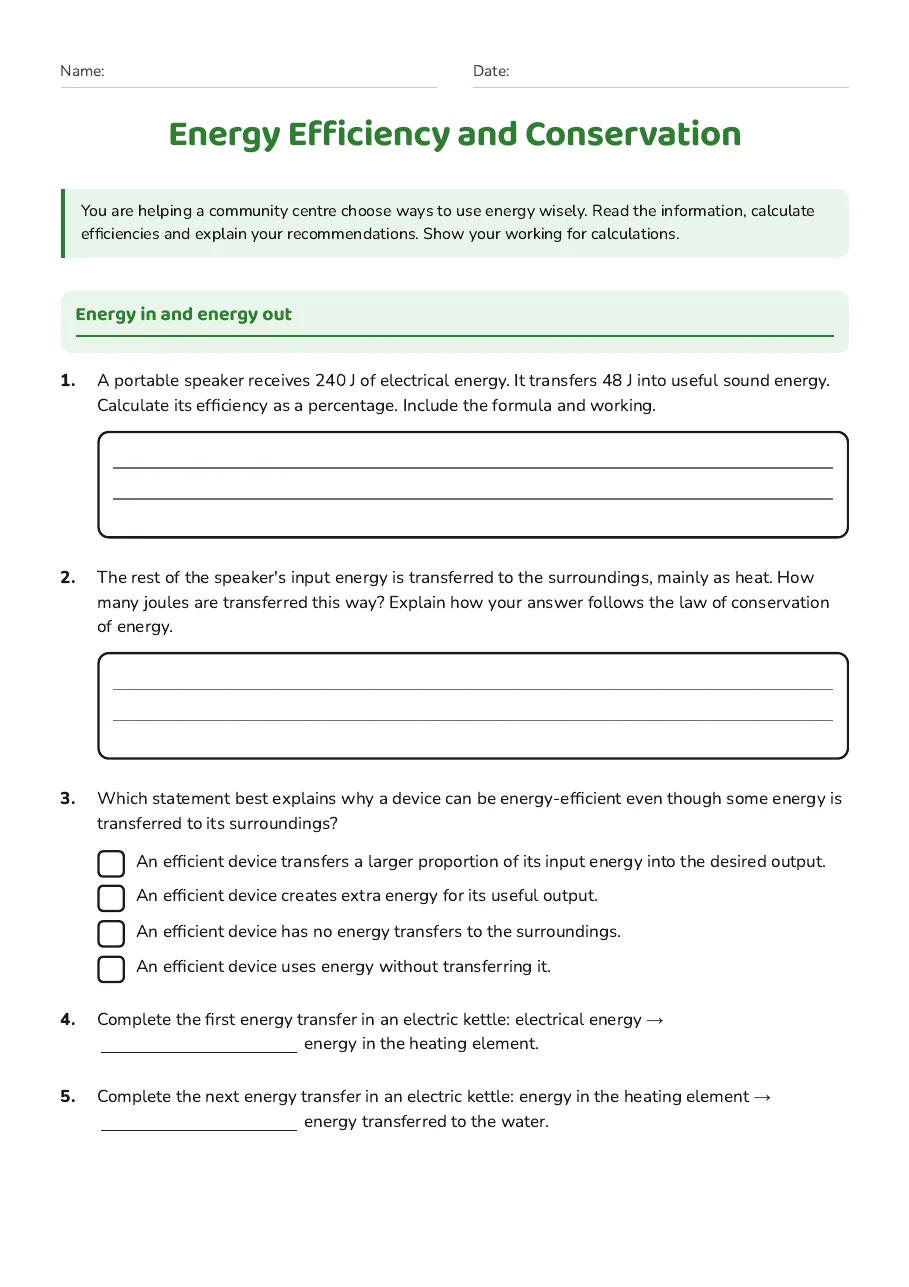
Energy Efficiency and Conservation
You are helping a community centre choose ways to use energy wisely. Read the information, calculate efficiencies and explain your recommendations. Show your working for calculations.
Energy in and energy out
1.A portable speaker receives 240 J of electrical energy. It transfers 48 J into useful sound energy. Calculate its efficiency as a percentage. Include the formula and working.
2.The rest of the speaker's input energy is transferred to the surroundings, mainly as heat. How many joules are transferred this way? Explain how your answer follows the law of conservation of energy.
3.Which statement best explains why a device can be energy-efficient even though some energy is transferred to its surroundings?
- An efficient device transfers a larger proportion of its input energy into the desired output.
- An efficient device creates extra energy for its useful output.
- An efficient device has no energy transfers to the surroundings.
- An efficient device uses energy without transferring it.
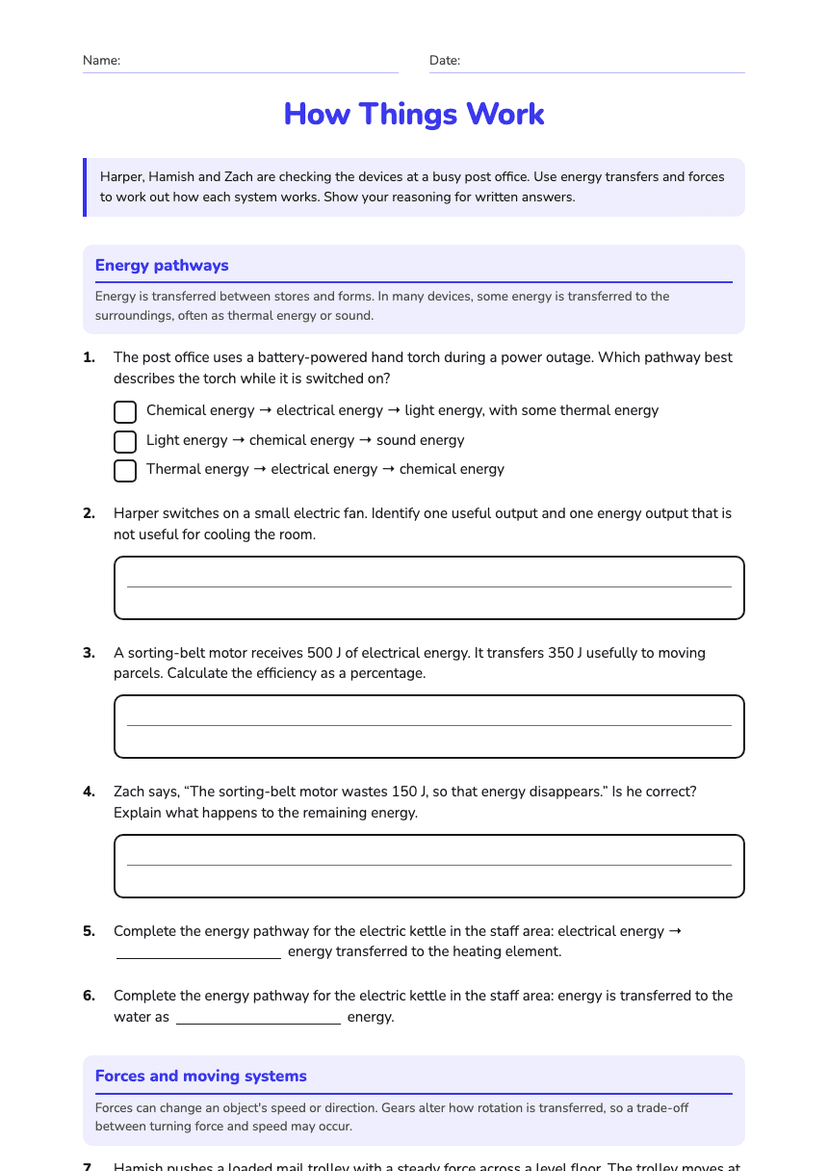
4.Complete the first energy transfer in an electric kettle: electrical energy → energy in the heating element.
5.Complete the next energy transfer in an electric kettle: energy in the heating element → energy transferred to the water.
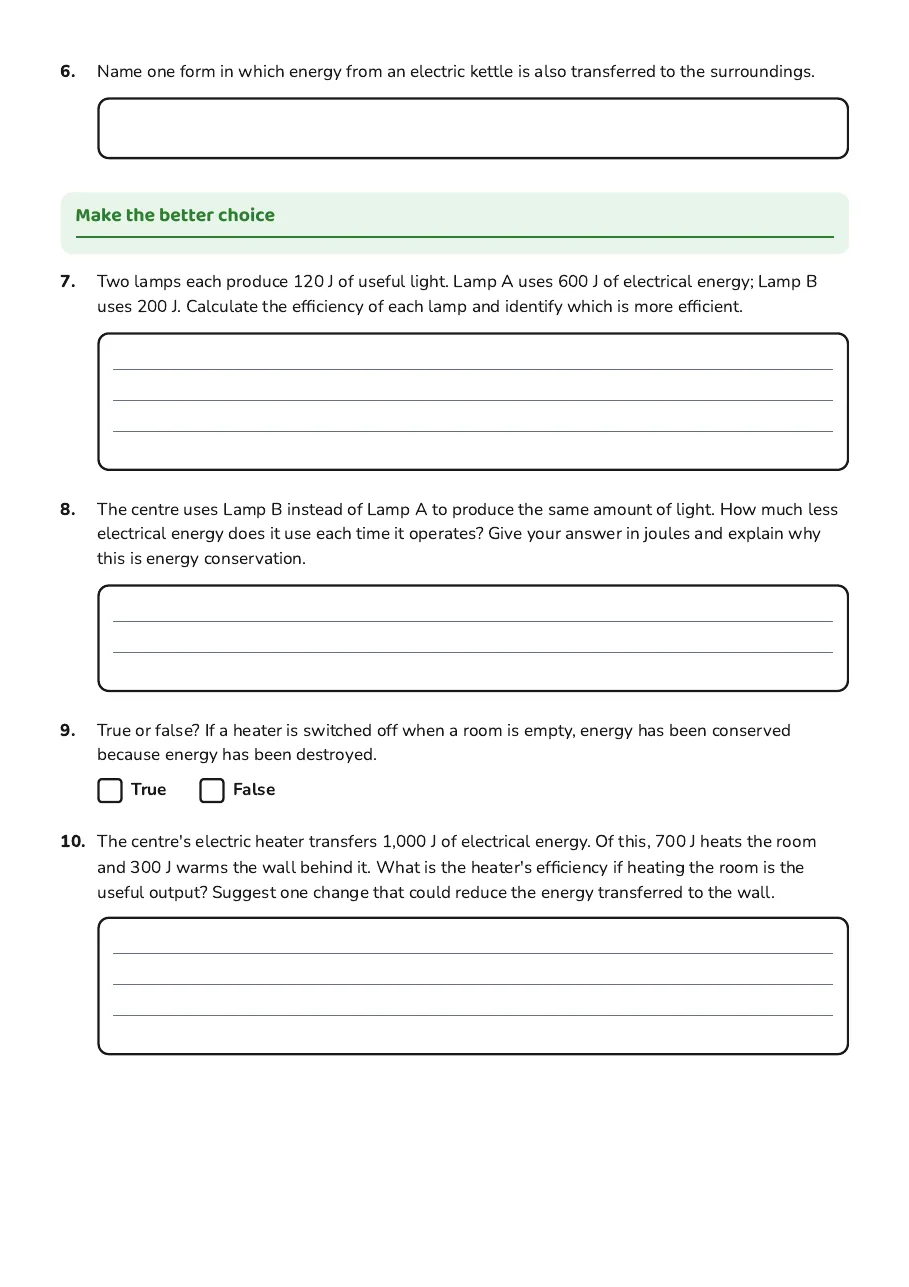
6.Name one form in which energy from an electric kettle is also transferred to the surroundings.
Make the better choice
7.Two lamps each produce 120 J of useful light. Lamp A uses 600 J of electrical energy; Lamp B uses 200 J. Calculate the efficiency of each lamp and identify which is more efficient.
8.The centre uses Lamp B instead of Lamp A to produce the same amount of light. How much less electrical energy does it use each time it operates? Give your answer in joules and explain why this is energy conservation.
9.True or false? If a heater is switched off when a room is empty, energy has been conserved because energy has been destroyed.
TrueFalse
10.The centre's electric heater transfers 1,000 J of electrical energy. Of this, 700 J heats the room and 300 J warms the wall behind it. What is the heater's efficiency if heating the room is the useful output? Suggest one change that could reduce the energy transferred to the wall.
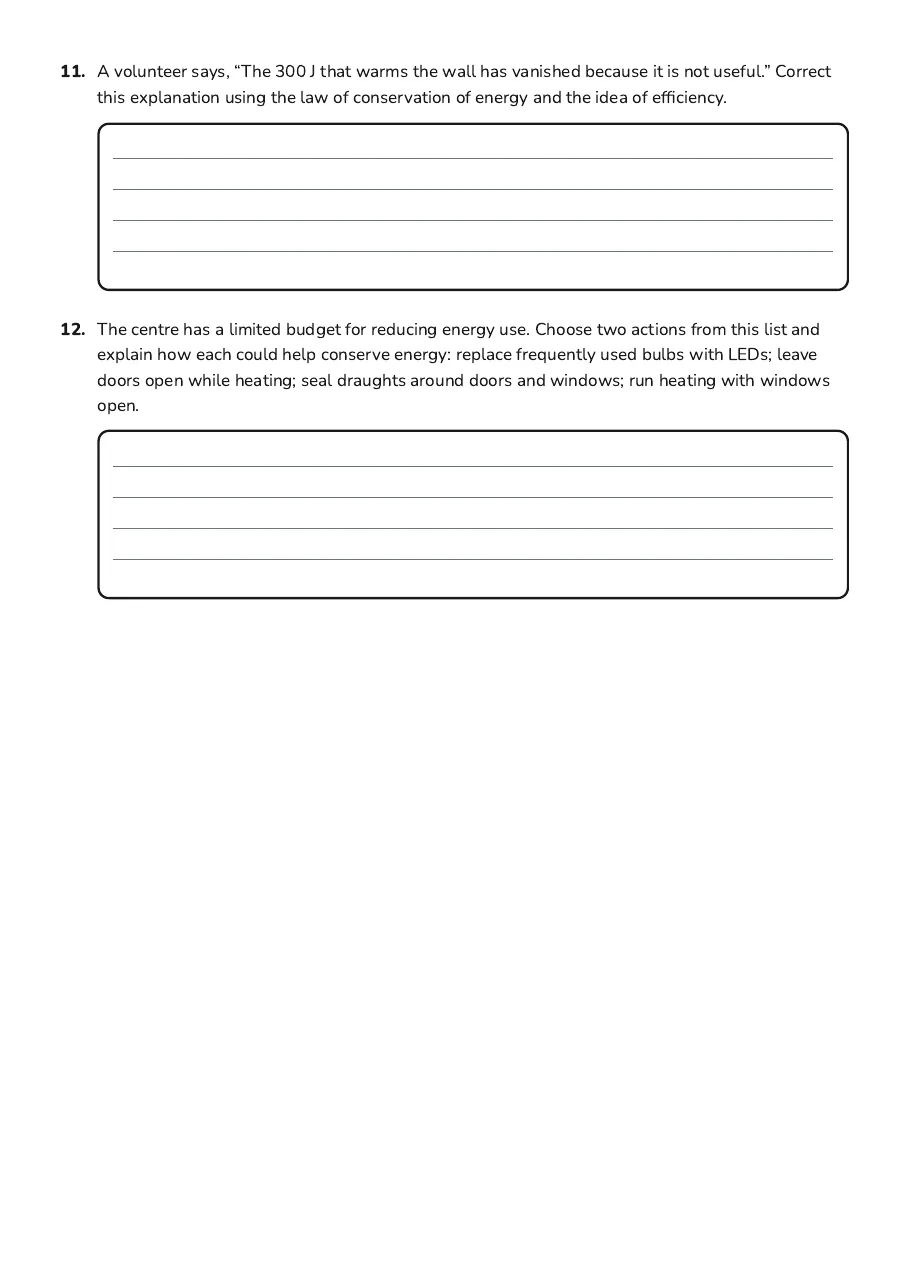
11.A volunteer says, “The 300 J that warms the wall has vanished because it is not useful.” Correct this explanation using the law of conservation of energy and the idea of efficiency.
12.The centre has a limited budget for reducing energy use. Choose two actions from this list and explain how each could help conserve energy: replace frequently used bulbs with LEDs; leave doors open while heating; seal draughts around doors and windows; run heating with windows open.
3 printable pages
Page 1
Page 2
Page 3
About This Worksheet
Free in Kuraplan
Sign up free, grab the PDF, and customize it for your class.
Print-Ready
Formatted for standard paper. Clean layout, easy to read.
AI-Generated
Created with Kuraplan's AI, designed for real classroom use.
For Teachers & Parents
Use in classrooms, for homework, tutoring, or homeschool.
Need a custom version of this worksheet?
Kuraplan's AI generates custom worksheets in seconds — differentiated for every learner, aligned to your curriculum.
Generate Custom Worksheets — Free No credit card Curriculum-aligned Under 60 seconds