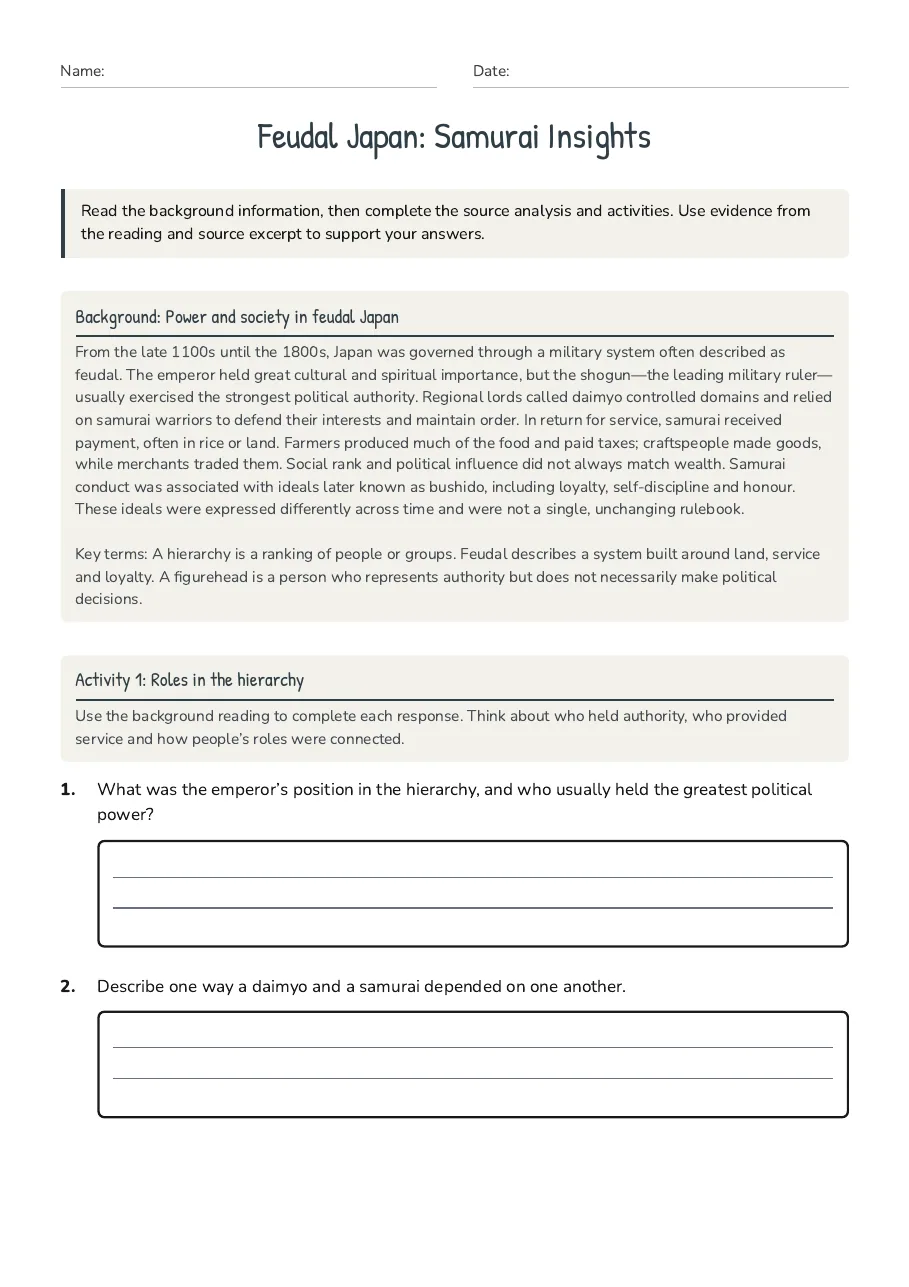
Feudal Japan: Samurai Insights
A free social sciences worksheet ready for your classroom. Open in Kuraplan to grab the print-ready PDF, customize it for your students, or generate a fresh version in seconds.
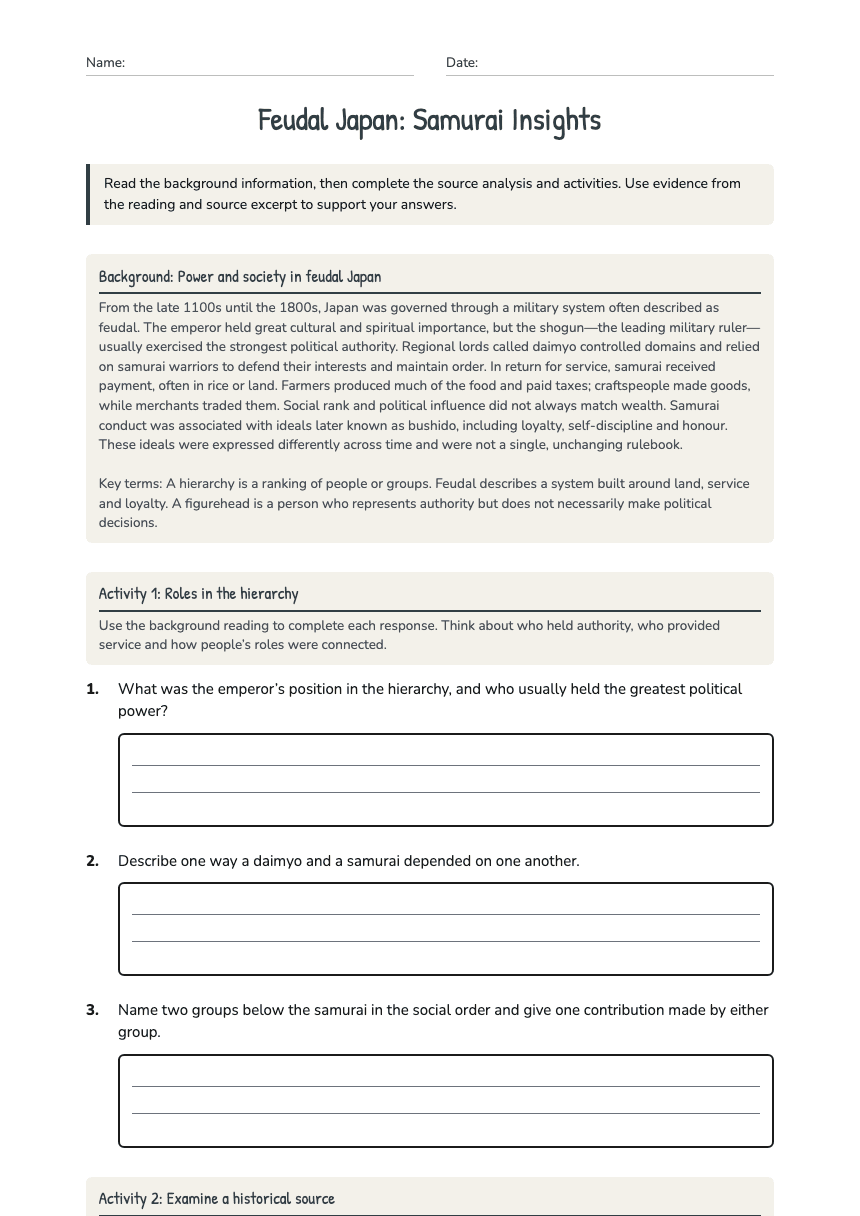
Feudal Japan: Samurai Insights
Background: Power and society in feudal Japan
From the late 1100s until the 1800s, Japan was governed through a military system often described as feudal. The emperor held great cultural and spiritual importance, but the shogun—the leading military ruler—usually exercised the strongest political authority. Regional lords called daimyo controlled domains and relied on samurai warriors to defend their interests and maintain order. In return for service, samurai received payment, often in rice or land. Farmers produced much of the food and paid taxes; craftspeople made goods, while merchants traded them. Social rank and political influence did not always match wealth. Samurai conduct was associated with ideals later known as bushido, including loyalty, self-discipline and honour. These ideals were expressed differently across time and were not a single, unchanging rulebook. Key terms: A hierarchy is a ranking of people or groups. Feudal describes a system built around land, service and loyalty. A figurehead is a person who represents authority but does not necessarily make political decisions.
Activity 1: Roles in the hierarchy
Use the background reading to complete each response. Think about who held authority, who provided service and how people’s roles were connected.
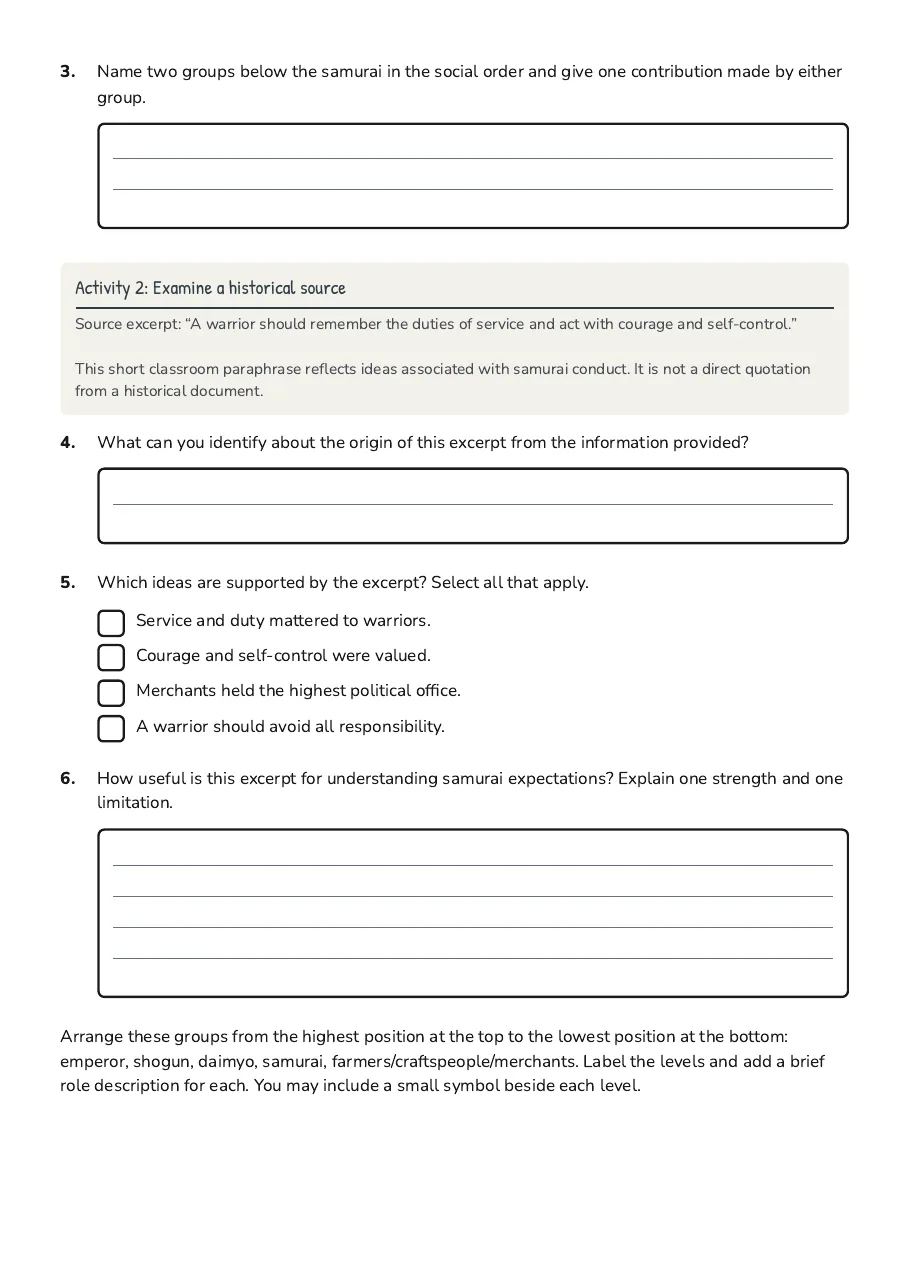
Activity 2: Examine a historical source
Source excerpt: “A warrior should remember the duties of service and act with courage and self-control.” This short classroom paraphrase reflects ideas associated with samurai conduct. It is not a direct quotation from a historical document.
- Service and duty mattered to warriors.
- Courage and self-control were valued.
- Merchants held the highest political office.
- A warrior should avoid all responsibility.
3 printable pages
Page 1
Page 2

Page 3
About This Worksheet
Free in Kuraplan
Sign up free, grab the PDF, and customize it for your class.
Print-Ready
Formatted for standard paper. Clean layout, easy to read.
AI-Generated
Created with Kuraplan's AI, designed for real classroom use.
For Teachers & Parents
Use in classrooms, for homework, tutoring, or homeschool.
Need a custom version of this worksheet?
Kuraplan's AI generates custom worksheets in seconds — differentiated for every learner, aligned to your curriculum.
Generate Custom Worksheets — Free