Australia's Historical Journey
A free social sciences worksheet ready for your classroom. Open in Kuraplan to grab the print-ready PDF, customize it for your students, or generate a fresh version in seconds.
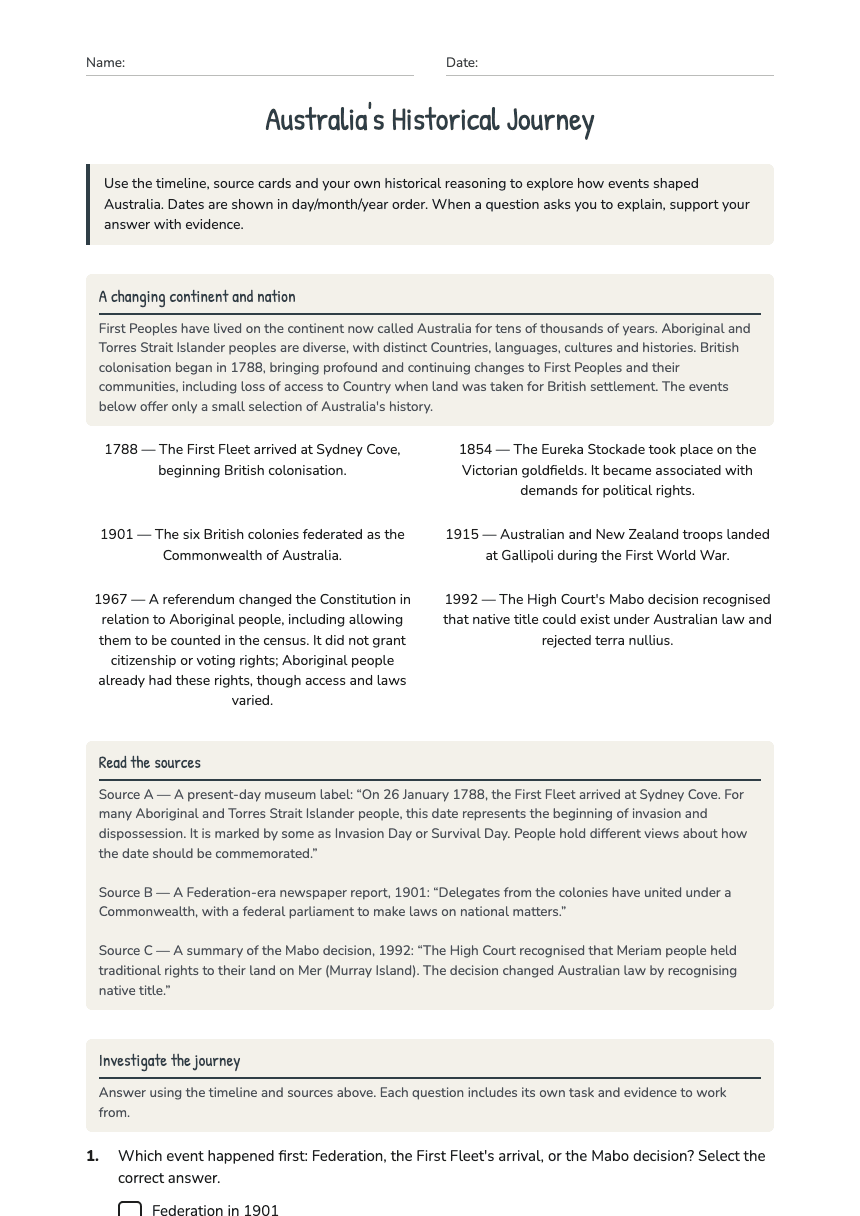
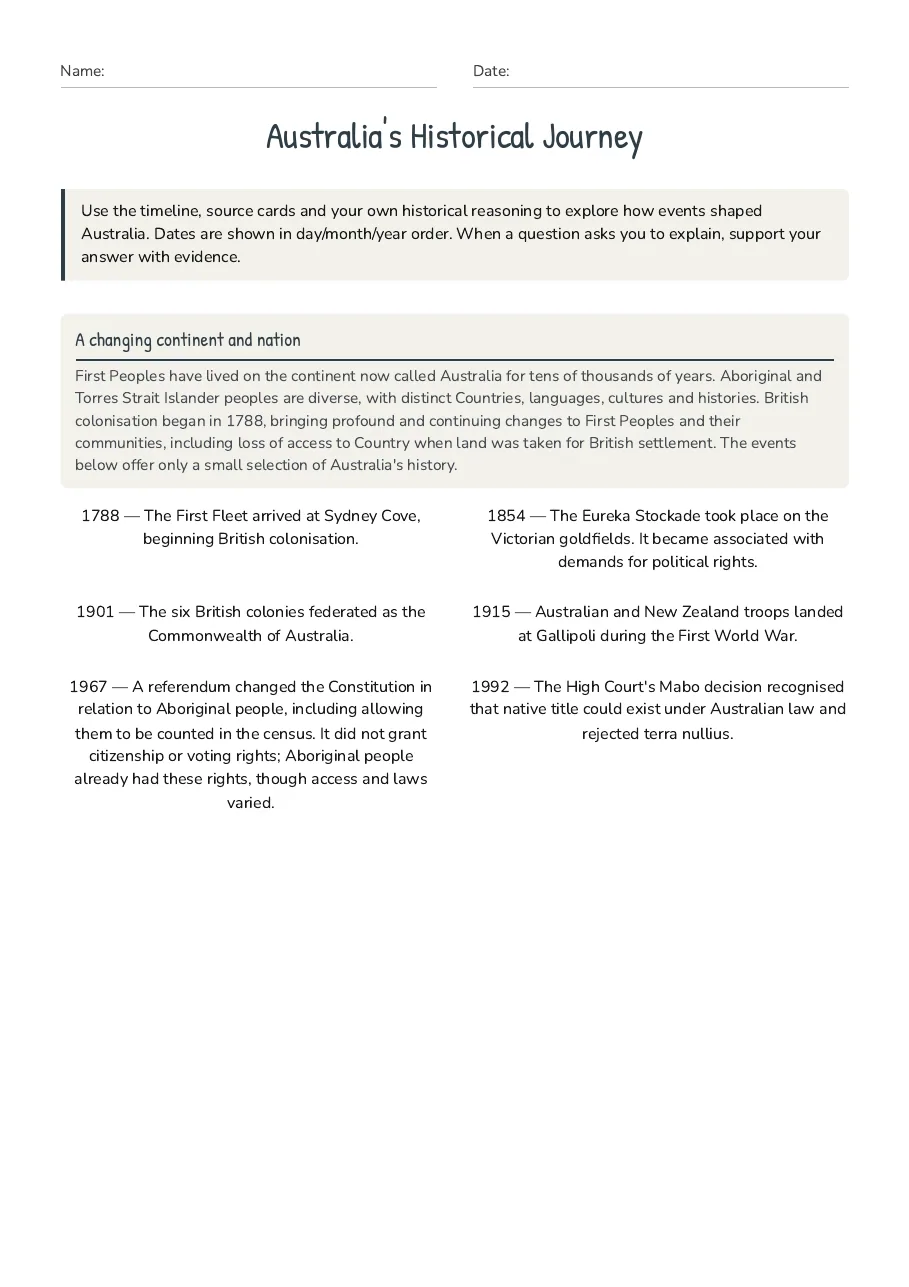
Australia's Historical Journey
A changing continent and nation
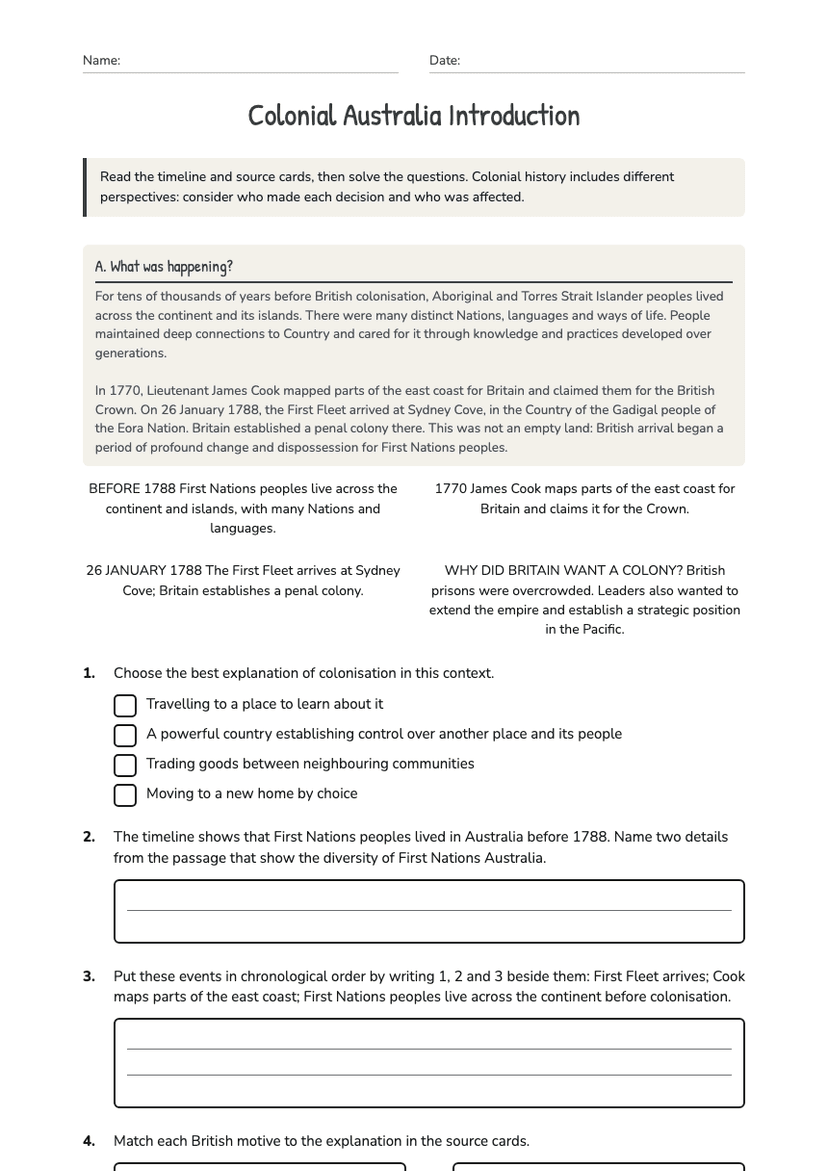
First Peoples have lived on the continent now called Australia for tens of thousands of years. Aboriginal and Torres Strait Islander peoples are diverse, with distinct Countries, languages, cultures and histories. British colonisation began in 1788, bringing profound and continuing changes to First Peoples and their communities, including loss of access to Country when land was taken for British settlement. The events below offer only a small selection of Australia's history.
1788 — The First Fleet arrived at Sydney Cove, beginning British colonisation.
1854 — The Eureka Stockade took place on the Victorian goldfields. It became associated with demands for political rights.
1901 — The six British colonies federated as the Commonwealth of Australia.
1915 — Australian and New Zealand troops landed at Gallipoli during the First World War.
1967 — A referendum changed the Constitution in relation to Aboriginal people, including allowing them to be counted in the census. It did not grant citizenship or voting rights; Aboriginal people already had these rights, though access and laws varied.
1992 — The High Court's Mabo decision recognised that native title could exist under Australian law and rejected terra nullius.
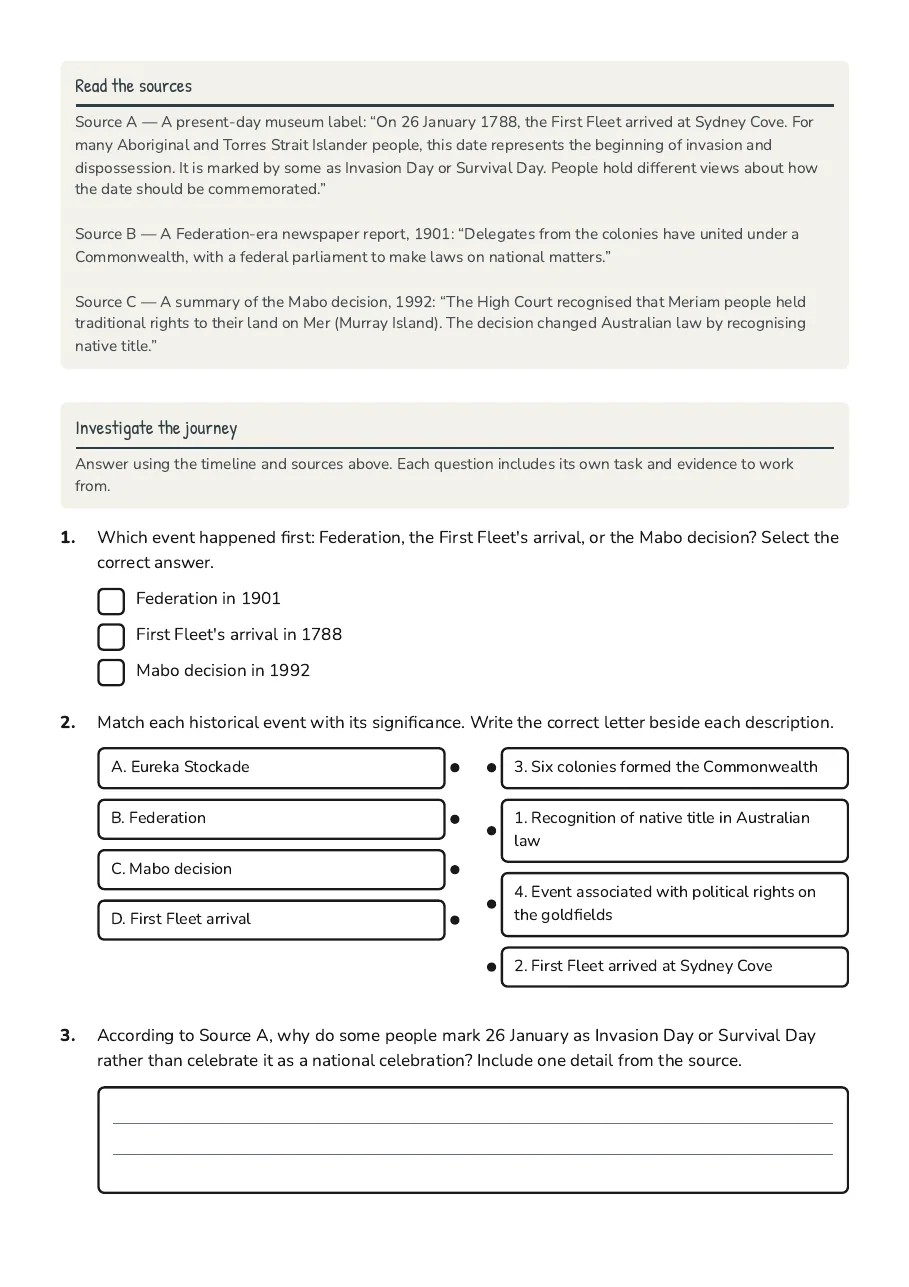
Read the sources
Source A — A present-day museum label: “On 26 January 1788, the First Fleet arrived at Sydney Cove. For many Aboriginal and Torres Strait Islander people, this date represents the beginning of invasion and dispossession. It is marked by some as Invasion Day or Survival Day. People hold different views about how the date should be commemorated.” Source B — A Federation-era newspaper report, 1901: “Delegates from the colonies have united under a Commonwealth, with a federal parliament to make laws on national matters.” Source C — A summary of the Mabo decision, 1992: “The High Court recognised that Meriam people held traditional rights to their land on Mer (Murray Island). The decision changed Australian law by recognising native title.”
Investigate the journey
Answer using the timeline and sources above. Each question includes its own task and evidence to work from.
- Federation in 1901
- First Fleet's arrival in 1788
- Mabo decision in 1992
- A. Eureka Stockade
- B. Federation
- C. Mabo decision
- D. First Fleet arrival
- 3. Six colonies formed the Commonwealth
- 1. Recognition of native title in Australian law
- 4. Event associated with political rights on the goldfields
- 2. First Fleet arrived at Sydney Cove
3 printable pages
Page 1
Page 2
Page 3
About This Worksheet
Free in Kuraplan
Sign up free, grab the PDF, and customize it for your class.
Print-Ready
Formatted for standard paper. Clean layout, easy to read.
AI-Generated
Created with Kuraplan's AI, designed for real classroom use.
For Teachers & Parents
Use in classrooms, for homework, tutoring, or homeschool.
Need a custom version of this worksheet?
Kuraplan's AI generates custom worksheets in seconds — differentiated for every learner, aligned to your curriculum.
Generate Custom Worksheets — Free