Folk Story Analysis Worksheet
A free english worksheet ready for your classroom. Open in Kuraplan to grab the print-ready PDF, customize it for your students, or generate a fresh version in seconds.
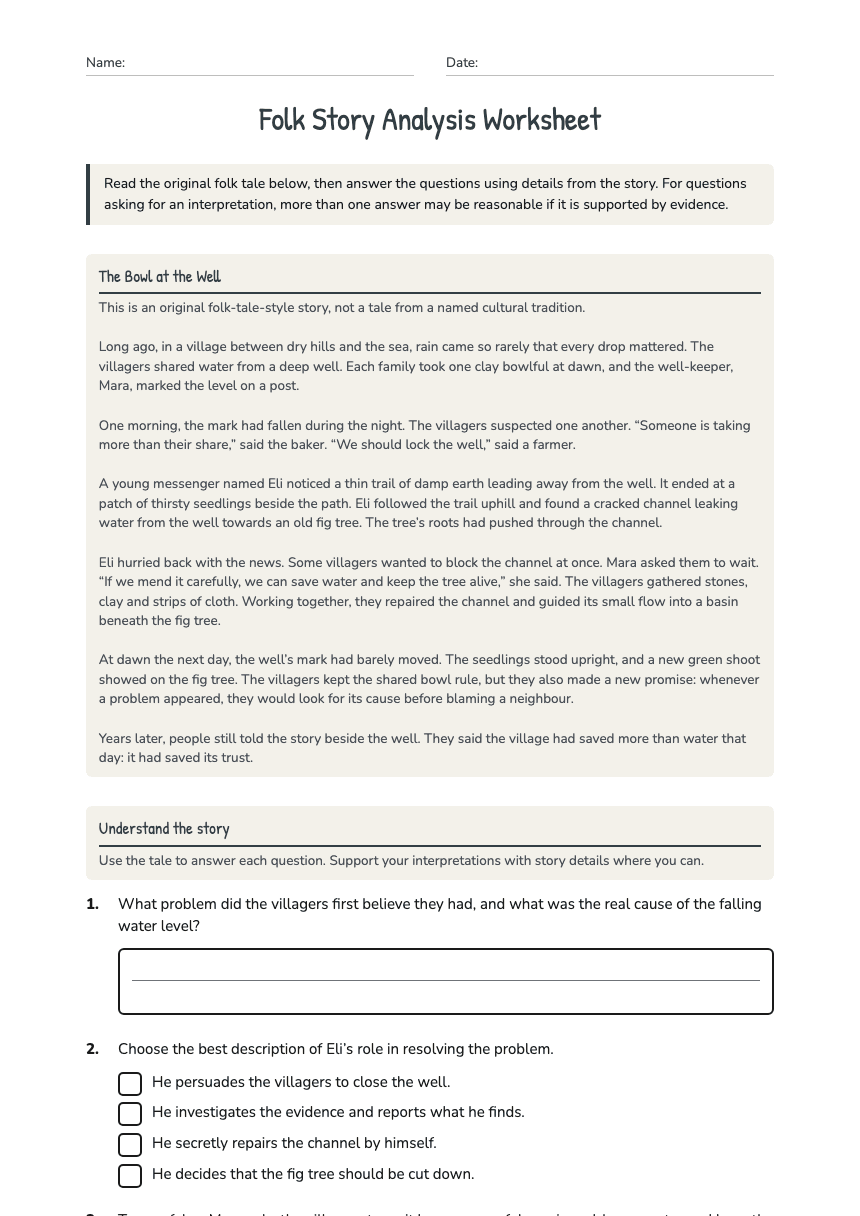
Folk Story Analysis Worksheet
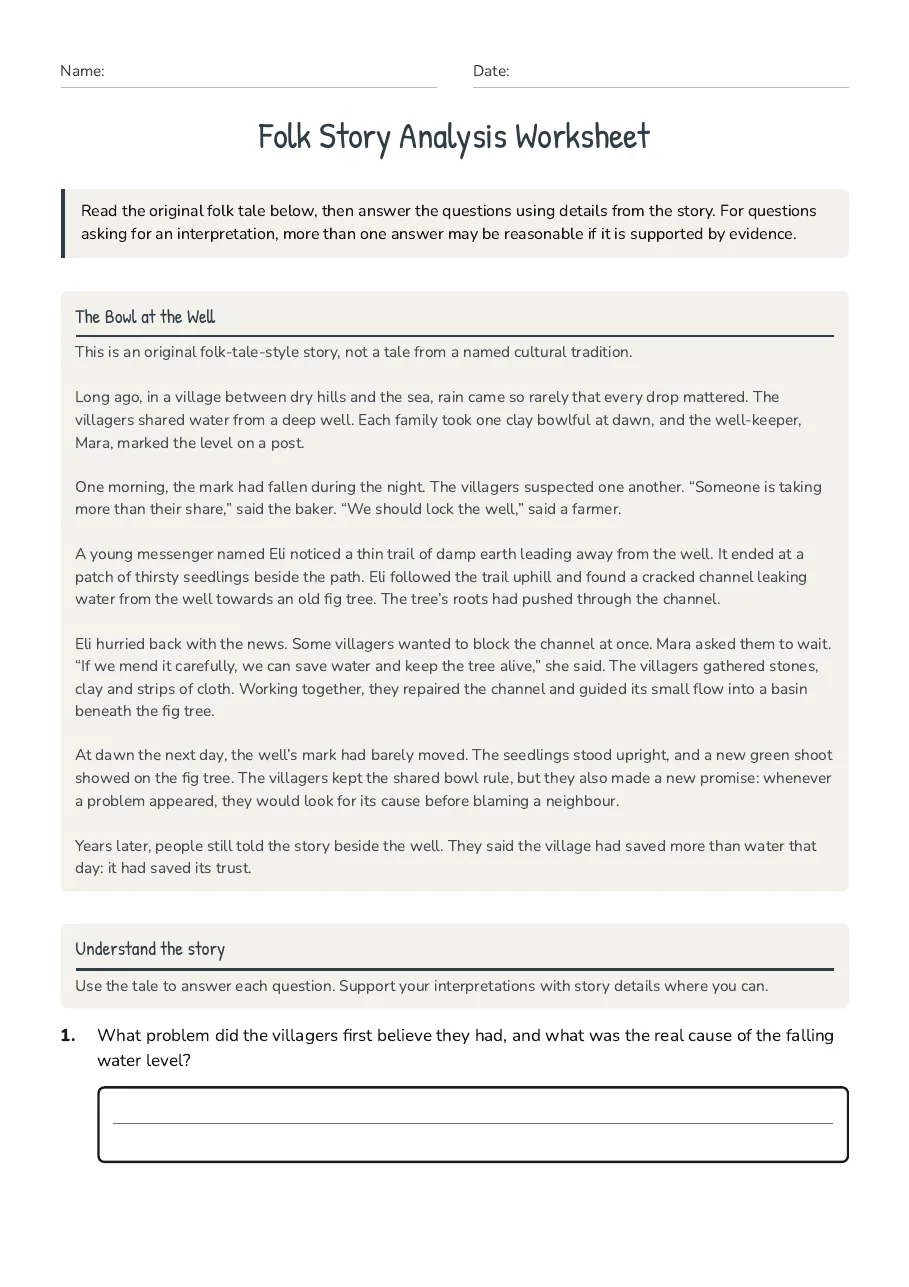
The Bowl at the Well
This is an original folk-tale-style story, not a tale from a named cultural tradition. Long ago, in a village between dry hills and the sea, rain came so rarely that every drop mattered. The villagers shared water from a deep well. Each family took one clay bowlful at dawn, and the well-keeper, Mara, marked the level on a post. One morning, the mark had fallen during the night. The villagers suspected one another. “Someone is taking more than their share,” said the baker. “We should lock the well,” said a farmer. A young messenger named Eli noticed a thin trail of damp earth leading away from the well. It ended at a patch of thirsty seedlings beside the path. Eli followed the trail uphill and found a cracked channel leaking water from the well towards an old fig tree. The tree’s roots had pushed through the channel. Eli hurried back with the news. Some villagers wanted to block the channel at once. Mara asked them to wait. “If we mend it carefully, we can save water and keep the tree alive,” she said. The villagers gathered stones, clay and strips of cloth. Working together, they repaired the channel and guided its small flow into a basin beneath the fig tree. At dawn the next day, the well’s mark had barely moved. The seedlings stood upright, and a new green shoot showed on the fig tree. The villagers kept the shared bowl rule, but they also made a new promise: whenever a problem appeared, they would look for its cause before blaming a neighbour. Years later, people still told the story beside the well. They said the village had saved more than water that day: it had saved its trust.
Understand the story
Use the tale to answer each question. Support your interpretations with story details where you can.
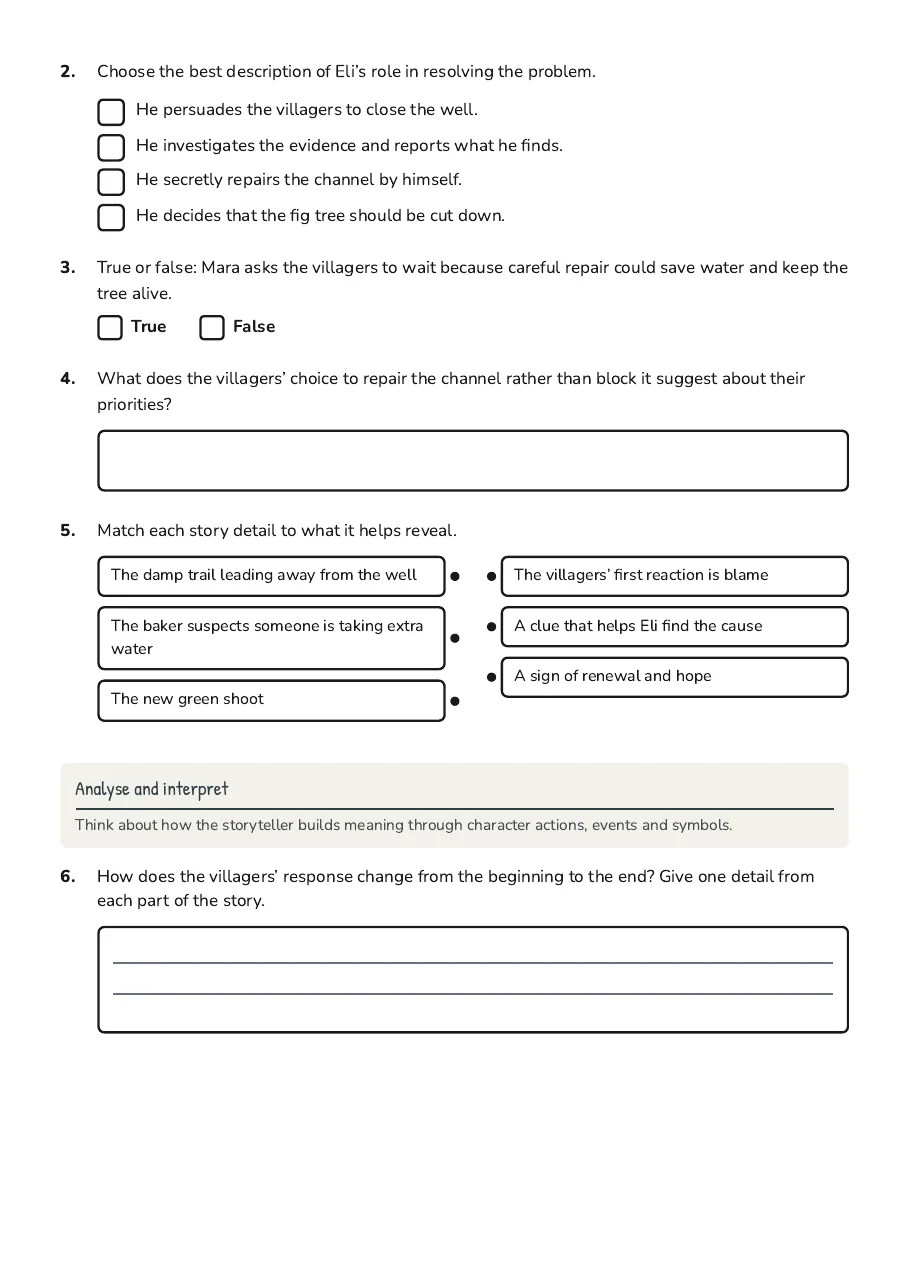
- He persuades the villagers to close the well.
- He investigates the evidence and reports what he finds.
- He secretly repairs the channel by himself.
- He decides that the fig tree should be cut down.
- The damp trail leading away from the well
- The baker suspects someone is taking extra water
- The new green shoot
- The villagers’ first reaction is blame
- A clue that helps Eli find the cause
- A sign of renewal and hope
Analyse and interpret
Think about how the storyteller builds meaning through character actions, events and symbols.
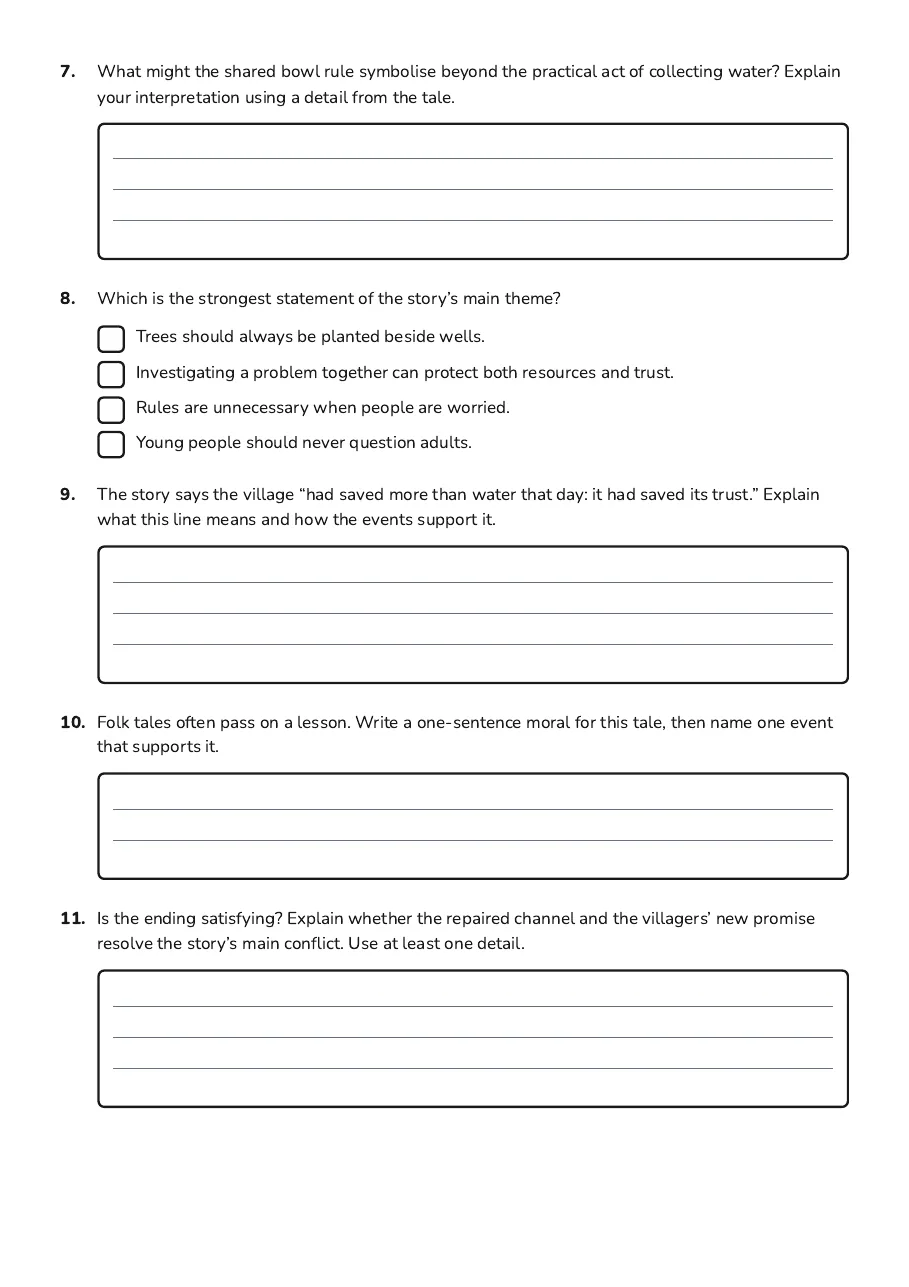
- Trees should always be planted beside wells.
- Investigating a problem together can protect both resources and trust.
- Rules are unnecessary when people are worried.
- Young people should never question adults.
3 printable pages
Page 1
Page 2
Page 3
About This Worksheet
Free in Kuraplan
Sign up free, grab the PDF, and customize it for your class.
Print-Ready
Formatted for standard paper. Clean layout, easy to read.
AI-Generated
Created with Kuraplan's AI, designed for real classroom use.
For Teachers & Parents
Use in classrooms, for homework, tutoring, or homeschool.
Need a custom version of this worksheet?
Kuraplan's AI generates custom worksheets in seconds — differentiated for every learner, aligned to your curriculum.
Generate Custom Worksheets — Free