Forces: Size and Direction
A free science worksheet ready for your classroom. Open in Kuraplan to grab the print-ready PDF, customize it for your students, or generate a fresh version in seconds.

Forces: Size and Direction
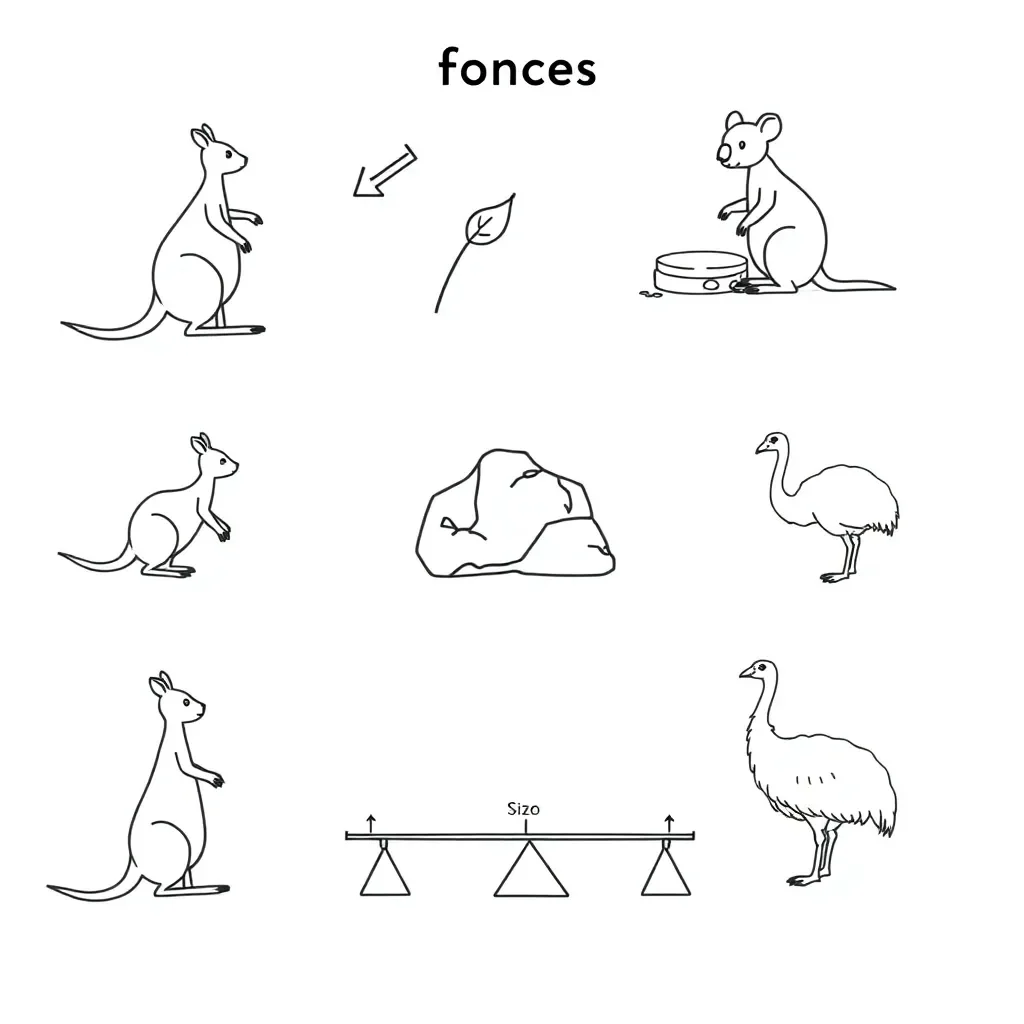
🔵 Part 1: Key Concepts
Choose the best answer for each question.
✏️ Part 2: Short Answer
Answer each question in full sentences where possible.
← 50 N [BOX] 80 N →
a) Which direction will the box move? _______________________________
b) What is the net (total) force on the box? _______ N
c) Are the forces balanced or unbalanced? _______________________________
• Engine push forward: 120 N
• Friction pushing backward: 120 N
Will the toy car speed up, slow down, or stay at the same speed? Explain why.
🎨 Part 3: Draw It!
Use arrows to show forces. Longer arrows = bigger forces. Label each arrow with its size in Newtons (N) and direction.
When forces acting on an object are balanced, the object will _______________________________.
When forces acting on an object are unbalanced, the object will _______________________________.
📋 Teacher Answer Guide
For relief teacher use — not to be distributed to students.
Q1: ✅ A push or a pull acting on an object
Q2: ✅ Newtons (N)
Q3: ✅ It stays still — the forces are balanced
Q4: ✅ Kicking a football, Pressing a button on a keyboard, Pushing a shopping trolley (pulling open a door and picking up a bag are pull forces)
Q5: Sample answer — A force's size tells us how strong it is (measured in Newtons) and its direction tells us which way it acts. For example, when you kick a football, the force is about 200 N and it acts forward in the direction of the kick.
Q6: The desk pushes upward on the book with 10 N. This upward force from the desk is called the normal force. The two forces (gravity down, normal force up) are equal and opposite — they are balanced forces.
Q7: a) To the right | b) 30 N to the right (80 − 50 = 30 N) | c) Unbalanced
Q8: The toy car will stay at the same speed (or remain still if already stopped). The forces are balanced (120 N forward = 120 N backward), so there is no net force to change its motion.
Q9: Diagram should show at minimum: an arrow pointing forward (push/applied force) and an arrow pointing backward (friction). Bonus: arrow pointing down (gravity/weight) and arrow pointing up (normal force). Arrows should be labelled with direction and a Newton value.
Q10: Balanced → stay still (or continue moving at the same speed) | Unbalanced → speed up, slow down, or change direction
About This Worksheet
Free in Kuraplan
Sign up free, grab the PDF, and customize it for your class.
Print-Ready
Formatted for standard paper. Clean layout, easy to read.
AI-Generated
Created with Kuraplan's AI, designed for real classroom use.
For Teachers & Parents
Use in classrooms, for homework, tutoring, or homeschool.
Need a custom version of this worksheet?
Kuraplan's AI generates custom worksheets in seconds — differentiated for every learner, aligned to your curriculum.
Generate Custom Worksheets — FreeMore Science Worksheets
Pushes and Pulls Worksheet
Free
Push and Pull Movement
Free
Push and Pull Movement
Free
Car Physics: Crashes & Traction
Free
Bridge Challenge Logbook
Free
Bridge Challenge Assessment Rubric
Free
Force Diagram Practice Year 7
Free