Social SciencesFreePrintable

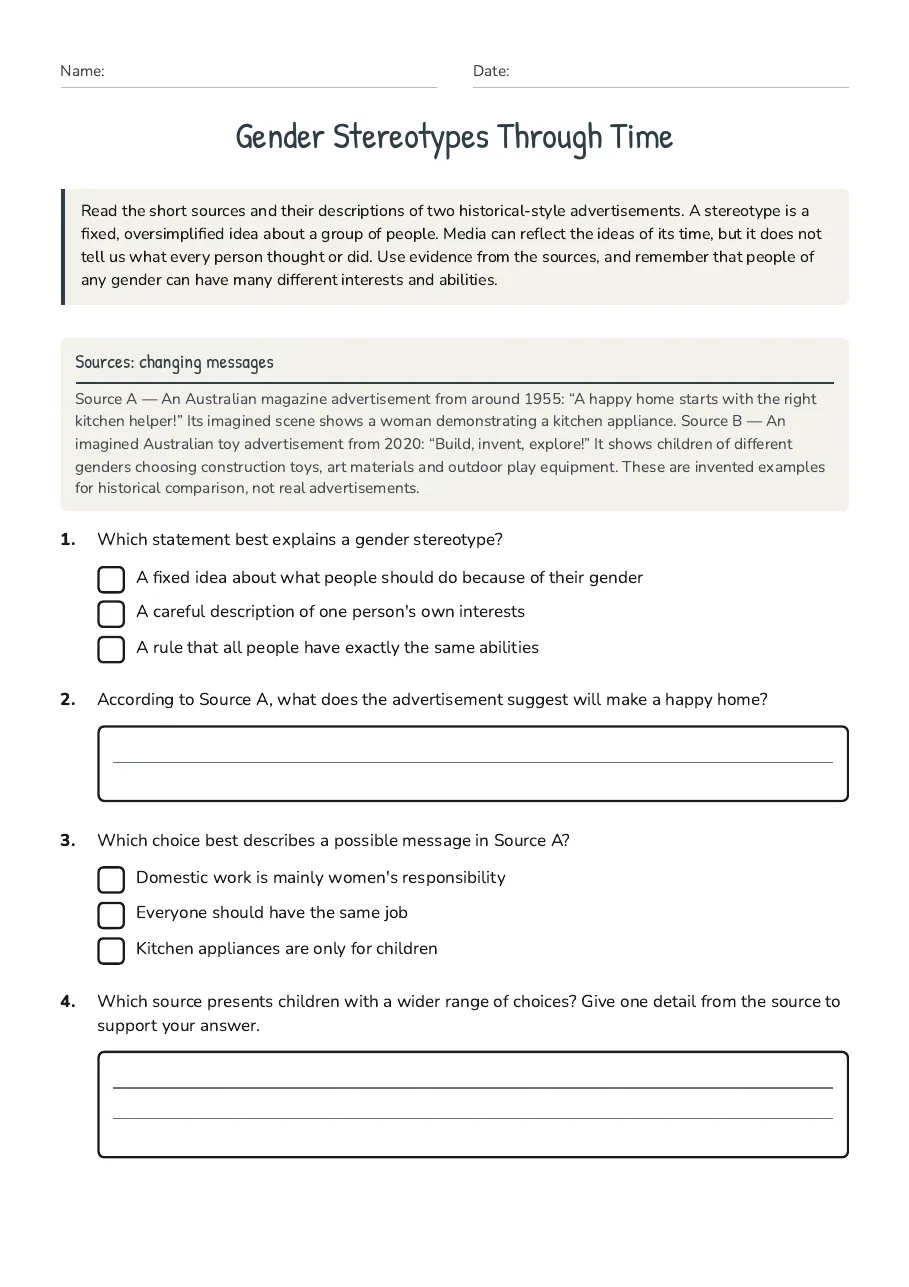
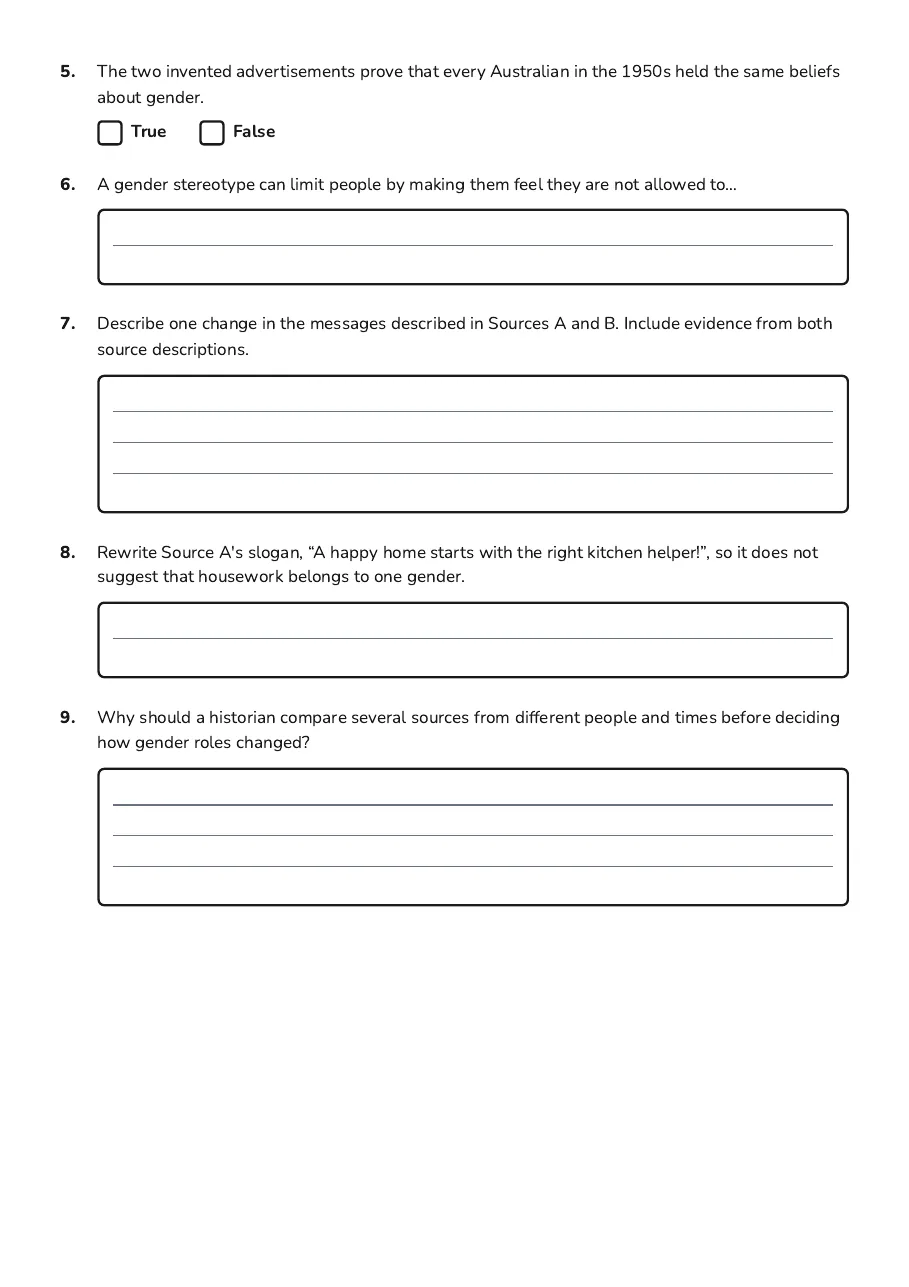
Gender Stereotypes Through Time

A free social sciences worksheet ready for your classroom. Open in Kuraplan to grab the print-ready PDF, customize it for your students, or generate a fresh version in seconds.
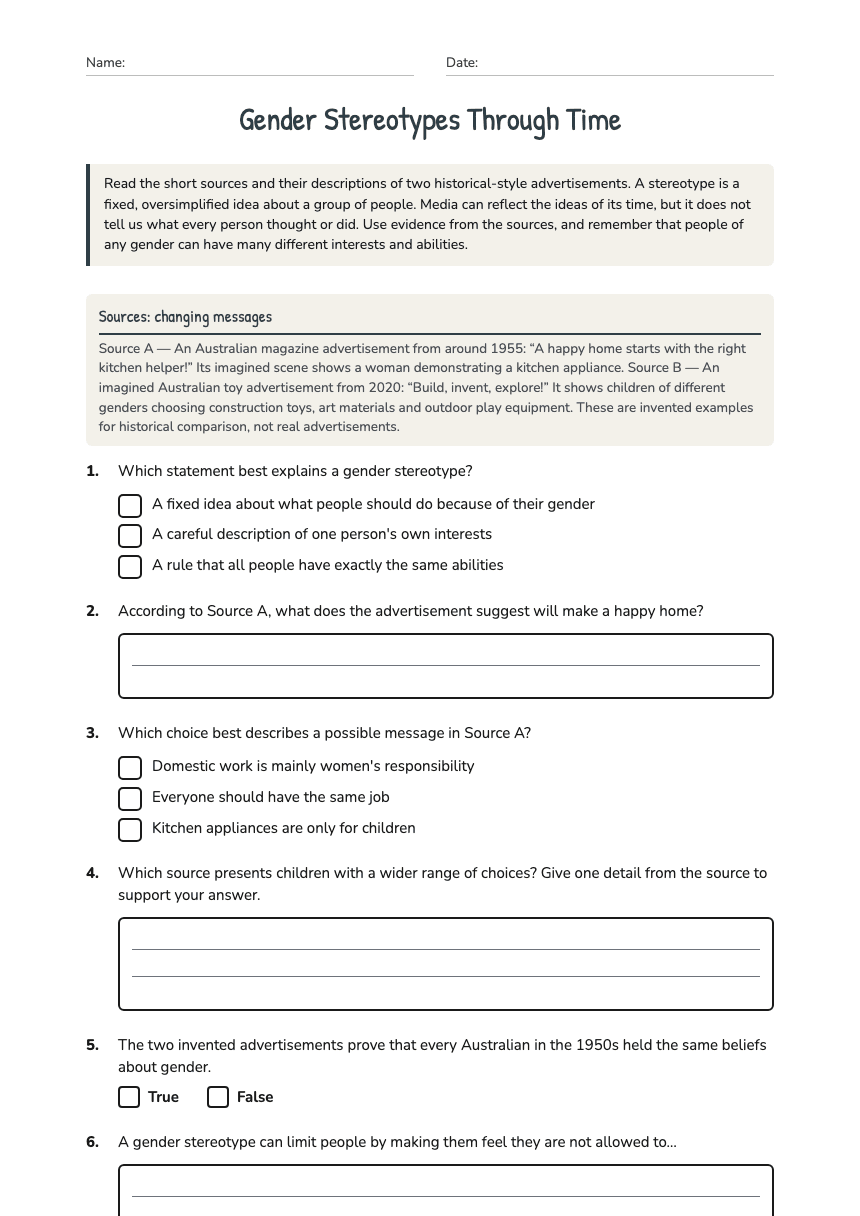
Gender Stereotypes Through Time worksheet preview

Gender Stereotypes Through Time

Part 1: Explore the Past and Present

WALT: We Are Learning To identify how gender stereotypes have appeared in media over time.

Success criteria: I can describe a stereotype, compare media from different time periods, and use evidence from a source.

Read the timeline.

Early 1900s: Many advertisements showed women mainly caring for the home and men mainly working outside the home.

1950s–1960s: Television and magazines often presented separate activities, jobs and toys as being “for boys” or “for girls”.

1980s–1990s: More media showed women in careers and men caring for children, although stereotypes continued.

Today: Media includes a wider range of people and choices, but some advertisements, films, games and social media posts still use stereotypes.

1. What is a gender stereotype?

A belief that everyone has exactly the same interests

A fixed idea about what people should do because of their gender

A fact that applies to every person

2. Which change is shown in the timeline?

Media has never changed.

Media has gradually shown a wider range of roles and choices.

Only children appear in media today.

3. Tick two examples of gender stereotypes.

Boys should not enjoy dancing.

People can choose activities they enjoy.

Girls are naturally better at caring jobs.

Everyone can learn new skills.

4. Complete the sentence: A stereotype can limit people because it tells them they should _____________.

Part 2: Analyse Media Messages

WALT: We Are Learning To identify and question messages about gender in media.

Success criteria: I can identify a stereotype, explain its possible effect, and suggest a fairer message.

Source A: An old toy advertisement shows girls playing with kitchen sets while boys build with construction toys.

Source B: A modern advertisement shows children of different genders cooking, building, caring for animals and playing sport.

5. Which source gives people more choices? Explain how you know.
6. What message might Source A send to children? Is this message fair to everyone?
7. Look at a media example chosen by your teacher. Record one detail that may be stereotypical and one detail that challenges a stereotype.

Part 3: Create a Fairer Media Message

WALT: We Are Learning To create media that represents people fairly.

Success criteria: I can challenge a stereotype, include a variety of people, and explain my choices.

8. Design a fairer version of a toy, sport, job or television advertisement. Include a slogan and describe who is represented.
9. Explain one way media has changed from the past to the present, and one way stereotypes can still be challenged.

Support options: You may listen to the timeline being read aloud, use text-to-speech, highlight key words, or discuss your ideas with a partner before writing. Use the sentence starters: “In the past, media often…”, “Today, media can…”, and “This is fairer because…”.

Extension: Compare two media examples from different decades. Identify one change, one similarity and one question you would ask the creators.

About This Worksheet

Free in Kuraplan

Sign up free, grab the PDF, and customize it for your class.

Print-Ready

Formatted for standard paper. Clean layout, easy to read.

AI-Generated

Created with Kuraplan's AI, designed for real classroom use.

For Teachers & Parents

Use in classrooms, for homework, tutoring, or homeschool.

Need a custom version of this worksheet?

Kuraplan's AI generates custom worksheets in seconds — differentiated for every learner, aligned to your curriculum.

Generate Custom Worksheets — Free
No credit card Curriculum-aligned Under 60 seconds