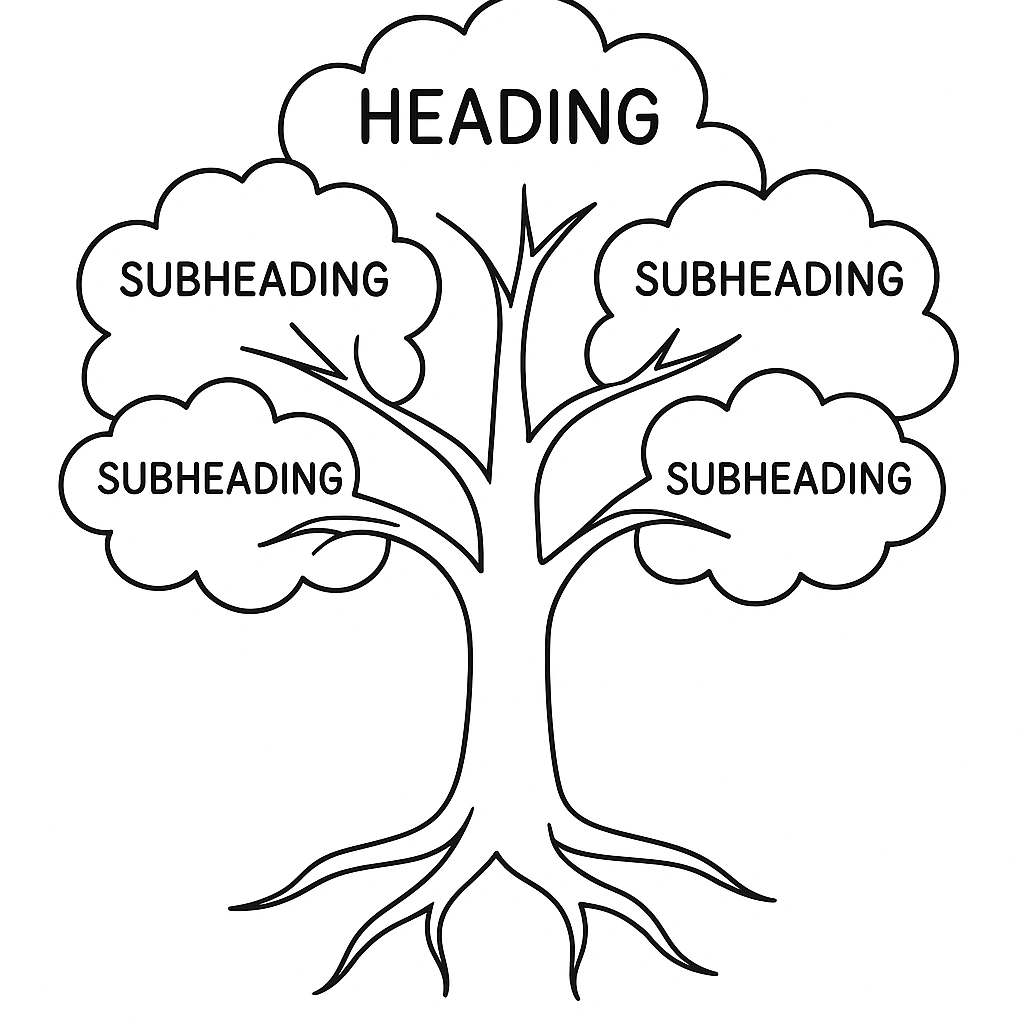
Headings and Subheadings Practice
🔍 Part 1: Identifying Headings and Subheadings
1. Look at this animal report extract. Circle the headings and subheadings:
Kangaroos
Kangaroos are amazing Australian animals that hop around on their strong back legs.
What Do Kangaroos Look Like?
Kangaroos have long tails, big ears, and powerful legs. They can grow up to 2 metres tall.
Where Do Kangaroos Live?
Most kangaroos live in the Australian bush and grasslands.
Baby Kangaroos
Baby kangaroos are called joeys. They live in their mother's pouch.
2. Why do we use headings in reports? Tick all the correct answers:
To help readers find information quickly
To organise information into sections
To make the text look pretty
To show what each section is about
✏️ Part 2: Creating Headings
3. Read each paragraph and write a suitable heading for it:
Heading: _________________________
Koalas eat eucalyptus leaves almost all day long. They have special teeth for chewing the tough leaves. An adult koala can eat up to 500 grams of leaves each day.
Heading: _________________________
Wombats dig burrows underground using their strong claws. These burrows can be up to 30 metres long! The burrows keep wombats cool in summer and warm in winter.
Heading: _________________________
Echidnas have spines all over their back to protect them from predators. When they feel scared, they roll up into a spiky ball. Their spines are very sharp!
🦘 Part 3: Organising an Animal Report
4. Here are some paragraphs about platypuses. Write headings to organise them into a proper report:
Main Title: _________________________
Heading 1: _________________________
The platypus is one of Australia's most unusual animals. It has a duck-like bill, a beaver-like tail, and webbed feet. It is covered in brown fur and can grow up to 60 centimetres long.
Heading 2: _________________________
Platypuses live near rivers and streams in eastern Australia. They build burrows in the riverbank where they sleep during the day. They are excellent swimmers and spend lots of time in the water.
Heading 3: _________________________
Platypuses hunt for food underwater. They close their eyes and ears and use their sensitive bill to find small fish, insects, and worms in the mud. They can hold their breath for up to 2 minutes!
Heading 4: _________________________
Female platypuses lay 1-2 leathery eggs in their burrow. The mother keeps the eggs warm for about 10 days until they hatch. Baby platypuses are called puggles.
🎯 Part 4: Matching Headings to Content
5. Match each heading with the correct paragraph content:
1. Diet and Feeding
2. Physical Features
3. Habitat
4. Behaviour
A. Dingoes live in deserts, forests, and grasslands across Australia.
B. Dingoes hunt in packs and howl to communicate with each other.
C. Dingoes have golden-brown fur, pointed ears, and a bushy tail.
D. Dingoes eat small animals like rabbits, birds, and sometimes fish.
💭 Part 5: Reflection
6. Explain in your own words why headings and subheadings are important in animal reports:
_________________________________________________
_________________________________________________
_________________________________________________
_________________________________________________
7. What makes a good heading? Write three tips: