Hitler's Early Influences
A free social sciences worksheet ready for your classroom. Open in Kuraplan to grab the print-ready PDF, customize it for your students, or generate a fresh version in seconds.
Hitler's Early Influences
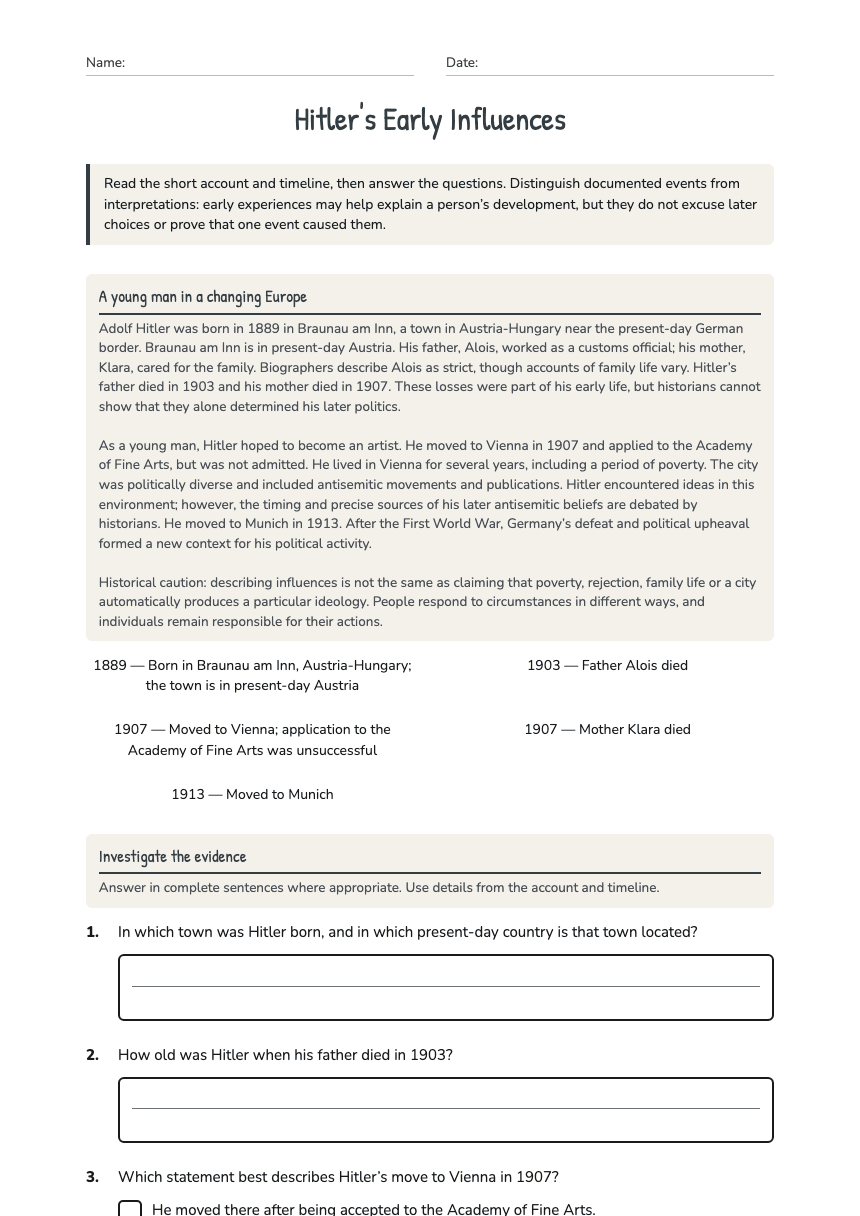
A young man in a changing Europe
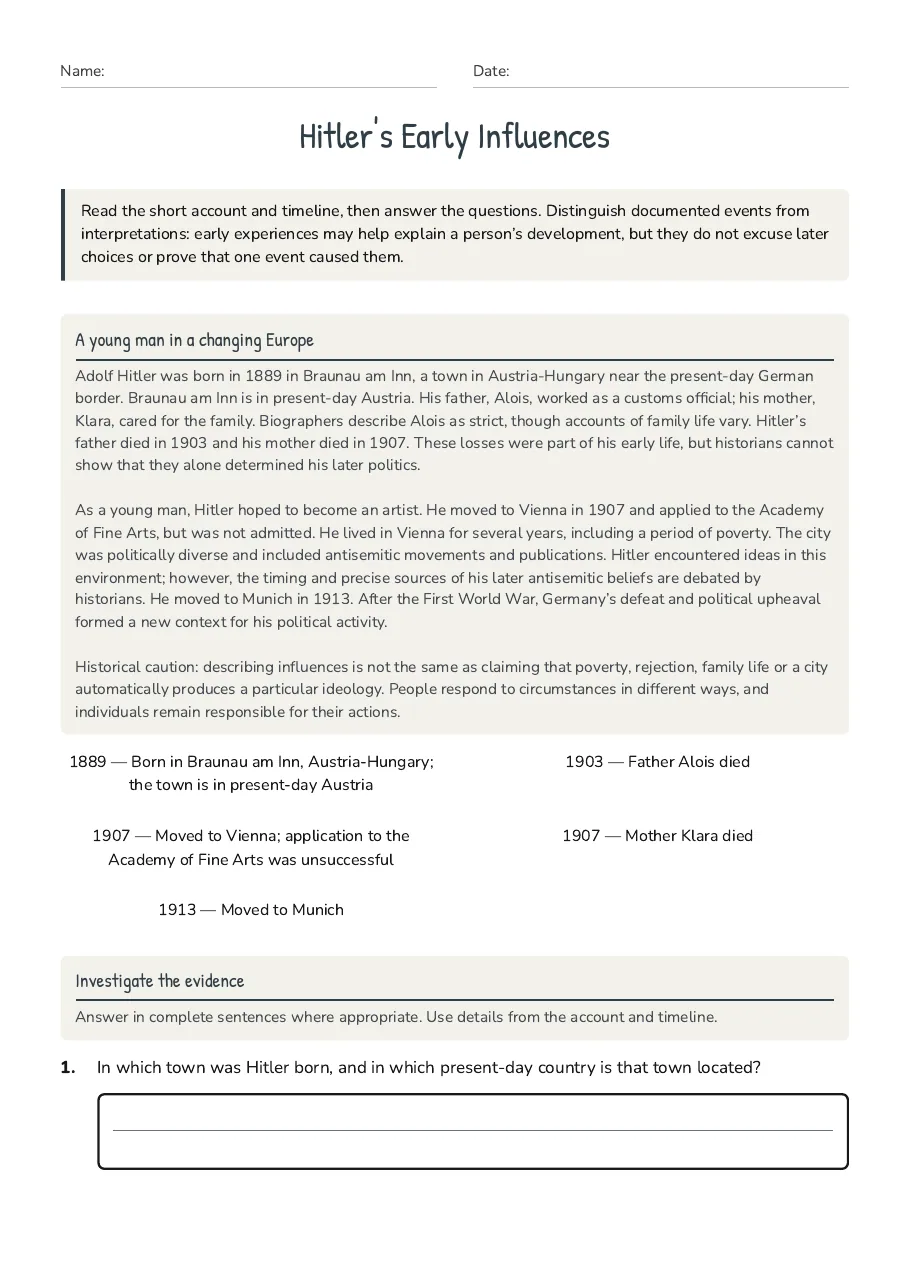
Adolf Hitler was born in 1889 in Braunau am Inn, a town in Austria-Hungary near the present-day German border. Braunau am Inn is in present-day Austria. His father, Alois, worked as a customs official; his mother, Klara, cared for the family. Biographers describe Alois as strict, though accounts of family life vary. Hitler’s father died in 1903 and his mother died in 1907. These losses were part of his early life, but historians cannot show that they alone determined his later politics. As a young man, Hitler hoped to become an artist. He moved to Vienna in 1907 and applied to the Academy of Fine Arts, but was not admitted. He lived in Vienna for several years, including a period of poverty. The city was politically diverse and included antisemitic movements and publications. Hitler encountered ideas in this environment; however, the timing and precise sources of his later antisemitic beliefs are debated by historians. He moved to Munich in 1913. After the First World War, Germany’s defeat and political upheaval formed a new context for his political activity. Historical caution: describing influences is not the same as claiming that poverty, rejection, family life or a city automatically produces a particular ideology. People respond to circumstances in different ways, and individuals remain responsible for their actions.
1889 — Born in Braunau am Inn, Austria-Hungary; the town is in present-day Austria
1903 — Father Alois died
1907 — Moved to Vienna; application to the Academy of Fine Arts was unsuccessful
1907 — Mother Klara died
1913 — Moved to Munich
Investigate the evidence
Answer in complete sentences where appropriate. Use details from the account and timeline.
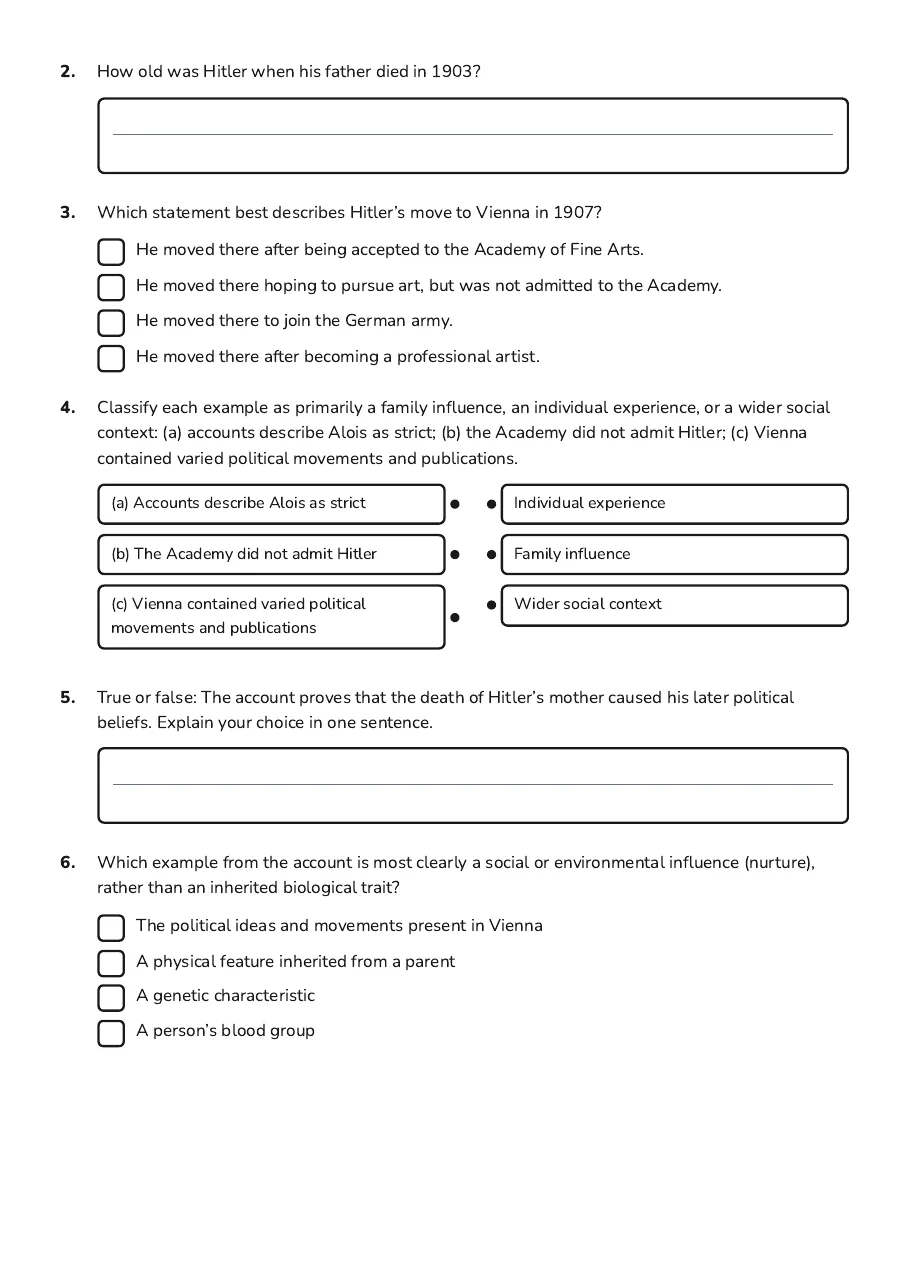
- He moved there after being accepted to the Academy of Fine Arts.
- He moved there hoping to pursue art, but was not admitted to the Academy.
- He moved there to join the German army.
- He moved there after becoming a professional artist.
- (a) Accounts describe Alois as strict
- (b) The Academy did not admit Hitler
- (c) Vienna contained varied political movements and publications
- Individual experience
- Family influence
- Wider social context
- The political ideas and movements present in Vienna
- A physical feature inherited from a parent
- A genetic characteristic
- A person’s blood group
3 printable pages
Page 1
Page 2

Page 3
About This Worksheet
Free in Kuraplan
Sign up free, grab the PDF, and customize it for your class.
Print-Ready
Formatted for standard paper. Clean layout, easy to read.
AI-Generated
Created with Kuraplan's AI, designed for real classroom use.
For Teachers & Parents
Use in classrooms, for homework, tutoring, or homeschool.
Need a custom version of this worksheet?
Kuraplan's AI generates custom worksheets in seconds — differentiated for every learner, aligned to your curriculum.
Generate Custom Worksheets — Free