ScienceFreePrintable

Investigating Energy Efficiency

A free science worksheet ready for your classroom. Open in Kuraplan to grab the print-ready PDF, customize it for your students, or generate a fresh version in seconds.
Investigating Energy Efficiency worksheet preview
Name:Date:

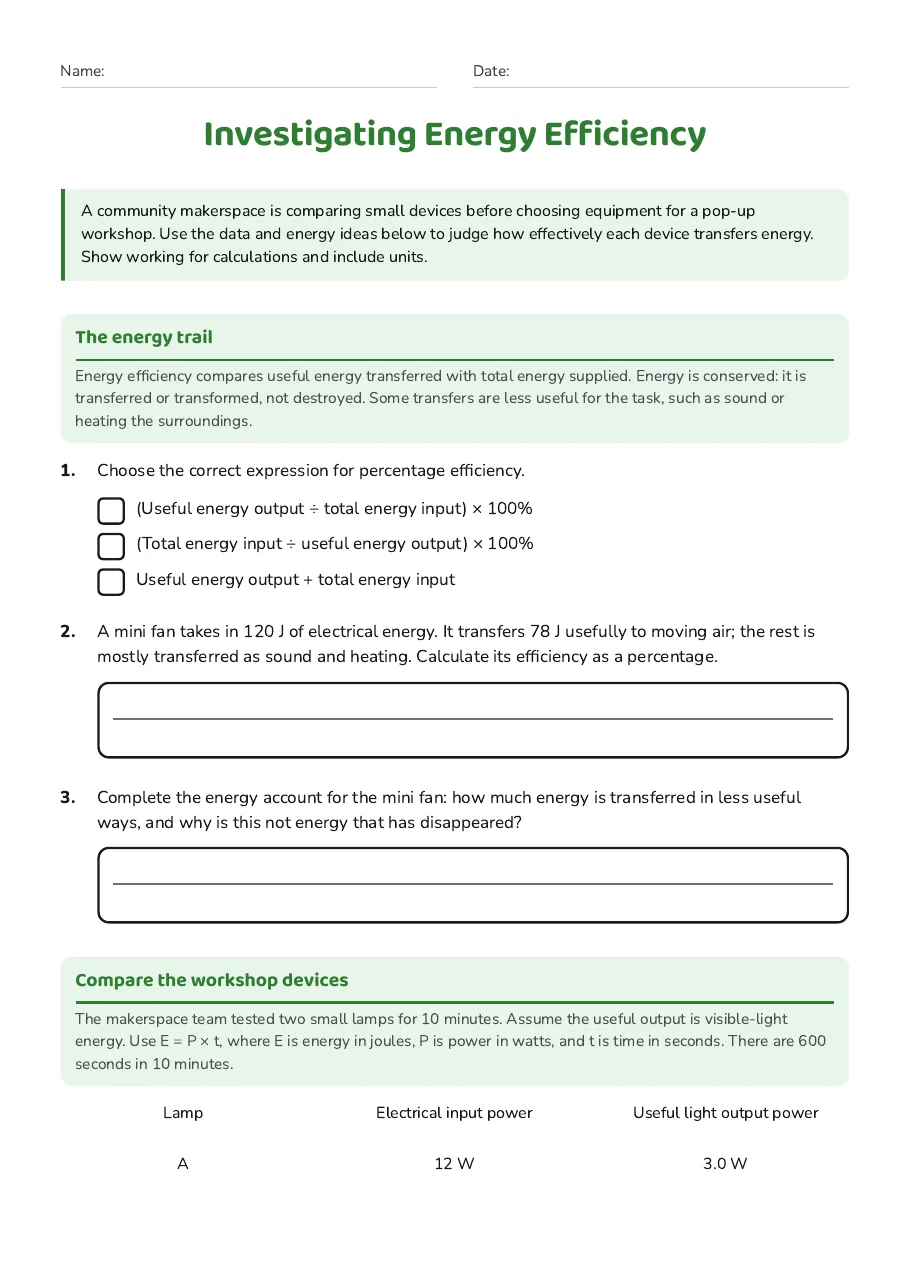
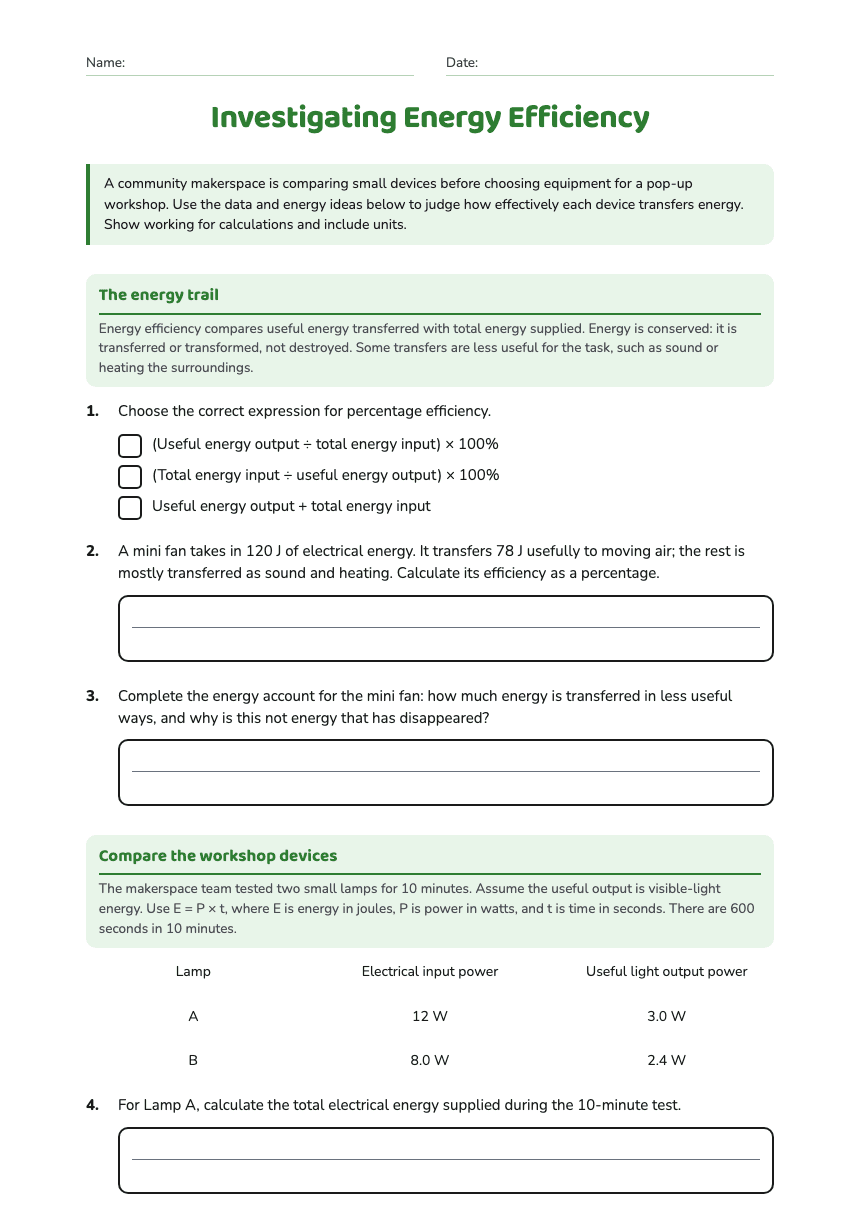
Investigating Energy Efficiency

A community makerspace is comparing small devices before choosing equipment for a pop-up workshop. Use the data and energy ideas below to judge how effectively each device transfers energy. Show working for calculations and include units.

The energy trail

Energy efficiency compares useful energy transferred with total energy supplied. Energy is conserved: it is transferred or transformed, not destroyed. Some transfers are less useful for the task, such as sound or heating the surroundings.

1.Choose the correct expression for percentage efficiency.
  • (Useful energy output ÷ total energy input) × 100%
  • (Total energy input ÷ useful energy output) × 100%
  • Useful energy output + total energy input
2.A mini fan takes in 120 J of electrical energy. It transfers 78 J usefully to moving air; the rest is mostly transferred as sound and heating. Calculate its efficiency as a percentage.
3.Complete the energy account for the mini fan: how much energy is transferred in less useful ways, and why is this not energy that has disappeared?

Compare the workshop devices

The makerspace team tested two small lamps for 10 minutes. Assume the useful output is visible-light energy. Use E = P × t, where E is energy in joules, P is power in watts, and t is time in seconds. There are 600 seconds in 10 minutes.

Lamp

Electrical input power

Useful light output power

A

12 W

3.0 W

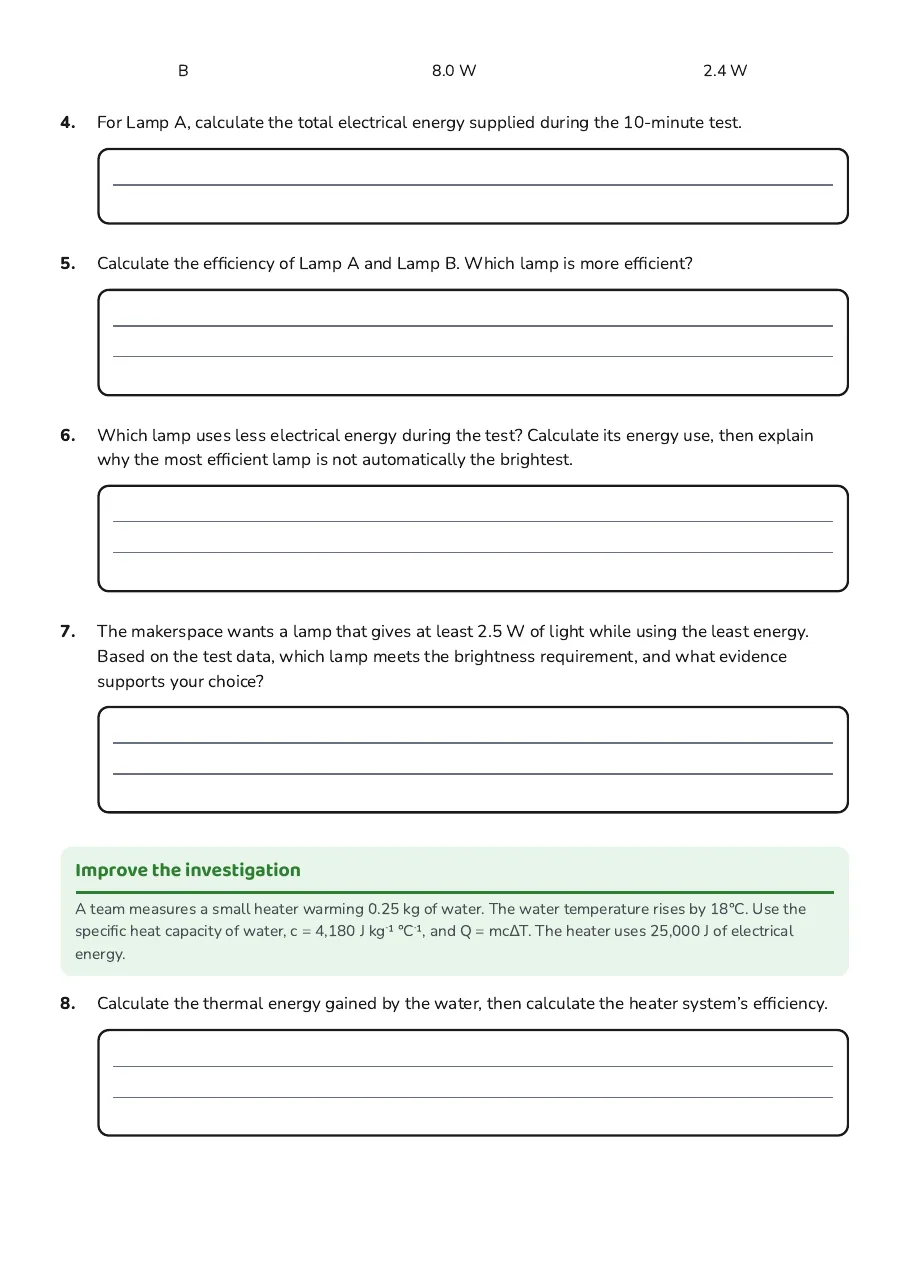
B

8.0 W

2.4 W

4.For Lamp A, calculate the total electrical energy supplied during the 10-minute test.
5.Calculate the efficiency of Lamp A and Lamp B. Which lamp is more efficient?
6.Which lamp uses less electrical energy during the test? Calculate its energy use, then explain why the most efficient lamp is not automatically the brightest.
7.The makerspace wants a lamp that gives at least 2.5 W of light while using the least energy. Based on the test data, which lamp meets the brightness requirement, and what evidence supports your choice?

Improve the investigation

A team measures a small heater warming 0.25 kg of water. The water temperature rises by 18°C. Use the specific heat capacity of water, c = 4,180 J kg⁻¹ °C⁻¹, and Q = mcΔT. The heater uses 25,000 J of electrical energy.

8.Calculate the thermal energy gained by the water, then calculate the heater system’s efficiency.
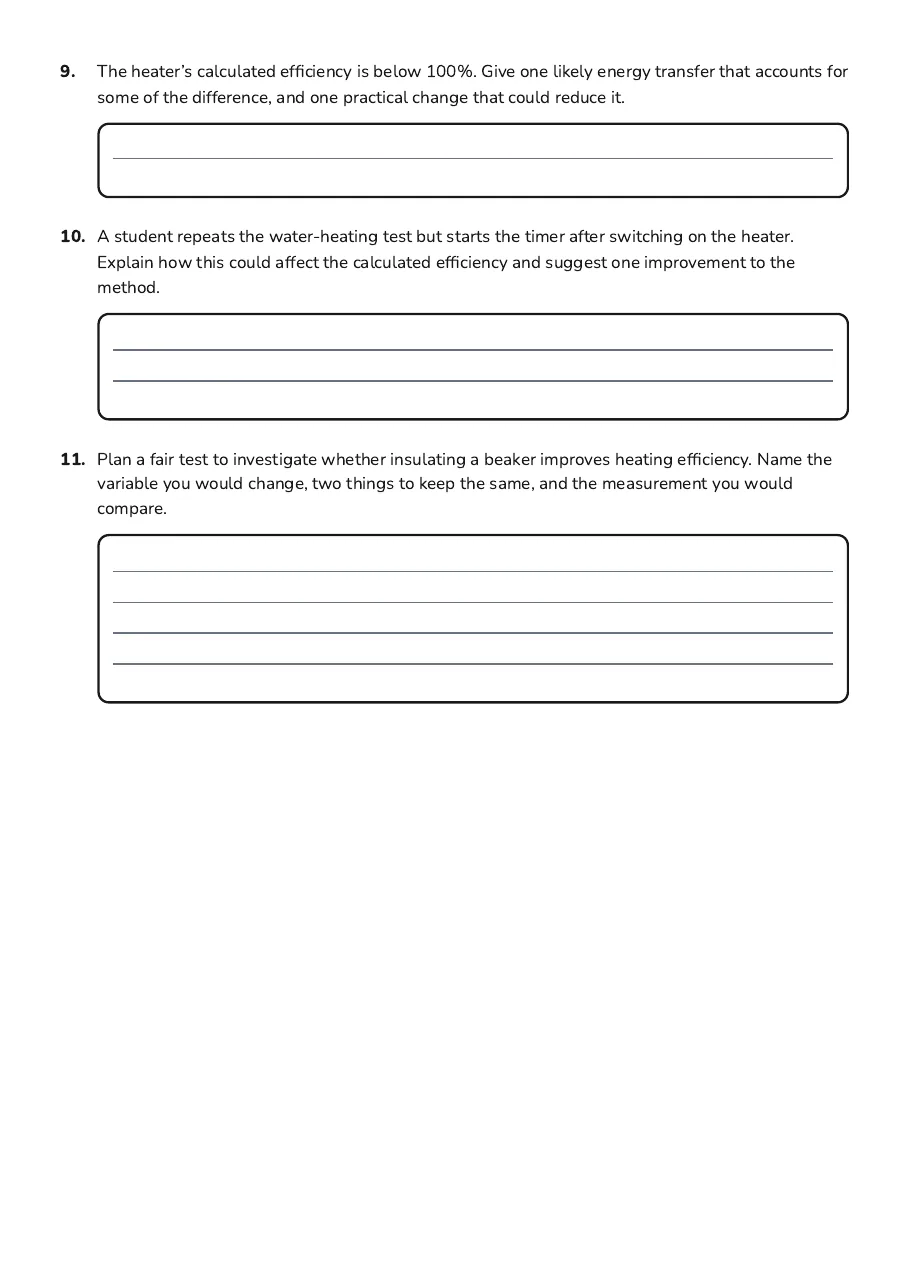
9.The heater’s calculated efficiency is below 100%. Give one likely energy transfer that accounts for some of the difference, and one practical change that could reduce it.
10.A student repeats the water-heating test but starts the timer after switching on the heater. Explain how this could affect the calculated efficiency and suggest one improvement to the method.
11.Plan a fair test to investigate whether insulating a beaker improves heating efficiency. Name the variable you would change, two things to keep the same, and the measurement you would compare.

3 printable pages

  • Investigating Energy Efficiency, page 1 of 3: The energy trail, Compare the workshop devices

    Page 1

  • Investigating Energy Efficiency, page 2 of 3: Improve the investigation

    Page 2

  • Investigating Energy Efficiency, page 3 of 3: 9. The heater’s calculated efficiency is below 100%. Give one likely energy transfer that…

    Page 3

About This Worksheet

Free in Kuraplan

Sign up free, grab the PDF, and customize it for your class.

Print-Ready

Formatted for standard paper. Clean layout, easy to read.

AI-Generated

Created with Kuraplan's AI, designed for real classroom use.

For Teachers & Parents

Use in classrooms, for homework, tutoring, or homeschool.

Need a custom version of this worksheet?

Kuraplan's AI generates custom worksheets in seconds — differentiated for every learner, aligned to your curriculum.

Generate Custom Worksheets — Free
No credit card Curriculum-aligned Under 60 seconds