Japan Under the Shoguns
A free au history worksheet ready for your classroom. Open in Kuraplan to grab the print-ready PDF, customize it for your students, or generate a fresh version in seconds.
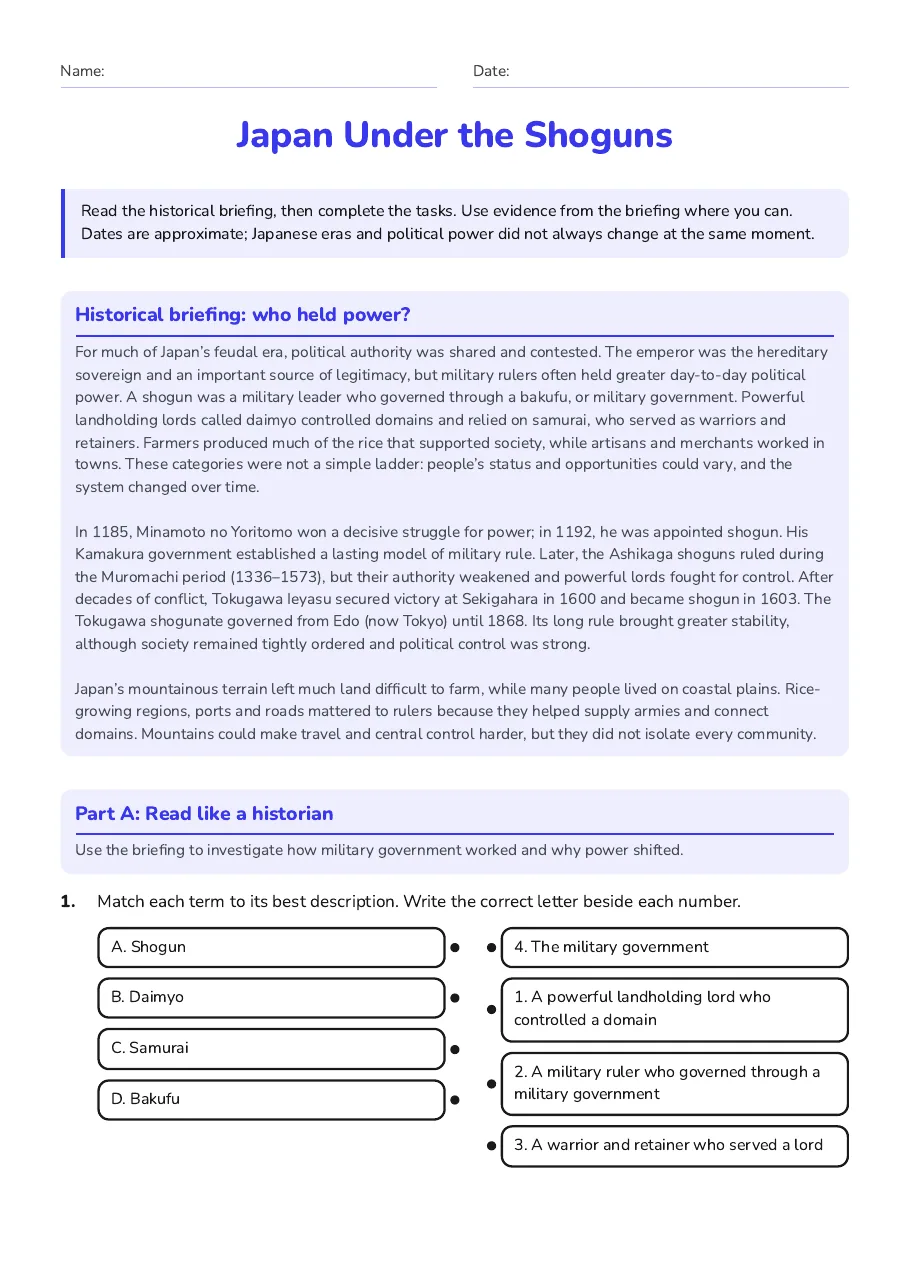
Japan Under the Shoguns
Historical briefing: who held power?
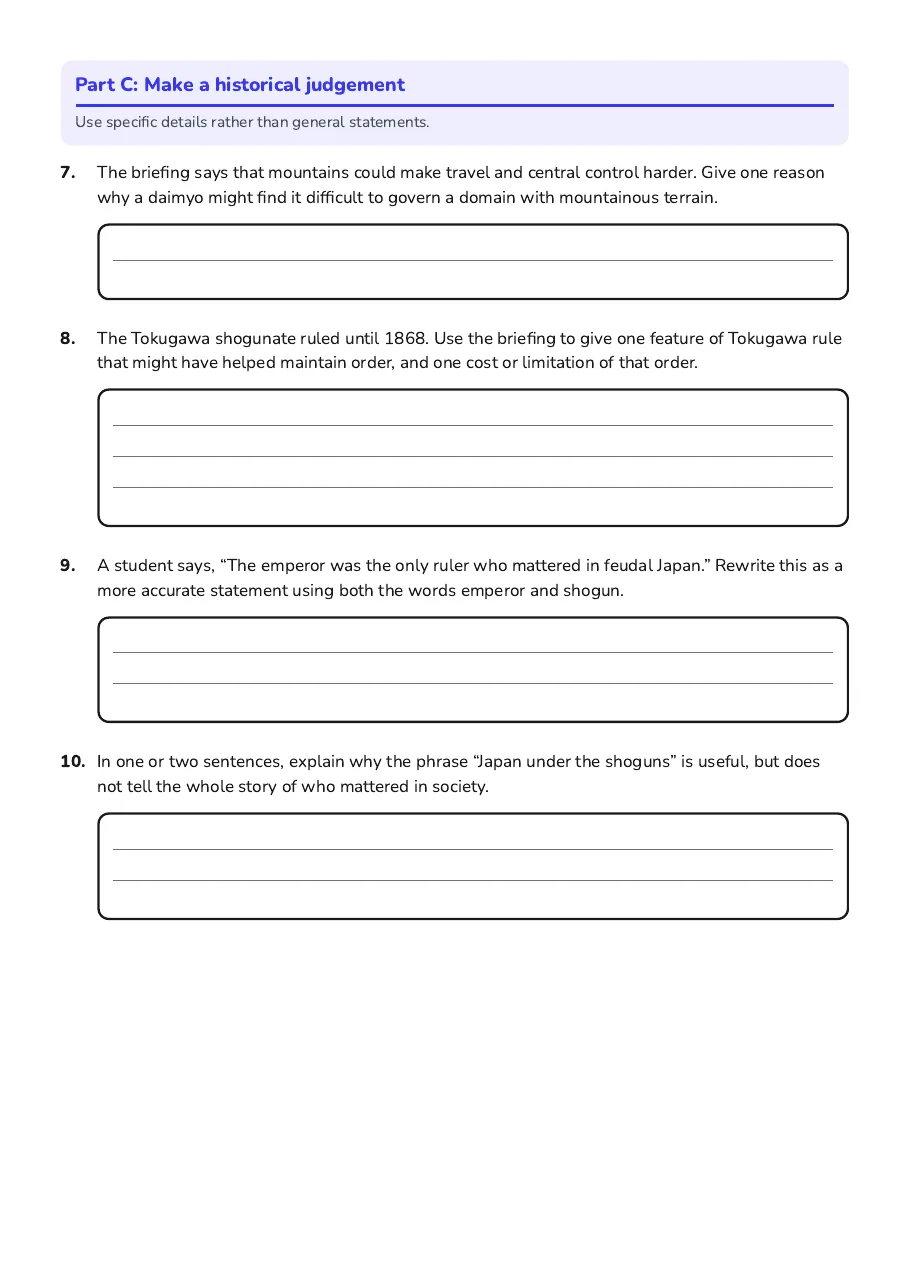
For much of Japan’s feudal era, political authority was shared and contested. The emperor was the hereditary sovereign and an important source of legitimacy, but military rulers often held greater day-to-day political power. A shogun was a military leader who governed through a bakufu, or military government. Powerful landholding lords called daimyo controlled domains and relied on samurai, who served as warriors and retainers. Farmers produced much of the rice that supported society, while artisans and merchants worked in towns. These categories were not a simple ladder: people’s status and opportunities could vary, and the system changed over time. In 1185, Minamoto no Yoritomo won a decisive struggle for power; in 1192, he was appointed shogun. His Kamakura government established a lasting model of military rule. Later, the Ashikaga shoguns ruled during the Muromachi period (1336–1573), but their authority weakened and powerful lords fought for control. After decades of conflict, Tokugawa Ieyasu secured victory at Sekigahara in 1600 and became shogun in 1603. The Tokugawa shogunate governed from Edo (now Tokyo) until 1868. Its long rule brought greater stability, although society remained tightly ordered and political control was strong. Japan’s mountainous terrain left much land difficult to farm, while many people lived on coastal plains. Rice-growing regions, ports and roads mattered to rulers because they helped supply armies and connect domains. Mountains could make travel and central control harder, but they did not isolate every community.
Part A: Read like a historian
Use the briefing to investigate how military government worked and why power shifted.
- A. Shogun
- B. Daimyo
- C. Samurai
- D. Bakufu
- 4. The military government
- 1. A powerful landholding lord who controlled a domain
- 2. A military ruler who governed through a military government
- 3. A warrior and retainer who served a lord
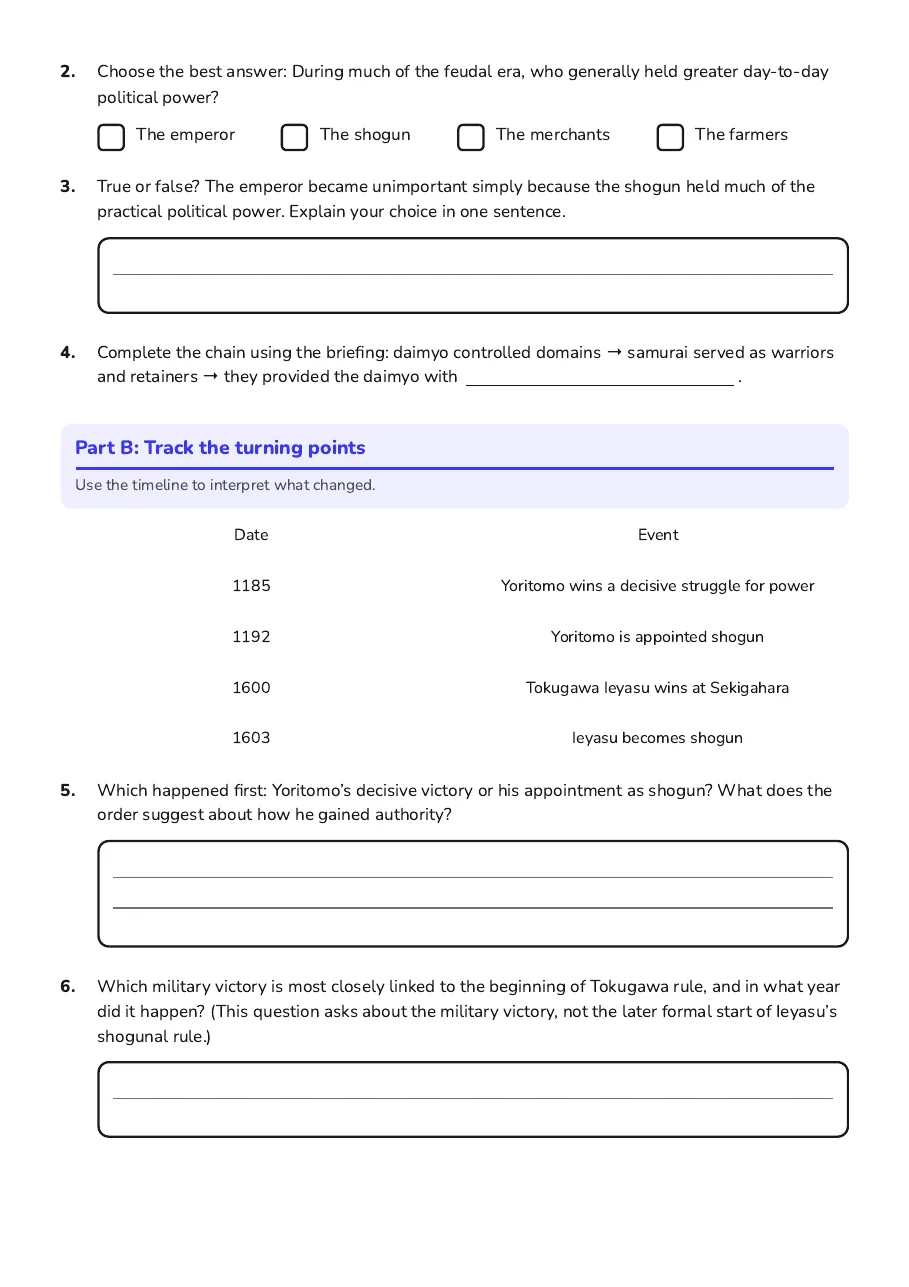
- The emperor
- The shogun
- The merchants
- The farmers
Part B: Track the turning points
Use the timeline to interpret what changed.
Date
Event
1185
Yoritomo wins a decisive struggle for power
1192
Yoritomo is appointed shogun
1600
Tokugawa Ieyasu wins at Sekigahara
1603
Ieyasu becomes shogun
Part C: Make a historical judgement
Use specific details rather than general statements.
3 printable pages
Page 1
Page 2
Page 3
About This Worksheet
Free in Kuraplan
Sign up free, grab the PDF, and customize it for your class.
Print-Ready
Formatted for standard paper. Clean layout, easy to read.
AI-Generated
Created with Kuraplan's AI, designed for real classroom use.
For Teachers & Parents
Use in classrooms, for homework, tutoring, or homeschool.
Need a custom version of this worksheet?
Kuraplan's AI generates custom worksheets in seconds — differentiated for every learner, aligned to your curriculum.
Generate Custom Worksheets — FreeMore AU History Worksheets

Understanding Our Environments
Free
Understanding Persuasive Writing
Free
Understanding How Light Changes Direction
Free
Understanding Personal Spaces
Free
Understanding Respect Worksheet
Free
Understanding Food Labels
Free
Understanding Digital Identity
Free