EnglishFreePrintable

Media Social Context Analysis

A free english worksheet ready for your classroom. Open in Kuraplan to grab the print-ready PDF, customize it for your students, or generate a fresh version in seconds.
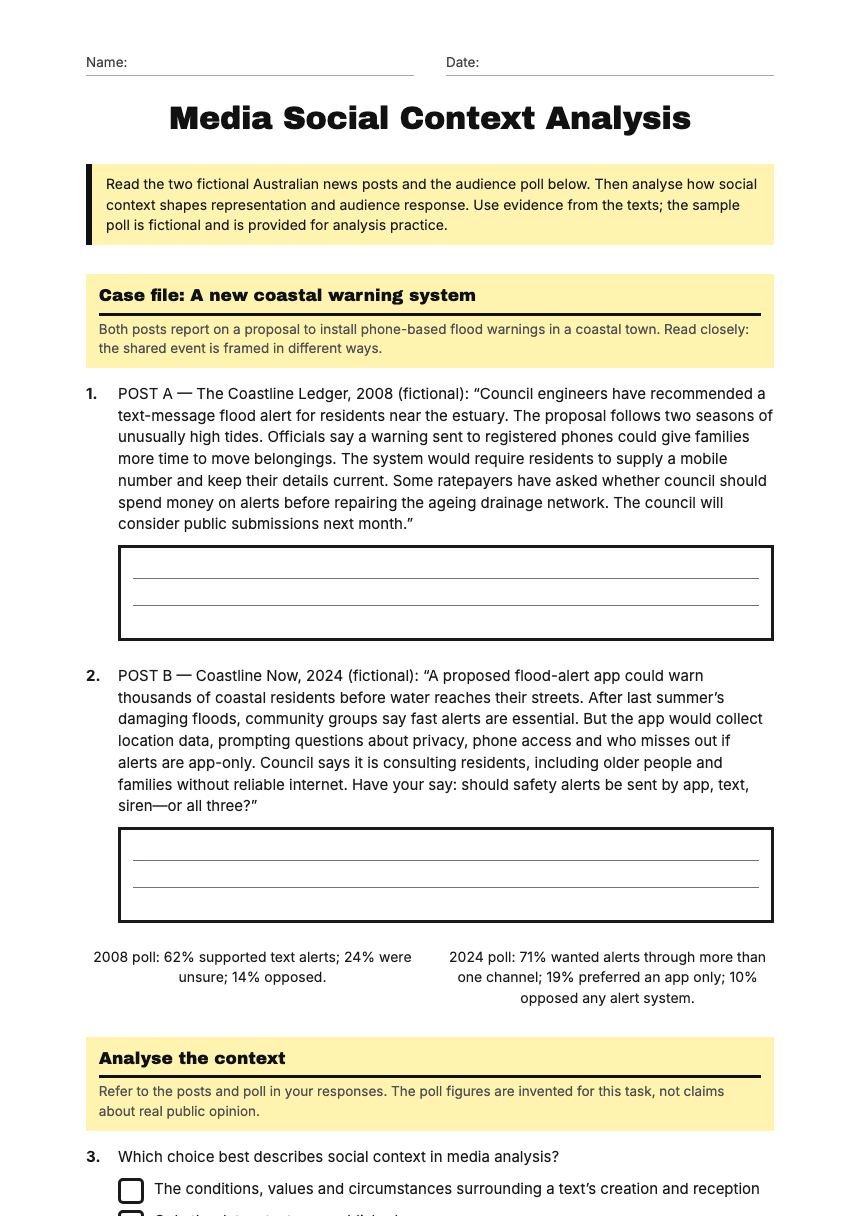
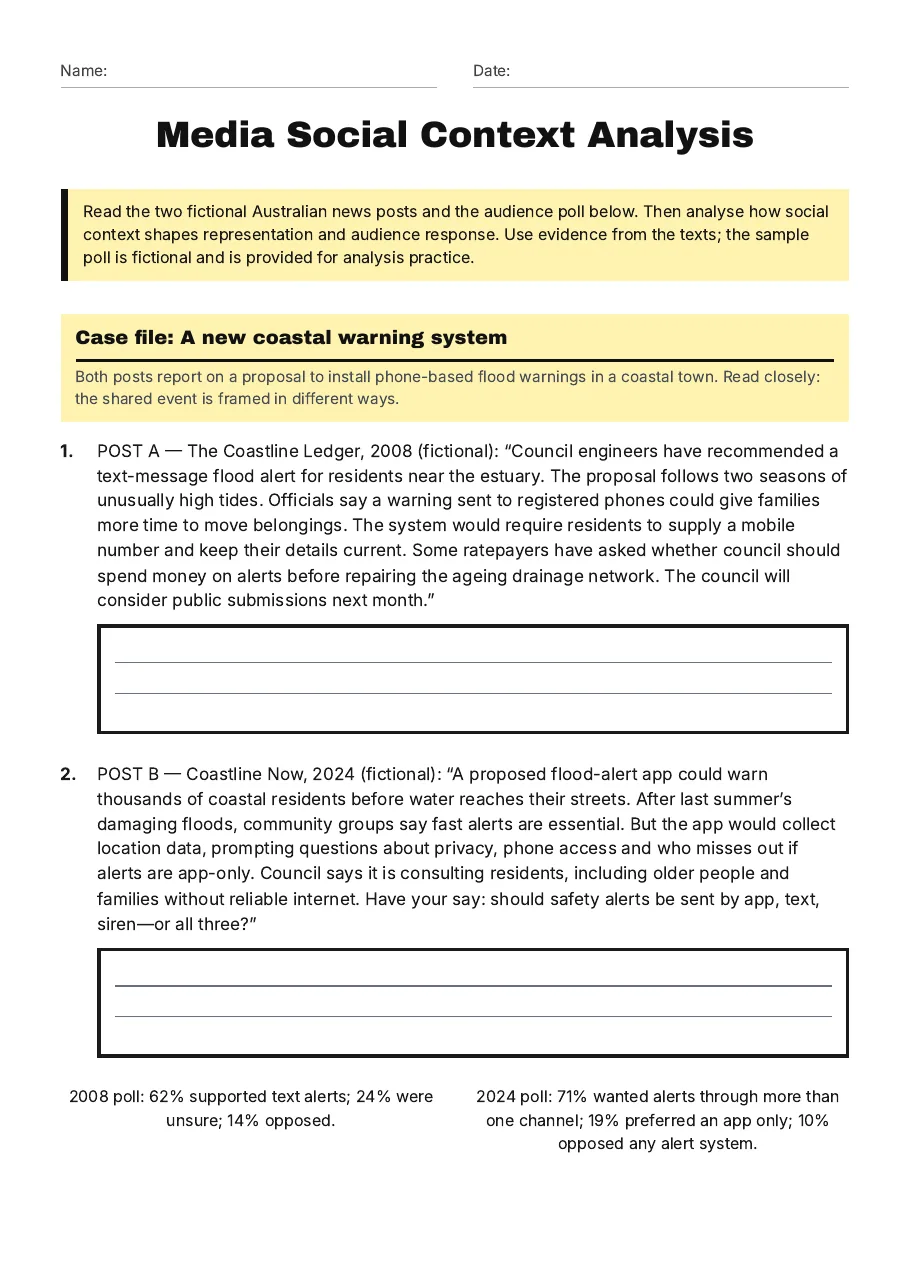
Media Social Context Analysis worksheet preview
Name:Date:

Media Social Context Analysis

Read the two fictional Australian news posts and the audience poll below. Then analyse how social context shapes representation and audience response. Use evidence from the texts; the sample poll is fictional and is provided for analysis practice.

Case file: A new coastal warning system

Both posts report on a proposal to install phone-based flood warnings in a coastal town. Read closely: the shared event is framed in different ways.

1.POST A — The Coastline Ledger, 2008 (fictional): “Council engineers have recommended a text-message flood alert for residents near the estuary. The proposal follows two seasons of unusually high tides. Officials say a warning sent to registered phones could give families more time to move belongings. The system would require residents to supply a mobile number and keep their details current. Some ratepayers have asked whether council should spend money on alerts before repairing the ageing drainage network. The council will consider public submissions next month.”
2.POST B — Coastline Now, 2024 (fictional): “A proposed flood-alert app could warn thousands of coastal residents before water reaches their streets. After last summer’s damaging floods, community groups say fast alerts are essential. But the app would collect location data, prompting questions about privacy, phone access and who misses out if alerts are app-only. Council says it is consulting residents, including older people and families without reliable internet. Have your say: should safety alerts be sent by app, text, siren—or all three?”

2008 poll: 62% supported text alerts; 24% were unsure; 14% opposed.

2024 poll: 71% wanted alerts through more than one channel; 19% preferred an app only; 10% opposed any alert system.

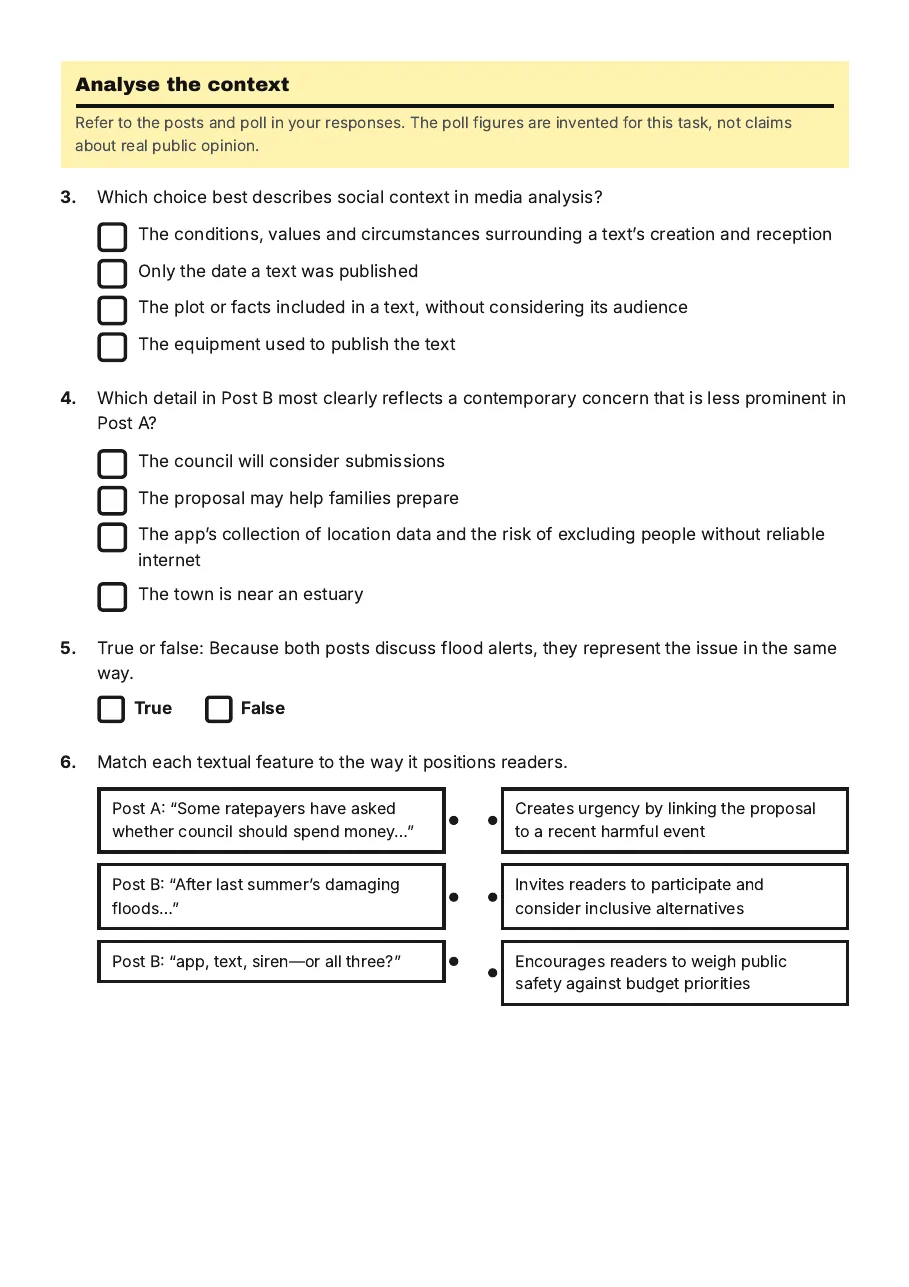
Analyse the context

Refer to the posts and poll in your responses. The poll figures are invented for this task, not claims about real public opinion.

3.Which choice best describes social context in media analysis?
  • The conditions, values and circumstances surrounding a text’s creation and reception
  • Only the date a text was published
  • The plot or facts included in a text, without considering its audience
  • The equipment used to publish the text
4.Which detail in Post B most clearly reflects a contemporary concern that is less prominent in Post A?
  • The council will consider submissions
  • The proposal may help families prepare
  • The app’s collection of location data and the risk of excluding people without reliable internet
  • The town is near an estuary
5.True or false: Because both posts discuss flood alerts, they represent the issue in the same way.
TrueFalse
6.Match each textual feature to the way it positions readers.
  • Post A: “Some ratepayers have asked whether council should spend money…”
  • Post B: “After last summer’s damaging floods…”
  • Post B: “app, text, siren—or all three?”
  • Creates urgency by linking the proposal to a recent harmful event
  • Invites readers to participate and consider inclusive alternatives
  • Encourages readers to weigh public safety against budget priorities
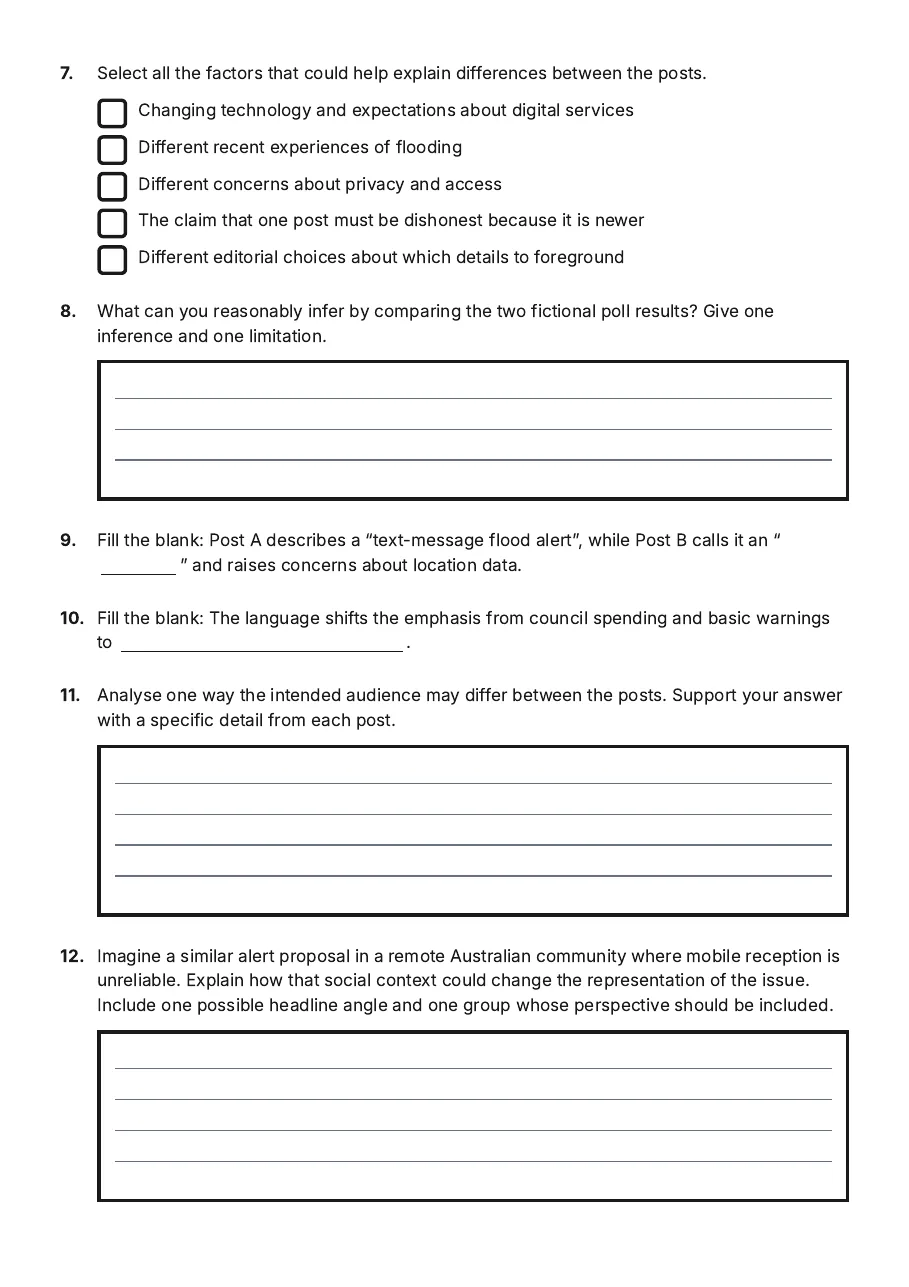
7.Select all the factors that could help explain differences between the posts.
  • Changing technology and expectations about digital services
  • Different recent experiences of flooding
  • Different concerns about privacy and access
  • The claim that one post must be dishonest because it is newer
  • Different editorial choices about which details to foreground
8.What can you reasonably infer by comparing the two fictional poll results? Give one inference and one limitation.
9.Fill the blank: Post A describes a “text-message flood alert”, while Post B calls it an “” and raises concerns about location data.
10.Fill the blank: The language shifts the emphasis from council spending and basic warnings to .
11.Analyse one way the intended audience may differ between the posts. Support your answer with a specific detail from each post.
12.Imagine a similar alert proposal in a remote Australian community where mobile reception is unreliable. Explain how that social context could change the representation of the issue. Include one possible headline angle and one group whose perspective should be included.
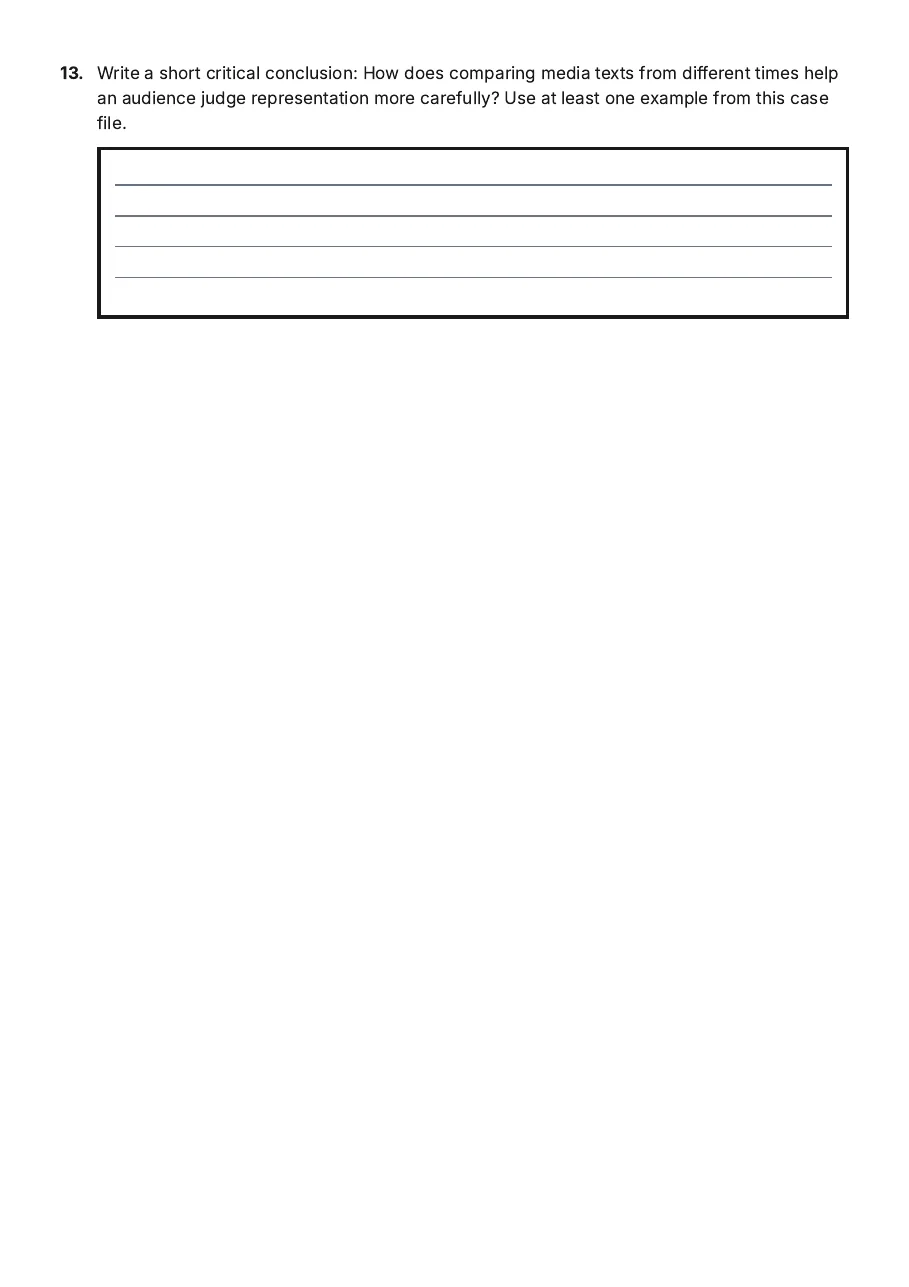
13.Write a short critical conclusion: How does comparing media texts from different times help an audience judge representation more carefully? Use at least one example from this case file.

4 printable pages

  • Media Social Context Analysis, page 1 of 4: Case file: A new coastal warning system

    Page 1

  • Media Social Context Analysis, page 2 of 4: Analyse the context

    Page 2

  • Media Social Context Analysis, page 3 of 4: 7. Select all the factors that could help explain differences between the posts.

    Page 3

  • Media Social Context Analysis, page 4 of 4: 13. Write a short critical conclusion: How does comparing media texts from different…

    Page 4

About This Worksheet

Free in Kuraplan

Sign up free, grab the PDF, and customize it for your class.

Print-Ready

Formatted for standard paper. Clean layout, easy to read.

AI-Generated

Created with Kuraplan's AI, designed for real classroom use.

For Teachers & Parents

Use in classrooms, for homework, tutoring, or homeschool.

Need a custom version of this worksheet?

Kuraplan's AI generates custom worksheets in seconds — differentiated for every learner, aligned to your curriculum.

Generate Custom Worksheets — Free
No credit card Curriculum-aligned Under 60 seconds