ScienceFreePrintable

Meiosis and Fertilisation Processes

A free science worksheet ready for your classroom. Open in Kuraplan to grab the print-ready PDF, customize it for your students, or generate a fresh version in seconds.
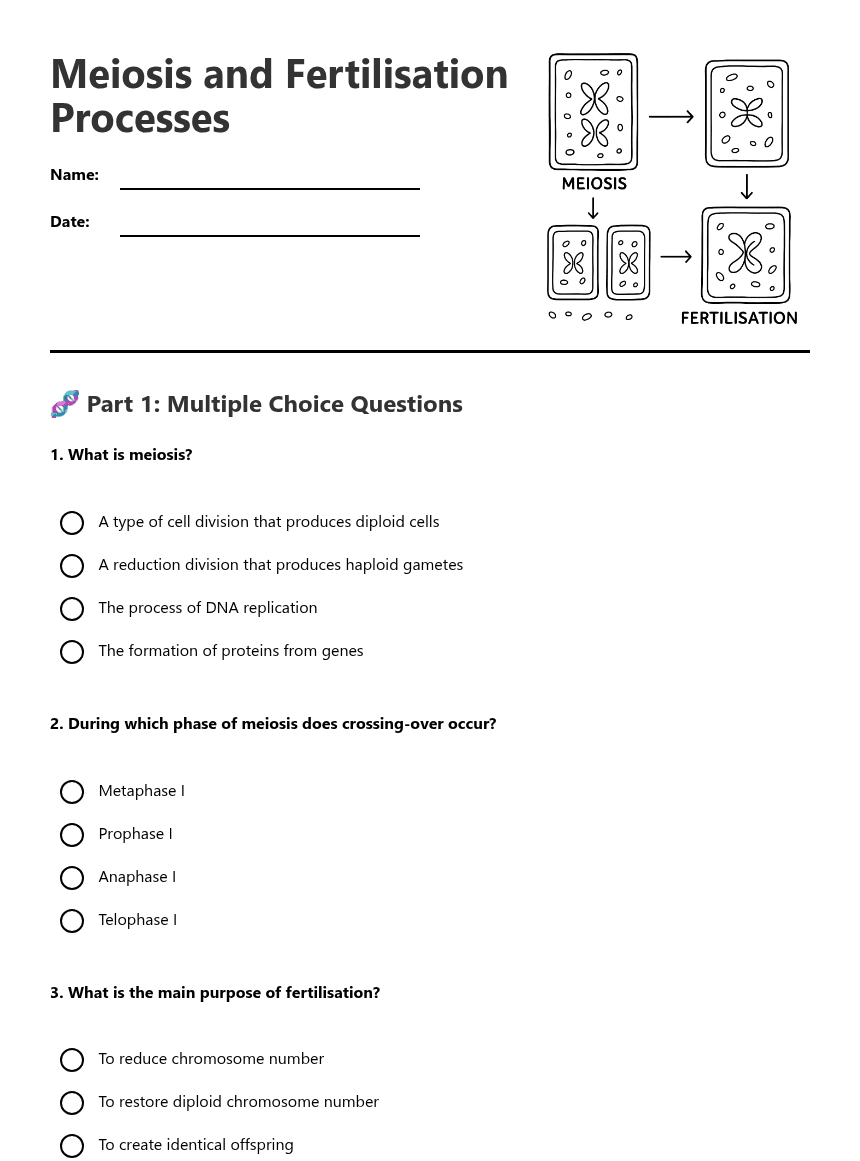
Meiosis and Fertilisation Processes worksheet preview
Meiosis and Fertilisation Processes

Meiosis and Fertilisation Processes

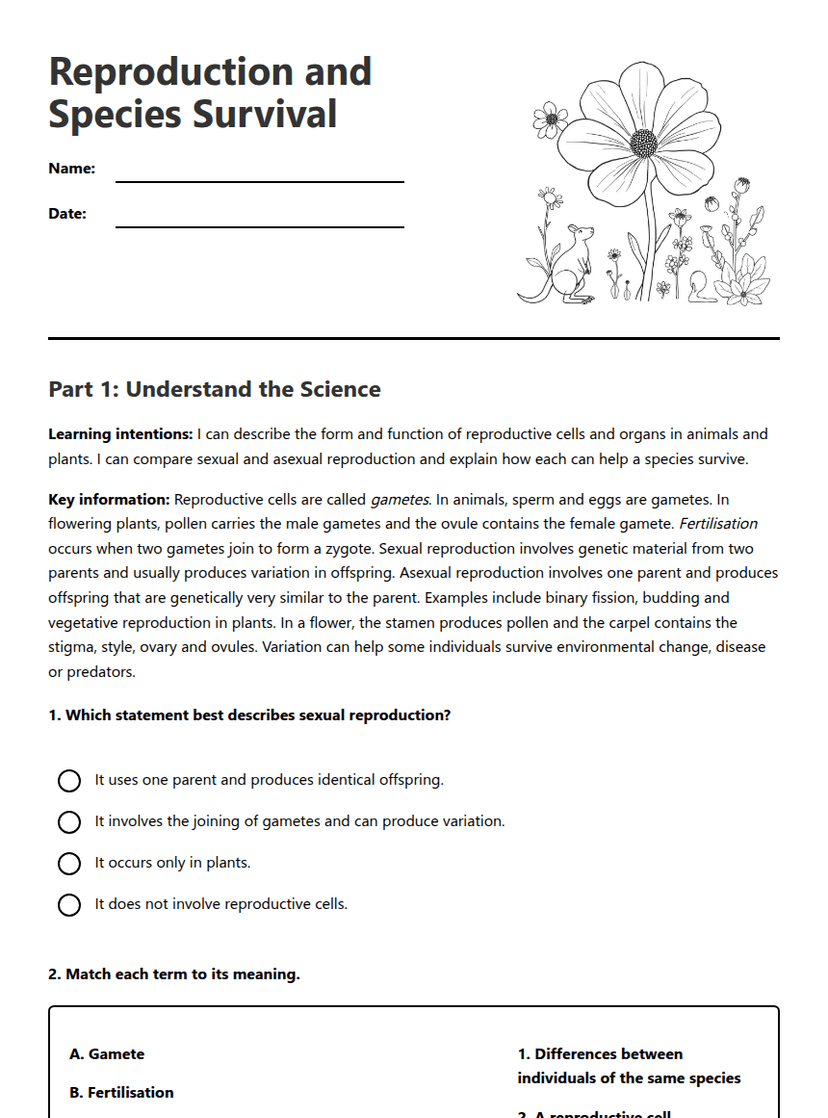
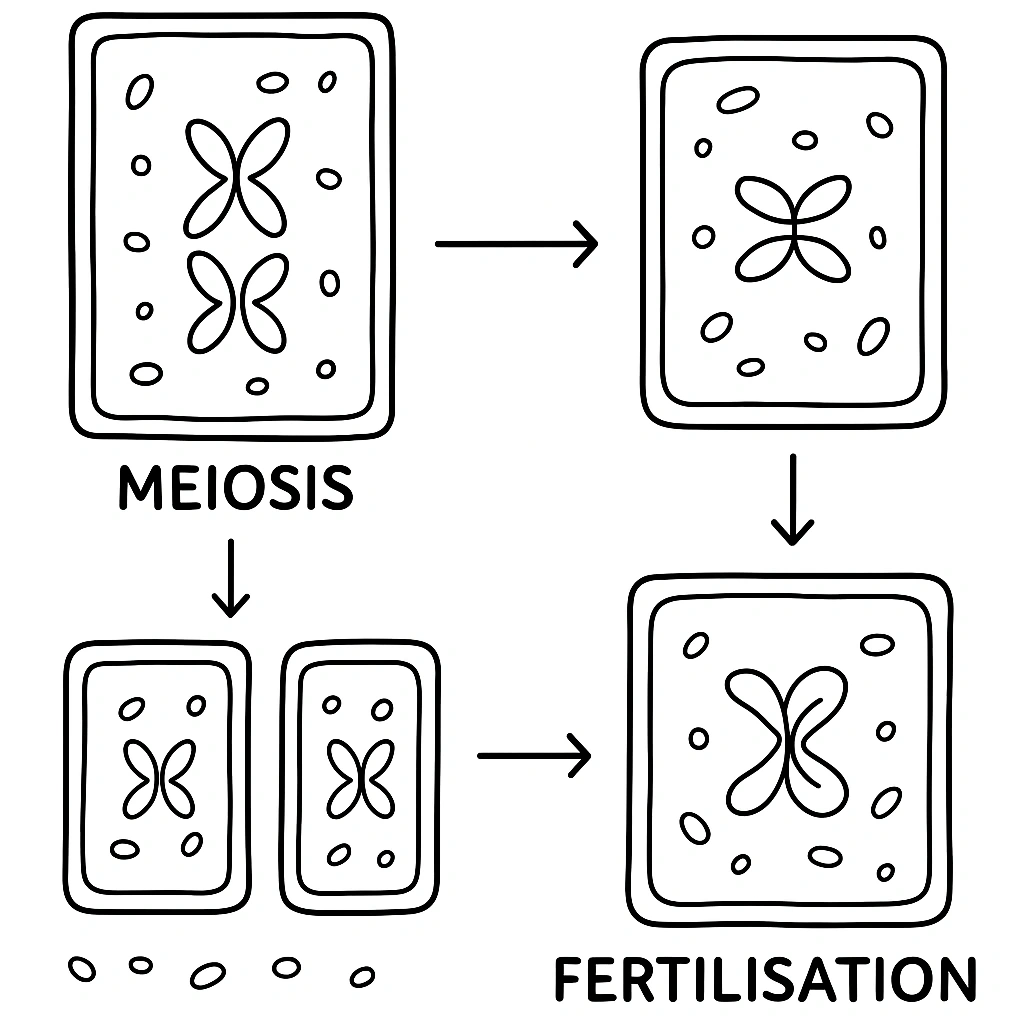
Chromosome division illustration

🧬 Part 1: Multiple Choice Questions

1. What is meiosis?

A type of cell division that produces diploid cells

A reduction division that produces haploid gametes

The process of DNA replication

The formation of proteins from genes

2. During which phase of meiosis does crossing-over occur?

Metaphase I

Prophase I

Anaphase I

Telophase I

3. What is the main purpose of fertilisation?

To reduce chromosome number

To restore diploid chromosome number

To create identical offspring

To prevent genetic variation

4. Which of the following contributes to genetic variation? (Select all that apply)

Crossing-over during meiosis

Independent assortment of chromosomes

Random fertilisation of gametes

Identical chromosome distribution

📝 Part 2: Fill in the Blanks

5. Complete the following sentences using the word bank below:

Word Bank: diploid, haploid, zygote, gametes, homologous, crossing-over

a) Meiosis produces _____________ cells called _____________ that contain half the chromosome number.

b) During prophase I, _____________ chromosomes exchange genetic material in a process called _____________.

c) When two gametes fuse during fertilisation, they form a _____________ _____________ cell.

6. Define the following terms:

Homologous chromosomes: _________________________________________________

Alleles: _________________________________________________

🎨 Part 3: Diagram and Analysis

7. Draw a simple diagram showing the stages of meiosis. Label at least 4 key stages.
8. In the space below, draw and label a diagram showing fertilisation. Include the gametes, zygote, and chromosome numbers.

🔗 Part 4: Concept Mapping

9. Create a concept map connecting the following terms. Draw lines between related concepts and write how they are connected.
Meiosis
Fertilisation
Genetic Variation
Gametes
Chromosomes
Alleles
Zygote
Crossing-over
10. Use the space below to draw connecting lines and write relationship labels for your concept map:

🤔 Part 5: Critical Thinking

11. Explain why genetic variation is important for species survival. Give at least two reasons.
12. What would happen if gametes were diploid instead of haploid? Explain your reasoning.
13. Compare and contrast meiosis and mitosis. List at least three differences.

🧪 Part 6: Application Questions

14. A human diploid cell contains 46 chromosomes. How many chromosomes would be found in:

a) A human sperm cell: _______ chromosomes

b) A human egg cell: _______ chromosomes

c) A human zygote after fertilisation: _______ chromosomes

15. Scenario: Two parents each contribute gametes with different alleles for eye colour (B for brown, b for blue). Show all possible combinations of alleles in their offspring.
16. Explain how crossing-over during meiosis increases genetic diversity in offspring.

About This Worksheet

Free in Kuraplan

Sign up free, grab the PDF, and customize it for your class.

Print-Ready

Formatted for standard paper. Clean layout, easy to read.

AI-Generated

Created with Kuraplan's AI, designed for real classroom use.

For Teachers & Parents

Use in classrooms, for homework, tutoring, or homeschool.

Need a custom version of this worksheet?

Kuraplan's AI generates custom worksheets in seconds — differentiated for every learner, aligned to your curriculum.

Generate Custom Worksheets — Free
No credit card Curriculum-aligned Under 60 seconds