Living Things and Habitats
A free science worksheet ready for your classroom. Open in Kuraplan to grab the print-ready PDF, customize it for your students, or generate a fresh version in seconds.
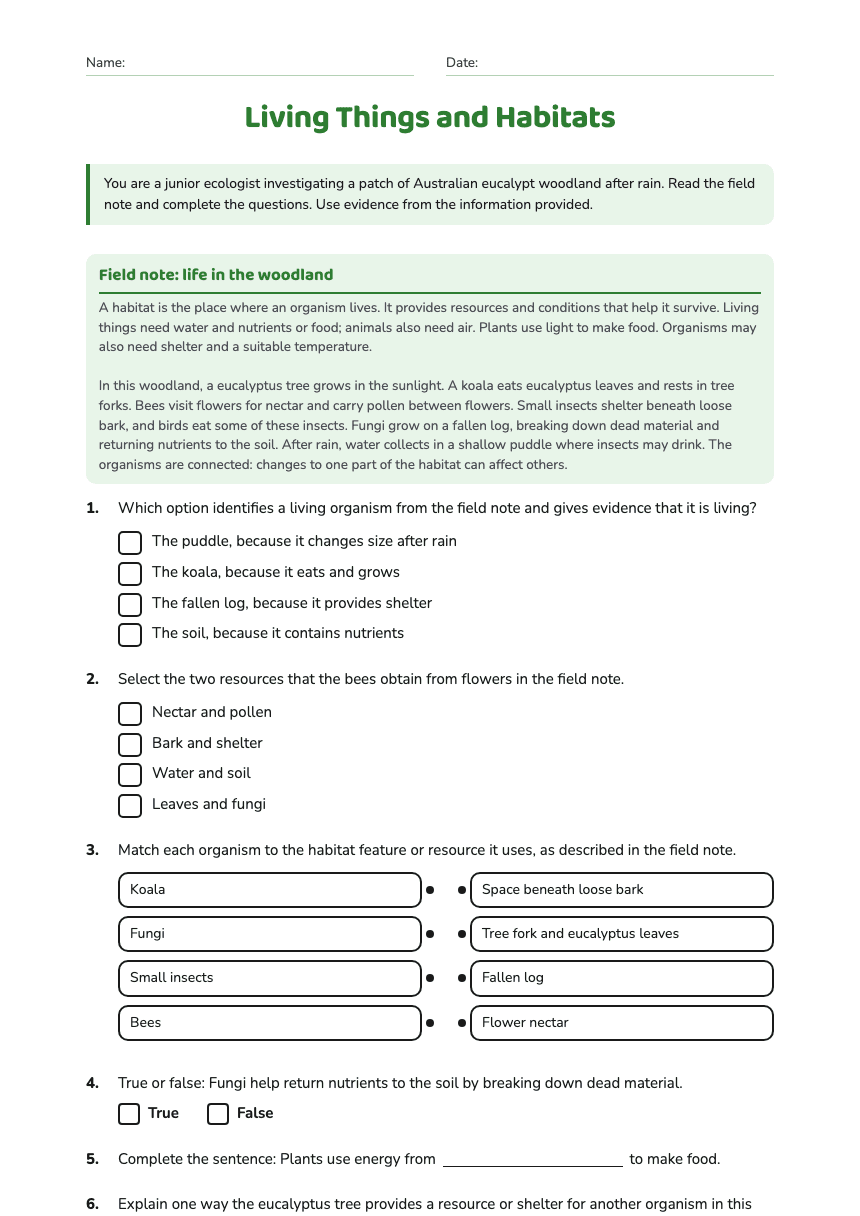
Living Things and Habitats
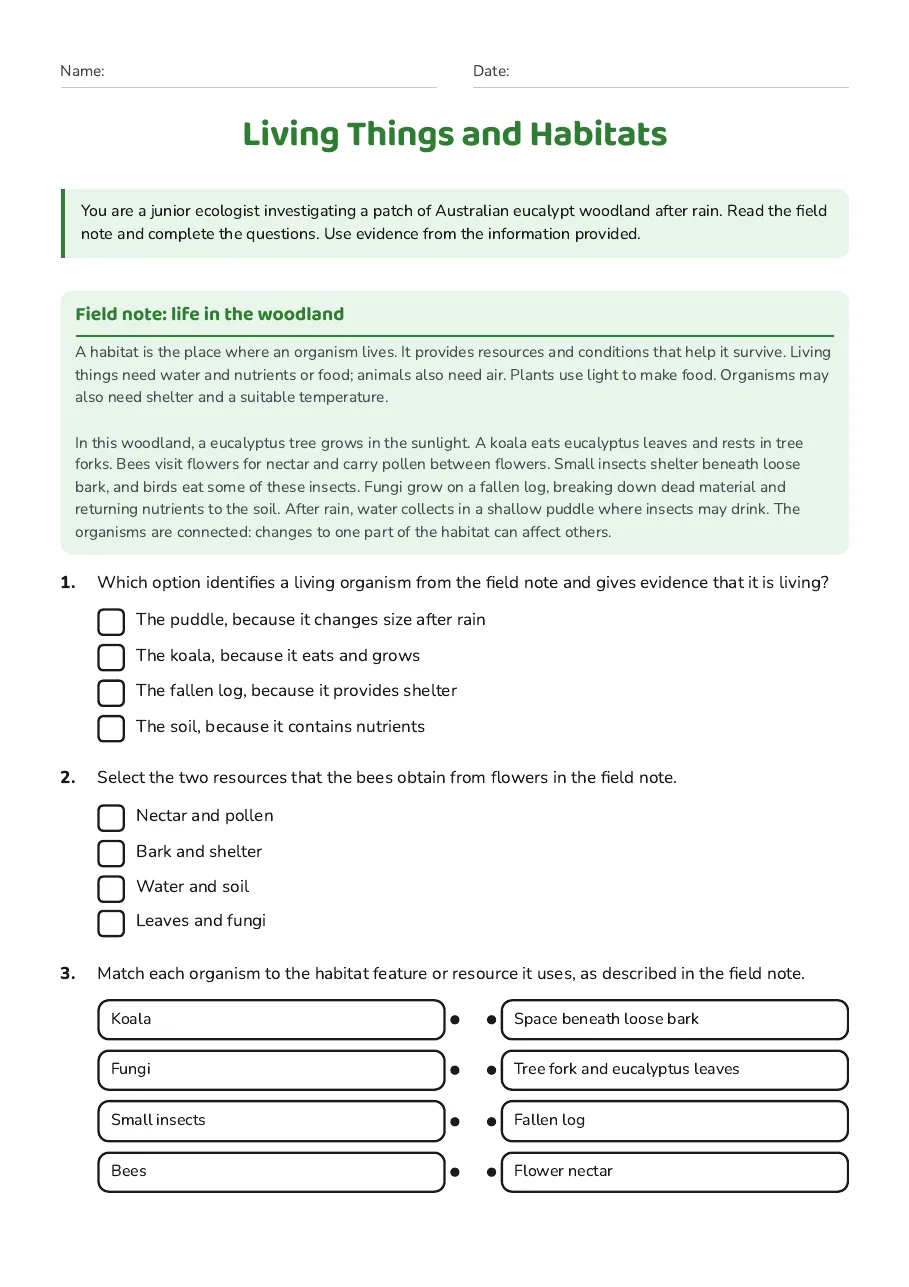
Field note: life in the woodland
A habitat is the place where an organism lives. It provides resources and conditions that help it survive. Living things need water and nutrients or food; animals also need air. Plants use light to make food. Organisms may also need shelter and a suitable temperature. In this woodland, a eucalyptus tree grows in the sunlight. A koala eats eucalyptus leaves and rests in tree forks. Bees visit flowers for nectar and carry pollen between flowers. Small insects shelter beneath loose bark, and birds eat some of these insects. Fungi grow on a fallen log, breaking down dead material and returning nutrients to the soil. After rain, water collects in a shallow puddle where insects may drink. The organisms are connected: changes to one part of the habitat can affect others.
- The puddle, because it changes size after rain
- The koala, because it eats and grows
- The fallen log, because it provides shelter
- The soil, because it contains nutrients
- Nectar and pollen
- Bark and shelter
- Water and soil
- Leaves and fungi
- Koala
- Fungi
- Small insects
- Bees
- Space beneath loose bark
- Tree fork and eucalyptus leaves
- Fallen log
- Flower nectar
3 printable pages
Page 1
Page 2
Page 3
About This Worksheet
Free in Kuraplan
Sign up free, grab the PDF, and customize it for your class.
Print-Ready
Formatted for standard paper. Clean layout, easy to read.
AI-Generated
Created with Kuraplan's AI, designed for real classroom use.
For Teachers & Parents
Use in classrooms, for homework, tutoring, or homeschool.
Need a custom version of this worksheet?
Kuraplan's AI generates custom worksheets in seconds — differentiated for every learner, aligned to your curriculum.
Generate Custom Worksheets — Free