MathsFreePrintable
Multiples Pattern Analysis
A free maths worksheet ready for your classroom. Open in Kuraplan to grab the print-ready PDF, customize it for your students, or generate a fresh version in seconds.
Name:Date:
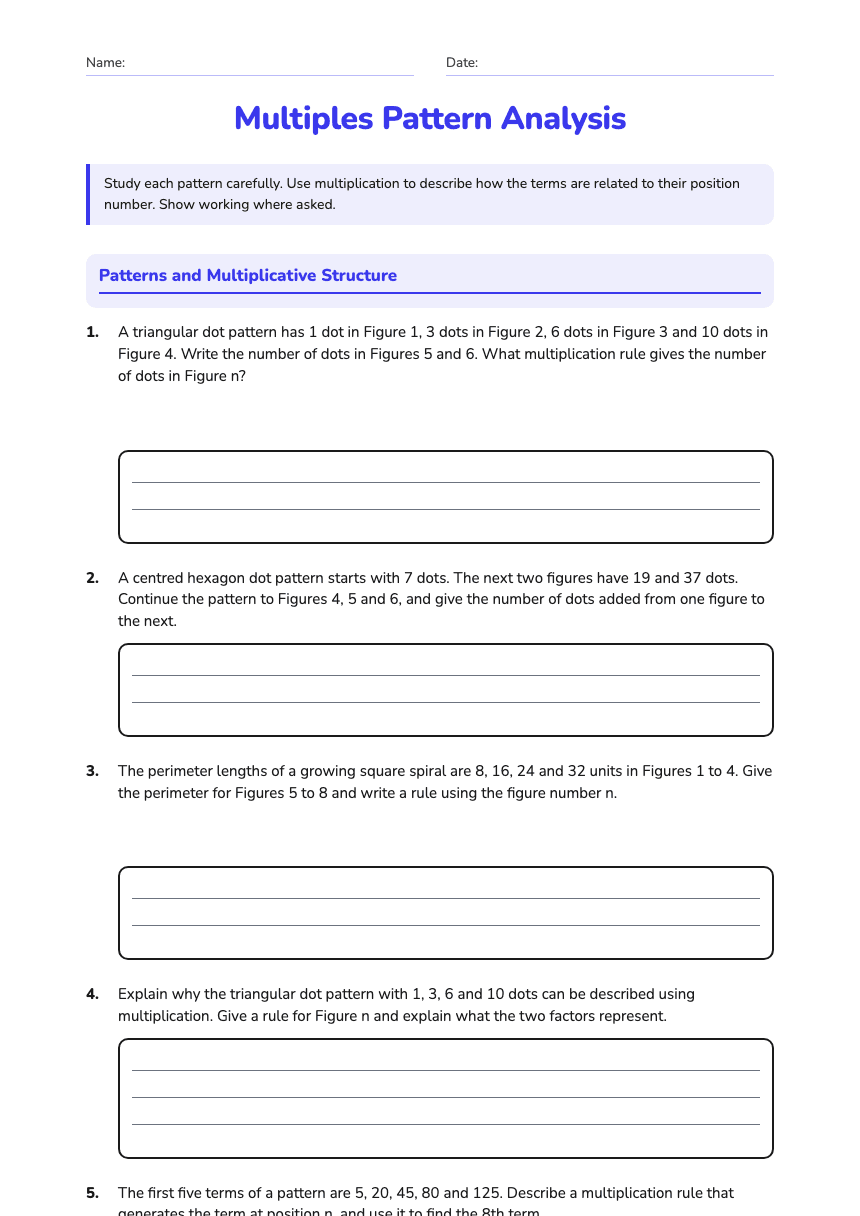
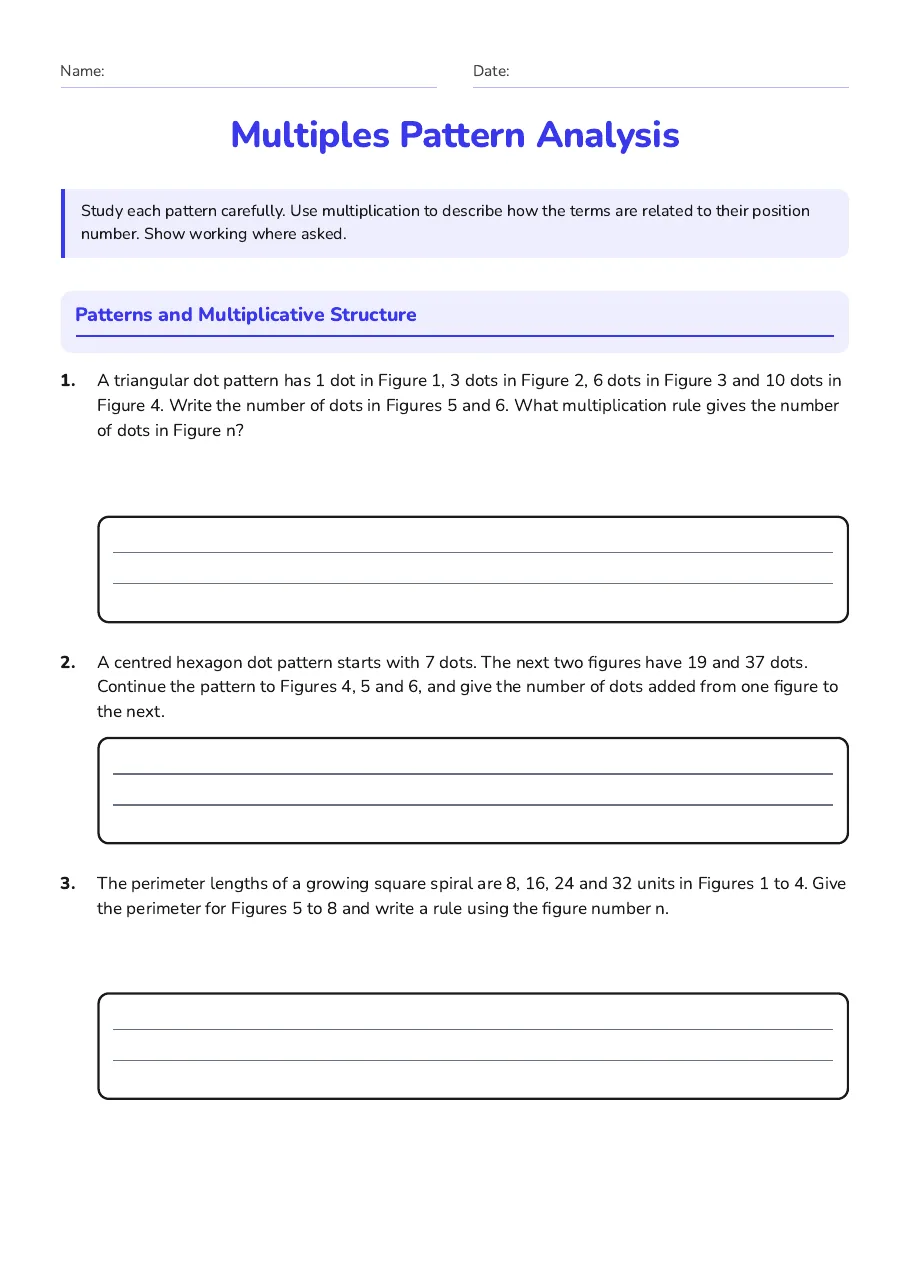
Multiples Pattern Analysis
Study each pattern carefully. Use multiplication to describe how the terms are related to their position number. Show working where asked.
Patterns and Multiplicative Structure
1.A triangular dot pattern has 1 dot in Figure 1, 3 dots in Figure 2, 6 dots in Figure 3 and 10 dots in Figure 4. Write the number of dots in Figures 5 and 6. What multiplication rule gives the number of dots in Figure n?
2.A centred hexagon dot pattern starts with 7 dots. The next two figures have 19 and 37 dots. Continue the pattern to Figures 4, 5 and 6, and give the number of dots added from one figure to the next.
3.The perimeter lengths of a growing square spiral are 8, 16, 24 and 32 units in Figures 1 to 4. Give the perimeter for Figures 5 to 8 and write a rule using the figure number n.
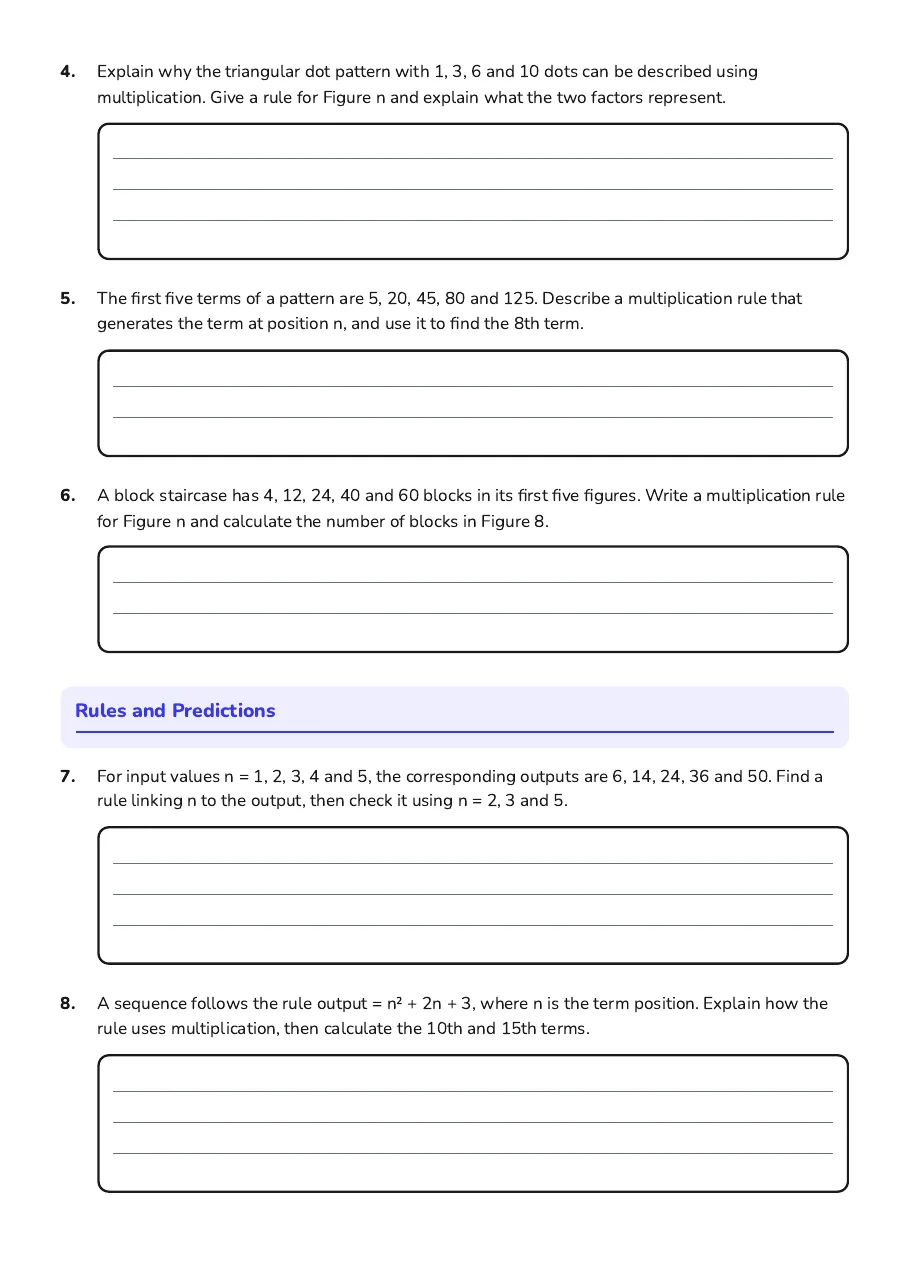
4.Explain why the triangular dot pattern with 1, 3, 6 and 10 dots can be described using multiplication. Give a rule for Figure n and explain what the two factors represent.
5.The first five terms of a pattern are 5, 20, 45, 80 and 125. Describe a multiplication rule that generates the term at position n, and use it to find the 8th term.
6.A block staircase has 4, 12, 24, 40 and 60 blocks in its first five figures. Write a multiplication rule for Figure n and calculate the number of blocks in Figure 8.
Rules and Predictions
7.For input values n = 1, 2, 3, 4 and 5, the corresponding outputs are 6, 14, 24, 36 and 50. Find a rule linking n to the output, then check it using n = 2, 3 and 5.
8.A sequence follows the rule output = n² + 2n + 3, where n is the term position. Explain how the rule uses multiplication, then calculate the 10th and 15th terms.
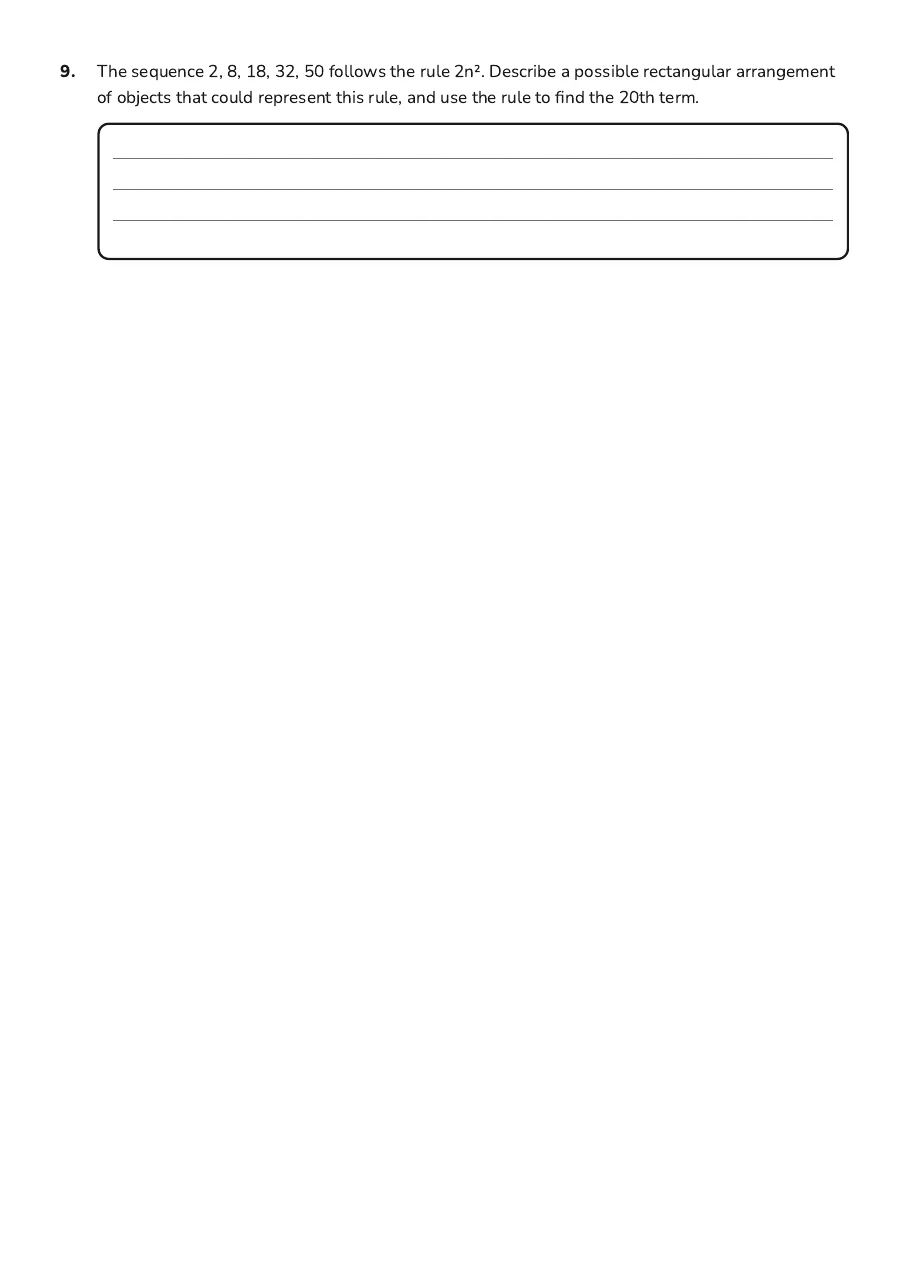
9.The sequence 2, 8, 18, 32, 50 follows the rule 2n². Describe a possible rectangular arrangement of objects that could represent this rule, and use the rule to find the 20th term.
3 printable pages
Page 1
Page 2
Page 3
About This Worksheet
Free in Kuraplan
Sign up free, grab the PDF, and customize it for your class.
Print-Ready
Formatted for standard paper. Clean layout, easy to read.
AI-Generated
Created with Kuraplan's AI, designed for real classroom use.
For Teachers & Parents
Use in classrooms, for homework, tutoring, or homeschool.
Need a custom version of this worksheet?
Kuraplan's AI generates custom worksheets in seconds — differentiated for every learner, aligned to your curriculum.
Generate Custom Worksheets — Free No credit card Curriculum-aligned Under 60 seconds
More Maths Worksheets
Year 3
Multiplication & Division Magic
Free
Year 5
Factors and Multiples Worksheet
Free
Multiplication and Division Practice
Free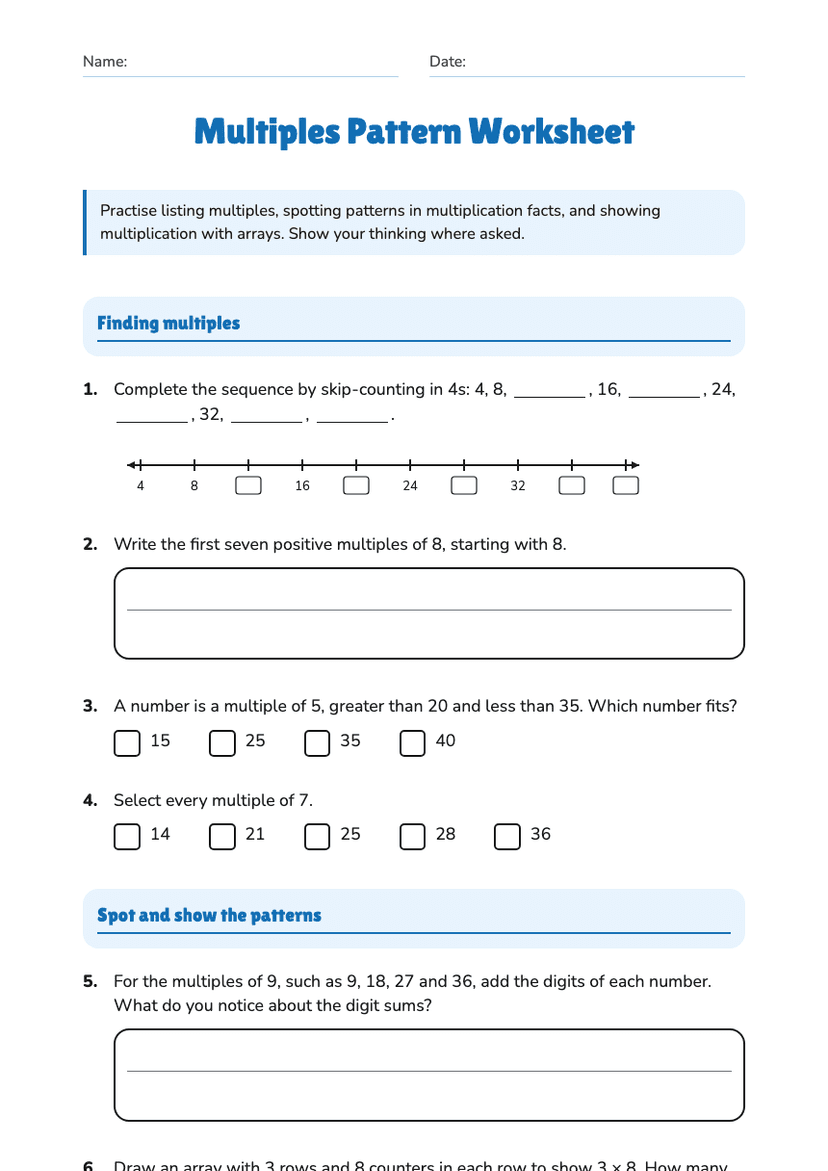
Year 4
Multiples Pattern Worksheet
Free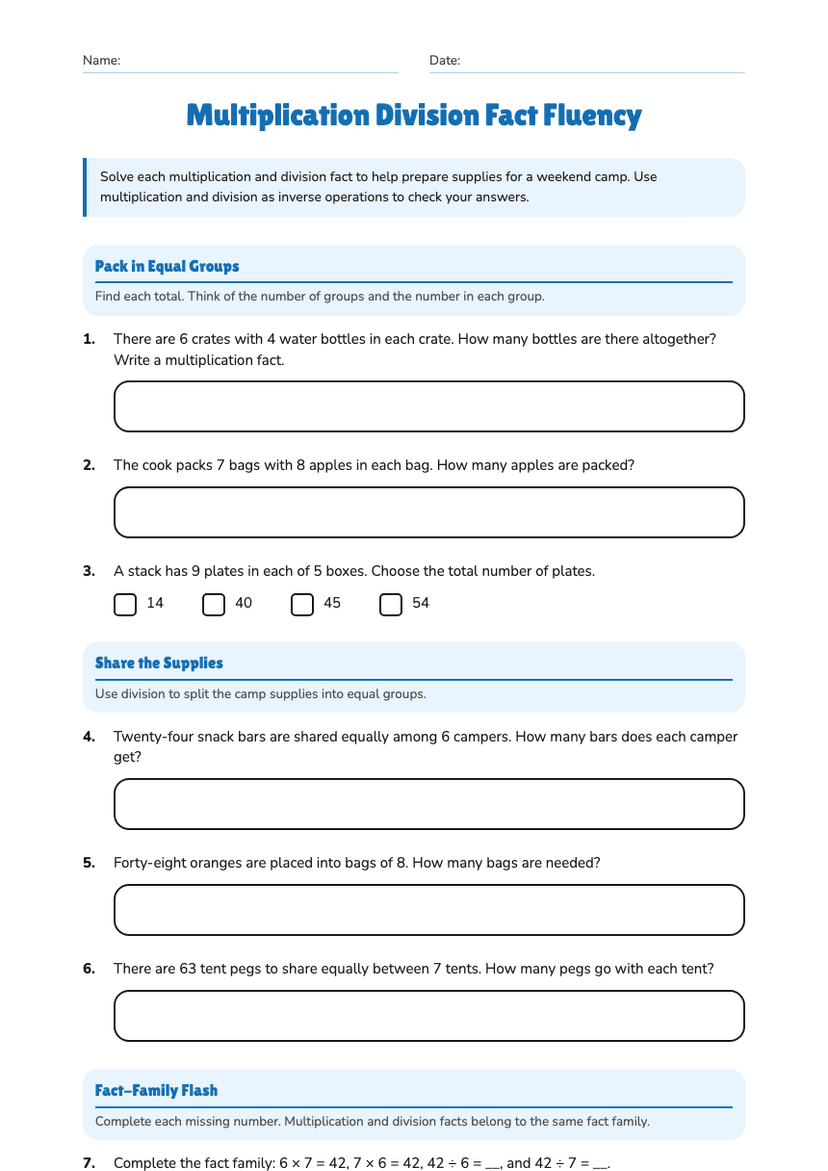
Multiplication Division Fact Fluency
Free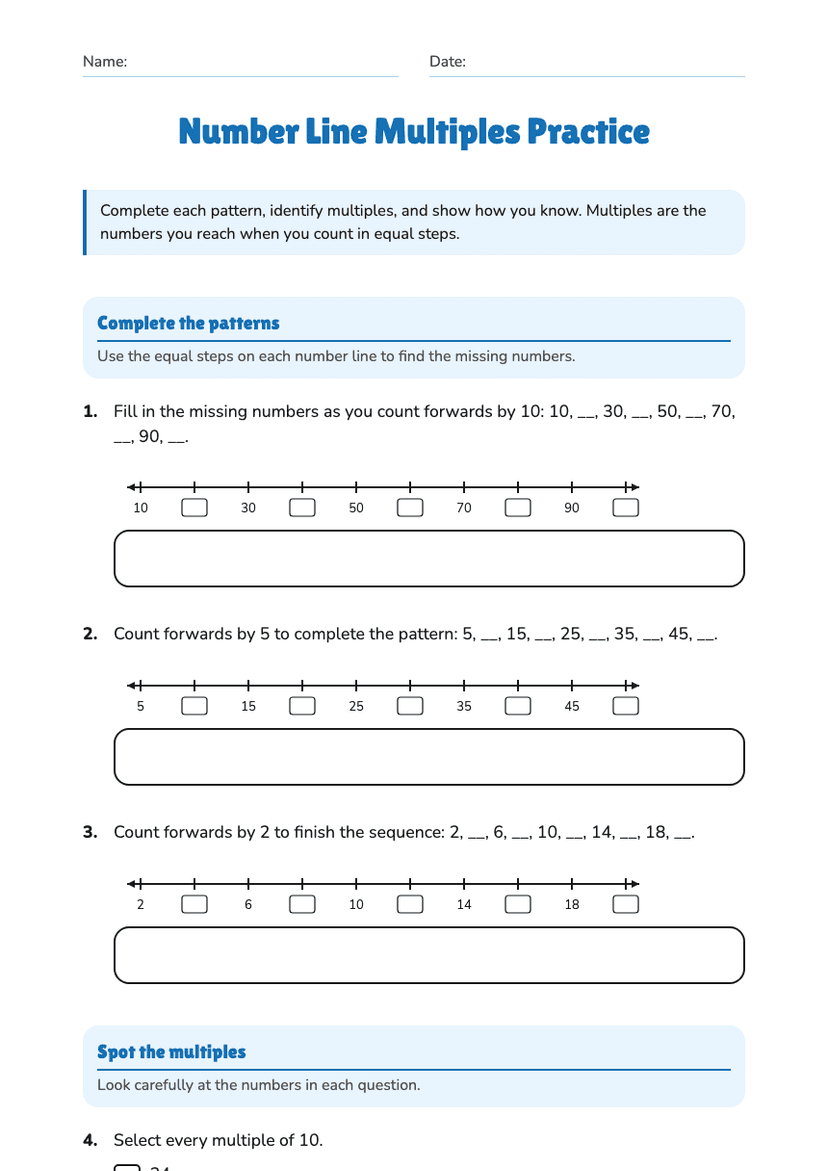
Number Line Multiples Practice
Free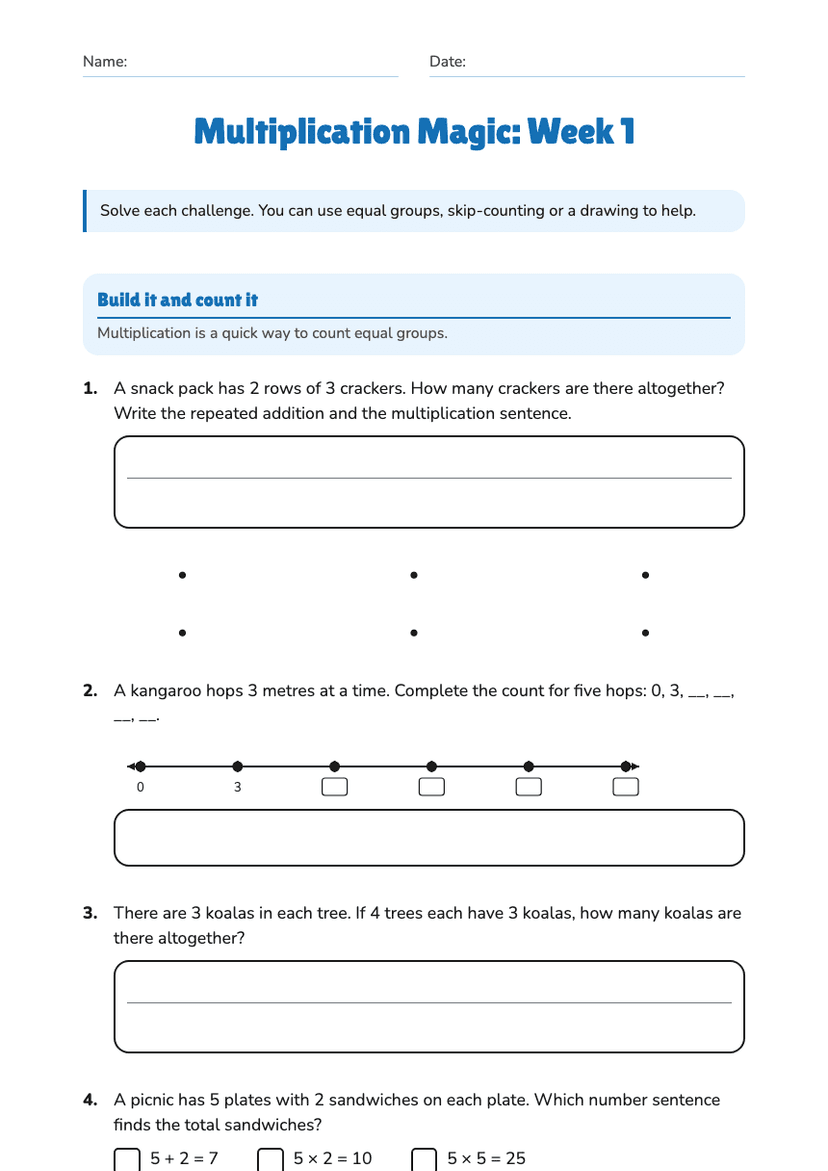
Year 3
Multiplication Magic: Week 1
Free