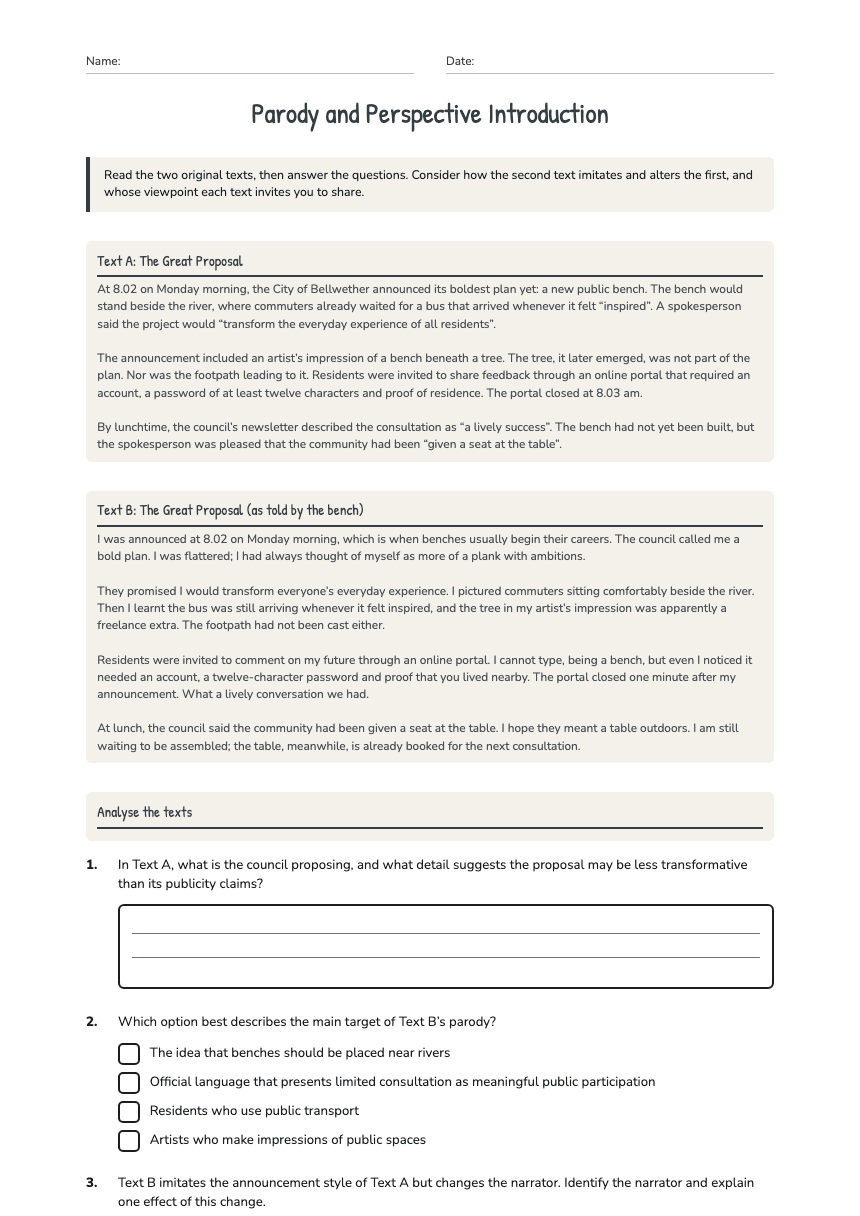
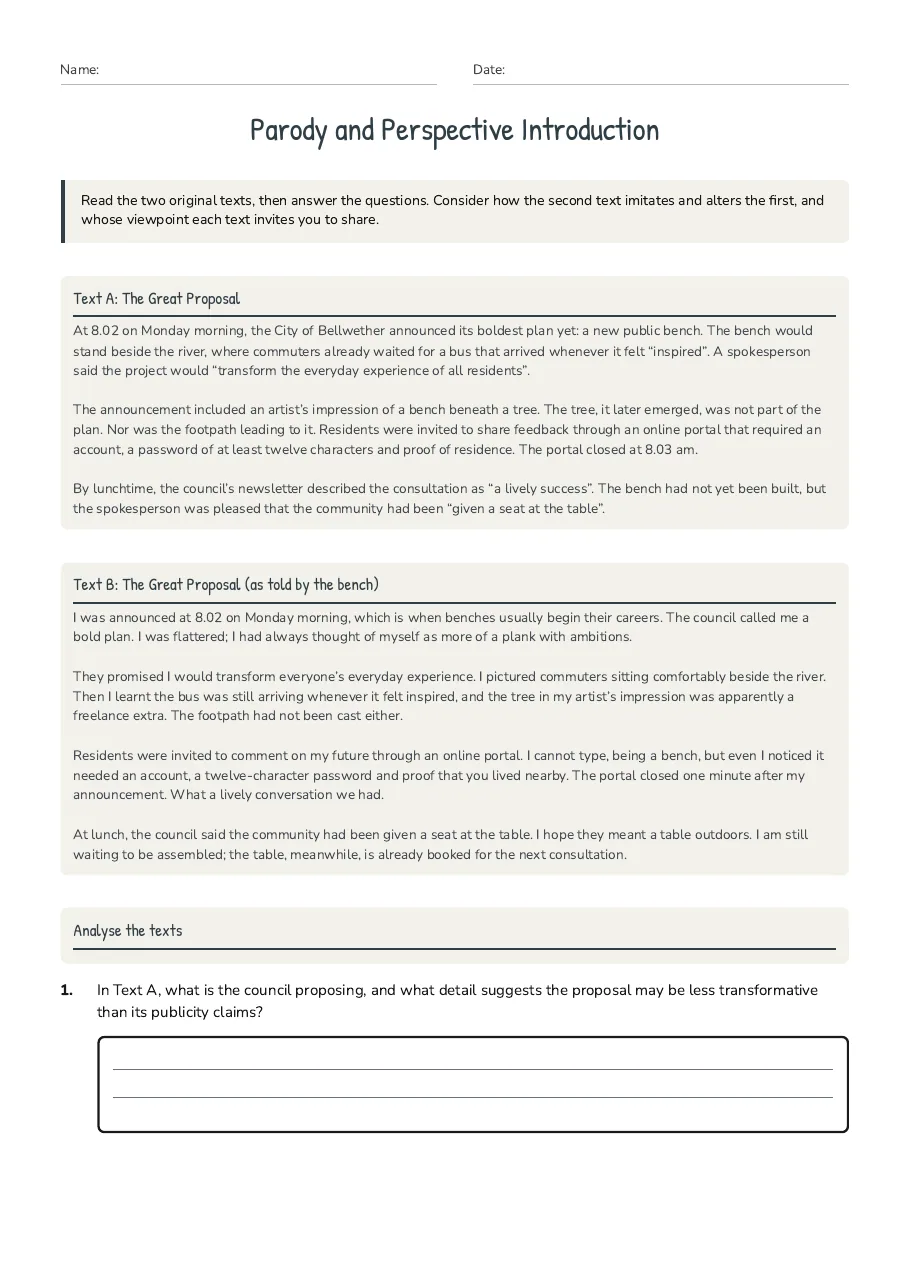
Parody and Perspective Introduction
A free english worksheet ready for your classroom. Open in Kuraplan to grab the print-ready PDF, customize it for your students, or generate a fresh version in seconds.
Parody and Perspective Introduction
Text A: The Great Proposal
At 8.02 on Monday morning, the City of Bellwether announced its boldest plan yet: a new public bench. The bench would stand beside the river, where commuters already waited for a bus that arrived whenever it felt “inspired”. A spokesperson said the project would “transform the everyday experience of all residents”. The announcement included an artist’s impression of a bench beneath a tree. The tree, it later emerged, was not part of the plan. Nor was the footpath leading to it. Residents were invited to share feedback through an online portal that required an account, a password of at least twelve characters and proof of residence. The portal closed at 8.03 am. By lunchtime, the council’s newsletter described the consultation as “a lively success”. The bench had not yet been built, but the spokesperson was pleased that the community had been “given a seat at the table”.
Text B: The Great Proposal (as told by the bench)
I was announced at 8.02 on Monday morning, which is when benches usually begin their careers. The council called me a bold plan. I was flattered; I had always thought of myself as more of a plank with ambitions. They promised I would transform everyone’s everyday experience. I pictured commuters sitting comfortably beside the river. Then I learnt the bus was still arriving whenever it felt inspired, and the tree in my artist’s impression was apparently a freelance extra. The footpath had not been cast either. Residents were invited to comment on my future through an online portal. I cannot type, being a bench, but even I noticed it needed an account, a twelve-character password and proof that you lived nearby. The portal closed one minute after my announcement. What a lively conversation we had. At lunch, the council said the community had been given a seat at the table. I hope they meant a table outdoors. I am still waiting to be assembled; the table, meanwhile, is already booked for the next consultation.
Analyse the texts
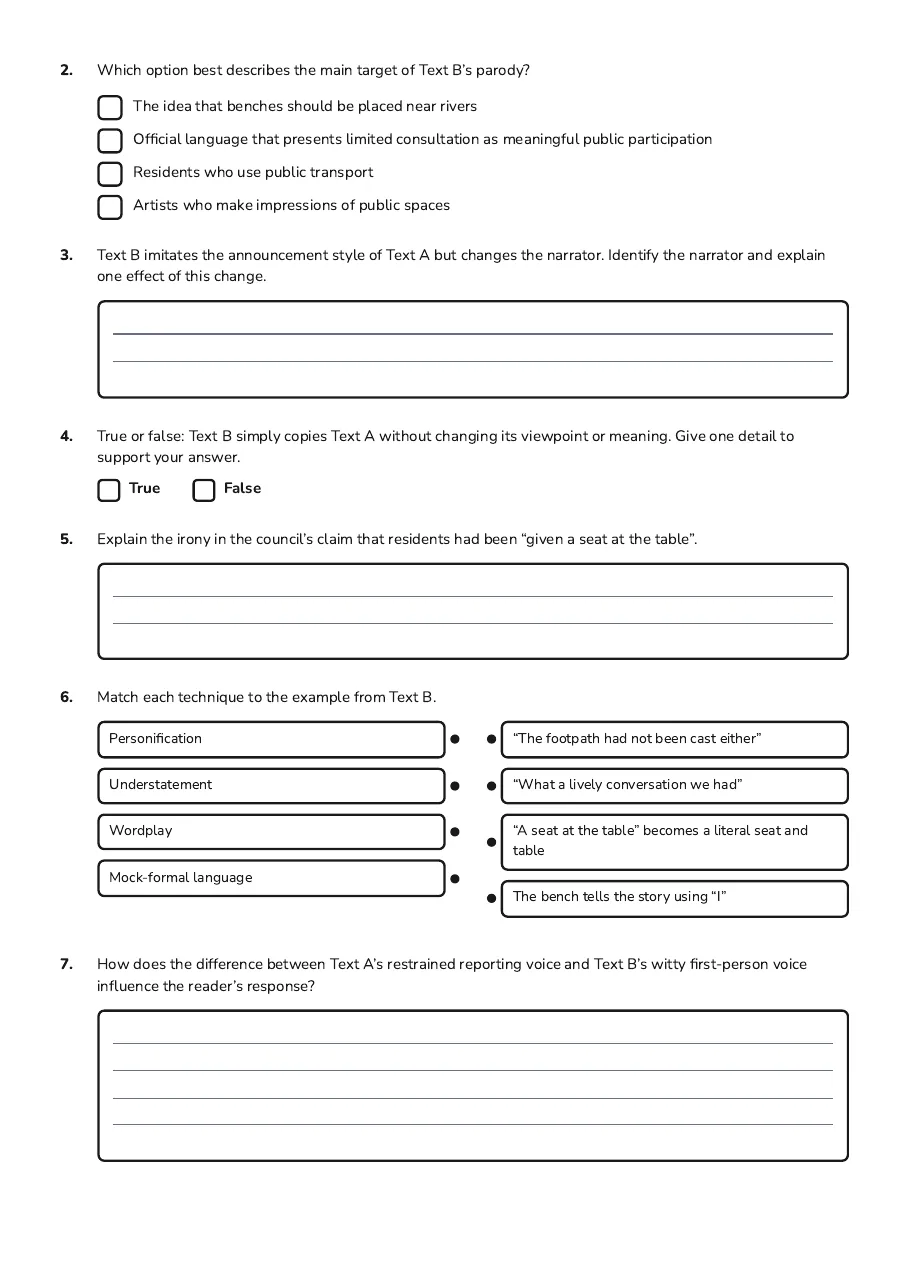
- The idea that benches should be placed near rivers
- Official language that presents limited consultation as meaningful public participation
- Residents who use public transport
- Artists who make impressions of public spaces
- Personification
- Understatement
- Wordplay
- Mock-formal language
- “The footpath had not been cast either”
- “What a lively conversation we had”
- “A seat at the table” becomes a literal seat and table
- The bench tells the story using “I”
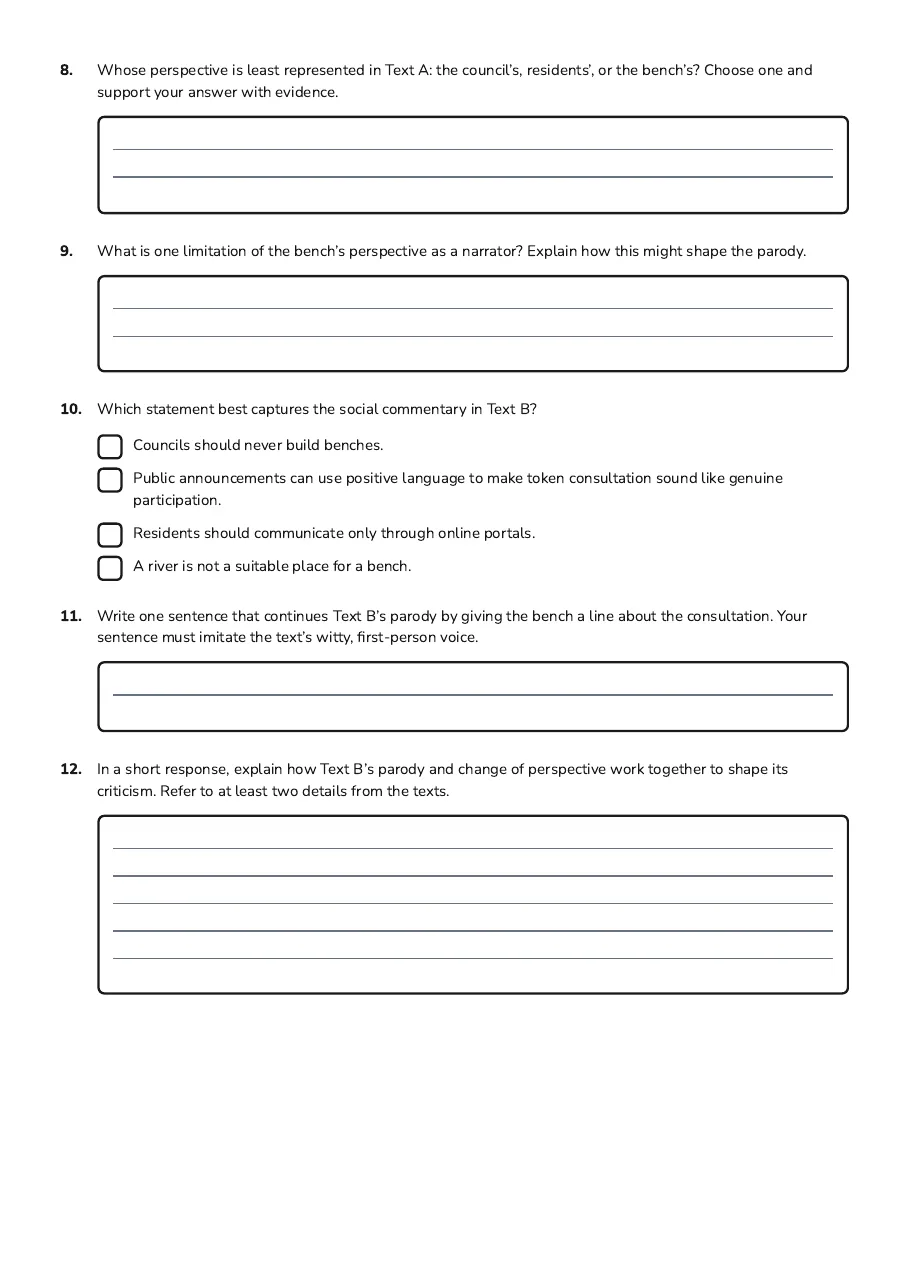
- Councils should never build benches.
- Public announcements can use positive language to make token consultation sound like genuine participation.
- Residents should communicate only through online portals.
- A river is not a suitable place for a bench.
3 printable pages
Page 1
Page 2
Page 3
About This Worksheet
Free in Kuraplan
Sign up free, grab the PDF, and customize it for your class.
Print-Ready
Formatted for standard paper. Clean layout, easy to read.
AI-Generated
Created with Kuraplan's AI, designed for real classroom use.
For Teachers & Parents
Use in classrooms, for homework, tutoring, or homeschool.
Need a custom version of this worksheet?
Kuraplan's AI generates custom worksheets in seconds — differentiated for every learner, aligned to your curriculum.
Generate Custom Worksheets — Free