Plate Tectonic Basics
A free science worksheet ready for your classroom. Open in Kuraplan to grab the print-ready PDF, customize it for your students, or generate a fresh version in seconds.
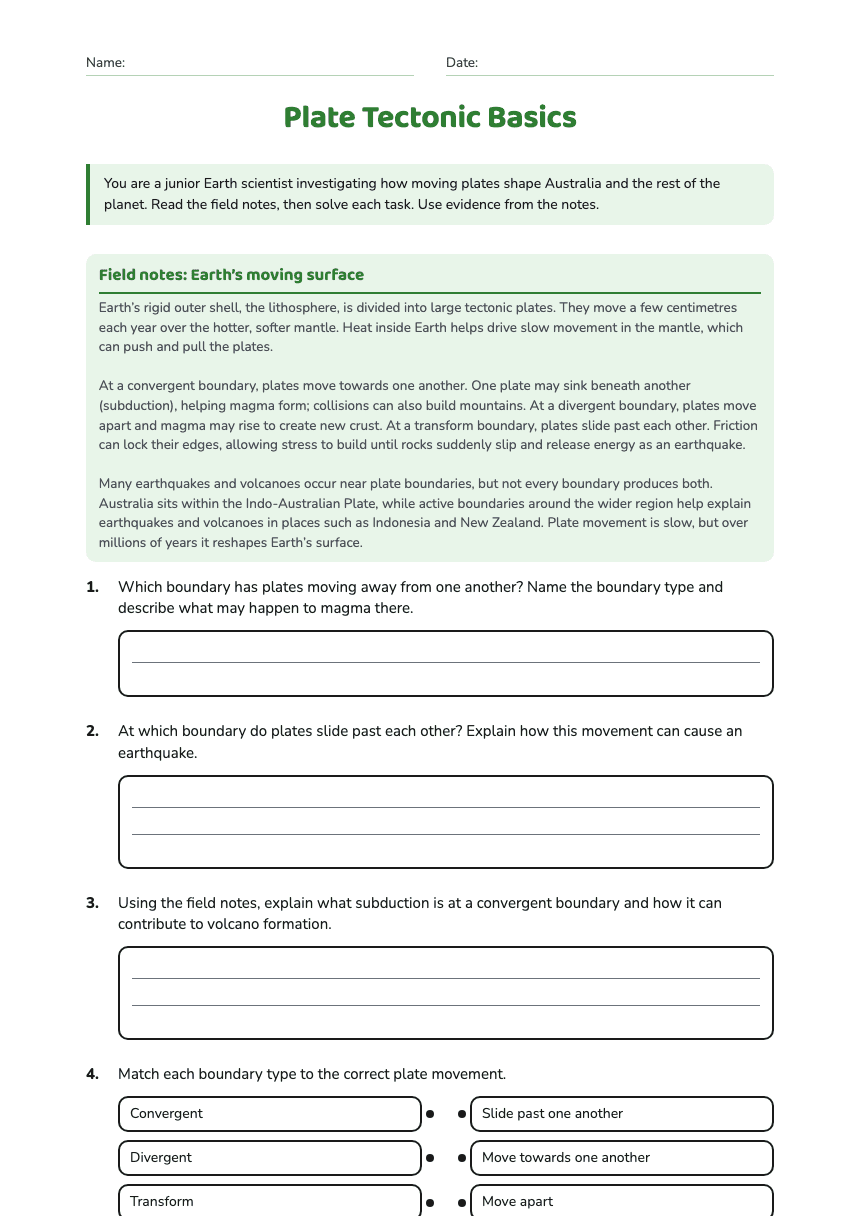
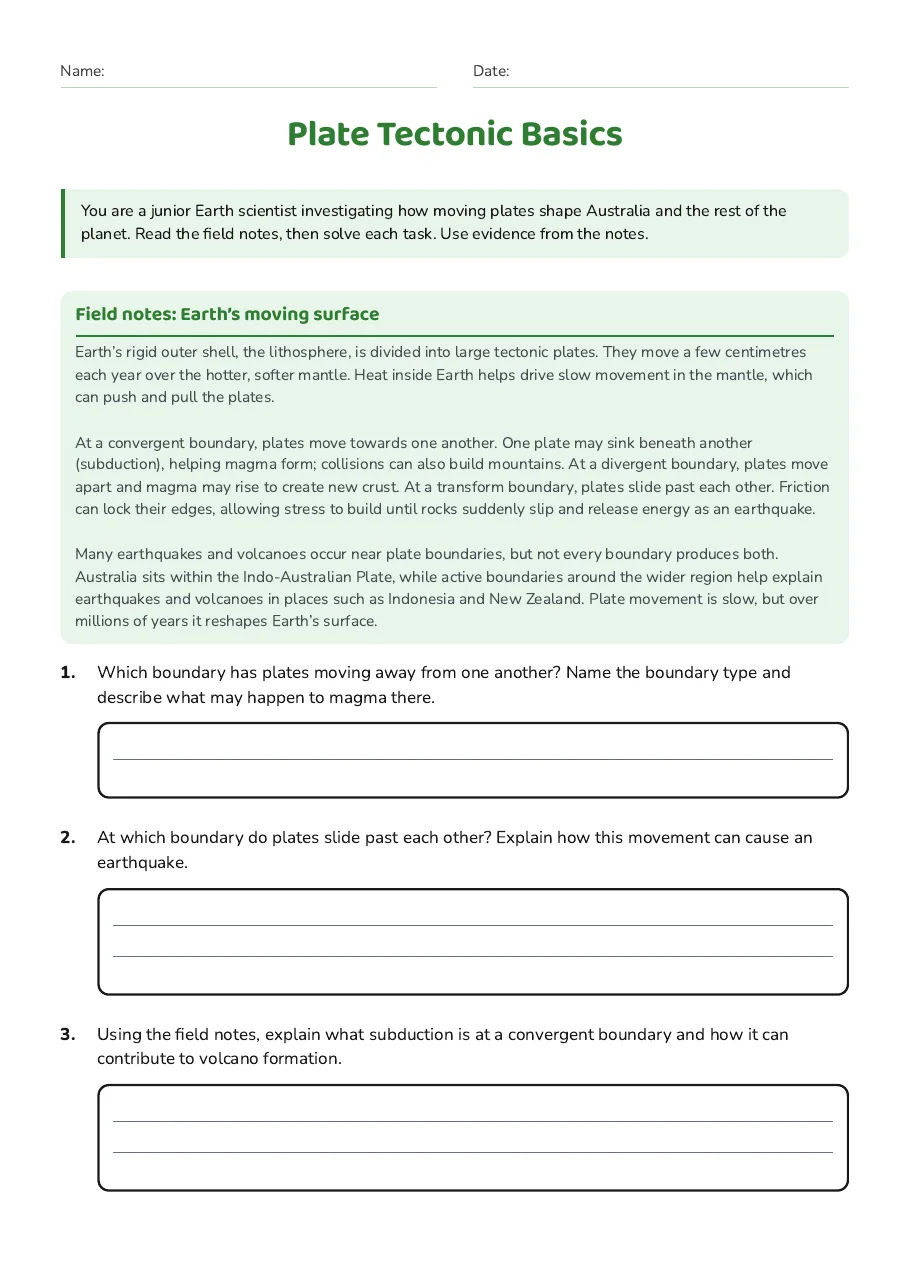
Plate Tectonic Basics
Field notes: Earth’s moving surface
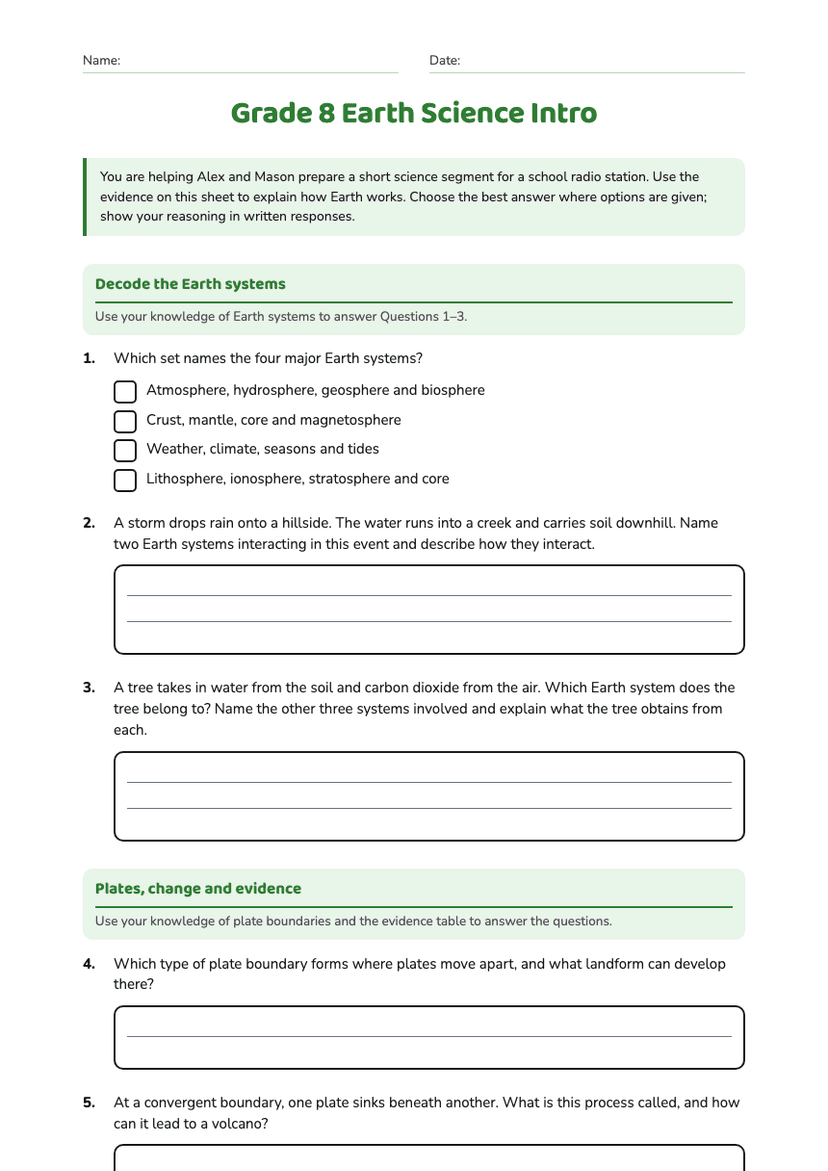
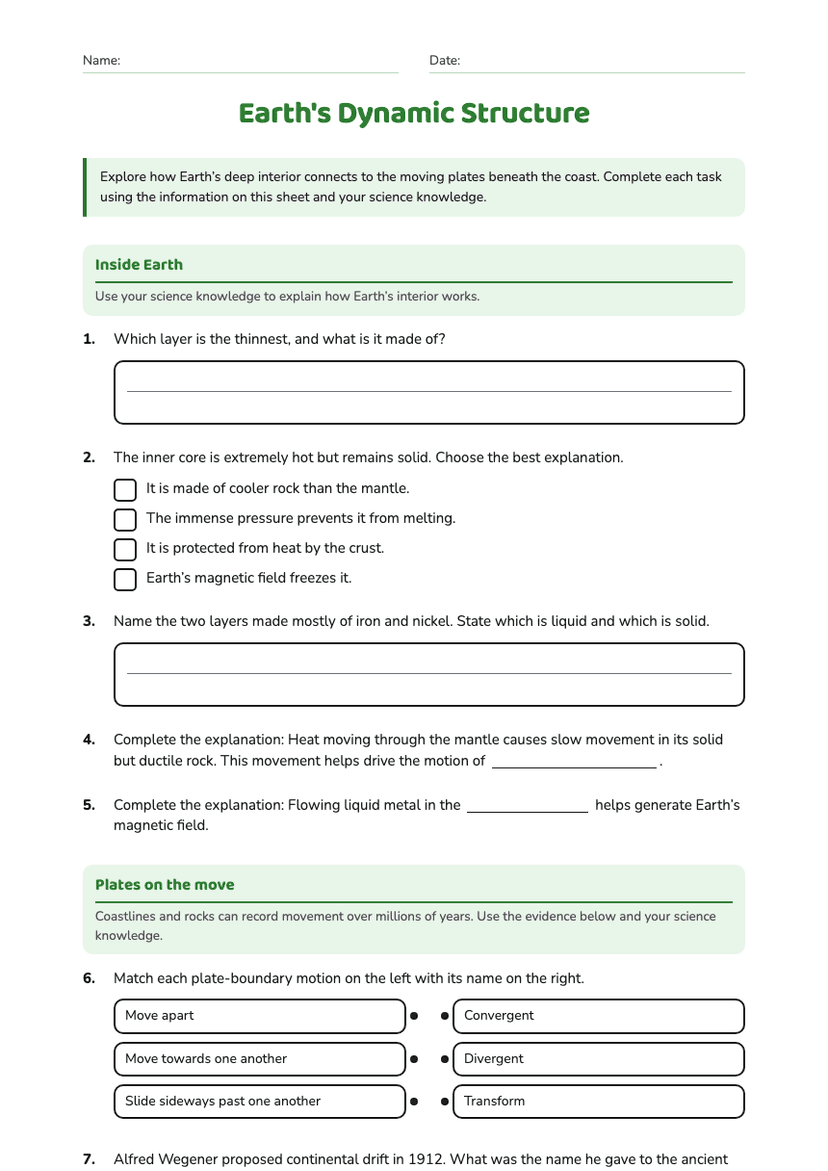
Earth’s rigid outer shell, the lithosphere, is divided into large tectonic plates. They move a few centimetres each year over the hotter, softer mantle. Heat inside Earth helps drive slow movement in the mantle, which can push and pull the plates. At a convergent boundary, plates move towards one another. One plate may sink beneath another (subduction), helping magma form; collisions can also build mountains. At a divergent boundary, plates move apart and magma may rise to create new crust. At a transform boundary, plates slide past each other. Friction can lock their edges, allowing stress to build until rocks suddenly slip and release energy as an earthquake. Many earthquakes and volcanoes occur near plate boundaries, but not every boundary produces both. Australia sits within the Indo-Australian Plate, while active boundaries around the wider region help explain earthquakes and volcanoes in places such as Indonesia and New Zealand. Plate movement is slow, but over millions of years it reshapes Earth’s surface.
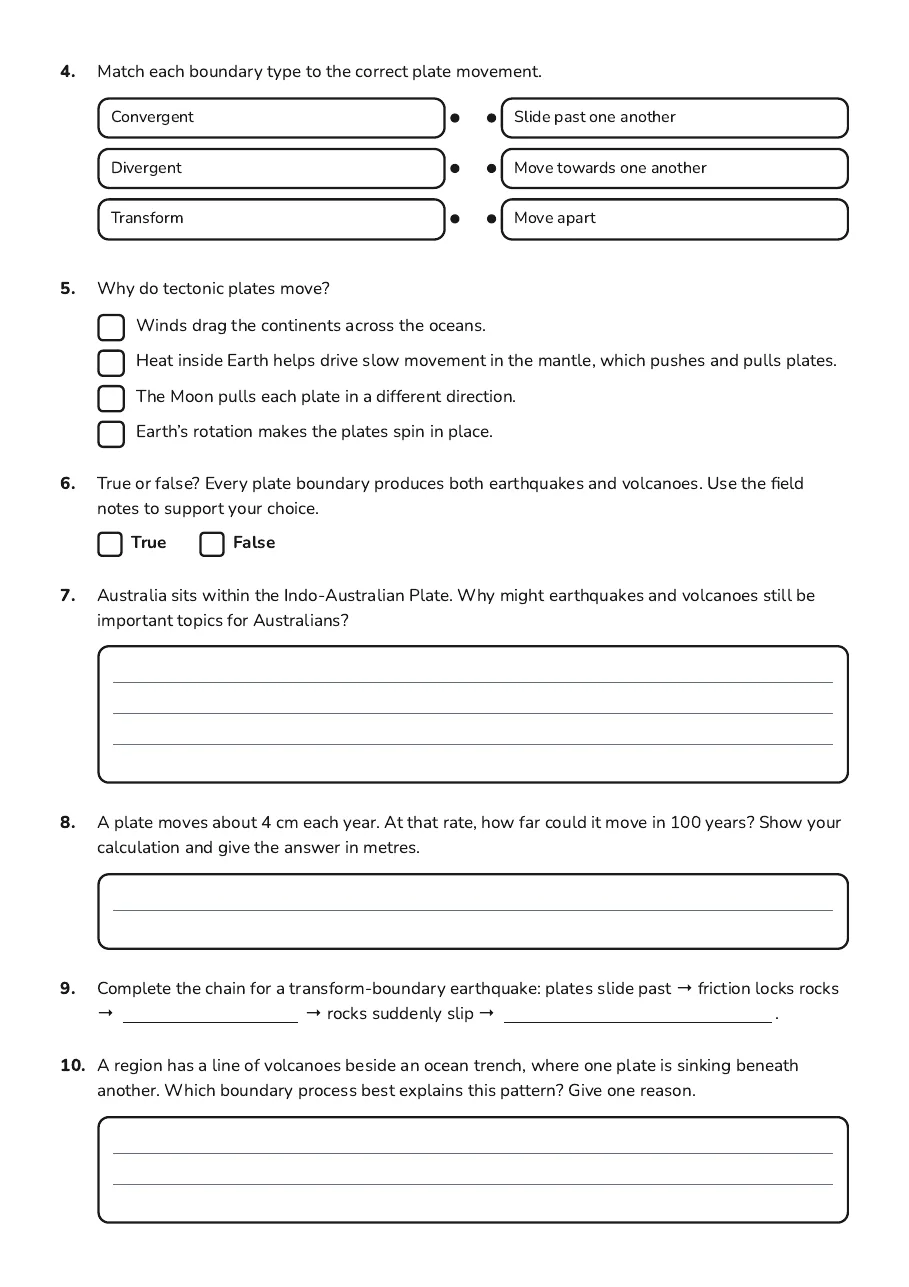
- Convergent
- Divergent
- Transform
- Slide past one another
- Move towards one another
- Move apart
- Winds drag the continents across the oceans.
- Heat inside Earth helps drive slow movement in the mantle, which pushes and pulls plates.
- The Moon pulls each plate in a different direction.
- Earth’s rotation makes the plates spin in place.
2 printable pages
Page 1
Page 2
About This Worksheet
Free in Kuraplan
Sign up free, grab the PDF, and customize it for your class.
Print-Ready
Formatted for standard paper. Clean layout, easy to read.
AI-Generated
Created with Kuraplan's AI, designed for real classroom use.
For Teachers & Parents
Use in classrooms, for homework, tutoring, or homeschool.
Need a custom version of this worksheet?
Kuraplan's AI generates custom worksheets in seconds — differentiated for every learner, aligned to your curriculum.
Generate Custom Worksheets — Free